
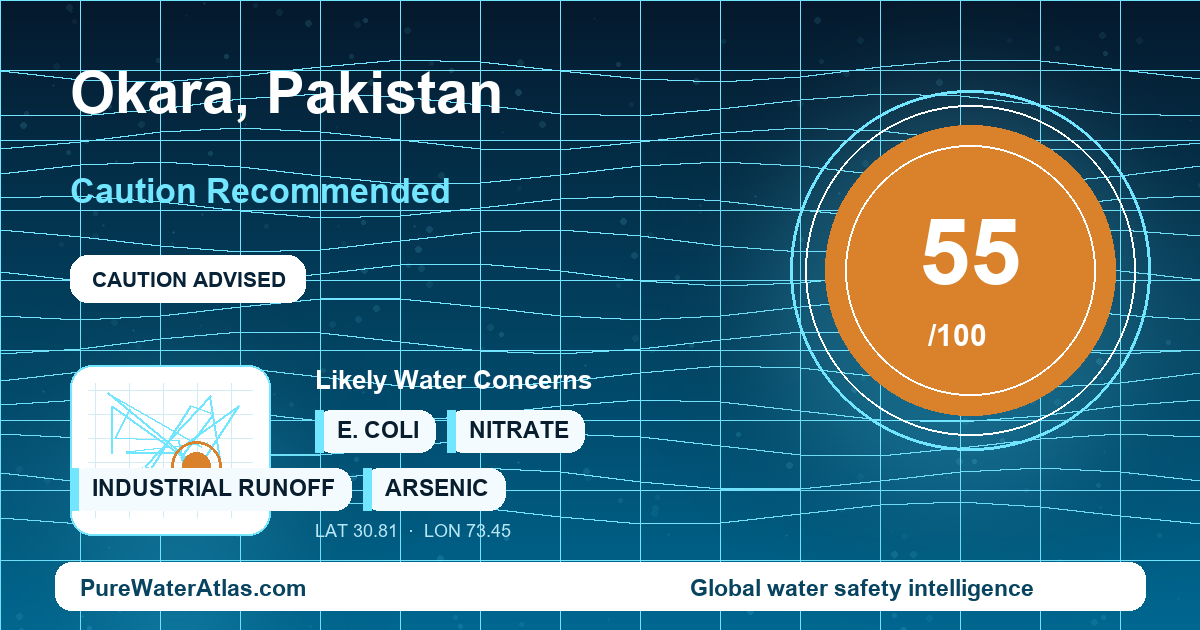
Okara, Pakistan: groundwater-based supply, variable neighborhood conditions, and practical safety guidance for visitors and residents.
Quick Answer
| Overall safety status | Caution recommended. Okara is not a city where visitors should assume untreated tap water is consistently safe to drink. |
|---|---|
| PureWaterAtlas score | 55 / 100 — risk level: Caution Recommended. |
| Traveler advice | Use sealed bottled water, hotel-provided purified water, or reliably treated water for drinking. Avoid ice unless it is confirmed to be made from purified water. |
| Resident advice | Test the actual water you drink, maintain clean storage tanks, and choose treatment based on results rather than taste or appearance. |
| Main water source | Primarily groundwater from municipal tube wells, private boreholes, hand pumps, and local water-supply schemes. |
| Local water authority context | Municipal Corporation Okara is associated with local water supply and sanitation functions; Public Health Engineering Department Punjab supports provincial water-supply and sanitation schemes. No separate dedicated WASA for Okara was identified in public sources. |
| Filter recommendation | A home system is often advisable, but the correct setup depends on testing. Sediment filtration plus UV or chlorination may address many microbial and particle concerns; reverse osmosis is justified only where testing shows high TDS, salinity, nitrate, arsenic, fluoride, or other dissolved contaminants. |
Why Okara Is Different
Okara is a central Punjab city in an intensively cultivated, canal-irrigated district of the Ravi-Sutlej alluvial plain, often described as part of the Bari Doab region. That setting is important for drinking-water safety because groundwater is central to the city’s water identity. Publicly available information points to municipal and household reliance on groundwater sources rather than a large, modern, citywide surface-water treatment plant feeding every tap.
The practical result is variability. A municipal tap, a private bore, a hand pump, a mosque or market filtration point, and a rooftop storage-tank outlet can all produce different water-quality results, sometimes even within the same neighborhood. Fresh groundwater can occur in canal-recharged zones, while other pockets may have higher total dissolved solids, salinity, hardness, chloride, or sulfate. Agricultural activity, irrigation return flows, shallow groundwater influence, and household storage conditions all matter.
For Okara, the key safety issue is not one confirmed citywide contaminant with a published current map. The more accurate conclusion is that multiple plausible risks exist in a groundwater-dependent secondary city where recent public tap-water compliance datasets, neighborhood sampling maps, and chlorine residual results are limited. Because of that data gap, users should avoid assuming that clear-looking water is safe, and should also avoid assuming that every water source in the city has the same risk profile.
Where Does Okara’s Tap Water Come From?
Okara’s municipal and household drinking water is primarily groundwater-based. The city and surrounding households have historically relied on shallow wells, hand pumps, private motors, and later municipal tube-well networks. Today, public information identifies a system built around municipal groundwater tube wells and pumping stations, local distribution mains, household service connections, storage reservoirs where present, and private boreholes or hand pumps used by some residents.
The area’s alluvial aquifer is influenced by canal recharge, agriculture, seepage, natural salinity variation, and the broader Indus Basin groundwater setting. This matters because groundwater quality in Punjab can vary over short distances. In Okara, one household bore may have acceptable taste and chemistry while another may show high dissolved minerals or nitrate risk. A community filtration plant may perform differently from a private bore, and a kitchen tap fed through a dirty rooftop tank may be less safe than the incoming supply.
Household storage is especially important. Rooftop and underground tanks are common practical control points. If tanks are uncovered, poorly sealed, contaminated by insects or rodents, affected by dirty sediment, or not periodically disinfected, they can introduce microbial contamination even when the source water is better. Intermittent pumping, power outages, low-pressure conditions, pipe repairs, and aging local distribution lines can also increase the chance of intrusion into pipes.
Who Manages Drinking Water in Okara?
Water supply and sanitation functions in Okara are associated with Municipal Corporation Okara under Punjab’s Local Government and Community Development framework. At the provincial level, the Public Health Engineering Department Punjab is the technical agency for water-supply and sanitation schemes, particularly outside the large metropolitan WASA cities. No separate dedicated WASA for Okara was identified in the public sources used for this profile.
Drinking-water quality in Pakistan is guided by national drinking-water standards and public-health monitoring institutions such as the Pakistan Council of Research in Water Resources. In Punjab, the Local Government and Community Development Department, Public Health Engineering Department, Punjab Environmental Protection Department, and provincial safe-water initiatives are relevant to the overall context. The Punjab Aab-e-Pak Authority is also relevant where public filtration plants or safe-water schemes are used by households.
The important limitation is that the existence of a municipal supply should not be read as proof of continuous, citywide compliance at every tap. Publicly accessible routine Okara tap-water compliance reporting is limited. This profile therefore does not claim exact current contaminant concentrations, neighborhood-level safety, or universal compliance. It identifies the risks most relevant to Okara’s source-water model, infrastructure context, and regional groundwater setting.
Main Local Water Concerns
The most immediate safety concern for untreated tap or stored water in Okara is microbial contamination. Possible routes include sewage ingress into damaged or low-pressure distribution lines, leaking pipes, unsealed boreholes, contaminated hand pumps, and dirty household storage tanks. Total coliform and E. coli testing is therefore essential when judging whether a specific tap, bore, or storage tank is safe for drinking.
Groundwater chemistry is the second major concern. In Okara’s groundwater-dependent setting, high TDS, salinity, hardness, chloride, or sulfate may occur in some pockets. These issues can affect taste, scaling, and long-term suitability for drinking. Sediment and cloudy water may appear after pipe disturbance, power interruptions, pump changes, tank cleaning, or repairs. Turbidity is not only an appearance issue; it can reduce disinfection effectiveness and indicate disturbed particles or contamination pathways.
Nitrate is relevant because Okara sits in an agricultural and peri-urban context where fertilizer use, livestock, septic leakage, and poor drainage can influence shallow groundwater. Residents using private bores or shallow sources should include nitrate in baseline laboratory testing, especially before using water for infants or vulnerable household members.
Arsenic is a recognized regional concern in parts of Punjab alluvial groundwater. However, this profile does not make an Okara-wide arsenic exceedance claim without sample results. The appropriate recommendation is targeted testing. Chlorine residual may vary where chlorination is practiced, especially at distant taps or after household storage. Lead is not documented here as an Okara-wide utility problem, but older internal plumbing, brass fixtures, solder, or service components can create building-specific exposure.
Seasonal conditions can change risk. Monsoon rains may increase runoff, drain overflow, and shallow groundwater contamination. Localized flooding or urban ponding can contaminate wells, boreheads, and underground tanks. Summer heat increases demand and can worsen tank hygiene if tanks are not covered and cleaned. Dry periods may make dissolved minerals, salinity, or taste problems more noticeable.
For Travelers
Short-term visitors should not drink untreated tap water in Okara. The safer default is sealed bottled water, hotel-provided purified water, or water treated by a reliable purifier. Check bottle seals and avoid bottles that appear refilled. For intercity travel, summer outings, or long roadside journeys, carry enough sealed water rather than assuming safe water will be available at each stop.
If only tap water is available, boiling can provide short-term microbial protection when the water is brought to a rolling boil and then stored in a clean, covered container. Boiling is not a complete solution for Okara’s groundwater concerns because it does not remove salinity, nitrate, arsenic, lead, fluoride, or other dissolved chemicals. For more detail, see the PureWaterAtlas Boiling Water Purification guide.
For brushing teeth, short-term visitors, pregnant travelers, immunocompromised people, small children, and anyone prone to stomach upset should use bottled, boiled, or filtered water. Long-term residents may become accustomed to local water microbiologically, but adaptation does not remove chemical risks.
Avoid ice from street vendors and small restaurants unless the venue can clearly confirm that it was made from purified water. Freezing does not reliably eliminate all pathogens and does not remove dissolved contaminants. In hotels, ask whether drinking water is sealed bottled water, RO-treated water, UV-treated water, or simply tap water served in a jug. Tea and hot drinks are generally safer microbiologically if freshly boiled, but utensils and storage practices still matter.
For Residents
Residents in Okara should treat water safety as a source-by-source decision. Do not rely only on clarity, taste, or the fact that the water comes from a municipal or private source. The best starting point is to test the exact water actually consumed: the kitchen tap, storage-tank outlet, private bore, hand pump, or filtration-plant water that fills household containers.
A practical household treatment approach often begins with sediment pre-filtration and disinfection. A washable or cartridge sediment filter can reduce particles and protect downstream devices. For microbial risk, UV, chlorination, or boiling with safe storage can be appropriate depending on turbidity and maintenance. The PureWaterAtlas UV Water Purification guide explains when UV is suitable; it works best when water is not highly turbid and the lamp is maintained.
Reverse osmosis should not be installed simply by habit. RO can be useful where testing shows high TDS, salinity, nitrate, arsenic, fluoride, or other dissolved contaminants, but it requires maintenance and wastes some water. If the problem is mainly microbial contamination from storage tanks, an RO unit alone may not solve the root cause unless the system is properly maintained and the storage pathway is hygienic.
Testing should include total coliform and E. coli, especially before water is used for infants, elderly people, pregnant people, or immunocompromised residents. A basic chemistry panel should include pH, electrical conductivity, TDS, hardness, alkalinity, chloride, sulfate, and turbidity. In Okara’s agricultural and alluvial-groundwater context, a baseline panel should also include nitrate, arsenic, fluoride, iron, and manganese. If the building is old or plumbing materials are unknown, test first-draw and flushed samples for lead.
Older buildings may have corroded internal pipes, sediment accumulation, contaminated tanks, or metal-bearing fixtures. Even if municipal water is acceptable at the source, building plumbing can change quality before the water reaches the glass. Rooftop and underground tanks should be tightly covered, screened from insects and rodents, protected from sewer or drain backflow, and cleaned and disinfected periodically. Repeat testing after flooding, sewer overflow, pipe repair, new bore installation, major taste or color changes, or recurring gastrointestinal illness in the household.
Relevant Contaminants and Water-Quality Issues
The most relevant microbial indicator for Okara households is E. coli, because it signals fecal contamination risk in taps, wells, bores, hand pumps, or storage tanks. Turbidity and sediment are also important because tube-well pumping, old pipes, tank deposits, and pipe repairs can disturb particles and reduce the reliability of disinfection.
For chemical testing, nitrate deserves attention in Okara’s agricultural and peri-urban setting. See also Nitrate Contamination in Drinking Water: Testing and Detection Methods. For groundwater-dependent households, arsenic should be checked by laboratory testing rather than appearance or taste; PureWaterAtlas provides a specific guide to arsenic testing and detection methods. Where old plumbing is a concern, use the lead testing guide to compare first-draw and flushed samples.
Okara’s agricultural setting also makes the PureWaterAtlas article on Agricultural Runoff in Drinking Water relevant. For broader background, see the PureWaterAtlas pillar guides on Drinking Water Safety, Water Microbiology, Water Contamination, and Water Treatment Systems.
How to Verify Your Water Quality
The most reliable way to judge drinking water in Okara is laboratory testing of the exact water you drink. Use a recognized laboratory such as PCRWR, PCSIR, a university laboratory, or a Punjab government-recognized water-quality laboratory where available. Compare results with Pakistan drinking-water standards and, where relevant, World Health Organization guideline values.
Start with microbial testing for total coliform and E. coli, then add a chemistry panel covering pH, electrical conductivity, TDS, hardness, alkalinity, chloride, sulfate, turbidity, nitrate, arsenic, fluoride, iron, and manganese. If you use a private bore or shallow source, repeat testing after monsoon flooding, sewer overflow, or changes in taste, odor, color, or illness patterns. If your home has old plumbing, include lead testing from both first-draw and flushed samples.
PureWaterAtlas resources can help you interpret results and choose next steps. Use the Water Testing guide for sampling and analysis basics, the Contaminants Search Engine to research individual parameters, and the Global Water Quality Checker for broader city and country context. Related categories include Drinking Water Safety, Global Water Quality, Water Testing, Water Microbiology, and Water Treatment Systems.
Official and Technical Sources
- Pakistan Council of Research in Water Resources — national water research and monitoring context, including drinking-water testing relevance.
- Public Health Engineering Department, Government of the Punjab — provincial water-supply and sanitation engineering context for Punjab schemes.
- Local Government and Community Development Department, Government of the Punjab — local-government service delivery context, including municipal functions.
- Punjab Saaf Pani Authority — context for Punjab public filtration and safe-water initiatives.
- Pakistan Environmental Protection Agency — national environmental and drinking-water standards context.
- World Health Organization drinking-water quality guidelines — public-health interpretation of microbial and chemical water risks.
- UNICEF Pakistan Water, Sanitation and Hygiene — Pakistan-wide WASH and public-health context.
- Punjab Municipal Development Fund Company — municipal infrastructure and secondary-city service-delivery context in Punjab.
Bottom Line
Okara’s tap water should be approached with caution, especially by visitors. The city’s drinking-water reality is groundwater-based and locally variable, with risks shaped by tube wells, private bores, intermittent distribution, agricultural surroundings, and household storage tanks. Sealed bottled or reliably purified water is the safest choice for short-term visitors. Residents should test the actual water they drink, including microbial indicators and key groundwater chemistry such as TDS, nitrate, arsenic, fluoride, hardness, chloride, and sulfate. A filter may be useful, but it should match the test results: sediment filtration and disinfection for particles and microbes, and RO only where dissolved contaminants justify it. Because recent public Okara tap-water compliance data are limited, source-specific testing is the most responsible safety decision.
Read the full guide: Global Water Quality Guide
Explore more in this category: Global Water Quality Articles