Tarakan’s tap-water safety depends on a treated municipal island supply, rainfall-fed reservoirs, distribution pressure, and household storage practices. The city has formal drinking-water infrastructure, but untreated tap water is not the safest choice for visitors or for residents without point-of-use treatment.
Quick Answer
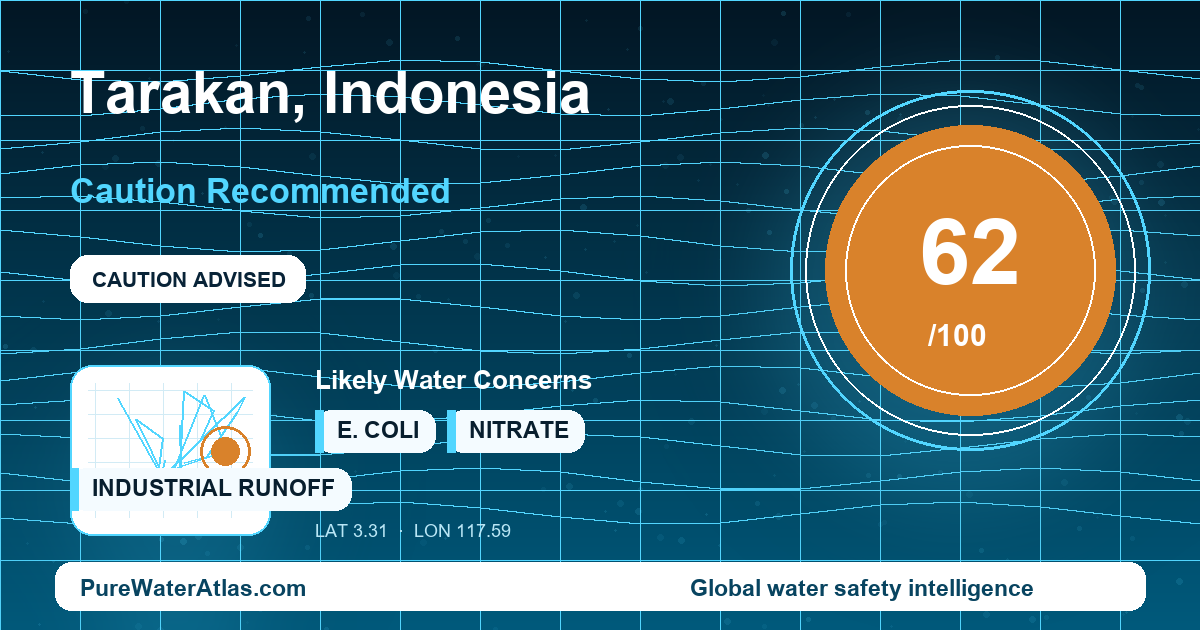
| Water safety score | 62 / 100 |
|---|---|
| Risk level | Caution Recommended |
| Can visitors drink the tap water? | Not recommended untreated. Visitors should use sealed bottled water, hotel-provided treated water, or water that has been boiled, disinfected, or filtered by a reliable purifier. |
| Resident guidance | Municipal tap water can be used for washing and general domestic use, but drinking water should be boiled or treated at the point of use unless recent local test results confirm microbiological safety at the household tap. |
| Main water source | Tarakan relies mainly on island surface-water and reservoir sources, including rainfall-fed catchments, embungs, reservoirs, and small water bodies, followed by municipal treatment. |
| Water authority | Perumda Air Minum Tirta Alam Tarakan, under the Tarakan City Government policy context. |
| Home filter recommendation | For drinking water, boiling is the minimum practical barrier. A maintained sediment prefilter plus activated carbon and either UV disinfection or reverse osmosis may be appropriate depending on household water tests. |
PureWaterAtlas classifies Tarakan as Caution Recommended. The city has a recognized municipal water company and treated piped-water system, but it is also a small coastal island city where raw-water storage, seasonal rainfall, turbidity after rain, intermittent pressure, private wells, refill-water depots, and household storage tanks can affect what reaches the glass.
Why Tarakan Is Different
Tarakan is not a mainland city supplied by a large inland river. It is an island city in North Kalimantan, located off the northeast coast of Borneo. That geography matters for drinking-water safety because local water security is tied closely to rainfall, reservoir storage, catchment condition, and the ability of a relatively compact island system to maintain supply through dry spells.
Tarakan’s water profile is therefore different from a city with multiple large river intakes or deep inland groundwater fields. The city’s municipal supply depends on local catchments, reservoirs, embungs, and small water bodies that must collect and store enough raw water before treatment. Local planning discussions have repeatedly emphasized the need to increase reservoir or embung storage and improve SPAM capacity. That is a Tarakan-specific signal that source quantity and storage are central constraints, not just treatment technology.
The main safety question is not only whether water is treated at the municipal installation. It is also whether the water remains safe through distribution pipes, pressure changes, repairs, household tanks, and storage containers. In Tarakan, many users depend on roof tanks, ground tanks, dispenser containers, or refill-water depots, especially when pressure or continuity varies. As a result, the water leaving a treatment plant may not have the same risk profile as water stored at home for drinking.
Where Does Tarakan’s Tap Water Come From?
Tarakan’s municipal drinking-water supply is primarily an island surface-water and reservoir system. Raw water is collected from rainfall-fed catchments, reservoirs, embungs, and small local water bodies on Tarakan Island. It is then treated through municipal water treatment installations, known in Indonesia as IPA, before entering the distribution network.
Key local infrastructure includes the Perumda Air Minum Tirta Alam Tarakan distribution network, the municipal SPAM drinking-water supply system, water treatment installations, and raw-water storage assets reported locally in areas such as Persemaian, Binalatung, Rawasari, and Juata. These systems are part of the city’s effort to secure enough raw water despite the limitations of island geography.
This source pattern creates several practical implications. Heavy tropical rainfall can increase suspended sediment and turbidity in raw water. Dry spells can reduce reservoir levels, increasing the chance of pressure interruptions or greater reliance on stored household water. Coastal conditions also matter: private shallow wells in low-lying or coastal parts of the island may be more vulnerable to brackish-water or salinity indicators than a centrally treated municipal supply.
Because current public data are limited, this page does not claim that all Tarakan tap water meets or fails any specific legal limit. The available city-level information supports a cautious position: the city has formal treatment and distribution infrastructure, but tap-level safety can vary by neighborhood, building, storage practice, and season.
Who Manages Drinking Water in Tarakan?
Tarakan’s municipal drinking-water company is Perumda Air Minum Tirta Alam Tarakan. It is the local utility responsible for the customer-facing piped-water system. The Tarakan City Government is the local owner and policy authority, and the municipal context can be followed through the Tarakan City Government official website.
Indonesia’s drinking-water health requirements are set nationally by the Ministry of Health. The relevant regulatory framework includes Permenkes No. 2 Tahun 2023, which implements provisions under Government Regulation No. 66 of 2014 concerning environmental health. Infrastructure planning for Indonesian SPAM systems is also connected to national public-works and human-settlement authorities, including the Ministry of Public Works and Housing, Directorate General of Human Settlements.
For residents, the most important distinction is between system-level management and household-level verification. A formal utility and a national regulatory framework are essential, but they do not replace local testing at the tap when water is stored, pressure is intermittent, pipes are repaired, or private plumbing may affect water quality.
Main Local Water Concerns
The most important Tarakan-specific concerns are linked to island water storage, tropical rainfall, distribution conditions, and household practices.
- Dry-season supply pressure: Tarakan’s reservoirs and embungs depend heavily on island rainfall. During low-rainfall periods, reduced storage can contribute to pressure issues or increased household storage.
- Turbidity after rain: Heavy rainfall, runoff, or catchment disturbance can raise turbidity and suspended sediment in raw water. Turbidity can interfere with treatment and can also be a warning sign for households relying on simple filters.
- Coastal groundwater risk: Private shallow wells near the coast may face brackish-water or salinity concerns. Conductivity, total dissolved solids, chloride, and sodium are relevant indicators for these wells.
- Microbial risk at the tap: If distribution pressure is intermittent, pipes are repaired, tanks are uncovered, or water is stored for long periods, microbial contamination becomes a practical concern. E. coli or total coliform testing is the clearest household verification step.
- Sediment, color, iron, and manganese: Some users may notice cloudy, reddish, blackish, metallic, or discolored water from storage tanks or older pipe sections. These observations may relate to sediment, iron, or manganese, but citywide concentrations should not be assumed without laboratory testing.
- Limited public tap-level data: Current routine neighborhood-level microbiological results, disinfectant residuals, turbidity excursions, metals data, and plant-by-plant compliance records are not consistently published in an easy-to-audit format.
For Travelers
Visitors to Tarakan should not rely on ordinary tap water for drinking unless it has been boiled, disinfected, or treated through a reliable purifier. For short stays, the simplest and safest approach is sealed bottled water or treated water provided by a reputable hotel or restaurant.
For brushing teeth, many healthy travelers can use tap water if they avoid swallowing it. More cautious travelers, young children, pregnant travelers, and people with weakened immune systems should use bottled or treated water. For infant formula, use boiled water and prepare it carefully.
Be careful with ice. Avoid ice from informal vendors unless you know it was made from treated water. In better hotels and restaurants, ask whether ice is made from purified or commercially produced water. Do not assume bathroom tap water is potable unless the property explicitly says it is treated for drinking.
During outings, carry sealed bottled water. Avoid drinks diluted with unknown water, especially from informal sources. A travel filter or UV purifier can be useful only if it is rated for microbial reduction and the water is not visibly dirty. If water is cloudy or sediment-heavy, a purifier may need prefiltration before disinfection. For more background, see PureWaterAtlas guides to boiling water purification and UV water purification.
For Residents
Residents connected to Perumda Air Minum Tirta Alam Tarakan can generally use municipal tap water for washing and household purposes, but drinking water deserves an added point-of-use barrier unless recent test results from the specific household tap confirm microbiological safety.
At minimum, boil water used for drinking and cooking. For better day-to-day protection, consider a maintained sediment prefilter plus activated carbon and either UV disinfection or reverse osmosis. The best setup depends on test results. If the main concern is microbes from storage or intermittent pressure, UV after adequate filtration can be useful. If salinity, dissolved solids, or certain chemical parameters are confirmed, reverse osmosis may be more relevant. Filters must be maintained; neglected filters and dirty storage containers can become contamination sources.
Household testing is especially important if water is stored in tanks, pressure is intermittent, water quality changes after pipe repairs, or flooding affects the property. Test for E. coli or total coliform when microbial safety is uncertain. Test turbidity, color, pH, conductivity, chloride, iron, and manganese if the water looks cloudy, reddish, blackish, salty, or metallic. Private coastal wells should be tested for electrical conductivity, total dissolved solids, chloride, sodium, and other salinity indicators. Households with infants should consider nitrate testing if using private wells or refill sources with unclear quality control; see PureWaterAtlas guidance on nitrate testing.
Tarakan is not known for the same legacy lead-service-line pattern seen in some older industrial countries, but premise plumbing can still matter. Brass fittings, solder, pumps, storage hardware, and older building plumbing may contribute metals. If plumbing materials are unknown, test first-draw and flushed samples rather than assuming the municipal supply is the only possible source. PureWaterAtlas has a practical guide to lead testing and detection.
Storage tanks are a major practical control point. Clean and disinfect roof tanks, ground tanks, and dispenser containers regularly. Keep them sealed against insects, dust, animals, and floodwater. Stored chlorinated water can lose residual disinfectant over time, allowing microbial regrowth.
Relevant Contaminants and Water-Quality Issues
The most relevant Tarakan water-quality issues are not a single confirmed contaminant across the whole city, but a set of conditions that can change by season, supply pressure, storage practice, and water source.
- Turbidity: important after heavy rain, runoff, or catchment disturbance.
- Sediment: relevant for stored water, older pipe sections, and visible particles.
- E. coli: the key household-level indicator when microbial contamination is suspected.
- Chlorine: relevant because disinfectant residual can decline during storage or long distribution times.
- Iron and manganese: relevant when water appears reddish, blackish, metallic, or discolored.
For broader background, see the PureWaterAtlas pillar pages on Drinking Water Safety, Water Microbiology, and Water Purification.
How to Verify Your Water Quality
The most reliable way to know whether water is safe at a specific Tarakan address is to test the water actually used for drinking. System-wide information is useful, but household storage tanks, private wells, building plumbing, refill-water depots, and intermittent pressure can all change tap-level risk.
Start with microbiological testing if the water is stored, if pressure has been interrupted, or if pipes were recently repaired. Add turbidity, pH, conductivity, chloride, iron, and manganese if water has visible color, cloudiness, metallic taste, or salty character. For private wells, salinity indicators are especially important because Tarakan is a coastal island city.
PureWaterAtlas resources that can help include the Complete Guide to Water Testing, the Global Water Quality Checker, and the Contaminants Search Engine. Relevant categories include Global Water Quality, Drinking Water Safety, Water Testing, and Water Purification.
Official and Technical Sources
- Perumda Air Minum Tirta Alam Tarakan official website — identifies Tarakan’s municipal water company and customer-facing utility context.
- Tarakan City Government official website — municipal source for city governance, public services, and infrastructure context.
- BPS Kota Tarakan — statistical source for Tarakan geography, population, and city-level indicators.
- Ministry of Public Works and Housing, Directorate General of Human Settlements — national authority for Indonesian settlement infrastructure and SPAM development.
- Permenkes No. 2 Tahun 2023 — Indonesian Ministry of Health regulatory basis for environmental health and drinking-water quality requirements.
- CDC Travelers’ Health: Indonesia — travel-health guidance supporting cautious food and water practices for visitors.
- WHO Drinking-water fact sheet — global public-health context for safe drinking-water management and microbial risk.
Data limitation: Tarakan has identifiable municipal water institutions and documented island raw-water constraints, but current public data do not provide a complete, independently verifiable neighborhood-level picture of microbiological results, residual disinfectant, turbidity events, metals, or customer tap compliance. This profile should be read as a risk-based guide, not a substitute for current local laboratory results.
Bottom Line
Tarakan has a formal municipal water utility and treated piped-water infrastructure, but untreated tap water should be approached with caution. The city’s island geography makes supply more dependent on local rainfall, reservoirs, embungs, and storage capacity than on large mainland rivers. Heavy rain can raise turbidity, dry spells can affect pressure and continuity, and household tanks or refill containers can change water quality after treatment. Travelers should use bottled, boiled, or reliably treated water for drinking. Residents can use municipal water for general domestic purposes, but should boil or filter drinking water and test household supplies when water is stored, pressure is intermittent, wells are used, or taste, color, cloudiness, or salinity changes appear.
Read the full guide: Global Water Quality Guide
Explore more in this category: Global Water Quality Articles