
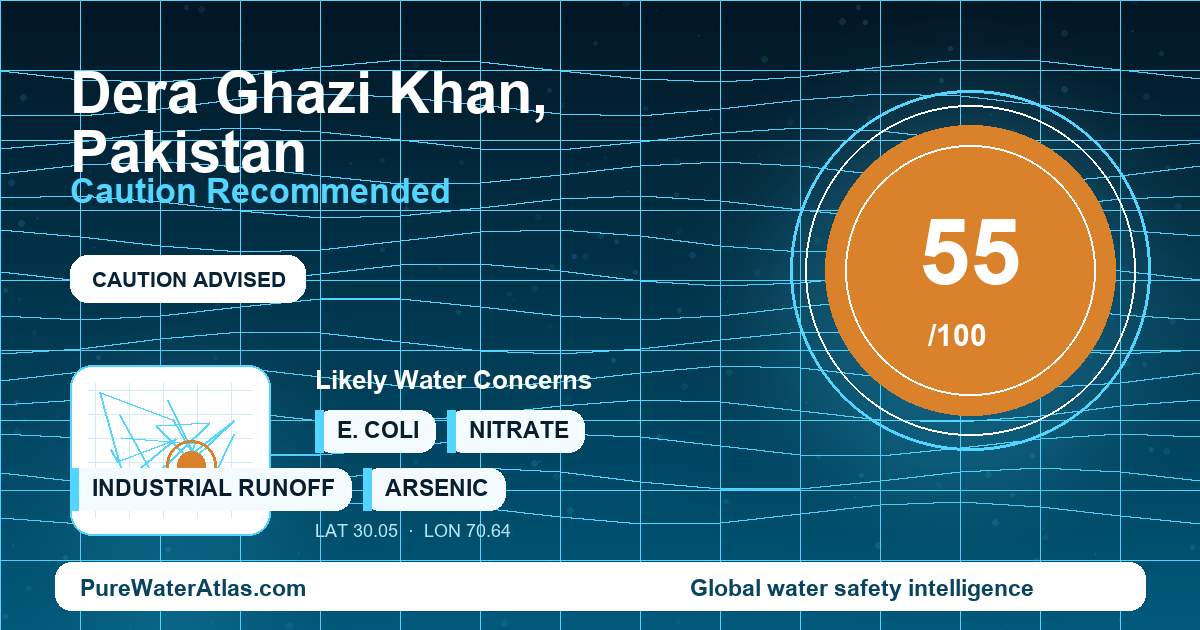
Dera Ghazi Khan, Pakistan: caution is recommended because drinking water commonly depends on groundwater, tubewells, intermittent distribution, household storage, and private bores, while current neighborhood-level public water-quality reporting is limited.
Quick Answer
| Overall status | Caution recommended. Dera Ghazi Khan tap water should not be treated as reliably potable without point-of-use treatment, especially for visitors, children, pregnant people, immunocompromised users, and households using private boreholes or stored water. |
|---|---|
| PureWaterAtlas score | 55 / 100 — risk level: Caution Recommended. |
| Short-term traveler advice | Use sealed bottled water from a reliable brand, boiled water, or water from a properly maintained purifier for drinking. Untreated tap water is not the lowest-risk choice. |
| Resident advice | Base decisions on your exact supply: municipal tap, private bore, storage tank, and household filter. Periodic testing is important because taste and clarity do not prove safety. |
| Main water source | Urban drinking water is primarily groundwater abstracted through public and private tubewells, influenced by the Indus basin, irrigation canals, and local flood and recharge conditions. |
| Water authority context | Municipal Corporation Dera Ghazi Khan is the local urban water-supply and sanitation authority under Punjab local-government arrangements, with PHED Punjab and PMDFC relevant to schemes, rehabilitation, and municipal infrastructure support. |
| Filter recommendation | For most households: sediment filtration plus activated carbon and reliable disinfection such as UV or boiling for drinking water. Use reverse osmosis only where testing confirms high TDS, salinity, nitrate, arsenic, fluoride, or other dissolved contaminants. |
The confidence level for this city profile is medium-low. The general water-source setting and institutional responsibilities are clear, but a current, utility-style, consumer-facing water quality report with neighborhood results for Dera Ghazi Khan was not found in the available source set.
Why Dera Ghazi Khan Is Different
Dera Ghazi Khan has a water-risk profile shaped by its location in south-west Punjab near the Indus River plain and the Suleiman Range. That setting creates a combination of issues that do not fit a simple “safe” or “unsafe” label. On one side, the city’s arid climate and groundwater dependence can mean mineralized groundwater, hardness, salinity, or taste problems in some supplies. On the other side, the Indus River, Taunsa Barrage command area, D.G. Khan Canal irrigation system, monsoon rain, and hill torrents can influence recharge, flooding, turbidity, drainage, and sanitation risks.
The city also has an important historical water context. Dera Ghazi Khan has long been associated with Indus River flooding. The older settlement was affected by river migration and flooding, and the modern planned city developed inland from the old riverbank settlement. That history matters for drinking water because flood exposure, high groundwater tables in some areas, damaged drains, and sanitation integrity can all influence microbial risk in wells, pipelines, and household tanks.
In practical terms, the water someone drinks in Dera Ghazi Khan may pass through several risk points before it reaches a glass: a municipal tubewell or private pump, a pipe network, an underground tank, a rooftop tank, and finally a kitchen filter, dispenser, or storage container. In many households, the last two stages — storage and household treatment — can determine real-world safety as much as the original source water.
Where Does Dera Ghazi Khan’s Tap Water Come From?
Available official and sector context indicates that urban drinking water in Dera Ghazi Khan is primarily based on groundwater abstraction through public and private tubewells, rather than a large conventional surface-water treatment plant. The wider water environment includes the Indus River, Taunsa Barrage, and the D.G. Khan Canal irrigation system, but household drinking water commonly reaches users through pumped groundwater, distribution pipes, and domestic storage.
Key infrastructure relevant to drinking water safety includes municipal tubewells and pumping stations that supply parts of the urban network; distribution mains and smaller neighborhood service lines; underground and rooftop household tanks used to manage interruptions; private boreholes and community water points in peri-urban or less reliably served areas; and the municipal sewerage and stormwater drainage system. Where water lines and drains are close together, damaged, or affected by low pressure, contamination can be introduced after water leaves the source.
This means that a clean tubewell result does not automatically guarantee clean water at the kitchen tap. Intermittent pumping, low pressure, pipe disturbance, unclean tanks, and private water handling can all change quality between the source and the point of use. During monsoon conditions, after pipe repairs, after pump restarts, or following long supply interruptions, households may see turbidity, sediment, or dirty water that needs treatment before drinking.
Who Manages Drinking Water in Dera Ghazi Khan?
The urban local water-supply and sanitation responsibility sits with Municipal Corporation Dera Ghazi Khan under Punjab local-government arrangements. The District Government Dera Ghazi Khan portal provides local government context for the city and district, while the Local Government and Community Development Department, Government of Punjab explains the broader municipal framework.
Other Punjab institutions may be involved in planning, construction, rehabilitation, or financing of water-supply and sanitation schemes. These include the Public Health Engineering Department Punjab and the Punjab Municipal Development Fund Company. The Punjab Irrigation Department is also relevant for understanding the Indus, Taunsa Barrage, and canal-command context that shapes the city’s source-water environment.
Pakistan’s National Standards for Drinking Water Quality are the main reference framework, with environmental oversight linked to the Pakistan Environmental Protection Agency and provincial authorities. The Pakistan Council of Research in Water Resources conducts water-quality monitoring and publishes national and source-level findings. However, for Dera Ghazi Khan specifically, this profile did not find a regularly published, utility-style consumer confidence report with current neighborhood-level compliance results. That reporting gap is one reason caution is recommended.
Main Local Water Concerns
- Microbial contamination: Intermittent supply, low pressure, sewage ingress, unclean storage tanks, and private handling can introduce pathogens. This is the most important practical risk for travelers and sensitive users.
- Turbidity and sediment: Brown, cloudy, sandy, or visibly dirty water can appear after pipe repairs, pump restarts, heavy rain, flood events, or disturbance in local distribution lines. Turbidity can reduce the effectiveness of disinfection.
- Groundwater minerals: Some groundwater and private bore supplies may have high dissolved minerals, hardness, salinity, or objectionable taste. These issues require testing rather than guesswork.
- Nitrate risk: Shallow or poorly protected groundwater may be vulnerable near sanitation systems, livestock areas, or agricultural land. Nitrate is especially important for infants and pregnant people.
- Regional arsenic and fluoride concern: Arsenic and fluoride are recognized groundwater parameters in parts of the Indus basin and Punjab, but current Dera Ghazi Khan neighborhood values should not be assumed without testing.
- Low chlorine residual: Even if water is chlorinated upstream, residual disinfectant may be low or inconsistent at the point of use after storage, transport, or time in rooftop and underground tanks.
- Building-level contamination: Old internal plumbing, metal fittings, dead-end lines, and household storage can degrade water quality even when the upstream supply is acceptable.
Season matters. Monsoon rain can increase turbidity, surface contamination, drain overflows, and infrastructure damage. Hill torrents from the Suleiman Range can cause rapid flooding in Dera Ghazi Khan District and surrounding areas, raising microbial risk in wells and storage systems. Hot months increase water demand, storage time, and bacterial regrowth risk where tanks are not cleaned and disinfected.
For Travelers
Drinking untreated tap water in Dera Ghazi Khan is not recommended for short-term visitors. Use sealed bottled water from a reliable brand, boiled water, or water treated by a properly maintained purifier. This recommendation is based on infrastructure and monitoring uncertainty, not on a claim that every tap in the city is unsafe.
For brushing teeth, visitors with sensitive stomachs, immunocompromised travelers, and anyone staying in a building with visible tank or plumbing issues should use bottled, boiled, or filtered water. Bathing and handwashing with tap water are generally lower-risk activities, but avoid swallowing water if the supply looks cloudy, smells unusual, or has recently returned after an outage.
Avoid ice unless you know it was made from treated water in a hygienic facility. Freezing does not reliably make contaminated water safe. In hotels and restaurants, ask for sealed bottles or confirm that drinking water comes from a maintained RO, UV, or other treatment system. Prefer hot tea, coffee, and cooked foods when hygiene is uncertain, and be cautious with open jugs, roadside juices, refilled bottles, and ice.
During hot weather, carry sealed water with intact caps and consider oral rehydration salts if needed during heat exposure or stomach illness. If bottled water is unavailable, bring tap water to a rolling boil and let it cool in a clean, covered container. PureWaterAtlas has a practical guide to boiling water purification for emergency and travel situations.
For Residents
Residents should make decisions based on the exact water they use. A household receiving municipal supply through a storage tank has a different risk profile from a home using a private borehole, and both may differ from water after a kitchen filter or dispenser.
For many municipal-supply households, a practical baseline is a washable sediment prefilter followed by activated carbon and a reliable disinfection step such as UV or boiling for drinking water. UV can be useful when turbidity is controlled and the system is maintained; see the PureWaterAtlas UV water purification guide. Reverse osmosis should be used where testing confirms high TDS, salinity, nitrate, arsenic, fluoride, or other dissolved contaminants. It should not be installed blindly, because the correct treatment depends on the contaminant and because neglected filters can become contamination sources.
Private boreholes and newly connected supplies should be tested before drinking use. At minimum, testing should include E. coli or thermotolerant coliforms, total coliforms, turbidity, pH, electrical conductivity or TDS, hardness, chloride, sulfate, nitrate, arsenic, fluoride, iron, manganese, and residual chlorine where chlorinated municipal water is supplied. Repeat microbiological testing after monsoon flooding, sewer overflow, pipe repair, tank cleaning, unexplained taste or odor change, or a period of no supply followed by dirty water.
Older buildings and buildings with repaired or undocumented plumbing need extra caution. Corroded pipes, metal fittings, dead-end lines, and cross-connections can affect water quality. Flush stagnant water before use, avoid hot tap water for cooking or infant formula, and consider metals testing where old plumbing materials are suspected.
Underground and rooftop tanks should be covered, screened, cleaned, and disinfected on a regular schedule. Tanks near drains, septic systems, open manholes, birds, rodents, or dust entry points are major recontamination risks. Safe water at the pump can become unsafe after storage.
Relevant Contaminants and Water-Quality Issues
The most important Dera Ghazi Khan concern for many users is microbial safety. Learn more about E. coli in drinking water, especially if your supply is intermittent, stored in tanks, or affected by sewer overflow. For broader context, see the PureWaterAtlas guide to water microbiology.
Cloudy, muddy, or sandy water should not be dismissed as only an aesthetic issue. Read about turbidity in drinking water and sediment in drinking water, particularly after monsoon events, pump restarts, and pipe disturbance. Chlorine residual also matters in piped and stored systems; see chlorine in drinking water.
For groundwater and private bores, chemical testing is essential. Relevant PureWaterAtlas profiles include nitrate, arsenic, iron, and manganese. If a lab confirms arsenic or nitrate, consult the specific guides on arsenic testing, arsenic treatment, nitrate testing, and nitrate treatment.
How to Verify Your Water Quality
The safest approach in Dera Ghazi Khan is testing-based decision-making. Use an accredited laboratory or official water-testing facility where available. Test both the source water and the water after household storage or filtration, because contamination may enter through the bore, the municipal line, the underground tank, the rooftop tank, or the kitchen device.
For step-by-step testing strategy, see How to Test Drinking Water. For choosing treatment based on actual results, use Water Treatment Systems. For overall risk interpretation, see Drinking Water Safety and Water Contamination.
If your lab report lists a contaminant you do not recognize, use the PureWaterAtlas Contaminants Search Engine. Travelers comparing destinations can also use the Global Water Quality Checker.
Official and Technical Sources
- District Government Dera Ghazi Khan, Government of Punjab — local government and district context.
- Local Government and Community Development Department, Government of Punjab — Punjab local-government framework for municipal functions.
- Public Health Engineering Department Punjab — water-supply and sanitation scheme context.
- Punjab Municipal Development Fund Company — municipal infrastructure and service-improvement context.
- Punjab Irrigation Department — Indus, Taunsa Barrage, and canal-system context.
- Pakistan Council of Research in Water Resources: Water Quality Reports — national water-quality monitoring and research.
- Pakistan Environmental Protection Agency — national environmental standards and oversight context.
- World Health Organization Guidelines for Drinking-water Quality — international benchmark for microbial and chemical drinking-water risk assessment.
- UNICEF Pakistan: Water, Sanitation and Hygiene — Pakistan WASH context relevant to safe-water and sanitation challenges.
Bottom Line
Dera Ghazi Khan tap water deserves a cautious, household-specific approach. The city’s drinking water is mainly groundwater-based, delivered through tubewells, distribution lines, private bores, and domestic storage rather than a clearly documented consumer-facing treatment-and-reporting system. Local risks include microbial contamination from intermittent supply and storage tanks, turbidity after rain or pipe disturbance, and possible groundwater mineral or chemical issues that require testing. Short-term visitors should use sealed bottled, boiled, or properly treated water for drinking and brushing teeth. Residents should test their own supply, clean and disinfect tanks, and use sediment filtration plus disinfection as a baseline, adding RO only when lab results show dissolved contaminants that require it.
Read the full guide: Global Water Quality Guide
Explore more in this category: Global Water Quality Articles