
Is Tap Water Safe in Ixtapaluca? Water Quality & Safety Guide
Ixtapaluca’s tap water is a regulated municipal supply, but caution is recommended because local public tap-by-tap water-quality data are limited and household storage, pressure interruptions, sediment, and building plumbing can strongly affect the water people actually drink.
Quick Answer
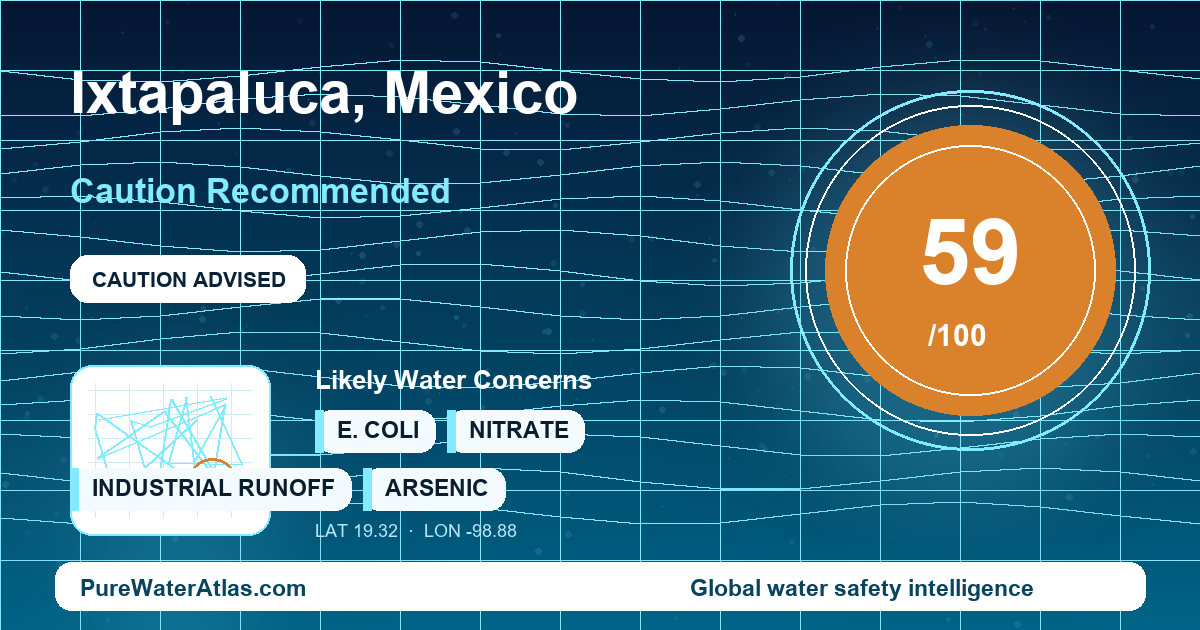
| Overall status | Caution recommended. PureWaterAtlas assigns Ixtapaluca a water safety score of 59/100. The municipal system is managed under Mexican drinking-water rules, but recent neighborhood-level tap monitoring is not consistently available to the public. |
|---|---|
| Can visitors drink it? | Not recommended untreated. Visitors should use sealed bottled water, agua purificada, or properly treated water for drinking, infant formula, medications, and sensitive stomachs. |
| Resident approach | Treat Ixtapaluca tap water as a managed municipal supply that still needs household-level control: clean cisterns and tinacos, check chlorine and turbidity after outages, and use tested treatment if drinking it regularly. |
| Main water source | Primarily groundwater from deep wells and regional groundwater infrastructure in the eastern Basin of Mexico, associated with the Chalco-Amecameca and Texcoco groundwater context. |
| Local authority | OPDAPAS Ixtapaluca, with state-level water functions associated with the Comisión del Agua del Estado de México and federal groundwater regulation by CONAGUA. |
| Filter recommendation | A maintained point-of-use system is advisable if drinking tap water regularly and no recent building-specific test results are available. Match treatment to test results; boiling helps microbes but does not remove metals, nitrate, arsenic, fluoride, salinity, or many chemicals. |
Why Ixtapaluca Is Different
Ixtapaluca is an eastern Estado de México municipality within the Mexico City metropolitan region. Its water situation is shaped by its position between the urbanized lowlands of the Basin of Mexico and higher terrain toward the Sierra Nevada. That location matters because drinking-water supply, drainage, flooding, groundwater extraction, and rapid urban growth are closely linked in this part of the metropolitan area.
The city should not be understood as a simple surface-reservoir system. Ixtapaluca is best characterized as a groundwater-dependent municipality in the eastern Mexico Valley. Local supply is associated with deep wells and groundwater infrastructure connected to the Chalco-Amecameca and Texcoco groundwater setting. In practical terms, the water reaching a home may pass through pumping, distribution, pressure zones, building cisterns, rooftop tanks, pumps, and private plumbing before it reaches a kitchen tap.
This is why the local safety question is not only “is the source regulated?” but also “what happened to the water after it entered the distribution network and the building?” A clean sample at a well or utility point does not automatically prove that water stored in a rooftop tinaco or older household plumbing is safe to drink.
Where Does Ixtapaluca’s Tap Water Come From?
Ixtapaluca’s public supply is mainly groundwater-based. The local system is associated with deep groundwater wells and pumping infrastructure serving the eastern metropolitan area, rather than a single surface lake or reservoir. The regional groundwater context includes aquifers identified by CONAGUA in the eastern Mexico Valley, including the Chalco-Amecameca aquifer and the Texcoco aquifer.
The broader water history of the area is important. Ixtapaluca sits near historical lake and lacustrine zones of the Basin of Mexico, including the former Lake Chalco and Texcoco environments. The eastern Valley of Mexico has been reshaped by drainage works, agricultural and urban expansion, and increasing groundwater extraction as the metropolitan area expanded. In such settings, groundwater stress can contribute to declining water levels, higher pumping costs, land subsidence pressures, and intermittent service conditions.
Key infrastructure affecting Ixtapaluca residents includes the municipal potable-water distribution network, deep wells, pumping equipment, state-level operational support where applicable, and household-level cisterns and rooftop tanks. For many households, these building-level systems are not minor details; they are major control points for the quality of water actually consumed.
Who Manages Drinking Water in Ixtapaluca?
The local drinking-water, sewerage, and sanitation authority is OPDAPAS Ixtapaluca, the Organismo Público Descentralizado de Agua Potable, Alcantarillado y Saneamiento de Ixtapaluca. Municipal government information is available from the Gobierno Municipal de Ixtapaluca.
At the state level, water functions relevant to potable-water infrastructure and regional management are associated with the Comisión del Agua del Estado de México. At the federal level, CONAGUA regulates national waters and groundwater concessions, including through the Registro Público de Derechos de Agua.
Drinking-water quality in Mexico is governed by federal sanitary standards, including NOM-127-SSA1-2021, which sets requirements for water for human use and consumption. Health authorities such as COFEPRIS and state health services have roles in sanitary surveillance. However, PureWaterAtlas did not find a consistently updated public database showing recent neighborhood-level Ixtapaluca tap results for microbial indicators, chlorine residual, metals, salinity, nitrate, arsenic, fluoride, and disinfection byproducts. For that reason, this profile does not claim that every tap complies or fails.
Main Local Water Concerns
The main practical concern in Ixtapaluca is not a single publicly documented citywide contaminant exceedance. The more realistic risk is the combination of groundwater dependence, pumping, intermittent pressure in some service areas, aging or stressed distribution assets, and household storage. These conditions can increase sediment, turbidity, chlorine loss, and microbial risk at the tap if systems are not maintained.
- Intermittent pressure and outages: When pressure is lost, distribution systems and household storage become more vulnerable to contamination pathways, especially after repairs, pipe breaks, or service changes.
- Sediment and turbidity: Residents may see cloudy, colored, or particle-laden water after outages, pressure changes, repairs, or local disturbances. Turbid water can interfere with disinfection and should not be treated as automatically safe.
- Microbial risk: Cisterns, tinacos, and pipes can allow microbial contamination if tanks are not sealed, cleaned, and disinfected, or if chlorine residual is lost during storage.
- Groundwater chemistry: Mineral content, salinity, hardness, iron, manganese, arsenic, fluoride, nitrate, and other groundwater-related parameters should be evaluated with local testing rather than assumed from regional geology alone.
- Building plumbing: Older plumbing, brass fixtures, solder, or unknown service materials can contribute metals at the tap, even if the municipal source is adequately treated.
- Rainy-season and flooding effects: Heavy rain and low-lying urban drainage constraints can increase turbidity, sewer overflow concerns, service disruption, and the need for caution until water runs clear and, where possible, is tested or boiled for microbiological safety.
For Travelers
Visitors should not rely on untreated tap water for drinking in Ixtapaluca. Use sealed bottled water, water from a trusted purified refill source, or water that has been treated appropriately for microorganisms and local contaminants. This advice is consistent with the cautious approach recommended for travelers to Mexico by CDC Travelers’ Health.
For brushing teeth, bottled or treated water is the safer choice if you are visiting briefly, have a sensitive stomach, are immunocompromised, or are preparing water for children. Many residents may brush with tap water, but traveler tolerance and building storage conditions vary.
Avoid ice unless a hotel, restaurant, or café can confirm it was made from purified water. Factory-made bagged ice is generally safer than ice made in a private freezer supplied by a rooftop tank or cistern. In restaurants, ask for bottled water, sealed beverages, or drinks made with agua purificada. Hotels and restaurants in the metropolitan area often use garrafón water, filtered water, or purified ice, but it is still worth confirming.
Carry bottled water during day trips, use sealed water for medications and infant formula, and avoid drinks mixed with unverified tap water. Boiling is useful for microbial risk, but it does not remove dissolved metals, nitrate, arsenic, fluoride, salinity, or many chemical contaminants.
For Residents
Residents should treat Ixtapaluca tap water as a managed municipal supply that may still need household-level risk control. If your household drinks tap water regularly and you do not have recent building-specific lab results, a home treatment strategy is advisable.
A practical setup for many homes starts with sediment prefiltration to protect downstream equipment, followed by activated carbon for taste, odor, chlorine, and some organic compounds. If testing identifies dissolved salts, arsenic, fluoride, nitrate, or metals, consider reverse osmosis or another certified technology matched to the contaminant. UV can help control microbes only when water is clear and the lamp, sleeve, power supply, and flow rate are properly maintained.
Testing is especially important after repeated low-pressure events, plumbing work, moving into an older building, recurring discoloration, sewage odors, flooding, unusual taste, or a change in supply pattern. Useful tests include total coliform and E. coli, turbidity, free chlorine residual, pH, conductivity or total dissolved solids, hardness, iron, manganese, and metals such as lead where plumbing is older or unknown. Arsenic, fluoride, nitrate, and salinity-related testing may also be appropriate because these can occur in regional groundwater systems, but they should be verified locally rather than assumed.
Cisterns and rooftop tanks deserve special attention in Ixtapaluca. Tanks should be sealed, protected from insects and dust, cleaned and disinfected on a regular schedule, and inspected after outages or flooding. Stored water can lose chlorine residual and become microbiologically unsafe even when the water entering the building was treated.
In older or poorly documented buildings, flush stagnant water, avoid using hot tap water for cooking or infant formula, and test both first-draw and flushed samples if lead is a concern. Lead risk is usually building-specific and cannot be resolved from a citywide statement alone.
Relevant Contaminants and Water-Quality Issues
The most relevant Ixtapaluca water-quality issues are the ones connected to groundwater supply, distribution pressure, storage, and plumbing. Learn more about chlorine in drinking water, because chlorine residual can decline during long storage in cisterns and tinacos. Turbidity and sediment are important after repairs, outages, or pressure changes.
For microbiological safety, review E. coli in drinking water and the broader PureWaterAtlas guide to water microbiology. For building-specific risks, especially in older properties, see lead in drinking water and lead testing and detection methods.
Because Ixtapaluca is groundwater-dependent, residents may also want to understand iron, manganese, arsenic, and nitrate. If local test results point to arsenic or nitrate, consult the PureWaterAtlas guides to arsenic testing and nitrate testing.
How to Verify Your Water Quality
The best way to answer the safety question for a specific Ixtapaluca home is to test the water at the point where it is consumed. A utility or well sample can be useful, but it does not capture contamination introduced by a building cistern, rooftop tank, pump, old plumbing, or stagnant household pipes.
Start with the PureWaterAtlas guide to water testing. For general safety principles, use the Drinking Water Safety pillar and the Water Treatment Systems guide before buying equipment. If you are comparing Ixtapaluca with another city, use the Global Water Quality Checker and the Global Water Quality guide.
To research a specific suspected contaminant, use the Contaminants Search Engine. For disinfection options, see boiling water purification and UV water purification. Boiling and UV are not substitutes for chemical testing when the concern is metals, salinity, nitrate, arsenic, or fluoride.
Official and Technical Sources
- OPDAPAS Ixtapaluca – local drinking water, sewerage, and sanitation authority.
- Gobierno Municipal de Ixtapaluca – official municipal government information.
- Comisión del Agua del Estado de México – state water authority relevant to regional potable-water infrastructure.
- CONAGUA Registro Público de Derechos de Agua – federal registry for water rights and concessions.
- CONAGUA Chalco-Amecameca groundwater availability assessment – official regional aquifer context.
- CONAGUA Texcoco groundwater availability assessment – official groundwater context for the eastern metropolitan setting.
- NOM-127-SSA1-2021 – Mexico’s federal drinking-water sanitary quality standard.
- INEGI México en cifras: Ixtapaluca municipality – official geographic and demographic reference.
- CDC Travelers’ Health: Mexico – traveler food and water safety guidance.
- COFEPRIS – federal sanitary authority involved in public-health risk control.
Bottom Line
Ixtapaluca tap water should be approached with caution, especially for visitors and households without recent tap-specific test results. The city is served mainly by a regulated groundwater-based municipal system, but public neighborhood-level monitoring data are limited, and the final quality at the tap can be strongly affected by pressure interruptions, sediment after repairs, cisterns, rooftop tanks, pumps, and old plumbing. Visitors should use sealed bottled or purified water for drinking, brushing teeth if sensitive, infant formula, and ice unless purification is confirmed. Residents should maintain storage tanks, test after outages or unusual water changes, and choose treatment based on local results rather than assumptions. A maintained filter or garrafón water is the safer default for regular drinking.
Read the full guide: Global Water Quality Guide
Explore more in this category: Global Water Quality Articles