
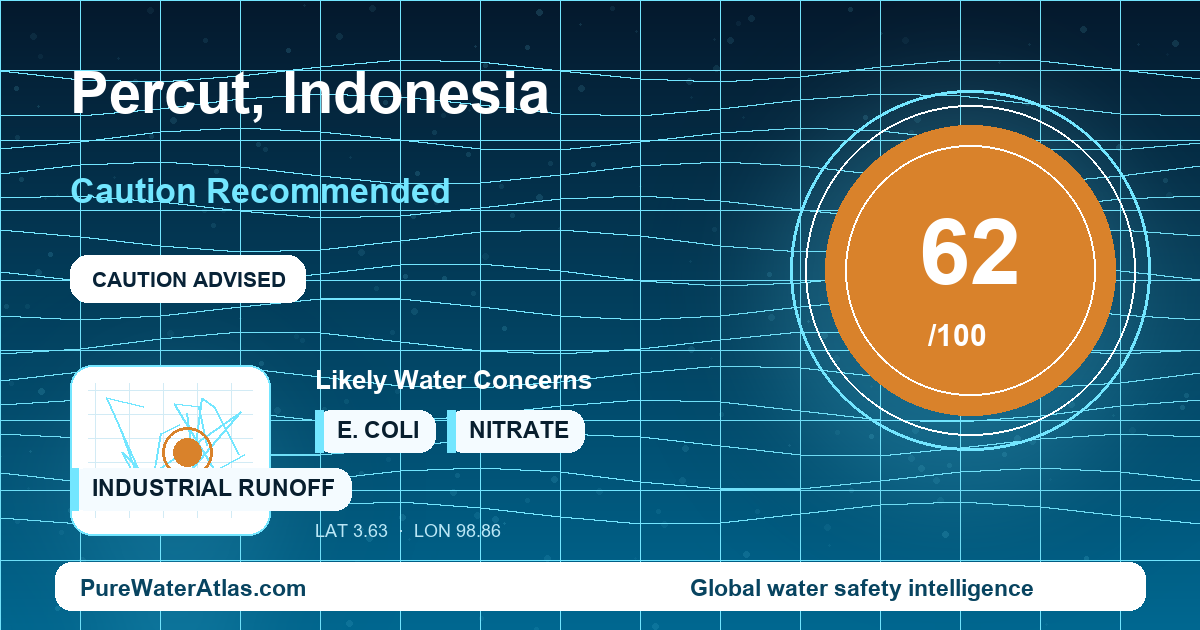
Percut, Indonesia: tap water safety in a low-lying Medan-Deli Serdang fringe area where PDAM supply, wells, refill-gallon water, storage tanks, flooding, and coastal groundwater all affect real household risk.
Quick Answer
| Water safety score | 62 / 100 |
|---|---|
| Safety status | Caution Recommended. Percut should not be treated as a place where untreated tap water is reliably drinkable. |
| Can tourists drink the tap water? | No, not without treatment. Visitors should use sealed bottled water, boiled water, or water from a reputable dispenser or refill source. |
| Resident advice | PDAM Tirtanadi piped water is a better starting point than shallow wells, but drinking water should still be boiled or treated with a maintained point-of-use system. |
| Main water context | Percut is part of the Percut Sei Tuan area in Deli Serdang, immediately east of Medan, and is best understood within the wider Medan-Deli Serdang water-supply region. |
| Relevant authority | PDAM Tirtanadi is the main piped-water authority relevant to the area; Deli Serdang Regency and health authorities provide local administrative and health oversight context. |
| Filter recommendation | Recommended for drinking water. Use sediment prefiltration plus activated carbon for piped water, followed by boiling, UV, or a maintained purifier for microbial control. For brackish wells, test first; carbon alone is not enough. |
The confidence level for Percut is medium-low: there is credible regional utility, regulatory, geography, and infrastructure context, but no verified Percut-specific consumer confidence report or routine laboratory dataset was identified in public sources.
Why Percut Is Different
Percut is not a standalone municipal water system with a clearly published city-level water-quality report. It is associated with Percut Sei Tuan, a district of Deli Serdang Regency on the eastern side of Medan, North Sumatra. That geography matters. The area includes dense suburban settlement and low-lying coastal terrain toward the Malacca Strait, so the practical water-safety picture is shaped by drainage, flooding, tidal influence, brackish groundwater, household septic systems, canals, fishponds, and urban expansion.
For many households in Percut, “tap water” is not a single category. A realistic household setup may include PDAM Tirtanadi piped water for general use, a rooftop or ground storage tank because pressure or supply can vary, boiled water or refill-gallon water for drinking, and a private well for backup. Each component has its own risk profile. Treated water can become unsafe after treatment if it passes through deteriorated connections, experiences intermittent pressure, or sits in dirty tanks. Shallow or bored groundwater can be affected by septic seepage, floodwater, salinity, nitrate, iron, manganese, and nearby drains.
This is why the safest interpretation for Percut is cautious: piped water, where connected to PDAM Tirtanadi, should be viewed as treated municipal water, but it should not automatically be assumed reliably potable at the household tap without local testing or treatment.
Where Does Percut’s Tap Water Come From?
Percut is best understood as part of the Medan-Deli Serdang water-supply area rather than a separate city utility. Piped connections in the area are associated with PDAM Tirtanadi, the provincial drinking-water company of North Sumatra. Regional systems serving Medan and surrounding Deli Serdang areas rely mainly on treated surface water from river catchments, including systems associated with the Deli, Belawan, and Belumai rivers depending on branch and network configuration.
The wider regional infrastructure context includes the PDAM Tirtanadi transmission and distribution network, regional raw-water and treatment infrastructure for the Medan-Binjai-Deli Serdang urban region, water-treatment plants connected to river intakes, and local distribution systems. The Ministry of Public Works and Housing provides official context for regional SPAM Mebidang infrastructure serving the Medan-Binjai-Deli Serdang urban region through Kementerian PUPR.
Outside reliable piped coverage, households may use shallow wells, bored wells, refill-gallon water depots, and stored water. Historically, before broader piped-water expansion, household wells and local groundwater were important domestic-water sources in lowland Deli Serdang settlements. In coastal parts of Percut Sei Tuan, groundwater can be affected by brackishness, tidal influence, poor drainage, estuarine waterways, aquaculture areas, septic systems, and canals. That older source context still matters because many homes may use wells for washing, cooking, or backup even where piped water is available.
Who Manages Drinking Water in Percut?
The main piped-water authority relevant to Percut is PDAM Tirtanadi, the North Sumatra provincial drinking-water company. The local government context is Deli Serdang Regency and Percut Sei Tuan District, with local administrative information available through the Percut Sei Tuan local government site. Demographic and geographic reference information for the regency is provided by Badan Pusat Statistik Kabupaten Deli Serdang.
Water-quality health oversight in Indonesia sits within national public-health regulation implemented by health authorities. The key regulatory context includes Regulation of the Minister of Health No. 2 of 2023, which provides national standards for drinking-water and environmental-health quality parameters. However, citing this regulation does not mean Percut-specific compliance has been verified. No current public laboratory-based compliance report specific to Percut was identified for this profile.
River-basin and flood-management context is also relevant because Percut’s water risks are tied to surface-water catchments, lowland drainage, and flood exposure. The Balai Wilayah Sungai Sumatera II provides official North Sumatra river-basin authority context for water resources and flood management.
Main Local Water Concerns
Microbial contamination is the most important practical concern. Floodwater, septic seepage, low pressure, pipe intrusion, household tanks, and refill-depot handling can introduce pathogens such as E. coli. This concern is plausible and regionally supported, but routine Percut-specific laboratory data were not publicly verified.
Turbidity and sediment are also relevant. River-derived raw water can become more turbid during heavy rain, and local distribution pipes or household tanks can add visible particles. High turbidity can interfere with disinfection and reduce confidence in water safety, while sediment may appear after pipe work, outages, or tank disturbance.
Salinity or brackish groundwater is a Percut-specific geographic issue in low-lying coastal and estuarine areas. Shallow wells near tidal waterways, aquaculture zones, or the coast may have elevated electrical conductivity, chloride, sodium, total dissolved solids, or hardness. Testing is needed at the household or well level before using such water for drinking.
Nitrate, nitrite, and ammonia are concerns for shallow wells in dense peri-urban settings. Septic systems, animal waste, agriculture, and drains can affect groundwater. Infants and pregnant people should avoid untested well water where nitrate risk is possible.
Iron, manganese, color, odor, and scaling can affect groundwater. Iron and manganese are common groundwater concerns in many lowland alluvial settings. They often create staining, taste, color, or treatment problems; household testing is needed to understand the actual level.
Residual chlorine variability can affect treated piped water. A disinfectant residual must remain through the distribution network and household storage. Long pipe runs, intermittent supply, stagnant tanks, and dirty storage can reduce protection. Chlorine taste alone does not prove safety, and absence of chlorine odor does not prove danger; testing is the useful check.
For Travelers
Visitors should not drink untreated tap water in Percut. Use sealed bottled water, boiled water, or water from a reputable dispenser or refill source known to use proper filtration and disinfection. This is especially important for short-stay travelers, children, pregnant travelers, and anyone with a sensitive stomach.
For brushing teeth, bottled or treated water is the safer choice if you are visiting, staying in basic accommodation, or traveling with children. Some long-term residents may brush with tap water, but that does not mean the exposure is low risk for a visitor who is not used to local water and hygiene conditions.
Avoid ice from unknown street vendors or informal sources. In established restaurants, hotels, and cafes, ask whether the ice is factory-made or made from treated water. Tube ice from a reputable supplier is generally lower risk than homemade ice made from tap or well water.
Do not assume bathroom tap water is drinkable even in a good hotel. Prefer sealed bottled water, clearly maintained dispensers, hot beverages made with boiled water, and restaurants with good hygiene. In guesthouses or homestays, ask whether drinking water is boiled, filtered, or refill-gallon water. During hot weather, carry water, check bottle seals, avoid rinsing fruit or utensils with untreated water, and use oral rehydration salts if diarrhea occurs. For longer stays, a kettle plus a certified filter or UV bottle gives an extra safety margin. PureWaterAtlas has a practical guide to boiling water purification for short-term microbial risk reduction.
For Residents
For residents connected to PDAM Tirtanadi, piped water should generally be considered a better starting point than shallow wells, but drinking water should still be boiled or treated through a maintained point-of-use system. A practical setup for piped water is sediment prefiltration, activated carbon for taste and chlorine-related issues, and either boiling, UV, or a well-maintained purifier for microbial control. For clear, prefiltered water where microbial disinfection is the main goal, see the PureWaterAtlas UV water purification guide.
For private wells, especially in coastal, flood-prone, or densely settled areas, test before drinking. Recommended parameters include E. coli or total coliform, pH, turbidity, electrical conductivity, total dissolved solids, chloride, nitrate, nitrite, ammonia, iron, manganese, hardness, odor, and color indicators. If the well tastes brackish, prioritize conductivity, chloride, sodium, TDS, and hardness. For nitrate-specific concerns, PureWaterAtlas explains nitrate testing and detection methods and nitrate treatment options.
After flooding, do not drink from wells, ground tanks, or rooftop tanks that may have been exposed until they are cleaned, disinfected, flushed, and microbiologically tested. Storage tanks are a major control point in Percut-style household water use. Keep tanks covered, screened from insects and animals, away from floodwater and septic contamination, and clean them every 3 to 6 months or immediately after flooding, pipe repairs, or visible sediment.
Lead service lines are not documented as a Percut-wide issue, but older buildings can still have risk from old brass fixtures, solder, galvanized pipe corrosion, or poorly maintained internal plumbing. If water has been standing overnight, flush the tap before use, avoid using hot tap water for cooking or infant formula, and consider a metals test in older properties. For background, see PureWaterAtlas on lead in drinking water and lead testing methods.
Relevant Contaminants and Water-Quality Issues
The most relevant Percut water-quality issue is microbial safety, particularly for untreated wells, flood-exposed tanks, refill containers, and distribution intrusion. Start with E. coli in drinking water and the broader PureWaterAtlas guide to water microbiology.
For river-sourced, rainy-season, or tank-related complaints, review turbidity and sediment. For treated piped water, chlorine explains why residual disinfectant matters but does not replace tap-level testing. For wells near septic systems, agriculture, or drains, nitrate is a priority. For staining, metallic taste, or colored groundwater, see iron and manganese. For a broader framework, use the PureWaterAtlas guide to water contamination.
How to Verify Your Water Quality
The most reliable way to know whether water is drinkable in a specific Percut home is to test the water actually used for drinking: the kitchen tap, the storage tank outlet, the well, or the refill-gallon container after it has been brought home. For testing strategy, use the PureWaterAtlas complete guide to water testing.
Households should choose tests based on source. For PDAM piped water, prioritize turbidity, residual chlorine, pH, E. coli or total coliform, and metals if plumbing is old or taste is unusual. For wells, include microbial indicators, salinity indicators, nitrate, nitrite, ammonia, iron, manganese, hardness, and basic chemistry. For brackish wells, focus on conductivity, chloride, sodium, TDS, and hardness. For refill water, periodically test the container actually used at home and choose depots with visible hygiene, sealed containers, regular maintenance, and health-office oversight.
To compare Percut with other destinations, use the Global Water Quality Checker. To research any parameter mentioned here, use the PureWaterAtlas Contaminants Search Engine. For treatment decisions, the general water purification methods guide and drinking water safety guide provide practical decision frameworks.
Official and Technical Sources
- PDAM Tirtanadi official website — regional drinking-water utility context for Medan and surrounding Deli Serdang service areas.
- Kementerian Pekerjaan Umum dan Perumahan Rakyat Republik Indonesia — official context for regional SPAM Mebidang infrastructure serving the Medan-Binjai-Deli Serdang urban region.
- Balai Wilayah Sungai Sumatera II — river-basin authority context for North Sumatra water resources and flood management.
- Percut Sei Tuan local government site — local administrative context for the district-level area in which Percut is located.
- Badan Pusat Statistik Kabupaten Deli Serdang — local demographic and geographic reference for Deli Serdang and Percut Sei Tuan.
- Regulation of the Minister of Health No. 2 of 2023 — Indonesian national health-standard reference for drinking-water and environmental-health parameters.
- WHO Guidelines for Drinking-water Quality — international benchmark guidance for drinking-water safety and microbial risk management.
Bottom Line
Percut’s tap water should be approached with caution. Where PDAM Tirtanadi piped water is available, it is the stronger starting point compared with shallow wells, but household safety still depends on local distribution, pressure, building plumbing, storage tanks, and post-treatment handling. Visitors should not drink untreated tap water and should rely on sealed bottled water, boiled water, or reputable treated refill/dispenser water. Residents should treat drinking water, clean storage tanks regularly, and test wells for microbial contamination, salinity indicators, nitrate, iron, manganese, and basic chemistry. Coastal terrain, flooding, drainage canals, septic systems, and mixed household water sources make Percut a place where tap-level testing and practical treatment are more useful than assumptions.
Read the full guide: Global Water Quality Guide
Explore more in this category: Global Water Quality Articles