
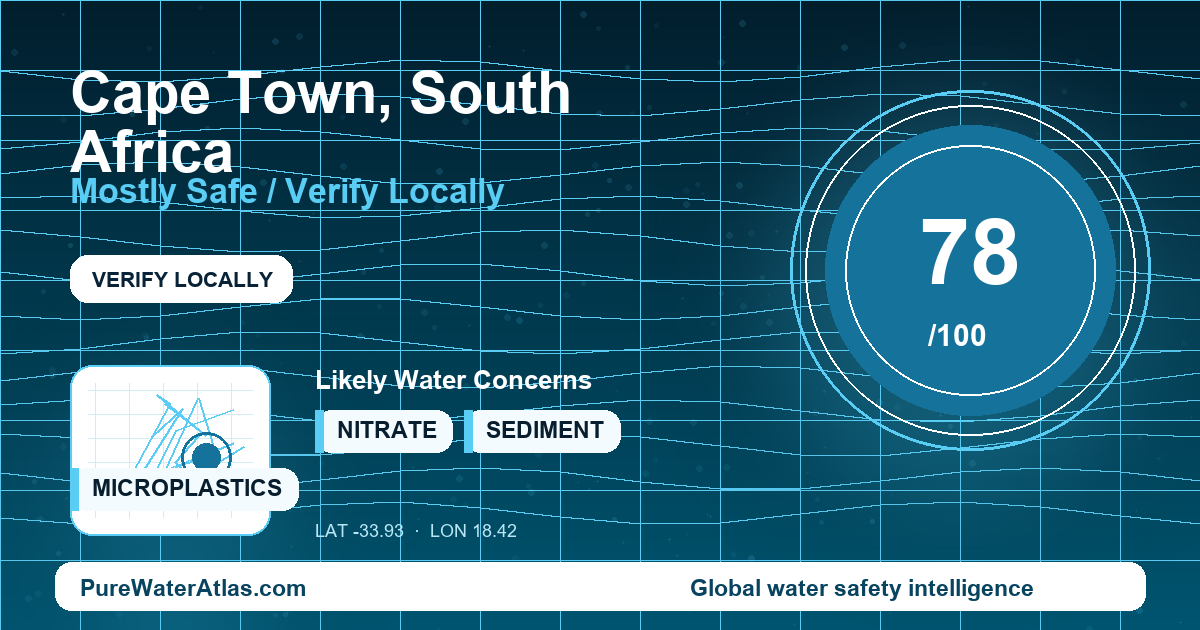
Cape Town municipal tap water is generally drinkable in the formal City of Cape Town supply area, but local notices, building plumbing, storage tanks, outages, and private water sources should be checked before assuming every tap is safe.
Quick Answer
| Overall status | Mostly safe / verify locally. PureWaterAtlas score: 78/100. Cape Town’s treated municipal water is generally considered suitable for drinking in formal areas served by the City of Cape Town network. |
|---|---|
| Can visitors drink it? | Usually yes in established hotels, guesthouses, restaurants, and central tourist areas. Use bottled or properly treated water if there is a boil-water notice, unusual odor, visible discoloration, recent outage, or uncertain accommodation plumbing. |
| Resident guidance | Most municipal customers do not need a whole-house filter for safety under normal conditions. A certified activated-carbon filter can improve chlorine taste and odor. Test locally if the building is old, uses tanks, or has recurring brown water. |
| Main water source | Rain-fed surface water from the Western Cape Water Supply System, including major mountain-catchment dams such as Theewaterskloof, Voëlvlei, Berg River, Wemmershoek, and the Steenbras system. |
| Water authority | City of Cape Town Water and Sanitation Directorate, with national oversight by South Africa’s Department of Water and Sanitation. |
| Filter recommendation | No routine safety filter is needed for normal municipal water, but carbon filtration may help taste. Use testing before choosing lead-removal, reverse-osmosis, or microbiological treatment systems. |
Why Cape Town Is Different
Cape Town’s drinking-water risk profile is shaped by its geography. The city sits in a Mediterranean-climate, winter-rainfall region where the main drinking-water catchments depend heavily on winter rains and mountain dam storage. That makes drought a real source-water risk, not a distant theoretical concern. The 2015 to 2018 drought and the “Day Zero” crisis showed how vulnerable a rain-fed surface-water system can become when several dry years occur together.
Under normal conditions, the treated municipal supply in the formal City of Cape Town service area is generally considered drinkable. The more practical risks are usually not the bulk treated water itself, but local or building-level conditions: pipe bursts, planned maintenance, pressure changes, sediment disturbance, internal plumbing, poorly maintained private tanks, or private boreholes used as drinking-water sources without testing.
Cape Town water can also have a noticeable chlorine taste or smell. In many cases this is an aesthetic issue related to residual disinfection, which helps protect the water microbiologically as it moves through the distribution network. A sudden strong chemical odor, persistent brown water, or illness after drinking should be treated differently: stop using the affected water for drinking, check City of Cape Town notices, and report the problem if it continues.
Where Does Cape Town’s Tap Water Come From?
Cape Town is supplied mainly by the Western Cape Water Supply System, a regional network of rain-fed surface-water sources in the Western Cape. The principal supply is captured in mountain catchment dams, treated, and then distributed through City of Cape Town reservoirs, pressure zones, and water mains.
Important dams in the system include Theewaterskloof Dam, the largest storage dam serving the regional system, along with Voëlvlei Dam, Berg River Dam, Wemmershoek Dam, and the Steenbras Upper and Lower dams. The system’s reliance on winter rainfall means dam levels, seasonal drawdown, and drought planning are central to Cape Town’s water-security story.
After the drought crisis, Cape Town’s water planning increasingly emphasized resilience. The city’s infrastructure includes treated-water bulk reservoirs, water treatment works, pressure-management zones, and demand-management infrastructure developed during and after the drought. The city’s New Water Programme also includes diversification components such as groundwater from the Table Mountain Group, Cape Flats and Atlantis aquifers, plus planned water reuse and desalination capacity.
These alternative sources do not mean that every private borehole or wellpoint is safe to drink. Private groundwater must be treated as a separate supply. It can be affected by salinity, nutrients, metals, hydrocarbons, or microbial contamination, especially in coastal or urban settings. Municipal water and private borehole water should not be assumed to have the same quality or monitoring.
Who Manages Drinking Water in Cape Town?
The City of Cape Town Water and Sanitation Directorate is the municipal water services authority and provider for the city. It manages the municipal network that delivers treated drinking water to formal service areas. Nationally, South Africa’s Department of Water and Sanitation oversees water resources and regulatory programs.
Municipal drinking water is expected to comply with South Africa’s drinking-water quality framework, including SANS 241 requirements and national oversight programs such as Blue Drop drinking-water quality assessments. These frameworks are important, but they should be read correctly: public reporting is usually system-level or period-level information. It does not prove the condition of every pipe, roof tank, hotel plumbing system, borehole, or individual tap at the moment of use.
This distinction matters in Cape Town because a citywide water-quality summary may remain acceptable while one building experiences stagnant plumbing, one street has temporary sediment after repairs, or one property’s tank becomes contaminated. For health decisions, local conditions and direct testing can be more useful than broad averages.
Main Local Water Concerns
- Drought and low dam levels: Cape Town’s surface-water system is dependent on winter rainfall. Low dam levels can increase operational pressure and may complicate taste, algal management, and treatment demands.
- Turbidity and brown water: Temporary discoloration can occur after pipe bursts, flushing, pressure changes, or local works. If it persists after flushing, it should be reported and investigated.
- Chlorine taste and odor: Chlorine complaints are common in many disinfected municipal systems. In Cape Town, this is usually an aesthetic issue, although sudden unusual odors should be checked.
- Older internal plumbing: Municipal reports do not guarantee the condition of old pipes, solder, brass fittings, galvanized plumbing, or stagnant internal plumbing inside a building.
- Private storage tanks: Roof tanks and other storage systems can become the weak link in an otherwise safe municipal supply if they are unsealed, dirty, exposed to pests, or left stagnant.
- Boreholes and wellpoints: Private groundwater is not automatically drinking water. It should be tested for microbiology, salinity-related indicators, nutrients, and other local contaminants before consumption.
- Intermittent or informal supply conditions: Areas with shared standpipes, storage containers, or intermittent supply can face higher post-treatment contamination risks.
Season also matters. Winter rainfall replenishes dams but can increase raw-water turbidity and organic matter entering treatment works. Late summer and autumn are typically higher water-security concern periods because dams have been drawn down after the dry season. Hot, dry periods increase demand, and outages or pipe repairs can temporarily introduce air, sediment, or discoloration at taps.
For Travelers
Most visitors staying in established hotels, guesthouses, and central tourist areas can usually drink Cape Town municipal tap water. Brushing teeth with tap water is normally acceptable in hotels, restaurants, and formal accommodation connected to the city network.
Ice from reputable hotels, restaurants, and cafés is normally acceptable if made from municipal tap water. Avoid ice from unknown street sources or places with visibly poor hygiene, uncertain storage, or unclear water origin. In central Cape Town, the Atlantic Seaboard, the Waterfront, and major tourist zones, established venues generally use municipal water, but it is reasonable to ask accommodation providers whether they use roof tanks, boreholes, or private filtration, especially during outages or restrictions.
Use bottled or properly treated water if there is a local boil-water advisory, if tap water is brown or visibly cloudy, if it has an unusual odor after an outage, or if you are staying in remote, informal, or poorly maintained accommodation. Travelers with sensitive stomachs, infants, or immunocompromised conditions may prefer bottled water or a certified filter as a precaution.
Boiling is appropriate when a boil-water advisory is issued or when microbial contamination is suspected. However, boiling does not remove salts, metals, or many chemical contaminants. For more detail, see PureWaterAtlas guides on boiling water purification and what boiling can and cannot address.
For Residents
For households receiving normal City of Cape Town municipal water, a whole-house safety filter is not routinely necessary. If the main complaint is chlorine taste or odor, a certified activated-carbon point-of-use filter can improve palatability. More expensive systems such as reverse osmosis or specialized lead-removal filters should be chosen based on testing, not fear or generic advice.
Residents in older properties should pay attention to building-level plumbing. Lead is not asserted here as a citywide Cape Town municipal-main problem, but older fittings, solder, galvanized pipes, brass fixtures, and stagnant internal plumbing can create tap-specific metal concerns. If the plumbing history is unknown, test both first-draw and flushed samples for relevant metals such as lead, copper, iron, and manganese. PureWaterAtlas has a practical guide to lead testing and detection methods.
If you use a roof tank, storage tank, rainwater system, borehole, wellpoint, or any private supply for drinking, test for E. coli and total coliforms before relying on it. Borehole and wellpoint water should also be tested for turbidity, conductivity, chloride, nitrate, and microbiology, especially in coastal, urban, agricultural, or industrial-influenced areas. For groundwater-related nutrient concerns, see nitrate contamination testing.
Private tanks should be sealed, screened, cleaned, protected from sunlight and pests, and periodically disinfected. After repairs, long stagnation, contamination, outages, or recurring sediment, use a SANAS-accredited or otherwise reputable laboratory for health-relevant decisions rather than relying only on taste or appearance.
Relevant Contaminants and Water-Quality Issues
The most relevant Cape Town tap-water issues are practical and local rather than a single citywide contaminant claim. Chlorine in drinking water is relevant because residual disinfection can affect taste and odor while helping maintain microbial safety in the network. Turbidity and sediment are relevant after pipe bursts, flushing, pressure changes, heavy rainfall impacts on raw water, or local works.
For tanks, private sources, and boil-water situations, E. coli in drinking water is a key microbiological indicator. For older buildings, lead is relevant as a building-plumbing issue to test for when the pipe and fixture history is uncertain. For boreholes and wellpoints, nitrate is relevant because private groundwater can be affected by urban or agricultural contamination sources.
How to Verify Your Water Quality
Start with current local information from the City of Cape Town, especially after outages, pipe bursts, planned maintenance, or visible water changes. If your issue is limited to one building or one tap, citywide reporting may not answer the question; building plumbing, tanks, and private systems need direct investigation.
For a structured approach, use the PureWaterAtlas complete guide to water testing. For broader safety principles, see Drinking Water Safety, Water Microbiology, and Water Treatment Systems. Travelers comparing destinations can use the Global Water Quality Checker, while specific substances can be researched in the Contaminants Search Engine.
Relevant PureWaterAtlas category pages include Drinking Water Safety, Global Water Quality, Water Testing, and Water Contamination.
Official and Technical Sources
- City of Cape Town – Water quality: official municipal information on drinking-water quality, monitoring, and consumer guidance.
- City of Cape Town – This is where our water comes from: official explanation of Cape Town’s dams, bulk sources, and supply system.
- City of Cape Town – Dam levels: current and historical dam-level information relevant to drought and source-water pressure.
- City of Cape Town – New Water Programme: information on groundwater, reuse, desalination readiness, and resilience planning.
- South African Department of Water and Sanitation – Blue Drop Watch Report 2023: national drinking-water quality oversight and regulatory-performance context.
- Department of Water and Sanitation – Western Cape Water Supply System reconciliation strategy: technical planning context for the regional system serving Cape Town and surrounding users.
- South African National Standards – SANS 241 drinking water quality: national drinking-water quality standard referenced in compliance reporting.
- World Health Organization – Guidelines for drinking-water quality: international public-health benchmark for drinking-water microbial and chemical safety principles.
Bottom Line
Cape Town tap water is generally suitable for drinking in formal areas served by the City of Cape Town municipal network, including most established hotels, restaurants, and central tourist areas. The main caution is local verification: check notices after outages, pipe bursts, repairs, discoloration, unusual odor, or boil-water advisories. Cape Town’s system is distinctive because it depends heavily on winter rainfall and mountain dams, and the 2015 to 2018 drought showed why source-water security matters. For residents, routine whole-house filtration is usually unnecessary, but carbon filtration may improve chlorine taste. Older buildings, roof tanks, boreholes, wellpoints, and recurring brown water should be tested directly because citywide reporting cannot guarantee conditions at every tap.
Read the full guide: Global Water Quality Guide
Explore more in this category: Global Water Quality Articles