
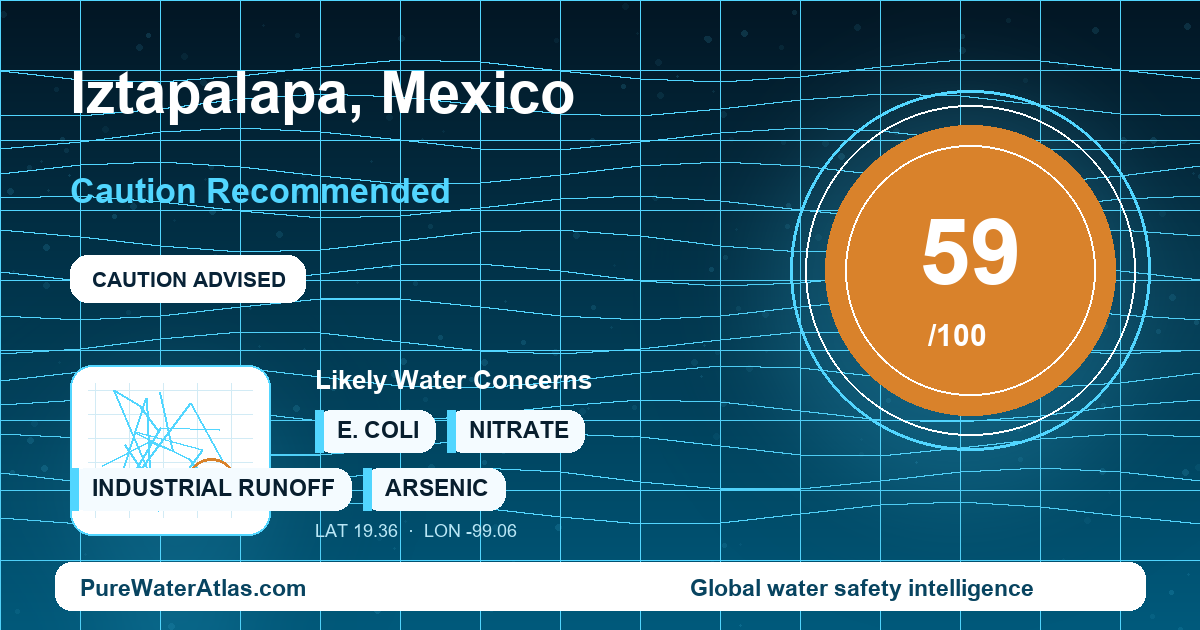
Iztapalapa is connected to Mexico City’s treated and chlorinated public water system, but intermittent supply, low pressure, household cisterns, rooftop tanks, and groundwater-related quality challenges make tap-water safety highly building-specific.
Quick Answer
| Water safety score | 59 / 100 |
|---|---|
| Risk level | Caution Recommended |
| Can you drink the tap water? | Not recommended without treatment, especially for short-term visitors. Iztapalapa receives formally treated municipal water, but final tap quality can be affected by storage tanks, intermittent service, low pressure, and building plumbing. |
| Traveler advice | Use sealed bottled water, verified purified water, or properly treated water for drinking. Bottled or treated water is also the lower-risk choice for brushing teeth. |
| Resident advice | Treat tap water as household-specific. If your home uses a cistern, tinaco, pipa deliveries, old plumbing, or intermittent service, use point-of-use treatment and test periodically. |
| Main water source | Mexico City’s mixed system: Valley of Mexico groundwater plus imported water from the Cutzamala and Lerma systems, with groundwater especially important in and around Iztapalapa. |
| Water authority | Sistema de Aguas de la Ciudad de México, commonly SACMEX, with local service coordination involving the Alcaldía Iztapalapa. |
| Filter recommendation | For many homes: sediment prefiltration plus activated carbon; consider reverse osmosis where dissolved salts, metals, nitrate, or mineral issues are confirmed or strongly suspected. UV can help only after sediment is controlled and maintenance is reliable. |
Why Iztapalapa Is Different
Iztapalapa is not a simple “safe” or “unsafe” tap-water location. The borough is part of Mexico City’s public water system, where water is treated and chlorinated under a national regulatory framework. However, Iztapalapa has some of the city’s most persistent real-world distribution problems: intermittent supply, low pressure, scheduled delivery known as tandeo, dependence on household storage, and pipa water-truck use in some areas or periods.
The borough’s geography matters. Iztapalapa is a large eastern borough of Mexico City located on former lake-bed terrain, near the Sierra de Santa Catarina and Cerro de la Estrella. This eastern Mexico Basin setting is associated with high population density, major water demand, aquifer stress, land subsidence, and uneven pressure conditions. Those factors do not mean every tap is contaminated, but they do mean the final water quality at a kitchen tap may differ from the quality of water leaving the public system.
For Iztapalapa, the most important practical issue is often not only the original treatment plant or supply source. It is the last part of the system: local distribution mains, pressure changes, building cisterns, rooftop tinacos, hoses, water-truck handling, and internal plumbing. A household can receive chlorinated municipal water and still face higher drinking-water risk if a cistern is dirty, a rooftop tank is uncovered, water sits for long periods, or pressure drops allow intrusion through damaged pipes.
Where Does Iztapalapa’s Tap Water Come From?
Iztapalapa is supplied through Mexico City’s mixed water system operated by SACMEX. The city’s raw-water portfolio combines groundwater pumped from the Valley of Mexico aquifer system with imported water from external systems, especially the Cutzamala System and the Lerma System. In Iztapalapa, local and regional groundwater is especially important, and delivered water can vary by zone, pressure condition, and operating schedule.
The infrastructure behind Iztapalapa’s tap water includes groundwater wells and wellfields, imported bulk-water connections, pumping stations, storage tanks, pressure-regulation infrastructure, chlorination points, and local distribution mains. After water reaches a neighborhood, the building-level system often becomes a major determinant of quality. Many homes and apartment buildings rely on cisterns and rooftop tanks known as tinacos. In areas or periods with insufficient pressure or scheduled supply, residents may also depend on pipas, or water trucks.
This is why Iztapalapa’s water safety cannot be judged only from a citywide statement that the system is treated. Treated water moving through a continuous, pressurized, well-maintained system is different from water that enters a cistern, sits in a rooftop tank, loses chlorine residual, and then travels through old internal plumbing. The water source is citywide and regional; the final risk is often hyperlocal.
Who Manages Drinking Water in Iztapalapa?
The main water operator for Mexico City, including Iztapalapa, is Sistema de Aguas de la Ciudad de México, commonly known as SACMEX. SACMEX is responsible for public water operations, system management, and user-facing information. The Alcaldía Iztapalapa also participates in local reporting, emergency water delivery, and resident service coordination, but the central utility is SACMEX.
Drinking water quality in Mexico is governed nationally by health standards for water for human use and consumption, including NOM-127-SSA1-2021. Mexico City’s official water-quality information is also presented through SACMEX’s Calidad del agua resources.
The key limitation is that regulatory treatment and chlorination do not guarantee identical tap-water conditions in every colonia, building, or apartment. Distribution intermittency, storage tanks, old plumbing, pressure drops, and long storage time can change water quality after treatment. Publicly accessible, current, colonia-by-colonia tap-water compliance data for all of Iztapalapa is limited, so this guide does not claim that all tap water is unsafe or that all locations meet drinking-water standards at all times.
Main Local Water Concerns
The most documented concern for Iztapalapa is unreliable distribution. Mexico City authorities and researchers widely identify the borough as one of the areas most affected by irregular supply, low pressure, and scheduled distribution. The city’s open-data resource on servicio de agua potable por tandeo supports the fact that scheduled or intermittent service is a real operating condition in Mexico City.
Intermittency matters because water systems are safest when they remain pressurized. Low pressure and outages can increase vulnerability to intrusion through damaged pipes, disturb sediment, and force residents to store water. After service returns, first-flush water may carry visible particles or discoloration. Residents may notice turbidity, sediment, or taste changes after outages, pipe repairs, hydraulic changes, storms, or tank disturbance.
Storage is another central concern. Cisterns and tinacos can protect households from unreliable supply, but they can also become contamination points if they are uncovered, dirty, poorly screened, exposed to insects or animals, or rarely disinfected. Chlorine residual can decay during storage, especially in hot weather or after long residence time. Water delivered by pipa may also depend on handling, hose condition, storage, and the receiving tank’s cleanliness.
Groundwater-related quality issues can also affect taste and treatment needs in the eastern Mexico Basin. High dissolved minerals, hardness, salinity, and mineral taste may occur in some groundwater-influenced supplies. Iron and manganese can be relevant in some groundwater systems, especially when water stains fixtures or develops metallic, yellow, brown, or black characteristics after standing. These are not claims that every Iztapalapa tap has these contaminants; they are issues that should be confirmed by testing when local signs or risk factors exist.
Older buildings add a separate risk layer. Internal plumbing, brass fixtures, corroded pipes, stagnation, and unknown materials can introduce metals such as lead in specific buildings, even if the public supply is treated. Land subsidence and pipe stress can also contribute to leaks, repairs, and distribution vulnerability.
For Travelers
Short-term visitors should avoid drinking untreated tap water in Iztapalapa. The borough is connected to Mexico City’s treated and chlorinated system, but visitors usually cannot evaluate the condition of a rental’s cistern, rooftop tank, plumbing, or service schedule. Travelers are also more likely to react to unfamiliar microbes than long-term residents.
For drinking, use sealed bottled water, a trusted purified-water refill source, or water treated with an appropriate system. Boiling can reduce microbial risk, but it does not remove dissolved salts, metals, or chemical contaminants. If your accommodation provides filtered or garrafón water, confirm that it is used for drinking and cooking.
For brushing teeth, bottled or treated water is the safest option. Many visitors use tap water for brushing teeth without incident, but in Iztapalapa the conservative recommendation is to use bottled or treated water, especially for children, pregnant travelers, older adults, and anyone with a sensitive stomach.
For ice, use only ice that is commercially made from purified water or served by a reputable hotel or restaurant that can confirm purified-water use. Avoid informal ice of unknown source. Higher-end hotels and established restaurants commonly use garrafón water, filtration, or commercial ice, but visitors should ask. In small rentals, markets, street-food settings, or older buildings, assume tap water and ice are not reliably safe for drinking unless the source is clear.
For Residents
Residents should treat Iztapalapa tap water as building-specific. A household with continuous pressure, a clean covered tank, maintained plumbing, and acceptable testing results has a different risk profile from a home with frequent outages, pipa deliveries, visible sediment, an uncovered tinaco, or an old cistern with uncertain cleaning history.
For drinking and cooking, a home filter is strongly advisable in many Iztapalapa households. A practical setup often starts with sediment prefiltration, followed by activated carbon for chlorine taste and some organic compounds. Reverse osmosis is worth considering where dissolved salts, metals, nitrate, or mineral issues are confirmed or strongly suspected. UV disinfection can be useful where microbiological risk is a concern, but only after sediment is controlled and the lamp is maintained correctly. For a broader overview of treatment choices, see PureWaterAtlas guides to water treatment systems and water purification methods.
Testing should prioritize the conditions common in Iztapalapa. Test for total coliform and E. coli if your home uses a cistern, tinaco, pipa water, or has intermittent service. Check free chlorine residual at the tap and after storage; absence of residual does not prove contamination, but it is a warning sign in a stored-water system. Test turbidity, pH, conductivity, and total dissolved solids if water has changing taste, color, salty character, or mineral character.
Use laboratory testing for lead if the building is old, has unknown plumbing materials, brass fixtures, or water that sits in pipes overnight. Consider iron and manganese testing if water stains fixtures or has metallic, yellow, brown, or black characteristics after standing. Consider nitrate and arsenic testing when relying on groundwater-influenced or alternative supplies, but do not assume either contaminant is present without data.
Cisterns and tinacos should be sealed, screened, cleaned, disinfected, and inspected on a regular schedule. Do not drink from a tank that is uncovered, has visible sediment, biofilm, dead insects, or uncertain cleaning history unless the water is effectively treated. Retest after major plumbing work, tank cleaning, repeated outages, flood events, or a change from network water to pipa or storage-dependent supply.
Relevant Contaminants and Water-Quality Issues
Several PureWaterAtlas contaminant profiles are especially relevant to Iztapalapa’s conditions. Chlorine in drinking water matters because chlorine residual can decay in cisterns, rooftop tanks, and long residence times. Low or absent residual at the tap is not a full diagnosis, but it is an important clue in stored-water systems.
Turbidity and sediment are relevant after outages, pipe repairs, pressure changes, and tank disturbance. Visibly cloudy or particulate water should not be used for drinking unless properly treated and verified.
Microbiological risk is central where water is stored, pressure is low, or pipa deliveries are used. See E. coli in drinking water and the PureWaterAtlas overview of water microbiology for why coliform and E. coli testing are useful indicators.
For older buildings, lead in drinking water is a building-plumbing concern, not a borough-wide claim. If testing suggests a risk, review lead testing methods and lead filter options. For groundwater-influenced supplies or staining complaints, iron and manganese may be worth testing. Where nitrate is a concern, use laboratory methods rather than guessing; see PureWaterAtlas guidance on nitrate testing.
How to Verify Your Water Quality
The best way to verify drinking-water safety in Iztapalapa is to test the water you actually drink, after it passes through your building’s cistern, tinaco, internal plumbing, and any filter. City-level information is useful, but household-level storage and plumbing can change the final result.
Start with a practical inspection: is the water continuous or intermittent, does it arrive by network or pipa, is the cistern covered, is the tinaco sealed, is there visible sediment, and does the water change color or odor after outages? Then match testing to the risk. For stored or intermittent water, include microbiological indicators. For old plumbing, include lead. For mineral taste, staining, or groundwater influence, include conductivity, total dissolved solids, iron, manganese, and other lab parameters as appropriate.
PureWaterAtlas resources that can help include the complete guide to water testing, the broader guide to drinking water safety, the Contaminants Search Engine, and the Global Water Quality Checker. If you are responding to suspected microbial contamination, the guide to boiling water purification can help; if considering disinfection equipment, review the UV water purification guide.
Official and Technical Sources
- Sistema de Aguas de la Ciudad de México — official Mexico City water authority information.
- SACMEX Calidad del agua — public-facing water-quality and chlorination context for Mexico City.
- NOM-127-SSA1-2021 — Mexican national drinking-water quality standard for water for human use and consumption.
- CONAGUA — national water-resources and infrastructure context.
- Estadísticas del Agua en México — national water statistics for basin and supply context.
- Servicio de agua potable por tandeo — Mexico City open-data context for scheduled or intermittent water service.
- Alcaldía Iztapalapa — local borough government context and resident-facing services.
- World Bank — background context on Mexico City water stress, groundwater extraction, and infrastructure challenges.
Bottom Line
Caution is recommended for Iztapalapa tap water. The borough is inside Mexico City’s treated and chlorinated public water system, but final tap quality is strongly affected by intermittent supply, low pressure, cisterns, rooftop tanks, pipa use in some areas, and old building plumbing. Short-term visitors should use bottled, purified, or properly treated water for drinking and preferably for brushing teeth. Residents should evaluate their own building rather than relying on citywide assumptions: keep tanks sealed and disinfected, use appropriate point-of-use treatment, and test for microbes, chlorine residual, turbidity, metals, and mineral indicators where local risk factors exist. The evidence supports caution, not a claim that every tap is unsafe.
Read the full guide: Global Water Quality Guide
Explore more in this category: Global Water Quality Articles