
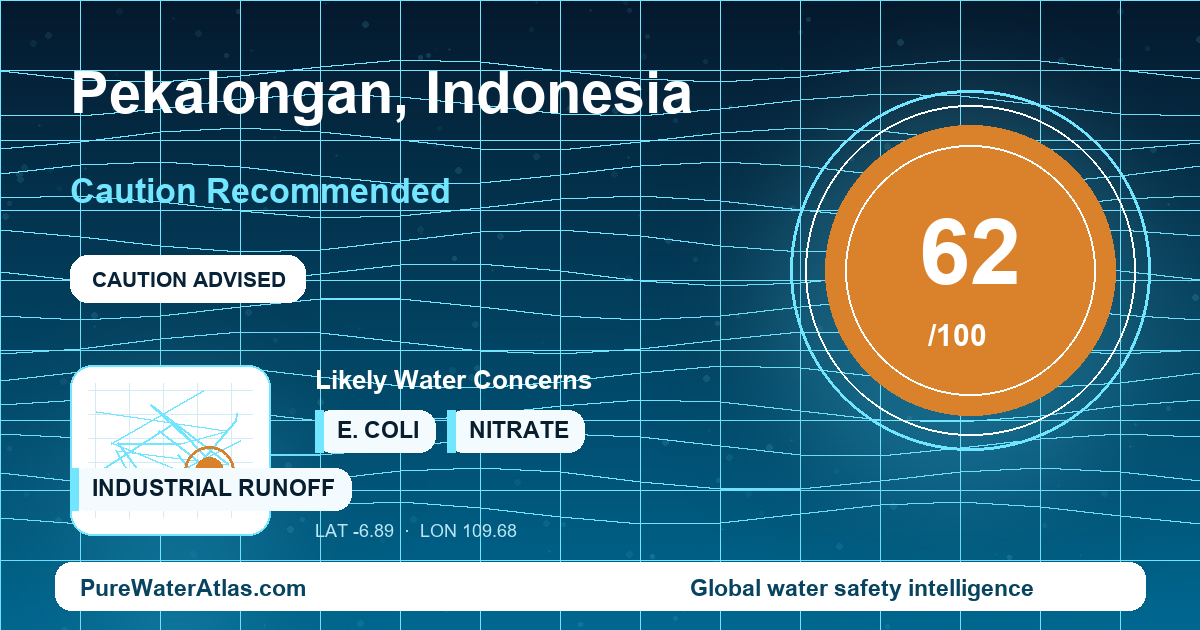
Pekalongan, Indonesia: tap water is rated Caution Recommended because municipal supply exists, but local flooding, tidal inundation, coastal groundwater salinity, sanitation pressure, and limited public finished-water reporting make untreated tap water a poor default drinking choice.
Quick Answer
| Water safety score | 62 / 100 |
|---|---|
| Risk level | Caution Recommended |
| Can visitors drink the tap water? | No, not as a default. Travelers should use sealed bottled water, reputable refill-gallon water, or water that has been boiled or treated with reliable filtration and disinfection. |
| Resident advice | PDAM or Perumda customers should still manage household risk with tank cleaning, flushing, sediment control, and a drinking-water treatment step for vulnerable users. Private well users should test before drinking. |
| Main water reality | A mixed system: municipal piped water for part of the population, plus private wells, refill-gallon water, and purchased bottled water. |
| Local water authority | PDAM or Perumda Air Minum Kota Pekalongan, with public-health oversight by Dinas Kesehatan Kota Pekalongan and national standards set by Indonesia’s Ministry of Health. |
| Filter recommendation | For municipal water, consider sediment filtration plus activated carbon, with boiling or UV for microbial protection. For brackish or high-TDS well water, test first; carbon alone will not remove salinity. |
Pekalongan tap water should be treated as caution recommended, not reliably drinkable straight from the tap. The city has a formal municipal utility, but public neighborhood-level finished-water data are limited. Local conditions add unusual risk: north-coast flooding, tidal inundation, land subsidence, saline groundwater intrusion, dense urban sanitation pressures, and river-quality stress from urban and batik-industry wastewater.
Why Pekalongan Is Different
Pekalongan is not an upland city with a simple source-to-tap risk profile. It is a low-lying city on the north coast of Central Java, and that geography changes the drinking-water question. Tidal flooding, locally known as rob, poor drainage, land subsidence, and seawater intrusion can affect wells, septic systems, pipes, and household storage. For this reason, a glass of water that looks clear in Pekalongan is not enough evidence that it is safe to drink.
The city is also internationally known for batik production. Batik and textile wastewater have been documented as pressure on local rivers in the Pekalongan area. This does not prove that finished municipal tap water contains textile chemicals, and this page should not be read as making that claim. It does, however, make source-water protection and urban drainage conditions especially relevant when evaluating local water safety.
The practical implication is that water safety in Pekalongan depends heavily on the final path from treatment to the glass. Even if water has been treated before entering the distribution network, quality can change because of low pressure, intermittent supply, aging pipes, flood exposure, household tanks, ground tanks, rooftop tanks, stagnant plumbing, and refill-container handling.
Where Does Pekalongan’s Tap Water Come From?
Pekalongan’s drinking-water reality is mixed. Part of the city is served by the PDAM or Perumda Air Minum Kota Pekalongan municipal piped-water network. Many households also rely on private wells, refill-gallon water, or sealed bottled water. The piped municipal system is best described as a treated public supply using regional raw-water sources such as river, spring, and groundwater sources in the Pekalongan area, rather than household shallow coastal wells.
That distinction matters. Shallow groundwater in low-lying coastal parts of Pekalongan is a higher-risk drinking source because salinity, floodwater intrusion, and sanitation contamination are plausible local concerns. Historically, before wider piped-water access and refill-water use, shallow dug wells and bore wells were common household sources. In the coastal plain, that older pattern is increasingly problematic when tidal flooding, land subsidence, seawater intrusion, and post-flood contamination affect shallow groundwater.
Key local water infrastructure includes the PDAM or Perumda municipal distribution network, water treatment installations, reservoirs, pumping stations, and distribution mains. But household infrastructure is also part of the drinking-water system in practice: storage tanks, ground tanks, rooftop tanks, refill-gallon containers, and internal plumbing can determine what actually reaches the cup. Flood and tidal-inundation works, such as pumps, drainage channels, polder systems, and river or coastal works, are not drinking-water treatment assets, but they influence water-risk conditions across the city.
Who Manages Drinking Water in Pekalongan?
The local piped-water provider is PDAM or Perumda Air Minum Kota Pekalongan, the city-owned drinking-water utility. Public-health oversight is associated with Dinas Kesehatan Kota Pekalongan. National drinking-water and hygiene-related health standards are set by Indonesia’s Ministry of Health, including Permenkes No. 2 Tahun 2023.
For local context, the Pemerintah Kota Pekalongan official portal provides municipal information, while BPS Kota Pekalongan provides official city statistics and geographic background. The PDAM Kota Pekalongan information portal is the relevant local utility source where public service information is available.
A major data limitation is that Pekalongan does not appear to publish an easily accessible consumer-confidence-style annual tap-water report with neighborhood-level finished-water results comparable to some international water systems. Therefore, this assessment relies on official institutional context, Indonesian drinking-water regulation, known local geography, flood and coastal risk factors, and the practical vulnerabilities of distribution and household storage.
Main Local Water Concerns
- Salinity and high dissolved solids: In shallow coastal groundwater, seawater intrusion and tidal inundation can raise salinity, chloride, electrical conductivity, and total dissolved solids. A salty taste, white crusting, or high-conductivity reading should trigger testing before filter selection.
- Microbial contamination: Wells and household tanks are vulnerable after tidal flooding, river flooding, septic overflow, or tank exposure. Microbial risk is especially important for children, pregnant people, elderly residents, and immunocompromised people.
- Turbidity and sediment: Heavy rain, flood events, pipe repairs, low pressure, distribution disturbances, and storage-tank sediment can cause cloudy, brown, or particle-laden water. Turbidity can also make disinfection less reliable.
- Iron and manganese: Groundwater or stagnant plumbing may produce staining, metallic taste, black or brown deposits, or sediment. These can be aesthetic problems, but they can also interfere with treatment performance.
- Nitrate risk in private wells: Dense settlement, septic systems, agricultural influence, and floodwater infiltration can make nitrate testing relevant for wells, especially where infants or pregnant people may consume the water.
- Urban and batik-wastewater pressure: Pekalongan’s rivers and drainage channels face domestic, urban, batik, and textile wastewater pressures. This is a source-water and watershed concern, not proof of a specific contaminant in every tap.
- Building plumbing risk: Older buildings, brass fittings, old solder, stagnant water, corroded internal pipes, and rooftop tanks can alter water quality after water enters the property. Widespread lead-service-line evidence for Pekalongan is not publicly established, but building-level testing can still be appropriate.
Seasonality matters. Wet-season rain and flooding can raise turbidity and microbial risk. Tidal flooding can affect coastal neighborhoods even without rainfall. Dry-season low flows may reduce dilution in rivers and drainage channels and may increase salinity pressure in coastal groundwater.
For Travelers
Visitors should not drink untreated tap water in Pekalongan. Use sealed bottled water, reputable refill-gallon water, or water that has been boiled or treated with a reliable filter and disinfection method. This is especially important in basic accommodation, bus stations, public toilets, small guesthouses, flood-affected areas, or any place with brown, cloudy, salty, or low-pressure tap water.
For brushing teeth, short-term visitors, travelers with sensitive stomachs, children, and people staying in basic lodging should use bottled or boiled water. In higher-standard hotels, brushing with tap water may be lower risk if the hotel has its own treated supply, but avoid swallowing water when quality is uncertain.
Use caution with ice. Factory-made tube ice from established restaurants is generally safer than chipped or block ice from informal street vendors. If the source is unclear, skip ice in drinks. Hot tea and coffee are safer when the water has reached a proper boil, but lukewarm drinks, diluted juices, and iced beverages can still be risky if untreated water was used.
During hot weather or flood-prone travel days, carry bottled water. If using a travel filter, pair particulate filtration with disinfection because microbial risk is one of the main traveler concerns. For emergency treatment, see the PureWaterAtlas guide to boiling water purification.
For Residents
Residents connected to PDAM or Perumda water should still manage household-level risk. Keep storage tanks sealed, screened, clean, and protected from floodwater entry wherever possible. Flush stagnant plumbing after long periods of non-use, especially in older buildings. If water is visibly cloudy, brown, or sediment-laden, use sediment filtration and flush before drinking or cooking.
For drinking water from municipal supply, many households should use at least a point-of-use barrier beyond the tap. A sediment prefilter plus activated carbon can improve clarity, taste, and chlorine-related taste or odor. For microbial protection, boiling or a properly maintained UV system can add an important disinfection step. UV is most effective on clear, prefiltered water; see the PureWaterAtlas UV water purification guide.
Private well users should test before using water for drinking. At minimum, test for E. coli or thermotolerant coliform, total coliform, turbidity, pH, electrical conductivity, TDS, chloride, nitrate, iron, manganese, hardness, and odor or color indicators. After tidal flooding, river flooding, septic overflow, or well submergence, do not drink the well water until the well has been disinfected and retested for microbial safety.
If water tastes salty, leaves white crusting, or shows high conductivity, test for chloride and TDS before buying a filter. Ordinary activated carbon filters do not remove salinity. Reverse osmosis may be appropriate for confirmed dissolved-salt or nitrate problems, but it requires maintenance and reject-water management. If infants, pregnant people, elderly residents, or immunocompromised residents drink the water, prioritize microbiological testing and a verified disinfection step.
Relevant Contaminants and Water-Quality Issues
Pekalongan’s practical warning signs align with several PureWaterAtlas contaminant and issue profiles. Cloudy water after rain, flooding, pipe repairs, or tank disturbance should be evaluated as turbidity in drinking water. Brown particles, settled material, and tank deposits are related to sediment in drinking water.
Microbial risk is central for flood-affected wells and unmaintained storage tanks; learn more about E. coli in drinking water and the broader PureWaterAtlas pillar on water microbiology. Groundwater staining, metallic taste, or black deposits may involve iron or manganese.
For private wells influenced by septic systems, dense settlement, agriculture, or floodwater infiltration, nitrate in drinking water is a relevant testing concern. Municipal water taste may involve chlorine, while older building plumbing may justify targeted testing for lead in drinking water even though a citywide Pekalongan lead-service-line problem is not publicly established.
How to Verify Your Water Quality
The most reliable way to make a household decision in Pekalongan is to test the water at the point where it is actually consumed: after the building plumbing, after the rooftop or ground tank, and after any refill or treatment device. For a complete testing framework, use the PureWaterAtlas guide to water testing and analysis.
Private well users should combine microbiological testing with salinity indicators such as electrical conductivity, TDS, and chloride. Where septic or agricultural influence is possible, use the guide to nitrate contamination testing. In older buildings, consider first-draw and flushed sampling for lead and copper; the PureWaterAtlas guide to lead testing methods explains why sampling method matters.
To compare Pekalongan with other places, use the Global Water Quality Checker. To research individual issues, use the Contaminants Search Engine. For broader decision-making, see PureWaterAtlas resources on drinking water safety and water purification methods.
Official and Technical Sources
- Pemerintah Kota Pekalongan official portal — local government context, municipal institutions, public-service references, flood and infrastructure information.
- BPS Kota Pekalongan — official city geography, population, administrative context, and statistical background.
- Permenkes No. 2 Tahun 2023 — Indonesian national health-based standards and regulatory context for drinking water, sanitation, and environmental health quality.
- PDAM Kota Pekalongan information portal — local piped-water utility identity and public-service context where available.
- Balai Besar Wilayah Sungai Pemali Juana — regional river-basin, drainage, flood, and water-resources context for the north coast of Central Java and the wider Pekalongan area.
- Kementerian PUPR official site — national public-works, water-supply, drainage, flood-control, and infrastructure context relevant to Indonesia and Pekalongan.
Bottom Line
Pekalongan tap water is best treated as caution recommended. The city has a formal PDAM or Perumda piped-water system, but public finished-water reporting is limited and local conditions create meaningful household risk. Low-lying coastal geography, tidal flooding, land subsidence, seawater intrusion, flood-exposed sanitation, sediment, private wells, storage tanks, and old plumbing can all affect what reaches the glass. Visitors should avoid untreated tap water and use sealed bottled, reputable refill-gallon, boiled, or properly treated water. Residents should clean tanks, flush stagnant plumbing, test private wells, and choose treatment based on the actual problem: disinfection for microbes, sediment filtration for cloudy water, and laboratory-guided treatment for salinity, nitrate, iron, manganese, or plumbing metals.
Read the full guide: Global Water Quality Guide
Explore more in this category: Global Water Quality Articles