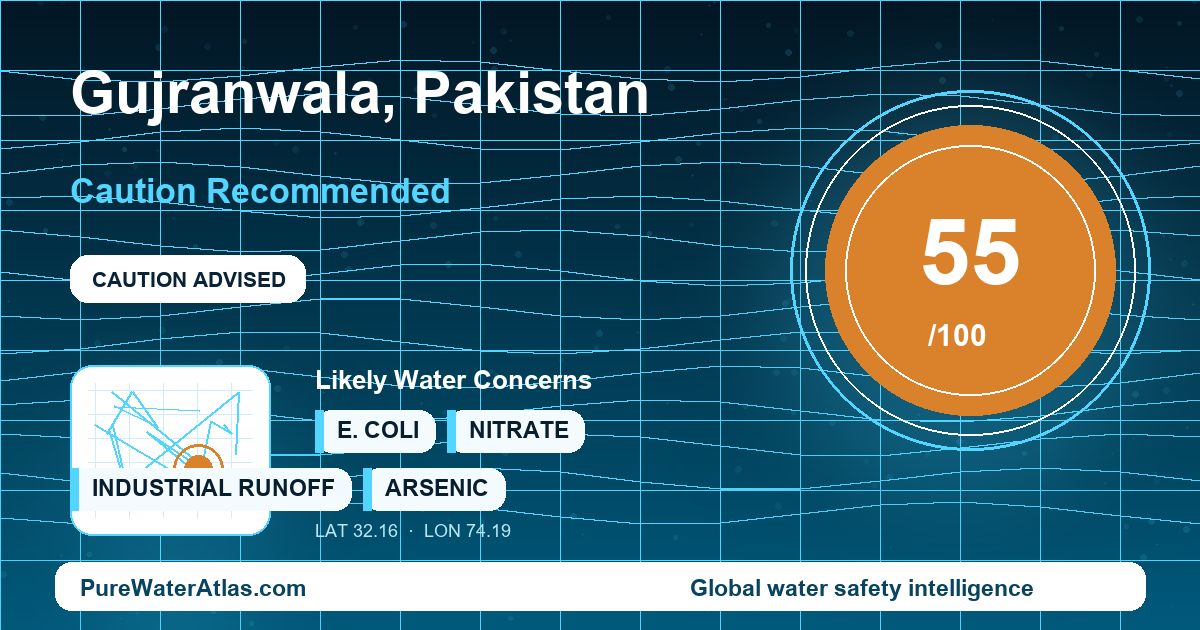
Gujranwala, Pakistan: groundwater-based municipal supply, tube wells, household storage tanks, and why untreated tap water deserves caution.
Quick Answer
| Water safety score | 55 / 100 |
|---|---|
| Risk level | Caution Recommended |
| Can visitors drink the tap water? | Not recommended untreated. Travelers should use sealed bottled water, boiled water, or water treated with a reliable purifier. |
| Resident advice | Do not rely only on taste, smell, or appearance. Test water at the point of drinking and choose treatment based on results. |
| Main water source | Primarily groundwater pumped by municipal tube wells from the Indus Basin alluvial aquifer. |
| Local authority | Water and Sanitation Agency Gujranwala, commonly WASA Gujranwala, under the Gujranwala Development Authority framework. |
| Filter recommendation | Often advisable. Sediment prefiltration plus UV or boiling can address microbial risk when water is clear; reverse osmosis or specialized media should be used only when testing shows dissolved contaminants such as high TDS, nitrate, arsenic, or certain metals. |
Overall verdict: caution is recommended. Gujranwala is not a city where visitors should assume untreated tap water is safe to drink. The main practical issue is not one confirmed citywide contaminant, but a combination of variable groundwater quality, aging distribution pipes, intermittent supply, household storage tanks, and possible sewage intrusion during low-pressure events or monsoon flooding.
Why Gujranwala Is Different
Gujranwala is a large industrial city in Punjab’s Rechna Doab region, within the wider Indus Basin groundwater system between the Chenab and Ravi river systems. Its drinking-water profile is different from cities that depend mainly on a large river-fed treatment plant or desalination system. In Gujranwala, the urban supply is understood to be mainly groundwater-based, with municipal tube wells feeding service reservoirs, overhead tanks, pumping stations, and distribution mains.
This matters because groundwater quality can vary significantly by well depth, location, nearby drains, sewer conditions, and the intensity of local pumping. A household in one neighborhood may see different mineral content, hardness, sediment, taste, or microbial risk from a household in another zone. The city’s rapid urban and industrial expansion has also placed pressure on water, sewerage, and drainage infrastructure. Gujranwala’s industrial profile includes metal, ceramics, sanitary ware, fan, cutlery, and small manufacturing sectors, making groundwater and drain protection an important local concern even where public neighborhood-level contaminant maps are limited.
Another Gujranwala-specific issue is that the water coming from a kitchen tap may not represent utility water alone. In many buildings, water passes through rooftop or underground storage tanks before use. Even if the water was acceptable when pumped or chlorinated, it can become contaminated later if a tank is uncovered, rarely cleaned, connected to old plumbing, or located near sewer leakage.
Where Does Gujranwala’s Tap Water Come From?
Gujranwala’s urban drinking-water supply is primarily produced from groundwater. Municipal tube wells pump water from the Indus Basin alluvial aquifer, then move it through a network that can include ground storage reservoirs, overhead reservoirs, pumping stations, distribution mains, neighborhood service lines, and building-level storage tanks.
Historically, domestic water in many Punjab cities, including Gujranwala, has depended on shallow and deeper groundwater, private wells, hand pumps, and later municipal tube wells. As the city expanded, dense housing, industrial growth, sewer leakage, and heavy groundwater abstraction increased stress on both the aquifer and the distribution network.
The practical safety of water can change at several points: the tube well, the storage reservoir, the distribution main, the street connection, the building plumbing, and the household tank. Even when disinfection is used at a supply point, contamination can occur later through leaking pipes, illegal connections, low-pressure events, unclean tanks, or contact with sewage where water and sewer lines are damaged or close together.
Seasonal conditions also matter. Monsoon rains can increase urban flooding, drain overflow, and cross-contamination risk. Hot weather can increase reliance on stored water, encourage bacterial regrowth in tanks, and lead households to use private vendors or bottled water. Power outages or pumping interruptions can create low-pressure conditions that make intrusion more likely in leaky networks.
Who Manages Drinking Water in Gujranwala?
Gujranwala’s municipal water, sewerage, and drainage services are associated with Water and Sanitation Agency Gujranwala, commonly referred to as WASA Gujranwala. The agency operates within the broader Gujranwala Development Authority institutional framework in Punjab.
Drinking-water quality in Pakistan is guided by national standards and regulatory structures, including the Pakistan Standards and Quality Control Authority. Monitoring and water-quality evidence also involve provincial bodies, health departments, local utilities, and the Pakistan Council of Research in Water Resources. The WHO/UNICEF Joint Monitoring Programme provides national context on household water access in Pakistan, while the WHO Guidelines for Drinking-water Quality provide international health-based guidance.
A key limitation for Gujranwala consumers is that recent public, neighborhood-level compliance reporting is not as routine or detailed as in some countries. There is enough information to identify the local supply identity and broad risk profile, but not enough publicly accessible ward-by-ward data to state that every tap in Gujranwala always meets or fails a specific limit. For that reason, building-level testing remains important.
Main Local Water Concerns
- Microbial contamination: The highest practical concern is microbial risk from sewage intrusion, intermittent pressure, contaminated household tanks, and poor point-of-use hygiene. Residents and travelers should be aware of pathogens such as E. coli, which is used as an indicator of fecal contamination.
- Turbidity and sediment: Pipe repairs, pressure changes, construction, supply restoration, or monsoon disturbance can produce visible cloudiness, particles, or discoloration. Learn more about turbidity and sediment in drinking water.
- Variable groundwater minerals: Some areas may experience hardness, high total dissolved solids, chloride, sulfate, taste issues, or staining linked to groundwater chemistry.
- Nitrate risk: Nitrate should be tested where properties are near drains, sewer leaks, agricultural land, septic systems, or suspected wastewater intrusion.
- Arsenic uncertainty: Arsenic is a documented groundwater issue in parts of Punjab and the Indus plain, but Gujranwala household risk should be confirmed by testing rather than assumed. Peer-reviewed research has reported high arsenic levels in groundwater in parts of Pakistan’s Indus plain.
- Iron and manganese indicators: Reddish, brown, black, metallic, or staining water may justify testing for iron and manganese.
- Old plumbing metals: Older buildings may have corroded galvanized iron pipes, brass fixtures, soldered joints, or degraded plumbing. Where children drink the water daily, point-of-use testing for metals such as lead may be prudent.
For Travelers
Travelers should not drink untreated tap water in Gujranwala. Use sealed bottled water from reputable brands, boiled water, or water treated with a reliable purifier. This recommendation is based on the city’s groundwater supply, distribution and storage vulnerabilities, and microbial-risk conditions; it is not a claim that every tap is unsafe every day.
Use bottled or treated water for brushing teeth, especially for short visits, children, pregnant travelers, older adults, and anyone with a sensitive stomach or weakened immune system. Avoid ice unless you know it was made from treated water. In small eateries, street stalls, and informal vendors, assume ice may have been made from tap or bulk water.
Higher-end hotels and restaurants may use filtration or bottled water, but ask directly whether drinking water and ice are filtered and disinfected, and whether storage tanks are cleaned. Hot tea and freshly cooked foods are generally lower risk when served hot, while cold drinks, chutneys diluted with water, and washed raw salads carry more risk. Check bottle caps carefully and avoid refilled bottles. If diarrhea occurs, use oral rehydration salts and seek medical care when symptoms are severe or persistent.
For Residents
Residents should not judge water safety only by whether the water looks clear or tastes normal. In Gujranwala, household testing is advisable because conditions can differ by tube well, distribution zone, service line, plumbing, and storage tank. The most useful sample is often from the kitchen tap after the household tank, not only from the street supply or before storage.
For microbial control, boiling or certified UV treatment after sediment filtration can be useful when water is clear. If the water is visibly turbid, prefilter before UV because particles can shield microbes from ultraviolet light. For step-by-step background, see the PureWaterAtlas guides to boiling water purification and UV water purification.
Reverse osmosis is not automatically required for every home, but it may be justified where testing shows high dissolved solids, nitrate, arsenic, or certain metals. Activated carbon alone is not enough for many dissolved contaminants. Any system must be maintained; an neglected filter can become a contamination source rather than a safety barrier.
Storage tanks are a major control point in Gujranwala. Keep rooftop and underground tanks covered, insect-proof, and away from sewer leaks. Clean and disinfect them regularly. Avoid suction-pump arrangements that may pull contaminated water into pipes. After flooding, major plumbing work, sewer repairs, long shutdowns, or installation of a new bore or tank, retest the water before relying on it for daily drinking.
Relevant Contaminants and Water-Quality Issues
The most relevant Gujranwala water-quality topics are microbial contamination, sediment, groundwater minerals, and location-specific dissolved contaminants. For microbial risk, start with E. coli, because its presence indicates fecal contamination and a need for disinfection. For visible particles or cloudy water after pressure changes, see turbidity and sediment.
For groundwater-fed supplies, residents should also understand nitrate, arsenic, iron, and lead. Arsenic and nitrate cannot be ruled out by taste or appearance. For deeper reading, use the PureWaterAtlas guides to arsenic testing, nitrate testing, and lead testing.
How to Verify Your Water Quality
The best way to verify drinking-water safety in Gujranwala is to test the water actually used for drinking. Residents should test for E. coli or total coliform at the point of use, plus TDS, electrical conductivity, pH, hardness, chloride, sulfate, nitrate, arsenic, iron, and manganese where relevant. Use an accredited or reputable laboratory where possible. Home strips may help screen some parameters, but they cannot reliably rule out microbes, arsenic, or lead.
PureWaterAtlas resources that can help include the complete guide to water testing, the drinking water safety guide, the water microbiology guide, and the water treatment systems guide. You can also use the Global Water Quality Checker and the Contaminants Search Engine to compare risks and treatment approaches.
Official and Technical Sources
- Water and Sanitation Agency Gujranwala — local utility and service context for Gujranwala water supply, sewerage, and drainage.
- Gujranwala Development Authority — institutional context for urban development and WASA-linked civic infrastructure.
- Pakistan Council of Research in Water Resources — national water-quality monitoring and groundwater-quality evidence.
- Pakistan Standards and Quality Control Authority — national standards context for drinking-water parameters in Pakistan.
- WHO/UNICEF Joint Monitoring Programme: Pakistan — national household drinking-water access and service-level context.
- WHO Guidelines for Drinking-water Quality — international health-based framework for microbial and chemical risks.
- High levels of arsenic in groundwater of Pakistan — peer-reviewed evidence supporting arsenic testing in parts of the Indus plain and Punjab.
Bottom Line
Gujranwala’s tap water should be treated with caution, especially for drinking. The city relies mainly on groundwater pumped through municipal tube wells, then distributed through reservoirs, mains, service lines, and household storage tanks. Safety can change after the source because of intermittent pressure, old pipes, sewer intrusion, monsoon flooding, and poorly maintained rooftop or underground tanks. Travelers should use sealed bottled, boiled, or reliably treated water and avoid uncertain ice. Residents should test water at the point of drinking for microbes, minerals, nitrate, arsenic, iron, and other relevant parameters, then choose filtration or disinfection based on results. Public neighborhood-level compliance data are limited, so household verification is the most practical safeguard.
Read the full guide: Global Water Quality Guide
Explore more in this category: Global Water Quality Articles