Bekasi, Indonesia: tap water safety guidance for a dense lowland city east of Jakarta, where treated piped supply, the Citarum-Jatiluhur raw-water system, household storage, wells, and refill water all affect what reaches the glass.
Quick Answer
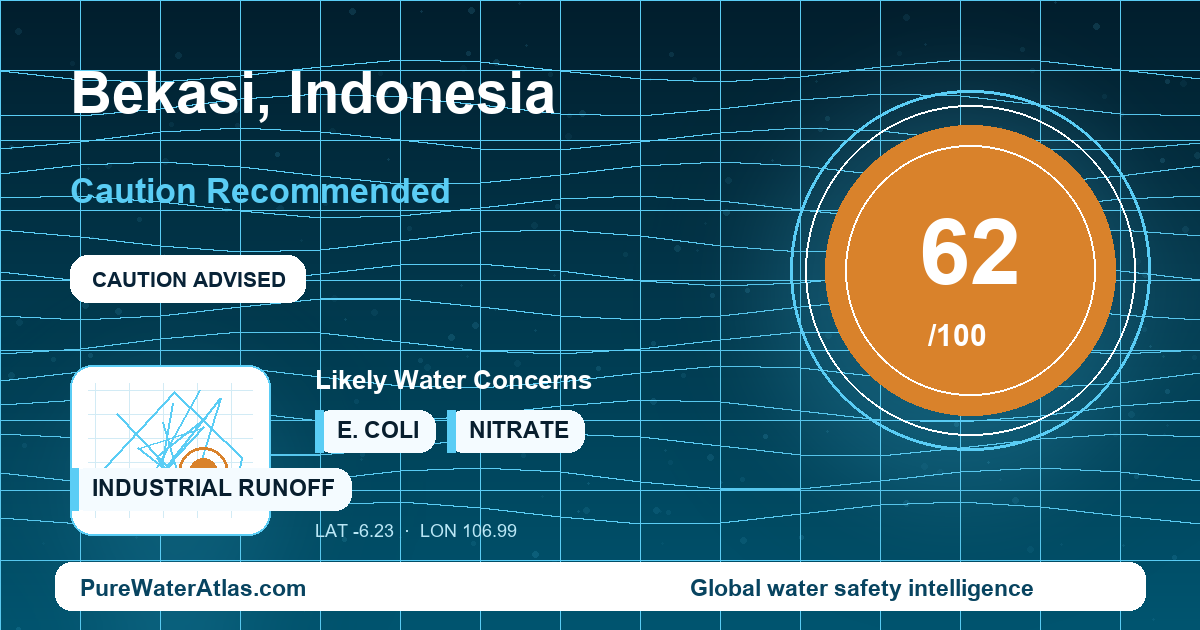
| Overall safety status | Caution recommended. Bekasi has formal treated piped-water infrastructure, but public neighborhood-level tap compliance data are limited and final water quality can change in household tanks, building plumbing, wells, and refill containers. |
|---|---|
| Water safety score | 62 / 100 — Risk level: Caution Recommended. |
| Can tourists drink the tap water? | No, not as a default. Short-term visitors should use sealed bottled water, reputable refill water, properly boiled water, or a verified purifier. |
| Resident guidance | Residents should manage point-of-use risk: clean tanks, maintain plumbing, boil or filter drinking water, and test wells or building systems rather than relying on taste or clarity. |
| Main raw-water system | Bekasi’s formal piped-water supply is closely tied to the Jatiluhur Reservoir and Citarum River system through the West Tarum Canal, locally known as Kalimalang. |
| Main water authority | Perumda Tirta Patriot is the main municipal water company for Kota Bekasi. Perumda Tirta Bhagasasi is relevant in the broader Bekasi service area and historical/regional context. |
| Filter recommendation | For piped water, use boiling plus a maintained activated-carbon or certified multi-stage filter when drinking. For well water, test first; reverse osmosis may be appropriate for nitrate, salinity, some metals, or broad dissolved contaminants if testing supports it. |
Why Bekasi Is Different
Bekasi is not a simple “one utility pipe equals one household tap” water environment. It is a dense lowland city immediately east of Jakarta within the Jabodetabek metropolitan area, and its drinking-water reality is shaped by rapid urbanization, the Citarum-Jatiluhur raw-water system, the Kalimalang canal corridor, piped-water expansion, wells, refill water, rooftop and ground tanks, booster pumps, and building-level plumbing.
The practical safety question in Bekasi is not only where the water originally came from. It is also what happened after it entered the city, the building, the household tank, or the refill container. A clear-looking glass of water does not prove that it is microbiologically safe, free of excess sediment, or unaffected by plumbing and storage conditions. This is especially important in areas with intermittent pressure, older internal pipes, low-pressure events, or flood exposure.
PureWaterAtlas rates Bekasi as Caution Recommended because treated piped-water infrastructure exists, but recent public, city-specific tap-water sampling results are not consistently available in a transparent consumer-report format for every neighborhood, pipe zone, building type, and private water source. This profile therefore avoids claiming that all Bekasi tap water either meets or fails a specific standard. The safer practical recommendation is to treat water before drinking unless the point-of-use system is verified as potable.
Where Does Bekasi’s Tap Water Come From?
Bekasi’s formal piped-water supply is closely connected to the regional Citarum-Jatiluhur system. The Jatiluhur Reservoir in the Citarum basin is a strategic raw-water storage source for West Java and the Jakarta metropolitan water system. From this broader system, the West Tarum Canal, commonly known locally as Kalimalang, conveys raw water across the Jakarta-Bekasi corridor.
This regional raw-water identity matters because the Citarum basin is one of Indonesia’s most heavily managed and stressed river basins. It supports irrigation, hydropower, industry, and urban water supply. Government rehabilitation efforts such as the Citarum Harum program exist because source-water pollution and river recovery are major public issues in West Java.
Bekasi also has local surface waters such as Kali Bekasi within the urban drainage and river network. In practice, however, many households do not experience water as a direct path from a treatment plant to a kitchen tap. Water may pass through distribution pipes, storage tanks, pumps, building plumbing, refill depots, or private wells before it is consumed.
Households outside reliable piped service may use shallow wells, deeper wells, commercial refill water, or a combination of sources. Those choices can create very different risk profiles. A private well may face microbial contamination, nitrate from sanitation leakage, iron, manganese, hardness, salinity, or localized contamination depending on depth and construction. Refill water may be safer than untreated tap water when properly treated and handled, but hygiene, container condition, sealing, and equipment maintenance matter.
Who Manages Drinking Water in Bekasi?
The main municipal water company for Kota Bekasi is Perumda Tirta Patriot Kota Bekasi. It is the primary local utility reference for Bekasi’s municipal piped-water identity, customer information, and treated-water service context.
Perumda Tirta Bhagasasi is also relevant to the broader Bekasi service area and historical city-regency water-supply context. Before the current municipal identity was fully established, water service in the Bekasi area was associated with PDAM Bekasi and the broader Bekasi city-regency utility setting.
Raw-water infrastructure and basin management involve national and basin institutions, including the Ministry of Public Works and Housing, BBWS Citarum, and Perum Jasa Tirta II, which is central to the Jatiluhur water-resources system. Local public-service context and infrastructure announcements may also be found through the Government of Bekasi City.
Drinking-water quality in Indonesia is governed nationally through Ministry of Health environmental health and drinking-water standards, including Regulation of the Minister of Health No. 2 of 2023. Local health authorities and water utilities are responsible for monitoring and implementation. The key limitation for consumers is that Bekasi does not have the same kind of public, granular, annual neighborhood tap-water reporting available in some countries.
Main Local Water Concerns
The most important Bekasi-specific concern is microbial risk after distribution or during household handling. Even treated piped water can become unsafe if it passes through dirty tanks, poorly maintained pumps, contaminated building plumbing, open containers, or low-pressure distribution conditions. Wells and refill containers also need scrutiny because microbes are not visible and may not change taste or smell.
Turbidity and sediment episodes are also plausible concerns in a city connected to canal and river source-water systems and dense urban infrastructure. Rainy-season runoff, flooding, pipe disturbance, repairs, or tank sediment can all affect clarity. Cloudy or particle-laden water can interfere with disinfection and may signal the need to flush, filter, clean tanks, or avoid drinking until treated.
Chlorine taste or odor may occur in treated piped water. A chlorine smell can indicate disinfection, but it does not prove that water remains safe at the household tap after storage or internal plumbing. Conversely, no chlorine smell does not prove water is unsafe; it simply is not a reliable household test.
Private wells in Bekasi require special caution. Relevant concerns include E. coli, nitrate, iron, manganese, total dissolved solids, salinity or chloride, pH, turbidity, and hardness. Localized contamination can vary by well depth, construction, sanitation leakage, flood exposure, and nearby urban activity.
Season matters. The rainy season can increase turbidity, flooding, sewer-overflow pressure, and contamination risk for shallow wells and storage systems. The dry season can reduce dilution in canals and rivers, concentrate taste and odor issues, and worsen interruptions in some systems. After floods, pipe repairs, pressure drops, or long building shutdowns, water lines should be flushed and drinking water should be boiled or filtered.
For Travelers
Tourists and short-stay visitors should not drink untreated tap water in Bekasi. This is a conservative traveler-health recommendation, not a claim that every municipal sample fails standards. Visitors are less acclimatized to local microbial conditions and usually do not know whether a hotel, apartment, or guesthouse has clean tanks and maintained plumbing.
Use sealed bottled water, reputable refill water, water brought to a rolling boil, or a reliable purifier. Check bottle seals, carry water in hot weather, and use caution with raw foods washed in unknown water if you are highly risk-averse. Hot beverages are generally a safer choice when made with water that has been properly boiled.
For brushing teeth, short-term travelers should use bottled, boiled, or filtered water, especially if pregnant, immunocompromised, traveling with children, or staying in a building with unknown tank maintenance. Many long-term residents may brush with tap water, but visitors should be more conservative.
Use ice only in reputable hotels, cafes, and restaurants that can confirm it is made from purified commercial ice. Avoid uncertain street-vendor ice, chipped block ice, or ice handled in open containers. Better hotels and restaurants commonly provide bottled water, dispensers, or commercially supplied ice, but bathroom tap water should not be assumed potable.
Boiling is useful for microbial risk, but it does not remove metals, nitrate, salinity, or many industrial chemicals. For more background, see the PureWaterAtlas Boiling Water Purification Guide and Water Microbiology.
For Residents
Residents connected to Perumda Tirta Patriot or other piped systems should still manage water at the point of use. For drinking and cooking, most Bekasi households should use at least a practical safety barrier. A common approach for piped water is boiling plus an activated-carbon or certified multi-stage filter, maintained according to instructions. This can help with common taste, sediment, chlorine, and microbial concerns, but only if filters are replaced and systems are kept clean.
For well water, do not choose a filter based only on taste, color, or advertising. Test first. At minimum, private wells should be tested for E. coli or total coliform, nitrate, iron, manganese, total dissolved solids, salinity or chloride, pH, turbidity, and hardness. After flooding, well repairs, pump replacement, or sudden changes in taste, odor, or color, test and disinfect the system before using the water for drinking.
Apartment buildings, offices, schools, boarding houses, and older homes should test water after the storage tank and at the kitchen tap, not only at the incoming pipe. If infants, pregnant people, elderly residents, or immunocompromised people live in the home, prioritize microbial testing and use a verified treated source for drinking.
Older buildings and renovated properties can introduce risk through corroded pipes, dead-end lines, old fixtures, solder, or poorly maintained pumps. Let stagnant water run before use, avoid using hot tap water for cooking or infant formula, and test for metals if building plumbing is old or unknown. The PureWaterAtlas guide to lead testing and detection is useful where plumbing materials are uncertain.
Storage tanks are a major practical risk in Bekasi-style urban water systems. Tanks should be covered, screened against pests, cleaned periodically, protected from floodwater and roof runoff, and checked for biofilm, sediment, cracks, and cross-connections. A safe utility supply can become unsafe if stored in a dirty tank.
Relevant Contaminants and Water-Quality Issues
The most relevant Bekasi concerns are not one single contaminant but a cluster of source-water, distribution, storage, and household risks. Microbial indicators such as E. coli matter for wells, tanks, refill containers, and low-pressure distribution conditions. Turbidity and sediment matter during rainy-season runoff, canal or river changes, pipe disturbance, and tank accumulation.
Chlorine is relevant because it is associated with treated piped-water disinfection and taste, but it should not be treated as a simple yes-or-no proof of safety at the tap. For private wells, nitrate is important where sanitation leakage or urban runoff may influence groundwater. The PureWaterAtlas guides to nitrate testing and nitrate treatment options are relevant if a well test shows elevated nitrate.
Iron and manganese are relevant to common groundwater staining, taste, and discoloration complaints. Lead is mainly a plumbing-related concern rather than a claim about Bekasi’s source water; it becomes more relevant in older buildings or systems where water stagnates in unknown pipes and fixtures.
How to Verify Your Water Quality
The only reliable way to know whether a specific Bekasi tap, well, tank, or refill source is safe is to verify it. Start by identifying the source: Perumda Tirta Patriot piped water, another piped system, a private well, a building tank, a refill depot, or a mix. Then test at the point where water is actually consumed.
For a practical framework, use the PureWaterAtlas guide to Drinking Water Safety and the complete guide to Water Testing. If a test identifies a contaminant, research it in the Contaminants Search Engine. For treatment choices, use Water Treatment Systems rather than buying a device before knowing the problem.
Travelers comparing destinations can use the Global Water Quality Checker and the broader Global Water Quality guide. Bekasi’s score reflects a medium-confidence assessment: the utility and raw-water context are identifiable, but recent routine public tap results by neighborhood and building condition are not available in a way that supports precise claims for every household.
Official and Technical Sources
- Perumda Tirta Patriot Kota Bekasi — municipal water-company source for Kota Bekasi service identity and local piped-water context.
- Perumda Tirta Bhagasasi — broader Bekasi service-area and historical/regional water-supply context.
- Government of Bekasi City — official local government source for public-service and infrastructure context.
- Perum Jasa Tirta II — Jatiluhur water-resources system operator relevant to the Jakarta-Bekasi raw-water corridor.
- BBWS Citarum, Ministry of Public Works and Housing — Citarum watershed and river-infrastructure authority.
- Citarum Harum Program — West Java government river rehabilitation program documenting official source-water pollution priorities.
- Regulation of the Minister of Health of Indonesia No. 2 of 2023 — national environmental health and drinking-water-related quality standard reference.
- BPS Kota Bekasi — official statistics source for city population, housing, and infrastructure context.
- CDC Travelers’ Health: Indonesia — travel-health guidance supporting conservative food and water precautions.
- WHO Guidelines for Drinking-water Quality — technical reference for microbial, chemical, and operational drinking-water risk concepts.
Bottom Line
Bekasi has treated municipal piped-water infrastructure and a recognizable regional raw-water system linked to Jatiluhur, the Citarum basin, and Kalimalang, but tap safety varies at the household level. Public, neighborhood-specific tap compliance data are limited, and many residents depend on tanks, pumps, wells, refill water, or mixed sources. Tourists should avoid untreated tap water and use sealed bottled, boiled, or verified purified water. Residents should treat drinking water, clean storage tanks, maintain plumbing, test wells and building taps, and be extra cautious after floods, pressure drops, repairs, or long shutdowns. In Bekasi, the safest judgment is point-of-use verification, not appearance, taste, or assumptions about the source.
Read the full guide: Global Water Quality Guide
Explore more in this category: Global Water Quality Articles