
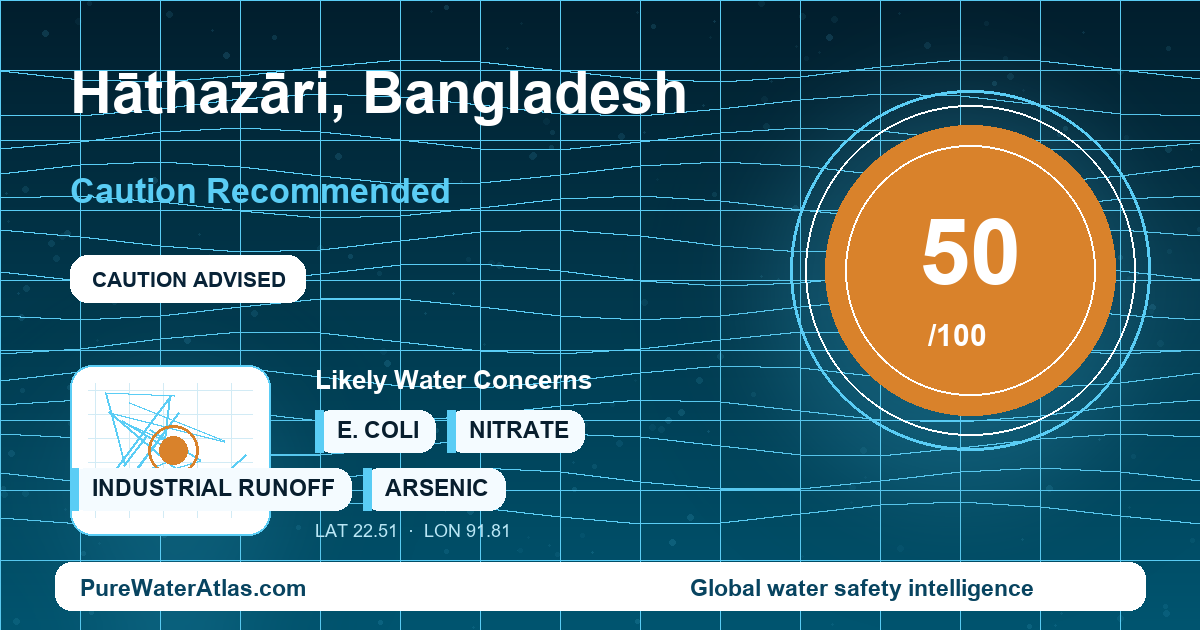
Hāthazāri, Bangladesh: Caution recommended for untreated tap, tubewell, and stored water because local supplies can vary by well, pipe network, storage tank, and season.
Quick Answer
| Water safety score | 50 / 100 |
|---|---|
| Risk level | Caution Recommended |
| Can visitors drink the tap water? | No, not as a default. Visitors should use sealed bottled water, properly boiled water, or water treated by a reliable purifier. |
| Resident guidance | Residents should decide based on the exact source serving the home: tested deep tubewell, local piped supply, private pump, or stored water. |
| Main water identity | Mixed sources: household, institutional, community, and municipal tubewells; localized piped or stored supplies; and regional surface-water infrastructure linked to the Halda River near Madunaghat. |
| Responsible authorities | Local government arrangements, Hāthazāri Pourashava or Union Parishad-level services where present, the Department of Public Health Engineering, and Chattogram WASA for regional surface-water production assets. |
| Filter recommendation | Use treatment matched to testing. Boiling, chlorination, UV, or ultrafiltration can address microbial risk when applied correctly; arsenic requires a proven arsenic-removal system or reverse osmosis verified by follow-up testing. |
Editorial verdict: Caution recommended. Hāthazāri should not be treated like a fully documented, continuously monitored urban tap-water system. Publicly available evidence indicates a mixed drinking-water reality, and no comprehensive public, city-level tap-water compliance dataset for Hāthazāri was found. That limitation matters: a safe result at one tubewell, campus, building, or pipe network should not be assumed for another.
Why Hāthazāri Is Different
Hāthazāri is an upazila and urbanizing settlement area north of Chattogram city in southeastern Bangladesh. Its drinking-water situation is shaped by both groundwater use and the Halda River. The Halda is a defining local water feature and an important part of the wider Chattogram water-supply landscape, but the presence of major regional water infrastructure near Hāthazāri does not mean every household receives the same treated utility water.
This is the key point for Hāthazāri: water safety is source-specific. A visitor staying near the town center, a madrasa or university campus area, a rural union, or a roadside guesthouse may encounter different water sources within the same upazila. One property may use a deep tubewell, another may use a private pump, another may depend on a local piped supply, and another may store delivered or pumped water in rooftop tanks. Asking “Is Hāthazāri tap water safe?” is less useful than asking “What is the exact water source for this building, and has it been tested recently?”
Hāthazāri also sits in a region where river-water and groundwater risks differ. Tubewells need chemical testing, especially for arsenic and naturally occurring minerals. River-derived, piped, or stored water needs close attention to turbidity, microbial control, chlorination, distribution integrity, and tank hygiene. These are not interchangeable risks, and no single treatment method solves all of them.
Where Does Hāthazāri’s Tap Water Come From?
Hāthazāri appears to rely on a mixed raw-water system rather than one clearly documented universal municipal tap supply. Common drinking-water sources include groundwater from private, household, community, school, mosque, institutional, and municipal tubewells. Localized piped supplies and stored water are also used where available. Household storage tanks, building reservoirs, pumps, and internal plumbing can become part of the water system even when the original source is acceptable.
The Halda River is also central to the regional water picture. Chattogram-area water-supply infrastructure includes important intake and treatment assets at or near Madunaghat in the Hāthazāri area. The wider system also includes Chattogram-area treatment assets such as Mohara and other river-based infrastructure. However, the existence of these facilities should not be interpreted as proof that every Hāthazāri household has a fully treated, continuously pressurized, utility-managed connection.
Historically, like many parts of Bangladesh, Hāthazāri and surrounding settlements used ponds, dug wells, rainwater, and later shallow and deep tubewells. Bangladesh’s national shift toward tubewells reduced many surface-water microbial risks, but it also created the need for well-by-well chemical testing. Hāthazāri is in eastern Bangladesh and is not among the highest-profile arsenic belt areas compared with many central and western districts, but groundwater quality can vary sharply between wells. A tubewell should be trusted only when the exact well has a recent relevant test result.
Who Manages Drinking Water in Hāthazāri?
Responsibility for drinking water in Hāthazāri is split across local and national-sector institutions. Hāthazāri Pourashava and Union Parishad-level arrangements may manage local supply points or municipal services where present. The Department of Public Health Engineering supports rural and small-town water supply, tubewell programs, arsenic mitigation, and water-quality work. Chattogram Water Supply and Sewerage Authority is the key regional utility for surface-water production assets in the Chattogram area, including infrastructure linked to the Halda River and Madunaghat corridor.
For a household or institution, the practical question is whether the address is actually connected to a managed system, uses its own groundwater source, or relies on stored water. Chattogram WASA’s regional role is important, but its service boundary and household connection coverage should be verified for the exact address. Bangladesh drinking-water oversight involves the Local Government Division, DPHE, local government institutions, and national environmental and public-health standards. In practice, standards are only useful if the specific well, tap, storage tank, and plumbing have been tested and maintained.
Main Local Water Concerns
- Microbial contamination: This is the most immediate short-term risk, especially for travelers. Shallow groundwater, intermittent pipes, low-pressure distribution, unclean storage tanks, and cross-connections with drains or septic systems can introduce E. coli and other pathogens.
- Arsenic in groundwater: Bangladesh has a nationally recognized groundwater arsenic problem. Hāthazāri is not described in the dataset as a leading hotspot, but no tubewell should be assumed safe without a recent test for that exact source. Learn more in the PureWaterAtlas guide to arsenic.
- Turbidity and sediment: Monsoon runoff can raise river turbidity, and local pipes, pumps, and storage tanks can introduce sediment. Turbidity can reduce the effectiveness of UV and chlorine unless water is prefiltered.
- Iron and manganese: Groundwater in parts of Bangladesh commonly contains iron and sometimes manganese. These can cause staining, taste, odor, and consumer rejection; high manganese can be a concern for infants and long-term exposure.
- Storage-tank contamination: Water that is safe at a tubewell or utility source can become unsafe in rooftop tanks, building reservoirs, or household containers if covers, screens, cleaning, and disinfection are poor.
- Lead and plumbing metals: There is no public evidence in the dataset that lead is a citywide Hāthazāri source-water problem. However, older metal plumbing, brass fixtures, pumps, solder, and stagnant building pipes can create building-specific exposure risks.
- Agricultural and sanitation pressure: Surrounding agricultural and peri-urban land uses mean fertilizer, livestock waste, latrines, and septic leakage can affect shallow groundwater and surface water, particularly after heavy rain. Nitrate should be considered where shallow wells, agriculture, septic systems, or infant consumption are involved.
- Seasonal stress: During the monsoon, generally June to October, runoff, flooding, latrine overflow, drain contamination, and high river turbidity can increase risk. After flooding, wells and tanks should be disinfected and tested. In the dry season, lower river flows can concentrate pollutants and some households may store water longer.
For Travelers
Visitors should avoid drinking untreated tap water, tubewell water, or stored water in Hāthazāri unless the accommodation can show reliable treatment and recent water-quality testing. The safest default is sealed bottled water from a reputable source, properly boiled water, or water treated by a trustworthy purifier. This conservative approach is especially important during the monsoon, after flooding, after pipe repairs, during pump failures, or where water is stored in rooftop or household tanks.
Use bottled, boiled, or purified water for brushing teeth, particularly for short-stay visitors, children, pregnant travelers, older adults, and anyone with a sensitive stomach or weakened immune system. Avoid ice unless you are confident it was made from treated water. In small shops, roadside restaurants, and informal settings, assume ice may have been made from untreated tap or tubewell water.
Better hotels, universities, hospitals, and larger restaurants may use filtration, UV, boiling, or bottled-water systems, but travelers should ask rather than assume. Hot tea and coffee are generally lower risk if freshly boiled. Cold drinks with ice, refilled bottles, and uncooked foods washed in local water carry higher risk. If carrying a travel filter, choose one rated for bacteria and protozoa, and add boiling, chlorine dioxide, or UV where microbial safety is uncertain. If the source is a tubewell with unknown arsenic status, boiling and basic carbon filters do not solve the chemical risk.
For Residents
Residents should begin with source identification. Is the household using a tested deep tubewell, a shallow well, a local piped supply, a private pump, a CWASA-linked source, or stored water? The right safety decision depends on that answer. A home filter or treatment system is advisable in many situations, but the correct system depends on confirmed contaminants. Do not choose a purifier based only on taste, because water can taste acceptable while still containing microbial or chemical risks.
For microbial risk, use boiling, chlorination, UV, or ultrafiltration after sediment removal. For arsenic, use a tested arsenic-removal unit, reverse osmosis, or another proven technology verified by follow-up testing. For iron, manganese, taste, or sediment, use source-specific filtration and maintain it carefully. Turbid water should be clarified or prefiltered before UV or chlorine treatment, because sediment can interfere with disinfection.
Testing priorities in Hāthazāri should include arsenic for every private or community tubewell before long-term drinking use, with periodic retesting or testing after installing a new well. Test for E. coli or thermotolerant coliforms if water comes from a shallow well, is stored in tanks, is supplied intermittently, or is used after flooding. Where taste, staining, agricultural influence, or infant consumption is a concern, check iron, manganese, electrical conductivity, salinity indicators, pH, turbidity, nitrate, and hardness.
For piped or building-supplied water, test at the point of use after the storage tank, not only at the source. Older buildings may have corroded galvanized pipes, brass fittings, solder, old pumps, or long stagnant pipe runs. These can affect taste, turbidity, iron, and sometimes lead or other metals. Flushing stagnant water can help reduce some building-related issues, but it is not a substitute for testing when infants, pregnant residents, or long-term exposure are involved.
Rooftop and ground-level storage tanks are a major control point in Hāthazāri-style household systems. Tanks should be covered, screened against insects and animals, cleaned on a schedule, disinfected after cleaning or flooding, and protected from backflow. A safe tubewell or treated source can become unsafe in a dirty tank.
Relevant Contaminants and Water-Quality Issues
The most relevant Hāthazāri drinking-water issues are not one single contaminant but a combination of microbial, groundwater, seasonal, and building-level risks. Start with E. coli for short-term illness risk, especially where tanks, intermittent pipes, flooding, drains, or septic systems may affect water. For tubewells, review arsenic and the PureWaterAtlas articles Arsenic in Drinking Water: Testing and Detection Methods and Arsenic in Drinking Water: Best Filters, Systems and Solutions.
For river-derived or stored water, turbidity matters because cloudy or sediment-rich water can undermine disinfection. Households with staining, metallic taste, or sediment should review iron and manganese. Where shallow wells are near agriculture, livestock, latrines, or septic systems, nitrate deserves attention. In older buildings, lead is a building-specific plumbing concern rather than a confirmed citywide source-water issue.
How to Verify Your Water Quality
The most reliable way to judge Hāthazāri water is to test the exact source and the point of use. Use a recognized laboratory, DPHE-supported testing channel, public-health office, university laboratory, or accredited private lab where available, and keep written results by source and date. For a tubewell, the well itself must be tested. For a piped or building system, test after the storage tank and at the tap used for drinking.
PureWaterAtlas resources can help interpret results and choose treatment. Start with Water Testing for sampling and lab interpretation, Drinking Water Safety for deciding whether tap water can be trusted, Water Microbiology for E. coli and pathogen risk, and Water Purification for matching treatment to contaminants. For specific results, use the Contaminants Search Engine. Travelers comparing destinations can also use the Global Water Quality Checker.
For practical treatment methods, see Boiling Water Purification: Complete Guide and UV Water Purification: Complete Guide. For plumbing-related metal concerns, see Lead in Drinking Water: Testing and Detection Methods. For shallow wells near agricultural or sanitation pressure, see Nitrate Contamination in Drinking Water: Testing and Detection Methods.
Official and Technical Sources
- Hāthazāri Upazila official portal — Bangladesh National Portal source for local administrative and geographic context.
- Chattogram Water Supply and Sewerage Authority — official regional utility source for Chattogram-area water-production infrastructure and the wider Halda River and Madunaghat supply context.
- Department of Public Health Engineering — Government of Bangladesh technical agency relevant to rural and small-town water supply, tubewells, arsenic mitigation, and water-quality support.
- WHO/UNICEF Joint Monitoring Programme Bangladesh WASH profile — national drinking-water, sanitation, and hygiene access evidence for Bangladesh.
- UNICEF Bangladesh: Water, sanitation and hygiene — public-health background on Bangladesh WASH challenges.
- CDC Bangladesh traveler health guidance — traveler health advice supporting conservative food, water, and ice precautions.
- British Geological Survey and DPHE reports on arsenic contamination of groundwater in Bangladesh — technical hydrogeology report archive relevant to Bangladesh tubewell arsenic assessment.
Bottom Line
Hāthazāri’s water safety cannot be answered with one citywide yes or no. The area uses mixed sources, including tubewells, local piped or stored supplies, and regional surface-water infrastructure linked to the Halda River near Madunaghat. Because no comprehensive public tap-water compliance dataset for Hāthazāri was found, untreated tap, tubewell, or stored water should not be treated as reliably safe by default. Visitors should use sealed bottled, boiled, or properly purified water and avoid uncertain ice. Residents should identify the exact source, test tubewells for arsenic, test taps and tanks for microbial contamination, and choose treatment based on results. Boiling helps with microbes but does not remove arsenic, nitrate, salinity, iron, manganese, or lead.
Read the full guide: Global Water Quality Guide
Explore more in this category: Global Water Quality Articles