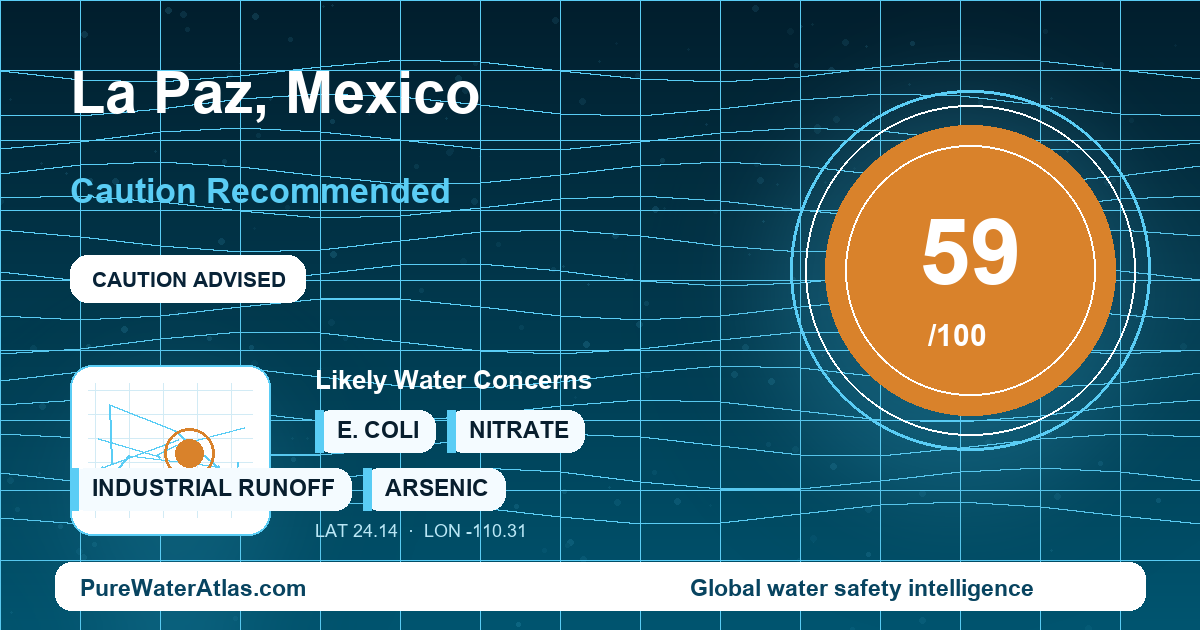
La Paz relies mainly on chlorinated groundwater from a stressed coastal aquifer, so drinking-water safety depends not only on municipal treatment but also on salinity pressure, intermittent service, distribution conditions, and household storage.
Quick Answer
| Overall status | Caution recommended. La Paz has a PureWaterAtlas water safety score of 59/100. The concern is not a single confirmed citywide contamination event, but a variable municipal supply in a water-stressed coastal desert basin. |
|---|---|
| Can visitors drink the tap water? | Not recommended as the default choice. Short-term visitors should use sealed bottled water, reputable purified water, or hotel-provided garrafon water for drinking. |
| Resident advice | Treat La Paz tap water as variable at the kitchen tap. A maintained point-of-use system and periodic lab testing are prudent, especially where taste, salinity, storage tanks, or old plumbing are concerns. |
| Main water source | Primarily groundwater from wells tapping the La Paz aquifer system and connected well fields in an arid coastal basin. |
| Water authority | OOMSAPAS La Paz operates local drinking-water and sewer services. CONAGUA oversees national water resources, and Mexican drinking-water standards are set through the federal health framework. |
| Filter recommendation | For routine drinking water, consider sediment filtration plus activated carbon, with reverse osmosis where salinity, high dissolved solids, nitrate, arsenic, or taste are concerns. UV can help after storage tanks if installed and maintained correctly. |
Why La Paz Is Different
La Paz is not a typical large inland city supplied by abundant rivers or reservoirs. It sits on the Bay of La Paz in Baja California Sur, one of Mexico’s driest regions, where rainfall is limited and there is no major permanent surface-water source serving the city in the way that reservoirs or large rivers supply many other urban areas. The city’s drinking-water identity is therefore tied closely to groundwater.
The local risk profile is shaped by a coastal aquifer under pressure. Official aquifer-availability information and regional hydrology literature identify the La Paz aquifer as a stressed coastal groundwater system. When withdrawals exceed sustainable recharge, coastal aquifers can experience seawater-intrusion pressure and rising salinity. In practical terms, this can show up as salty taste, high total dissolved solids, scaling, or water that residents do not want to drink even if it has been disinfected.
Another reason La Paz is different is the role of storage and intermittent delivery. Even when water is chlorinated by the utility, quality at the tap may be affected by low pressure, pipe repairs, aging mains, sectorized delivery, household cisterns, rooftop tinacos, and the condition of building plumbing. For that reason, PureWaterAtlas does not treat La Paz tap water as uniformly safe or uniformly unsafe at every address. The better conclusion is that caution is warranted and point-of-use conditions matter.
Where Does La Paz’s Tap Water Come From?
La Paz municipal water is based primarily on groundwater. Production wells extract water from the La Paz basin and connected well fields. Municipal planning and regional discussions also refer to nearby aquifer fields such as El Carrizal, but the essential point for consumers is that La Paz depends on groundwater in a coastal arid basin rather than a large, resilient surface-water system.
The main infrastructure includes municipal wells, chlorination before or within the distribution system, storage tanks and distribution reservoirs, and a network that may deliver water intermittently in some service areas during scarcity periods. This intermittent scheduling is commonly managed through tandeo or sectorized delivery. In homes, apartments, rentals, schools, and small businesses, cisterns and rooftop tanks can become part of the effective drinking-water system, even though they are not part of the utility’s direct control.
That last step is important. Water that leaves a municipal facility with chlorine residual can change before it reaches a glass. Long residence time in storage, low turnover, open or damaged tank lids, sediment accumulation, insects, animals, stagnant plumbing, or pressure changes after outages can all affect tap-water quality. For a general overview of how drinking-water safety is evaluated, see the PureWaterAtlas guide to Drinking Water Safety.
Who Manages Drinking Water in La Paz?
The local water and sewer operator is OOMSAPAS La Paz, the Organismo Operador Municipal del Sistema de Agua Potable, Alcantarillado y Saneamiento de La Paz. OOMSAPAS is responsible for municipal drinking-water operations, service notices, billing, local infrastructure, and related water-service management.
At the federal level, CONAGUA manages national water resources, water rights, aquifer availability, and hydrologic information. The official CONAGUA aquifer availability document for Acuifero La Paz 0324 is especially relevant because it supports the identification of La Paz as a groundwater-dependent coastal aquifer system and provides context for availability and over-extraction concerns.
Drinking water for human use and consumption in Mexico is regulated under NOM-127-SSA1-2021, the federal standard covering microbiological, chemical, physical, and disinfectant-related criteria. COFEPRIS is the federal health regulator involved in sanitary control and health-protection regulation relevant to drinking water. This profile does not claim current La Paz-wide compliance with every NOM-127 parameter because recent, comprehensive, public, neighborhood-level finished-water data were not found in a single transparent source.
Main Local Water Concerns
The most important La Paz concern is the combination of groundwater dependence and aquifer stress. Over-extraction in a coastal desert basin can increase salinity and seawater-intrusion pressure. For residents, this may be experienced as salty taste, high total dissolved solids, hardness, scaling, or water that requires reverse osmosis to become acceptable for drinking.
Intermittent water service is another city-specific issue. During low-pressure periods, pipe repairs, or service interruptions, distribution systems can be more vulnerable to sediment disturbance, intrusion through damaged pipes, and loss of chlorine residual. After service returns, water may appear cloudy, rusty, or turbid for a time. Learn more about these issues in the PureWaterAtlas profiles for Turbidity and Sediment.
Microbial risk is not best understood as a constant citywide condition; it is often event-specific or building-specific. Pipe breaks, pressure loss, storm impacts, poorly maintained cisterns, or dirty rooftop tanks can create microbial hazards at the tap. The most relevant indicator organisms for household testing include total coliform and E. coli. If contamination is suspected, boiling can be useful for microbial risk, but it does not remove dissolved salts, nitrate, arsenic, fluoride, or metals. See the PureWaterAtlas Boiling Water Purification guide for what boiling can and cannot do.
Groundwater chemistry in arid Mexico can vary, so residents should consider a full lab panel when evaluating a specific home. This profile does not assert a current citywide exceedance for nitrate, arsenic, fluoride, lead, or other parameters without fresh local test data. However, Nitrate, Arsenic, and Lead are sensible items to include in a point-of-use test, especially where plumbing history is unknown or the water is used by infants, pregnant people, elderly people, or immunocompromised residents.
Season also matters. Late-summer and early-autumn tropical storms or hurricanes can create short-term turbidity, flooding, sewage, and distribution-contamination risks. Hot dry months can increase demand and worsen low-pressure or intermittent-service conditions. Long drought periods reduce recharge and increase stress on wells.
For Travelers
For most short-term visitors, La Paz tap water is not the lowest-risk drinking choice. Use sealed bottled water, verified purified water, or hotel-provided garrafon water. This is especially important for travelers with sensitive stomachs, children, pregnant travelers, and immunocompromised people. Tap water is generally more appropriate for handwashing, showering, cleaning, and flushing than for routine drinking during a short stay.
For brushing teeth, many healthy travelers can use tap water if they avoid swallowing it. More conservative travelers should use bottled or purified water. In rentals and small hotels, check whether the kitchen dispenser or garrafon is the intended drinking-water source; many La Paz properties are connected to the municipal system but still provide separate purified drinking water.
Use ice only where it is clearly made from purified water, such as reputable hotels, established restaurants, and commercial ice suppliers. If you are minimizing stomach-illness risk, avoid unknown ice from informal sources. Established hotels and restaurants in tourist areas are accustomed to using purified water and commercial ice, but it is still reasonable to ask whether drinking water and ice are purified, especially in budget lodging, beach stands, small rentals, or areas outside the central service area.
Carry bottled or purified water during hot weather. Do not refill bottles from bathroom taps unless you treat the water. Be extra cautious after storms, flooding, pipe breaks, or municipal repair notices. The CDC Travelers Health guidance for Mexico supports conservative food and water precautions for visitors.
For Residents
Residents should treat La Paz tap water as a variable municipal supply rather than assume it is reliably potable at every kitchen tap. A practical home setup often starts with a sediment prefilter, followed by activated carbon for chlorine, taste, and organic compounds. Where salinity, high total dissolved solids, nitrate, arsenic, or taste are concerns, reverse osmosis is commonly the more appropriate point-of-use treatment. UV can be useful after storage tanks or cisterns, but only after sediment filtration and only if maintained correctly. For more detail, see Water Purification Methods and the PureWaterAtlas UV Water Purification guide.
Testing should be done at the point of use, not only at the street connection. A useful resident panel includes total coliform and E. coli, free residual chlorine, turbidity, pH, conductivity, total dissolved solids, hardness, chloride, sodium, nitrate, arsenic, fluoride, iron, manganese, and lead where the building is older or plumbing history is unknown. Test after moving in, after major plumbing work, after cistern cleaning, after repeated pressure outages, or if water becomes salty, cloudy, rusty, sulfur-like, or unusual in taste or odor.
If using reverse osmosis, periodically test treated water for TDS reduction and replace cartridges and membranes on schedule. If infants, pregnant people, elderly people, or immunocompromised residents drink the water, use a certified lab rather than relying on taste, appearance, or low-cost strips.
Older buildings, rentals, schools, and small businesses may have plumbing materials, fixtures, solder, valves, or storage components that are not reflected in utility-level water quality. Let stagnant water flush before use and test for lead and metals if plumbing history is uncertain. Cisterns and rooftop tinacos should be sealed, screened against insects and animals, cleaned and disinfected on a schedule, and inspected after storms, repairs, or long vacancies.
Relevant Contaminants and Water-Quality Issues
The most relevant La Paz water-quality topics are tied to groundwater chemistry, disinfection, distribution conditions, and household storage. Chlorine matters because municipal water is disinfected, but chlorine residual can decline in storage tanks or long building plumbing. Turbidity and Sediment matter after pressure changes, repairs, or service interruptions.
E. coli is a key microbial indicator for point-of-use safety, especially after cistern contamination, flooding, or pressure loss. Nitrate, Arsenic, and fluoride should be considered in a full groundwater panel because arid-region groundwater chemistry can be variable, although this page does not assert a current citywide exceedance. Lead is mainly a building-specific concern related to older plumbing, fixtures, solder, tanks, or stagnant water, not a citywide claim.
How to Verify Your Water Quality
The safest way to evaluate a La Paz address is to test the water actually used for drinking. Sample from the kitchen tap after the building’s cistern, rooftop tank, filter, and plumbing, because these components can change water quality after the water leaves the municipal system. For a complete testing framework, use the PureWaterAtlas Water Testing guide.
Residents concerned about groundwater-related parameters can review the PureWaterAtlas guides to Nitrate Testing and Detection, Arsenic Testing and Detection, and Lead Testing and Detection. To research other parameters, use the Contaminants Search Engine. Travelers and residents comparing locations can also use the Global Water Quality Checker.
Data limitations are important in La Paz. High-authority sources support the city’s groundwater dependence, arid coastal setting, aquifer stress, and salinity pressure. However, recent, comprehensive, neighborhood-level finished-water results are not consistently available in public sources, and water quality can vary between the utility main, building storage, and the kitchen tap.
Official and Technical Sources
- OOMSAPAS La Paz — municipal operator for drinking-water, sewer, service notices, billing, and local infrastructure.
- CONAGUA — federal authority for water resources, aquifer management, concessions, and hydrologic availability.
- CONAGUA aquifer availability document for Acuifero La Paz 0324 — official source-water context for the La Paz groundwater system.
- Diario Oficial de la Federacion, NOM-127-SSA1-2021 — Mexican federal drinking-water standard for water for human use and consumption.
- COFEPRIS — federal health regulator involved in sanitary control and health-protection regulation.
- CDC Travelers Health, Mexico — traveler health guidance supporting conservative food and water precautions.
- World Health Organization Guidelines for Drinking-water Quality — international reference for microbial risk, water safety planning, and chemical drinking-water parameters.
Bottom Line
La Paz tap water deserves caution because the city depends mainly on chlorinated groundwater from a stressed coastal desert aquifer, with salinity and seawater-intrusion pressure, intermittent service, and household storage all affecting real tap quality. Visitors should use sealed bottled water, verified purified water, or hotel garrafon water for drinking, and should confirm purified ice in smaller or informal settings. Residents should not judge safety by appearance or taste alone. A maintained point-of-use system, often sediment plus carbon and reverse osmosis where dissolved solids or salinity are concerns, is prudent. Because public neighborhood-level finished-water data are limited and building tanks can change quality, point-of-use lab testing is the best way to verify safety at a specific La Paz address.
Read the full guide: Global Water Quality Guide
Explore more in this category: Global Water Quality Articles