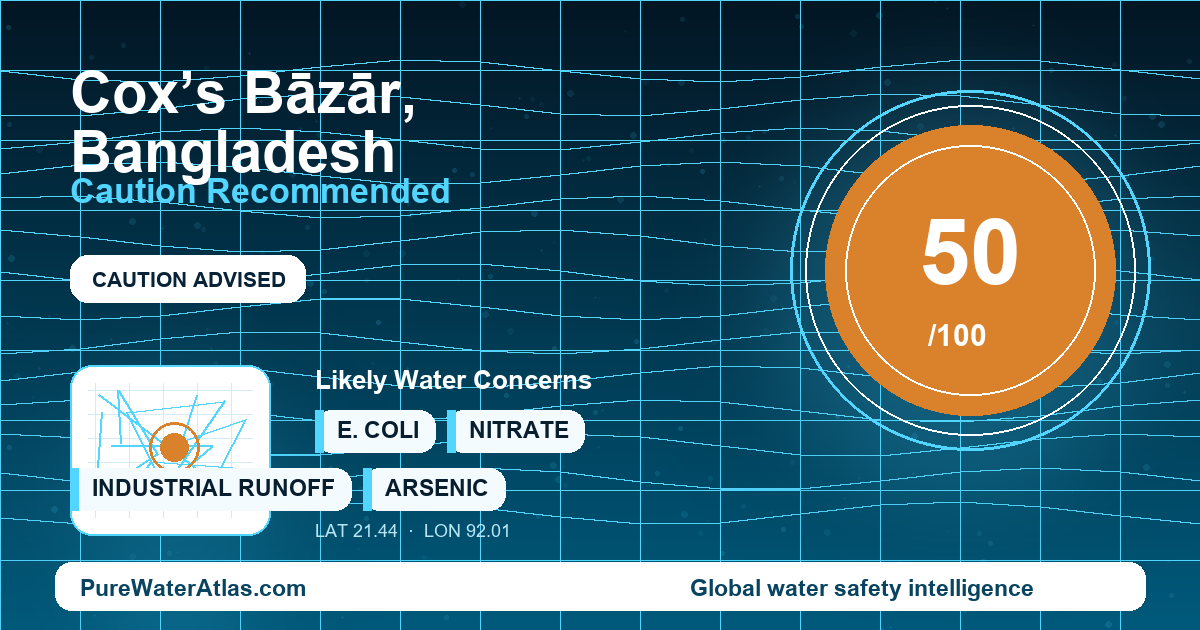
Caution recommended for Cox’s Bāzār, Bangladesh: a coastal groundwater-based town system where tap safety depends heavily on treatment, storage tanks, building plumbing, season, and verified testing.
Quick Answer
| Water safety score | 50 / 100 |
|---|---|
| Risk level | Caution Recommended |
| Can tourists drink untreated tap water? | No. Visitors should use sealed bottled water, properly boiled water, or water from a verified purifier. Avoid untreated tap water as a default practice. |
| Resident advice | Do not rely on taste or appearance. Test municipal, private-well, and stored water for microbial indicators and locally relevant groundwater parameters. |
| Main water source | Primarily coastal groundwater from municipal production tube wells or deep wells, with many premises also using private boreholes, storage tanks, jar water, bottled water, or building-level treatment. |
| Local authority | Cox’s Bāzār Paurashava, also known as Cox’s Bāzār Municipality, with national technical relevance from Bangladesh’s Department of Public Health Engineering. |
| Filter recommendation | Use treatment matched to the risk: boiling, UV, chlorination, ceramic filtration, or ultrafiltration for microbes; reverse osmosis or another rated system for salinity, arsenic, nitrate, or dissolved ions. |
Cox’s Bāzār is not a city where visitors should casually drink untreated tap water. Treated municipal water may be suitable for washing and general use, but drinking safety at the tap depends on the water source, continuity of supply, cleanliness of rooftop or ground storage tanks, hotel treatment systems, and the condition of building plumbing. Publicly accessible tap-level compliance data for Cox’s Bāzār Paurashava are limited, so this profile uses a precautionary approach.
Why Cox’s Bāzār Is Different
Cox’s Bāzār is a low-lying coastal city on the Bay of Bengal near the Bakkhali River and Maheshkhali Channel. That location matters for drinking water. Unlike an inland city with a large, continuously monitored surface-water treatment plant, Cox’s Bāzār is best understood as a coastal-town groundwater system. Its aquifers and infrastructure face coastal stress, dry-season salinity pressure, monsoon flooding, cyclones, storm surge, and rapid demand changes from tourism.
The city is also Bangladesh’s main beach tourism hub. Seasonal visitor peaks can increase demand on hotels, restaurants, private wells, tank cleaning schedules, and bottled or jar-water supply chains. A hotel may advertise “filtered water,” but the practical safety question is more specific: does it use municipal water, a private borehole, tanker or jar water, reverse osmosis, UV, chlorination, or a combination, and are the storage tanks and filters maintained?
Another local factor is the last-mile system. Many buildings use rooftop tanks, ground tanks, private pumps, boreholes, and point-of-use treatment. Even when source water has been treated, water can become unsafe after storage if tanks are uncovered, dirty, flooded, connected to unsafe plumbing, or not disinfected regularly. This makes Cox’s Bāzār a place where “tap water safety” can vary from one building to another.
Where Does Cox’s Bāzār’s Tap Water Come From?
Cox’s Bāzār’s urban drinking-water supply is associated with Cox’s Bāzār Paurashava and relevant national or local-government water agencies. The main raw-water identity is groundwater: municipal production tube wells or deep wells draw from local aquifers, then water is pumped through storage and distribution infrastructure serving parts of the town.
Important infrastructure includes municipal production tube wells or deep groundwater wells, pumping stations, storage reservoirs or overhead tanks, and distribution mains. Donor-supported coastal-town infrastructure programs have also been relevant to Cox’s Bāzār, including Asian Development Bank-supported investments in coastal-town water supply, sanitation, drainage, and environmental infrastructure. The inclusion of Cox’s Bāzār in the ADB Emergency Assistance Project and its additional financing is an important signal that the city has faced legacy infrastructure gaps and climate-resilience needs rather than having a fully mature metropolitan water system.
Public-network coverage and continuity can vary, so many premises also rely on private boreholes, building-level pumps, jar water, bottled water, boiling, UV units, filtration, chlorination, or reverse osmosis. For drinking purposes, the point of use is often more important than the pipe entering the property. A clean source can become contaminated in an underground tank, rooftop tank, filter housing, stagnant plumbing line, or poorly maintained hotel treatment system.
Who Manages Drinking Water in Cox’s Bāzār?
The local service provider for municipal water-supply functions within the town is Cox’s Bāzār Paurashava, also known as Cox’s Bāzār Municipality. Bangladesh’s Department of Public Health Engineering, under the national local-government framework, is the key public-health engineering agency for water supply and sanitation outside the major WASA cities. The Local Government Division provides the broader institutional context for municipal water supply, sanitation, and local-government service delivery.
Cox’s Bāzār is not served by a separate large-city WASA like Dhaka or Chattogram WASA. That means municipal and national-agency roles are central. Bangladesh drinking-water quality is governed through national standards and public-health oversight involving agencies such as the Local Government Division, DPHE, health authorities, and the Department of Environment for environmental regulatory context.
A practical limitation for households and travelers is transparency: recent, publicly accessible, tap-level compliance reporting for Cox’s Bāzār Paurashava is limited. For this reason, users should verify water quality at the building, well, hotel, or storage-tank level rather than assuming that citywide status applies to their specific tap.
Main Local Water Concerns
- Microbial contamination: The most immediate health concern is unsafe stored water, intermittent distribution, leaking pipes, shallow wells, or post-flood contamination. E. coli or thermotolerant coliforms are key indicators for this risk.
- Salinity and high dissolved solids: Cox’s Bāzār’s coastal groundwater setting creates risk from salinity, chloride, and high total dissolved solids, especially in dry periods or where groundwater is over-pumped.
- Monsoon turbidity and sediment: Turbidity and visible particles can occur after pipe repairs, low-pressure events, monsoon runoff, flooding, or disturbed tanks.
- Iron and manganese: These are plausible Bangladesh groundwater issues. They may cause staining, metallic taste, blackish deposits, filter clogging, or aesthetic complaints and should be tested rather than assumed absent.
- Arsenic: Arsenic is a national groundwater concern in Bangladesh. Cox’s Bāzār is not identified here as one of the most widely cited worst-affected districts, but any private or new tube well should still be tested because arsenic cannot be detected by taste, smell, or boiling.
- Nitrate and sanitation proximity: Wells near septic tanks, pit latrines, drains, livestock, poorly managed wastewater, or agricultural areas can be vulnerable to nitrate and fecal contamination.
- Building plumbing metals: There is no strong public evidence of a citywide lead service-line problem in Cox’s Bāzār, but older fixtures, brass components, solder, pumps, and stagnant plumbing can contribute metals until tested.
Season is important. Monsoon conditions can increase turbidity, flooding, drain overflow, and microbial risk. Cyclones and storm surges can damage infrastructure and contaminate wells, tanks, and distribution networks. Dry season can worsen coastal-aquifer salinity and high-TDS problems.
For Travelers
Travelers should not drink untreated tap water in Cox’s Bāzār as a default practice. Use sealed bottled water, water brought to a rolling boil, or water from a reliable purifier. Check that bottle caps are intact and avoid refilled bottles. Use bottled or safely treated water for oral medications.
For brushing teeth, use bottled, boiled, or reliably filtered water unless you have confirmed that your accommodation has a maintained treatment system and clean storage tanks. This is especially sensible during monsoon season, after flooding, or if tap water looks cloudy, has sediment, or comes from an unknown building storage tank.
Avoid ice from street vendors or small restaurants unless you know it was made from purified water. In hotels, ask whether ice is made from reverse-osmosis or otherwise treated water. Higher-end hotels may use filtration, UV, chlorination, or reverse osmosis, but travelers should not assume this. Ask specifically what source and treatment system the hotel uses.
Freshly boiled tea or coffee is generally a safer choice than untreated cold drinks when the boiling is real and recent. For longer stays, a travel filter with microbial protection can reduce biological risk, but it will not solve salinity, arsenic, nitrate, or high dissolved solids unless the device is specifically rated for those contaminants. In high-salinity situations, bottled or properly maintained RO-treated water is usually more appropriate.
For Residents
Residents should build a home water plan around testing, storage hygiene, and treatment matched to contaminants. Boiling, verified UV, chlorination, ceramic filtration, and ultrafiltration can help with microbial risk when used correctly. However, these methods do not remove salinity, arsenic, nitrate, or many dissolved chemicals. If testing shows high salinity, chloride, arsenic, nitrate, or metals, use a treatment system rated for that contaminant, commonly reverse osmosis for dissolved ions, and maintain it carefully.
Private tube wells and stored household water should be tested for E. coli or thermotolerant coliforms, especially before and after monsoon season or after flooding. Electrical conductivity, total dissolved solids, chloride, and salinity should be checked during the dry season because coastal groundwater can change seasonally. Arsenic testing is recommended for any private tube well, newly installed borehole, or well that has never had a reliable laboratory result.
Test iron and manganese if water stains fixtures, tastes metallic, appears reddish or blackish, or clogs filters. Test nitrate if the water source is near septic tanks, pit latrines, drains, livestock, or agricultural areas. Basic pH and turbidity testing can help identify treatment performance problems or disturbance in pipes and tanks. Consider lead testing for older buildings, long-unused plumbing, brass fixtures, or premises serving infants, pregnant people, or young children.
Storage tanks deserve special attention in Cox’s Bāzār. Rooftop and underground tanks should be covered, screened against insects and debris, cleaned and disinfected on a schedule, inspected after cyclones or flooding, and protected from cross-connections with drains, roof runoff, or unsafe private-well water. A safe source can become unsafe in a dirty tank.
Relevant Contaminants and Water-Quality Issues
The highest-priority health concern for visitors and many households is E. coli in drinking water, because it indicates fecal contamination and is directly relevant to stored water, monsoon events, unsafe wells, and gastrointestinal illness. Turbidity and sediment are also important in Cox’s Bāzār because cloudy water, particles, pipe disturbance, and tank deposits can reduce disinfection effectiveness and signal system problems.
For groundwater users, arsenic should not be ignored simply because Cox’s Bāzār is not singled out here as a worst-affected district. Bangladesh groundwater is a known arsenic context, and private tube wells should be verified. Nitrate is relevant where wells are near sanitation sources, drains, pit latrines, livestock, or agricultural inputs.
Aesthetic and operational issues such as iron and manganese can affect groundwater taste, staining, and filter performance. Chlorine is relevant because disinfectant residual, taste, and storage-tank safety are central to microbial control in an intermittent or stored-water environment.
How to Verify Your Water Quality
For a Cox’s Bāzār household, hotel, restaurant, school, or guesthouse, the most useful question is not only “is the city supply safe?” but “is this tap safe today after the well, municipal line, pump, tank, filter, and plumbing?” Use DPHE, municipal, university, NGO, or accredited laboratory services where available rather than relying only on low-accuracy visual kits.
For a practical testing framework, see PureWaterAtlas guides on water testing, drinking water safety, water microbiology, and water purification methods. Travelers comparing destinations can use the Global Water Quality Checker, while residents investigating specific substances can use the Contaminants Search Engine.
For treatment decisions, match the device to the contaminant. Boiling is useful for microbial risk; see the boiling water purification guide. UV can help with microbes when water is clear enough; see the UV water purification guide. For invisible chemical risks, use specific testing resources such as arsenic testing methods, nitrate testing methods, and lead testing methods.
Official and Technical Sources
- Cox’s Bazar Municipality official portal — local municipal authority context for Cox’s Bāzār Paurashava.
- Department of Public Health Engineering, Government of Bangladesh — national public-health engineering agency for water supply and sanitation outside major WASA cities.
- Local Government Division, Government of Bangladesh — national local-government context for municipal water supply and sanitation service delivery.
- Asian Development Bank: Emergency Assistance Project — coastal-town infrastructure project including Cox’s Bāzār.
- Asian Development Bank: Emergency Assistance Project — Additional Financing — continuation of coastal-town infrastructure investment.
- CDC Travelers’ Health: Bangladesh — traveler food and water precaution context for Bangladesh.
- WHO Guidelines for Drinking-water Quality — global framework for microbial safety, chemical contaminants, disinfection, and risk-based drinking-water management.
- British Geological Survey and DPHE: Arsenic contamination of groundwater in Bangladesh — authoritative Bangladesh groundwater arsenic background.
- Department of Environment, Government of Bangladesh — environmental regulatory context relevant to water resources and pollution control.
Bottom Line
Cox’s Bāzār tap water deserves caution, especially for visitors. The city’s supply is primarily a coastal groundwater-based system, shaped by aquifer stress, dry-season salinity pressure, monsoon flooding, cyclones, tourism demand, and heavy reliance on building-level tanks and treatment. Untreated tap water is not recommended for travelers; use sealed bottled, boiled, or verified purified water, including for brushing teeth when the hotel system is uncertain. Residents should test wells, tanks, and treated water for E. coli, salinity, arsenic, nitrate, iron, manganese, pH, turbidity, and possible plumbing metals where relevant. Because recent public tap-level compliance data are limited, the safest approach in Cox’s Bāzār is building-specific verification, clean storage, and contaminant-specific treatment.
Read the full guide: Global Water Quality Guide
Explore more in this category: Global Water Quality Articles