
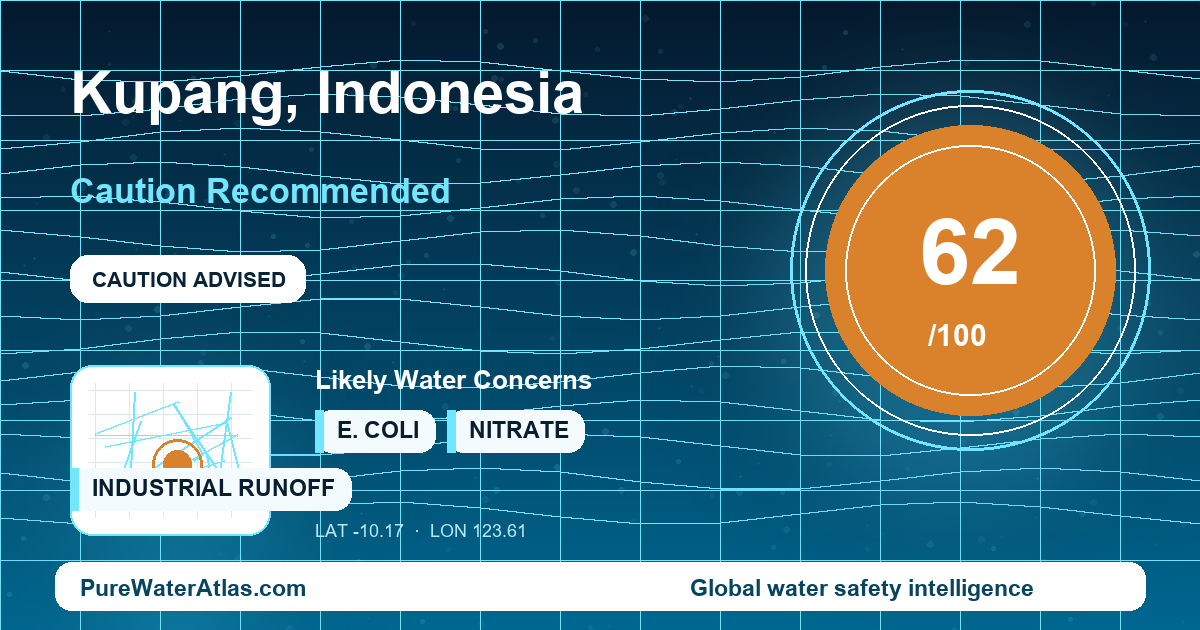
Kupang, Indonesia: caution-level tap water guidance for a dry-island coastal city where source reliability, intermittent pressure, storage tanks, private wells, and limited public testing data all affect drinking-water safety at the tap.
Quick Answer
| City | Kupang, East Nusa Tenggara, Indonesia |
|---|---|
| Water Safety Score | 62 / 100 |
| Risk Level | Caution Recommended |
| Can travelers drink untreated tap water? | No, not as a default. Short-stay visitors should use sealed bottled water, reputable refill water, or tap water that has been boiled or treated with a reliable purifier. |
| Resident advice | Residents should treat tap water for drinking unless they have recent tap-specific testing and consistent confidence in disinfection at the household tap. |
| Main water identity | A mixed small-city system using springs, groundwater or production wells, and surface-water or regional raw-water infrastructure in a dry-island setting. |
| Water authority | PDAM or Perumda Air Minum Kota Kupang, with national and basin agencies relevant for bulk water, dams, and source infrastructure. |
| Filter recommendation | Sediment prefiltration plus boiling, UV, or a maintained point-of-use system for microbes. Private wells require lab testing before choosing treatment. |
Kupang tap water should be treated as caution-level drinking water. The city has formal piped-water infrastructure, but local conditions include a pronounced dry season, intermittent supply risk, household storage tanks, possible turbidity after rain or pipe repairs, and limited publicly accessible, neighborhood-level water-quality reporting.
Why Kupang Is Different
Kupang is not a wet, river-rich capital with one dominant large municipal source. It is a coastal city on the western part of Timor Island in East Nusa Tenggara, a province known for a pronounced dry season and lower water availability than many wetter Indonesian regions. That matters because drinking-water safety in Kupang is shaped not only by treatment standards, but also by source yield, pressure continuity, household storage time, tanker or refill dependence, and the condition of water after it leaves the utility system.
The practical water picture in Kupang often includes municipal piped water, local springs, production wells, household roof tanks, ground tanks, purchased refill gallons, and sometimes private wells. Even if water is treated at a spring system, well field, intake, or plant, its quality at the drinking point can change during distribution or storage. Low-pressure periods, repairs, stagnant pipes, poorly covered tanks, and refill-water handling can all introduce microbial risk.
This is why PureWaterAtlas rates Kupang as Caution Recommended rather than “drink freely.” The available public information supports a clear precautionary recommendation, but it does not support an overconfident claim that every household tap is either consistently safe or consistently unsafe. Recent, routine, neighborhood-level results for residual chlorine, E. coli, turbidity, and chemical parameters are not easily available in public sources.
Where Does Kupang’s Tap Water Come From?
Kupang’s drinking-water supply is best understood as a mixed small-city system. Publicly described sources for Kupang and the surrounding service area include local springs, boreholes or production wells in limestone or karst terrain, and surface-water or regional raw-water infrastructure linked to local rivers and reservoirs. Local source names and infrastructure commonly referenced in government and public materials include Baumata and Oepura spring or production areas, Kali Dendeng-related supply works, and regional dam or raw-water assets such as Tilong and Raknamo that support water security in the Kupang area.
The city has historically relied heavily on nearby springs, groundwater, public wells, and stored household water. This historical dependence is important because Kupang’s dry-season conditions can make source quantity and supply reliability central water-safety issues. When supply is intermittent, households and businesses often store water before use. That storage can be helpful for continuity, but it also moves part of the safety burden from the utility to the building owner.
Key infrastructure relevant to Kupang includes municipal piped-water distribution operated by the local PDAM or Perumda Air Minum Kota Kupang structure, spring collection systems, groundwater production wells, Kali Dendeng-related intake or treatment infrastructure, reservoirs, service tanks, pumps, and pressure zones serving hilly urban terrain. Regional raw-water infrastructure managed under national or basin agencies also supports the wider Kupang water-security picture. At the household level, storage tanks, refill-water depots, private wells, pumps, filters, and taps can be just as important as the upstream source.
Who Manages Drinking Water in Kupang?
The local water utility is generally identified as PDAM or Perumda Air Minum Kota Kupang, operating within the Kupang city government framework. The Pemerintah Kota Kupang provides the local government context for municipal services, while national and provincial public-works agencies are relevant for bulk-water infrastructure, river-basin works, dams, and larger source-security projects.
At the national level, Indonesia’s drinking-water health standards are set by the Ministry of Health. The current regulatory framework referenced for drinking-water and environmental health quality requirements is Minister of Health Regulation No. 2 of 2023. Infrastructure context for municipal drinking-water systems is also connected to the Kementerian Pekerjaan Umum dan Perumahan Rakyat, Direktorat Air Minum, and raw-water and dam context in East Nusa Tenggara is connected to the Balai Wilayah Sungai Nusa Tenggara II.
The main limitation for consumers is transparency at the tap level. Public sources identify institutions, infrastructure, and regulatory requirements, but they do not provide a complete, recent, tap-by-tap compliance dataset for Kupang. That means households should not rely on general infrastructure existence alone as proof of drinking safety at their own kitchen tap.
Main Local Water Concerns
- Microbial contamination: The leading practical concern is microbial risk from intermittent supply, low pressure, private wells, household storage tanks, and refill-water handling. This is especially relevant after outages, repairs, or periods of stagnant storage.
- Turbidity and sediment: Rainy-season runoff, source disturbance, pipe repairs, or zone switching can create cloudy or discolored water. Turbidity can reduce disinfection effectiveness and should be taken seriously before drinking.
- Dry-season stress: Lower source yield can increase storage time, reduce flow, and increase dependence on purchased or stored water. Groundwater-influenced supplies may show stronger mineral taste or higher dissolved solids in some settings.
- Groundwater chemistry: Hardness, mineral taste, iron, manganese, salinity, or elevated TDS may occur in some groundwater-influenced or coastal settings, but these should not be assumed citywide without testing.
- Nitrate in shallow wells: Private wells near septic systems or dense settlement areas should be checked for nitrate, especially where infants, pregnant people, or vulnerable residents drink the water.
- Building plumbing: Lead is not identified here as a documented citywide source-water problem for Kupang. Where lead risk exists, it is mainly a building-plumbing issue in older premises, brass fittings, solder, or stagnant internal pipes.
For Travelers
Short-stay visitors should not drink untreated tap water in Kupang. Use sealed bottled water, reputable refill water, or tap water that has been boiled or treated with a purifier appropriate for microbes and sediment. This advice is especially important because travelers may be more sensitive to unfamiliar microbes and because hotel bathroom taps should not be assumed potable.
For brushing teeth, use bottled, boiled, or properly filtered water if you are a short-term visitor, immunocompromised, pregnant, or traveling with young children. Many long-term residents may use local tap water for brushing, but visitor risk tolerance should be lower.
Avoid ice from informal stalls unless you know it was made from treated water. In higher-standard hotels and restaurants, ask whether ice is made from commercial purified water. For meals, choose sealed bottled water or hot drinks made with fully boiled water. Mid-range and higher-end hotels commonly provide bottled or dispenser water, but that does not mean bathroom tap water is safe to drink.
Carry sealed water on day trips, especially during hot dry-season weather. If you must treat water in an emergency, bring it to a rolling boil and then store it in a clean, covered container. For travel treatment methods, see the PureWaterAtlas Boiling Water Purification guide and the CDC’s Water Disinfection guidance.
For Residents
Most Kupang households should use a drinking-water treatment barrier unless recent testing confirms safety at the tap and supply is continuous. For municipal water, a practical setup is sediment prefiltration plus boiling, UV, or a well-maintained point-of-use filter designed for microbial reduction. Sediment removal matters because cloudy water can interfere with disinfection and can reduce the performance of UV systems.
Private wells need a different approach. Do not choose treatment based only on taste or appearance. Test the well first, because nitrate, salinity, hardness, iron, manganese, turbidity, and microbial contamination require different treatment strategies. Test private wells at least annually for E. coli or total coliform, and test again after floods, nearby septic problems, or well repairs. If infants or pregnant people use the water, nitrate testing is particularly important.
Residents in coastal or groundwater-influenced areas should consider measuring TDS, chloride, conductivity, hardness, and salinity indicators, especially during the dry season. Brown, cloudy, metallic-tasting, or staining water should be checked for turbidity, iron, and manganese. Older buildings should not be overlooked: first-draw and flushed samples may be useful where internal plumbing is old or uncertain.
Storage tanks are a major point-of-use risk in Kupang. Roof tanks and ground tanks should be covered, screened from insects and animals, protected from sewage or roof-runoff intrusion, cleaned periodically, and disinfected after cleaning or contamination events. Flush stagnant water before drinking treatment, especially after outages or repairs.
Relevant Contaminants and Water-Quality Issues
The most relevant Kupang drinking-water issue is microbial safety at the point of use. Read more about E. coli in drinking water to understand why intermittent pressure, wells, and storage tanks matter. Turbidity and sediment are also important because cloudy first-flush water after outages, repairs, rain, or tank disturbance can reduce treatment confidence.
Chlorine is relevant because disinfectant residual helps protect piped water, but low-pressure distribution and household storage can reduce confidence by the time water reaches the tap. For private wells, nitrate deserves attention near septic systems or dense settlement areas, while iron can explain some staining, metallic taste, or discoloration complaints in groundwater-influenced supplies.
For treatment choices, see PureWaterAtlas guides to water purification methods, UV water purification, and boiling water purification. UV can be useful for residents when water is clear and prefiltered; boiling remains one of the most practical short-term microbial barriers when water safety is uncertain.
How to Verify Your Water Quality
The best way to move from general Kupang guidance to household-specific confidence is testing. Ask PDAM or Perumda Air Minum Kota Kupang for recent water-quality information where available, and compare any household or laboratory results with Indonesian Ministry of Health requirements. Because public neighborhood-level compliance data are limited, residents using wells, tanks, or older plumbing should consider their own tests rather than relying only on citywide assumptions.
For a structured testing plan, use the PureWaterAtlas Water Testing guide. Households can also look up specific parameters in the Contaminants Search Engine. If nitrate is a concern, see the guide to nitrate testing and detection methods. If you live in an older building or have uncertain internal plumbing, review lead testing and detection methods.
Travelers comparing destinations can use the Global Water Safety Checker. For broader background, see PureWaterAtlas resources on drinking water safety and water microbiology.
Official and Technical Sources
- Pemerintah Kota Kupang — local government context for Kupang and the municipal setting for city services.
- PDAM or Perumda Air Minum Kota Kupang — local water-utility identity and customer-service context.
- Badan Pusat Statistik Kota Kupang — official city statistics and geographic-demographic context.
- Kementerian PUPR, Direktorat Air Minum — national drinking-water infrastructure and SPAM context.
- Balai Wilayah Sungai Nusa Tenggara II — river-basin, dam, and raw-water infrastructure context for East Nusa Tenggara.
- Minister of Health Regulation No. 2 of 2023 — Indonesian regulatory framework for water quality and environmental health requirements.
- World Health Organization: Drinking-water fact sheet — public-health context for microbial safety and safe drinking-water management.
- CDC Travelers’ Health: Water Disinfection — traveler guidance on treating uncertain drinking water.
Bottom Line
Kupang has formal piped-water infrastructure, local water institutions, and regional raw-water assets, but untreated tap water should still be approached with caution. The city’s dry-island setting, spring and groundwater dependence, intermittent supply risk, storage tanks, possible turbidity after rain or repairs, and limited public neighborhood-level testing make point-of-use treatment important. Travelers should drink sealed bottled water, reputable refill water, or boiled or properly filtered water. Residents should use sediment prefiltration plus boiling, UV, or a maintained purifier for drinking water, and private wells should be lab-tested for microbes, nitrate, salinity indicators, hardness, iron, manganese, and turbidity. In Kupang, the “last meter” matters: tanks, pumps, filters, refill gallons, and building plumbing can determine actual drinking-water safety.
Read the full guide: Global Water Quality Guide
Explore more in this category: Global Water Quality Articles