
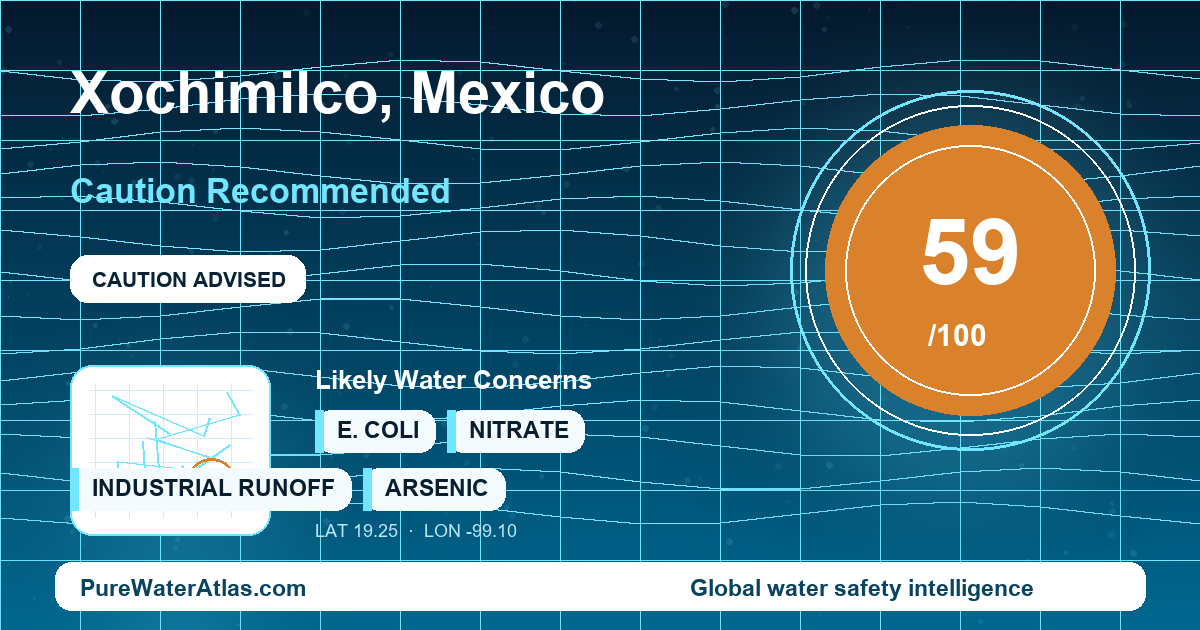
Xochimilco tap water is part of Mexico City’s formal SACMEX supply, but intermittent service, cisterns, rooftop tinacos, older distribution infrastructure, and limited borough-level tap-water reporting mean caution is recommended before drinking it straight from the tap.
Quick Answer
| Water safety score | 59 / 100 |
|---|---|
| Risk level | Caution Recommended |
| Can visitors drink the tap water? | Not recommended for most travelers. Use sealed bottled water, reputable garrafón water, boiled water, or properly filtered and treated water. |
| Resident approach | Treat tap water as potentially usable after point-of-use treatment, not automatically drinkable straight from the tap. |
| Main supply context | Mexico City public water system operated by SACMEX, using a mix of Valley of Mexico groundwater and imported water from the Lerma and Cutzamala systems. In southern and southeastern areas such as Xochimilco, groundwater wells and local distribution infrastructure are especially important. |
| Water authority | Sistema de Aguas de la Ciudad de México, commonly known as SACMEX. |
| Filter recommendation | For drinking and cooking, use sediment prefiltration plus certified activated carbon at minimum. Consider reverse osmosis if testing shows metals, high dissolved solids, nitrate, arsenic, or other inorganic concerns. |
Verdict: Caution recommended. The central issue in Xochimilco is not that the borough’s famous canals supply household taps; they do not. The practical concern is what can happen between the municipal system and the glass: low-pressure periods, pipe disturbances, storage in cisterns and rooftop tanks, older building plumbing, and limited easily accessible neighborhood-level water-quality data.
Why Xochimilco Is Different
Xochimilco is a southern borough of Mexico City with a water identity unlike most urban districts. It is internationally known for its canals, wetlands, chinampa landscape, and trajinera tourism. That setting can create confusion for visitors: the canal system is part of Xochimilco’s historic and environmental landscape, but it is not a potable-water source and should never be treated as drinking water.
Modern household tap water in Xochimilco comes from the Mexico City public water network, not directly from the tourist canals. The drinking-water question is therefore about municipal supply, distribution reliability, storage tanks, and building plumbing. Xochimilco’s risk profile is shaped by the broader Mexico City system, which depends on both local groundwater and imported water, while also facing the practical stresses of urban growth, drainage changes, groundwater extraction, subsidence, repairs, and uneven pressure.
The most important Xochimilco-specific point is the “last mile.” Even when water is chlorinated in the public network, actual quality at a kitchen tap can be altered by leaks, low pressure, long storage time, dirty cisterns, uncovered tinacos, corroded plumbing, or sediment mobilized after outages and repairs. For that reason, a hotel room, Airbnb, market stall, canal-side restaurant, older apartment, and single-family home may not all present the same level of risk.
Where Does Xochimilco’s Tap Water Come From?
Xochimilco is served by the Mexico City potable-water distribution system operated by SACMEX. The broader city system uses a combination of local groundwater from the Valley of Mexico aquifer and imported surface water from the Lerma and Cutzamala systems. For southern and southeastern boroughs, including Xochimilco, groundwater wells and local distribution tanks are especially important, although exact block-by-block source blending is not consistently published in a consumer-facing format.
Key infrastructure influencing Xochimilco tap water includes SACMEX distribution mains, local storage tanks, pumping stations, pressure zones, groundwater wells, and imported-water connections within the wider Mexico City network. At the property level, cisterns, rooftop tinacos, float valves, internal pipes, fixtures, and low-use plumbing lines can strongly influence the water that actually reaches a faucet.
During service interruptions, some affected areas may rely on water trucks or temporary supply measures. That can be necessary for access, but it also makes household handling and storage practices more important. Stored water that sits too long, loses disinfectant residual, or enters a dirty tank should not be assumed safe just because it originated in the public supply.
Because public information is stronger for Mexico City as a whole than for Xochimilco-specific tap results at the consumer faucet, this profile does not claim exact contaminant concentrations, neighborhood compliance status, or safety for every block. Source blending, pressure, maintenance, drought conditions, tank cleanliness, and plumbing materials can all change local outcomes.
Who Manages Drinking Water in Xochimilco?
The main water authority for Xochimilco is Sistema de Aguas de la Ciudad de México, commonly known as SACMEX. SACMEX is responsible for Mexico City’s potable-water service, drainage, and related infrastructure. The Alcaldía Xochimilco may be involved in local reporting and coordination, but the main utility identity for drinking-water service is SACMEX.
Mexico’s drinking-water quality framework is national. Water for human use and consumption is governed by the Secretaría de Salud framework, including NOM-127-SSA1-2021. COFEPRIS and health authorities have sanitary surveillance roles. CONAGUA provides national water-resource and system context, including major systems relevant to Mexico City such as Cutzamala.
A key limitation for residents and visitors is transparency at the faucet level. Mexico does not provide the same type of easily searchable, address-specific annual consumer confidence reports used in some countries. That means a Xochimilco household often needs direct utility information, official advisories, or independent testing to understand water quality at the actual point of use.
Main Local Water Concerns
- Intermittent service and low pressure: Parts of southern Mexico City can experience service interruptions or low-pressure periods. If pipes are compromised, low pressure can increase intrusion risk.
- Cisterns and tinacos: Xochimilco households and buildings often depend on storage. Dirty, uncovered, cracked, or poorly maintained tanks can introduce sediment, biofilm, insects, and microbial risk.
- Turbidity and sediment: Cloudiness, particles, or discoloration may appear after outages, pipe repairs, changes in supply direction, or disturbances in storage tanks.
- Variable chlorine at the tap: Chlorination may be present in the public network, but residual disinfectant can decline after long storage in cisterns or rooftop tanks.
- Groundwater taste and mineral issues: Some supplies may have salty, hard, earthy, or mineralized taste, but this should not be generalized to every Xochimilco neighborhood without testing.
- Older internal plumbing: Lead or other metals risk is more likely to come from older building plumbing, solder, fixtures, or service components than from a known borough-wide lead source.
- Microbial risk after disruptions: Outages, flooding, low pressure, dirty storage, or damaged pipes can create conditions where microbial indicators should be checked.
- Unsafe non-municipal sources: Private wells, shallow wells, canal water, and untreated hauled water should not be assumed safe for drinking.
Season also matters. Rainy periods can increase flooding, sewer overflow, surface contamination, and turbidity around vulnerable infrastructure and storage systems. Dry periods and drought can increase demand, reduce reliability, and lengthen storage time in household tanks. Regional Cutzamala shortages or maintenance can affect pressure and supply patterns across Mexico City, even where local groundwater remains important.
For Travelers
Most short-term visitors to Xochimilco should avoid drinking tap water straight from the faucet. Use sealed bottled water, reputable garrafón water, water treated by a reliable purifier, or water brought to a full rolling boil. This is especially important for first-time visitors, people with sensitive stomachs, children, pregnant travelers, and immunocompromised people.
For brushing teeth, bottled or purified water is the safer choice if you are staying in an older building, hostel, Airbnb, canal-side lodging, or any place where the condition of the cistern or rooftop tank is unknown. Many residents may use tap water for brushing, but travelers have different exposure histories and risk tolerance.
Use ice only if it is commercially produced or clearly made from purified water. Hotels and established restaurants often use purified water for drinking water and ice, but visitors should still ask. In informal stalls, markets, trajinera settings, small venues near the canals, or places where water handling is unclear, skip the ice.
During canal visits, carry sealed water. Do not drink canal water or use it to rinse fruit, utensils, cups, or hands before eating. Be cautious with drinks diluted with unknown water, aguas frescas from informal sources, bathroom taps, hoses, public spigots, and any tap connected to a visibly neglected storage system. For oral medications, use bottled or purified water.
Travelers who need a fallback disinfection method can review Boiling Water Purification: Complete Guide. Boiling is most relevant for microbial risk; it does not remove dissolved metals, salts, or many chemical contaminants.
For Residents
Xochimilco residents should think in terms of household risk control. A practical setup for drinking and cooking water starts with sediment prefiltration followed by a certified activated carbon filter for chlorine, taste, odor, and particulate reduction. Where testing identifies metals, high dissolved solids, nitrate, arsenic, or other inorganic concerns, reverse osmosis or another system certified for the specific contaminant may be appropriate. UV can help address microbes only when water is already low in turbidity and the lamp is properly maintained.
Testing should be done at the kitchen point of use, not only at the street connection, because the cistern, tinaco, and internal plumbing may be the main risk points. Include total coliform and E. coli testing after outages, low pressure, flooding, tank contamination, or unexplained gastrointestinal illness in the household. Check free chlorine residual if water is stored for long periods. Test turbidity, color, odor, pH, conductivity or total dissolved solids, hardness, iron, and manganese if water has sediment, staining, salty taste, metallic taste, or cloudiness.
Older buildings deserve extra caution. Lead-bearing plumbing components, corroded pipes, soldered copper, brass fixtures, and stagnant low-use lines can contribute metals, sediment, biofilm, and taste problems. Flush stagnant lines before using water for drinking or cooking, and test for lead if building age or plumbing materials are uncertain. The PureWaterAtlas guide to Lead in Drinking Water: Testing and Detection Methods is useful for planning this type of verification.
Cisterns and tinacos should be covered, screened, cleaned, and disinfected on a regular schedule. Do not drink untreated water from a tank with sludge, insects, open lids, cracked walls, dirty float valves, or long water age. After major plumbing work, pipe repairs, earthquake damage, prolonged water cuts, flooding, or tank cleaning, retest or treat water more conservatively until it runs clear and any official advisories are resolved.
Relevant Contaminants and Water-Quality Issues
Several water-quality topics are especially relevant to Xochimilco’s storage-and-distribution risk profile. Chlorine in drinking water matters because the public supply may be chlorinated, but residual can change after storage in cisterns and rooftop tanks. Turbidity and sediment are important when water appears cloudy, discolored, or particle-laden after outages, repairs, or tank disturbance.
For microbial safety, E. coli is a key indicator when low pressure, flooding, storage contamination, or private sources are involved. For older homes and apartments, lead should be considered if plumbing materials are unknown or metallic taste appears. Nitrate is not presented here as a borough-wide Xochimilco problem, but it is relevant for private wells or non-SACMEX sources in peri-urban or agricultural settings.
Residents choosing treatment equipment can compare options in Water Treatment Systems. For homes considering microbial control after sediment filtration, see UV Water Purification: Complete Guide.
How to Verify Your Water Quality
The most reliable way to assess a Xochimilco household is to test the water you actually drink. Because borough-level public data are limited and building storage can dominate risk, testing should focus on the kitchen tap after water has passed through the property’s cistern, tinaco, pipes, and fixtures.
- Start with the PureWaterAtlas Water Testing guide to choose appropriate lab and field tests.
- Use the Contaminants Search Engine to interpret contaminants listed on lab reports.
- Review Drinking Water Safety for a broader decision framework.
- Compare destination-level risk using the Global Water Quality Checker.
- If using any private well or non-municipal source, consider the PureWaterAtlas guide to Nitrate Contamination Testing along with microbial testing.
Official alerts, local utility information, and independent testing should be treated as complementary. If water suddenly changes color, odor, taste, or clarity after a pressure loss, flood, pipe repair, or storage-tank issue, switch to bottled, boiled, or properly treated water until the issue is resolved.
Official and Technical Sources
- Sistema de Aguas de la Ciudad de México, SACMEX — local water authority responsible for Mexico City potable-water service and infrastructure affecting Xochimilco.
- Secretaría de Salud / Diario Oficial de la Federación, NOM-127-SSA1-2021 — national sanitary standard framework for water for human use and consumption.
- COFEPRIS: Agua de uso y consumo humano — federal sanitary surveillance context for drinking water in Mexico.
- CONAGUA — national water authority and source for broader water-resource and major system context.
- UNESCO World Heritage Centre: Historic Centre of Mexico City and Xochimilco — confirms Xochimilco’s historic canal and wetland identity.
- CDC Travelers’ Health: Mexico — supports conservative traveler guidance on safe bottled, boiled, or treated water.
- Mexico City Government Open Data Portal — official data portal for city datasets, while not replacing household-level tap testing.
- PAOT — Mexico City environmental and land-use context relevant to Xochimilco’s conservation area and water environment.
Bottom Line
Xochimilco tap water should be approached with caution, especially by visitors. The borough is served by Mexico City’s SACMEX system, not by the tourist canals, but local safety at the faucet depends heavily on pressure history, distribution conditions, cisterns, rooftop tinacos, and internal plumbing. Travelers should use sealed bottled water, reputable garrafón water, boiled water, or properly treated water, and should be cautious with ice and informal canal-side food or drinks. Residents should use point-of-use treatment for drinking and cooking, maintain storage tanks, and test kitchen-tap water after outages, flooding, repairs, or changes in taste, odor, color, or clarity. Public data are not detailed enough to certify every Xochimilco tap.
Read the full guide: Global Water Quality Guide
Explore more in this category: Global Water Quality Articles