
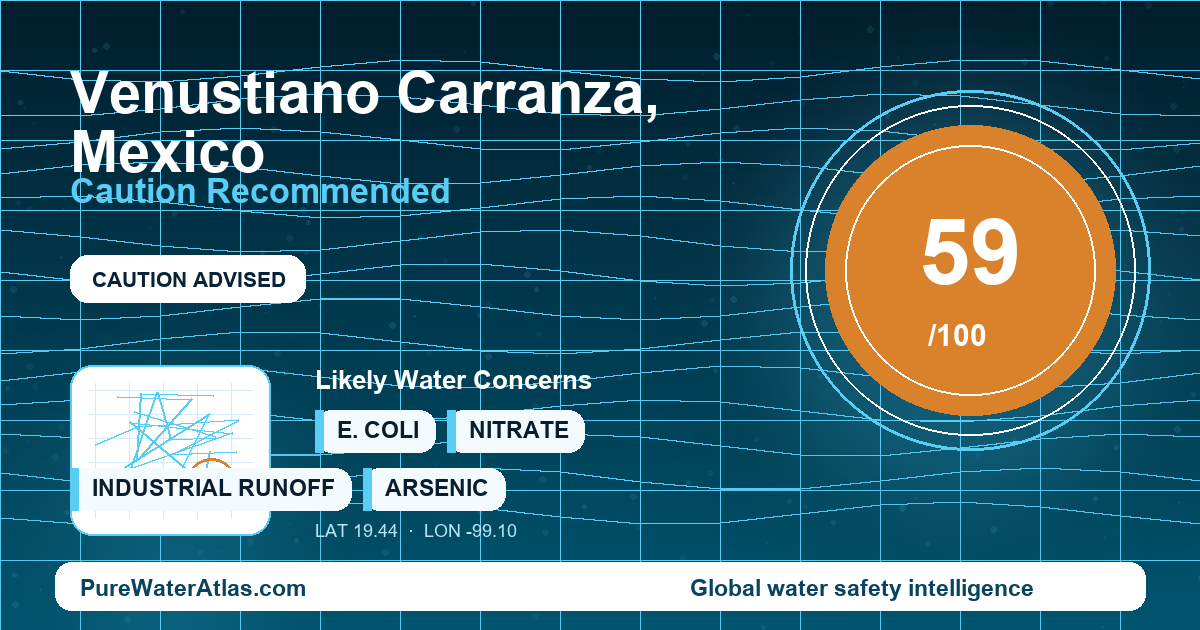
Venustiano Carranza, Mexico City: tap water is supplied by the broader CDMX network, but building storage tanks, old plumbing, intermittent pressure, and variable tap-level conditions mean caution is recommended for drinking.
Quick Answer
| Water safety score | 59 / 100 |
|---|---|
| Risk level | Caution Recommended |
| Can visitors drink the tap water? | Not recommended without treatment. Visitors should use sealed bottled water, hotel-provided purified water, or water treated by a reputable purifier. |
| Resident guidance | Treat safety as building-specific. If your building has a cistern or rooftop tinaco, tank maintenance and internal plumbing may matter as much as the municipal supply. |
| Main water source | Venustiano Carranza is supplied through the Mexico City public network, a blended system using Valley of Mexico groundwater and imported Cutzamala and Lerma water. |
| Water authority | Sistema de Aguas de la Ciudad de México, commonly known as SACMEX. |
| Filter recommendation | A point-of-use filter is advisable for drinking and cooking. Use sediment filtration, activated carbon, and certified lead/cyst reduction where appropriate; consider reverse osmosis for dissolved-solids or inorganic-contaminant concerns. |
Overall verdict: Venustiano Carranza is not a separate water-utility city. It is an alcaldía of Mexico City, and its tap water is part of the citywide hydraulic system managed primarily by SACMEX. The main practical concern is not a confirmed borough-wide toxic contaminant, but vulnerability between the treatment/distribution system and the glass: old mains, pressure interruptions, turbidity after repairs or outages, declining residual chlorine, and contamination inside cisterns or tinacos.
Why Venustiano Carranza Is Different
Venustiano Carranza is a central-eastern alcaldía of Mexico City that includes dense older urban neighborhoods, transport corridors, commercial areas, and Mexico City International Airport. This matters for water safety because Venustiano Carranza should not be evaluated as a stand-alone municipality with its own isolated water source. The water reaching local homes, hotels, restaurants, and businesses comes through the broader Mexico City public drinking-water network.
The local exposure pathway is highly building-specific. In many homes, apartment buildings, guesthouses, and small hotels, municipal water may enter an underground cistern, be pumped to a rooftop tank known as a tinaco, and then flow through internal pipes before reaching a tap. That final storage-and-plumbing stage can determine whether the water a person actually drinks is clear, chlorinated, and microbiologically protected, or instead affected by sediment, low disinfectant residual, tank contamination, or old fixtures.
Venustiano Carranza also sits within the former lakebed environment of the Basin of Mexico, historically associated with Lake Texcoco. Soft lacustrine soils, groundwater pumping, and regional land subsidence are relevant because they can stress buried infrastructure. Across Mexico City, this structural water-system pressure can contribute to leaks, pipe breaks, uneven pressure, and repairs that disturb sediment. For this alcaldía, the practical question is less “Is all tap water unsafe?” and more “What is happening in this building, after the water leaves the city network?”
Where Does Venustiano Carranza’s Tap Water Come From?
Tap water in Venustiano Carranza comes through the Mexico City metropolitan drinking-water network. The raw-water base is a blend of groundwater from the Valley of Mexico aquifer system and imported water from the Cutzamala and Lerma systems. The exact mix at a given address can vary depending on network operations, season, maintenance activity, pressure management, and the availability of Cutzamala water.
The relevant infrastructure includes SACMEX-operated distribution mains, pumping and storage infrastructure, pressure zones, and citywide re-chlorination points. Venustiano Carranza residents are also affected by building-level infrastructure: cisterns, tinacos, private pumps, internal plumbing, fixtures, and any local repairs or block-level service interruptions. These final components are not minor details. A clean municipal main does not guarantee safe water at the kitchen tap if a rooftop tank is uncovered, dirty, cracked, or rarely disinfected.
Seasonal and operational factors can change the experience at the tap. Dry-season stress can make low pressure or service cuts more noticeable. Cutzamala shortages or maintenance can change the availability and blend of water delivered into Mexico City. During the rainy season, runoff, pipe disturbance, and repairs can increase visible turbidity after breaks or pressure changes. After any outage, major road work, earthquake-related repair, flooding event, or service restoration, residents should flush cold taps until the water runs clear and use treated water until normal service is restored.
Who Manages Drinking Water in Venustiano Carranza?
Drinking-water production and network management for Venustiano Carranza are handled primarily at the Mexico City level by Sistema de Aguas de la Ciudad de México, SACMEX. The local government unit is Alcaldía Venustiano Carranza, which is relevant for local context, public works, citizen reporting, and service coordination, but it is not the main drinking-water utility operator.
Mexico’s national drinking-water framework includes NOM-127-SSA1-2021, the federal standard for water for human use and consumption. Public-health oversight involves national health institutions including COFEPRIS. Broader water-resource and regional-system information is provided by CONAGUA and the Sistema Nacional de Información del Agua.
Public information is sufficient to identify the responsible water system, regulatory context, and source-water setting. However, verified tap-water laboratory data at the neighborhood, block, building, or household-storage level are not consistently public. That limitation is important: this profile should not be read as proof that every tap in Venustiano Carranza is either safe or unsafe at all times. It is a risk-based assessment based on the known CDMX water system and practical exposure pathways inside buildings.
Main Local Water Concerns
The main local concerns in Venustiano Carranza are distribution and premises-plumbing risks. Intermittent service or low pressure can increase the chance of sediment release and microbial intrusion in distribution pipes. When pressure drops, water that would normally flow outward can be more vulnerable to contamination pathways, especially around leaks, repairs, or cross-connections.
Residents may notice turbidity, brown water, particles, or changed odor after repairs, pressure changes, or service restoration. These events do not automatically prove a long-term chemical hazard, but they are signals not to drink the water untreated until it clears and, if problems persist, until it is tested. Visible particles point toward sediment and turbidity, both of which can interfere with disinfection and reduce confidence in microbial safety.
Residual chlorine may be adequate in parts of the public network but decline inside poorly maintained building tanks. A rooftop tinaco exposed to heat, sediment, organic matter, insects, missing lids, cracks, or algae can reduce the protective effect of disinfection before water reaches the tap. For this reason, tank inspection and cleaning are not optional housekeeping details; they are part of drinking-water safety in many Venustiano Carranza buildings.
Older internal plumbing and fixtures may also contribute metals such as lead, especially where plumbing materials are unknown or where old solder, brass components, galvanized lines, or legacy fixtures are present. Groundwater contributions in the broader CDMX supply can create mineral taste, hardness, and dissolved-solids concerns at some taps, although public data are not sufficient to map these reliably within Venustiano Carranza. Airport and dense urban land uses are reasons to be cautious with private wells or non-network sources, but they are not, by themselves, proof of contamination in the public tap-water network.
For Travelers
Short-term visitors in Venustiano Carranza should generally avoid drinking unfiltered tap water. This is especially practical for travelers staying near the airport, in older buildings, in small guesthouses, or anywhere the bathroom tap is the only obvious water source. Use sealed bottled water, hotel-provided purified water, garrafón water from a reputable source, or water treated by a reliable purifier. Boiling can improve microbial safety, but it does not remove dissolved metals, salts, or many chemical contaminants; see the PureWaterAtlas boiling water purification guide for the limits of boiling.
For brushing teeth, many healthy adults use tap water without incident, but cautious travelers, young children, immunocompromised people, and anyone with a sensitive stomach should use bottled or purified water. For infant formula, use bottled or properly purified water unless you have verified that the tap and storage system are safe.
Ice in established hotels, airport facilities, and reputable restaurants in Mexico City is commonly made from purified water, but travelers should avoid loose ice from informal vendors unless the purified source is clear. In hotels and restaurants, ask directly whether water and ice are purified. Better hotels and restaurants often rely on filtered or garrafón water. In small guesthouses, it is reasonable to ask whether the cistern and tinaco are cleaned and disinfected on a routine schedule.
The CDC Travelers’ Health guidance for Mexico supports conservative food and water precautions for visitors. For Venustiano Carranza, that conservative approach is sensible because the greatest uncertainty is often not the citywide source but the final building plumbing and storage system.
For Residents
Residents should treat drinking-water safety as a household and building question. A home filter is advisable for drinking and cooking water. A simple activated-carbon pitcher or faucet filter may improve chlorine taste and odor, but it is not designed to address every concern. For stronger protection, choose a certified system matched to the problem: a sediment prefilter for particles, a filter certified for lead and cyst reduction where plumbing age is a concern, ultraviolet treatment only after low-turbidity filtration for microbial control, and reverse osmosis where dissolved solids, nitrate, arsenic, or other inorganic contaminants are credible concerns.
Testing is especially important if your building uses a cistern, tinaco, private pump, or has experienced recent outages. Consider testing for total coliform and E. coli to evaluate microbial contamination. Check free chlorine residual at the tap, especially when water has been stored in a rooftop tank. Test turbidity, color, odor, pH, conductivity or TDS, and hardness if the water looks or tastes different. Test lead if the building is old, plumbing materials are unknown, or water has been sitting overnight in pipes. For private wells or non-network sources, additional testing for nitrate, arsenic, iron, manganese, and dissolved solids may be appropriate.
Older buildings in Venustiano Carranza may have corroded fixtures, old galvanized lines, brass components, unknown solder, or legacy plumbing that affects water after it leaves the municipal system. A citywide supply report is not a substitute for first-draw and flushed sampling at your own tap. Cisterns and tinacos should be covered, screened, cleaned, and disinfected on a routine schedule. If a tank has sediment, algae, insects, cracks, a missing lid, or no maintenance record, do not drink the tap water without treatment and testing.
Relevant Contaminants and Water-Quality Issues
The most relevant PureWaterAtlas topics for Venustiano Carranza are distribution-system and building-level indicators. Turbidity and sediment are important after outages, pipe repairs, pressure changes, or brown-water events. They can also reduce the effectiveness of disinfection and make UV treatment less reliable unless prefiltration is used.
Chlorine is a key disinfectant indicator because residual disinfectant can decline during storage in cisterns and rooftop tanks. Microbial indicators such as E. coli are important when evaluating whether tank water or tap water has been contaminated. Lead is primarily a premises-plumbing concern in older buildings or where fixtures and materials are unknown. Nitrate is most relevant when a private well, non-network source, or specific lab result suggests groundwater-related risk.
How to Verify Your Water Quality
For a practical framework, start with the PureWaterAtlas guide to drinking water safety and the complete guide to water testing. If you are choosing equipment, review water treatment systems and the guide to UV water purification. For metal concerns, see lead testing and detection methods. For groundwater-related concerns, review nitrate testing and detection methods.
You can also use the Global Water Quality Checker for risk-screening context and the Contaminants Search Engine to look up specific substances. For Venustiano Carranza, the most useful verification is tap-specific: sample after overnight stagnation, sample after flushing, and, where a cistern or tinaco is present, test water as it is actually delivered to the kitchen tap.
Official and Technical Sources
- Sistema de Aguas de la Ciudad de México, SACMEX — Mexico City water-system operator and primary authority for supply, drainage, service notices, and system information affecting Venustiano Carranza.
- Gobierno de la Ciudad de México, Alcaldía Venustiano Carranza — local government context, public works, and citizen reporting.
- CONAGUA — national water authority relevant to regional systems such as Cutzamala and Valley of Mexico water management.
- Sistema Nacional de Información del Agua, SINA — official national water data platform for aquifers, basins, infrastructure, and indicators.
- NOM-127-SSA1-2021 — Mexican federal drinking-water standard for water for human use and consumption.
- COFEPRIS — federal sanitary authority involved in public-health protection and drinking-water quality oversight.
- INEGI geographic and demographic information — authoritative reference for Venustiano Carranza as a Mexico City alcaldía.
- CDC Travelers’ Health: Mexico — travel-health guidance supporting conservative food and water precautions.
- World Health Organization Guidelines for Drinking-water Quality — global reference for microbial risk, chemical contaminants, and multi-barrier drinking-water safety.
Bottom Line
Tap water in Venustiano Carranza deserves caution, not panic. The alcaldía is supplied by Mexico City’s SACMEX network, using a variable blend of Valley of Mexico groundwater and imported Cutzamala and Lerma water. The biggest everyday uncertainty is what happens after water enters the local distribution network and the building: low pressure, old mains, sediment after outages, reduced chlorine, cisterns, tinacos, and legacy plumbing can all affect tap quality. Visitors should use bottled or purified water for drinking, and residents should filter, maintain tanks, and test when conditions change. Because public tap-level data are limited by neighborhood and building, the safest conclusion is building-specific: verify your own tap before treating it as potable.
Read the full guide: Global Water Quality Guide
Explore more in this category: Global Water Quality Articles