
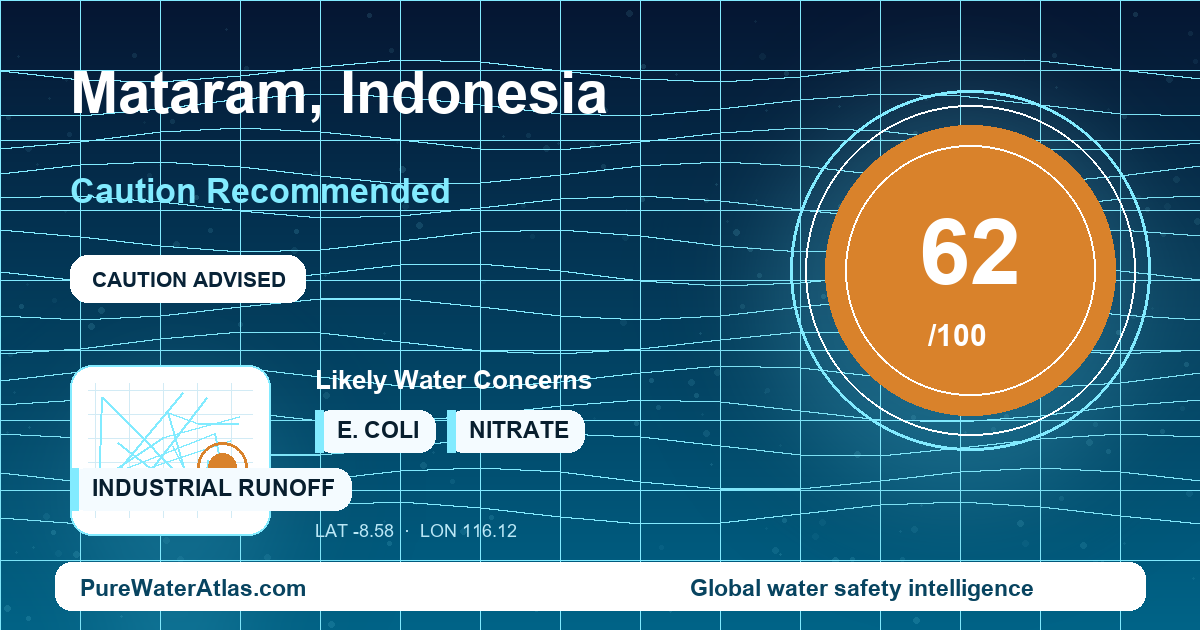
Mataram, Indonesia: a coastal Lombok city where piped utility water, upland spring and groundwater sources, private wells, refill depots, and building storage tanks can produce very different drinking-water risk at the tap.
Quick Answer
| Overall status | Caution recommended. PureWaterAtlas water safety score: 62/100. Mataram has a formal piped-water utility and Indonesian drinking-water regulations, but recent public, faucet-level laboratory data are limited. |
|---|---|
| Can tourists drink the tap water? | Most short-term visitors should not drink untreated tap water in Mataram. Use sealed bottled water, boiled water, or water treated with a reliable filter plus disinfection. |
| Resident guidance | Residents connected to Perumda Air Minum Giri Menang should check current utility and local health-office information, and should consider point-of-use treatment for drinking water, especially where water passes through roof tanks, ground tanks, older plumbing, or intermittent supply. |
| Main water identity | Mataram is served primarily by Perumda Air Minum Giri Menang, using spring and groundwater sources associated with West Lombok upland catchments such as Sesaot, Narmada, Lingsar, and related recharge areas. Some households and businesses also use wells, tanker water, refill depots, or stored water. |
| Water authority | Perumda Air Minum Giri Menang is the local drinking-water utility for Mataram and West Lombok. Public-health oversight is linked to Dinas Kesehatan Kota Mataram and Indonesian national health authorities. |
| Filter recommendation | For drinking and cooking, a treatment barrier is advisable. A practical household approach is sediment prefiltration plus activated carbon, followed by boiling, UV, ultrafiltration, or reverse osmosis depending on test results and household vulnerability. Private wells should be tested before choosing treatment. |
Why Mataram Is Different
Mataram is not a simple “one source, one pipe, one answer” city. It is a dense coastal city on the west side of Lombok facing the Lombok Strait, with lowland coastal areas such as Ampenan and inland districts that depend on water arriving from upland West Lombok catchments and local aquifers. That geography matters because drinking-water safety in Mataram depends not only on the public utility but also on distribution pressure, household storage, private wells, coastal groundwater conditions, and building maintenance.
The city’s tap-water question is often a building-level question. A hotel, boarding house, home, office, or restaurant may receive utility water, but then store it in roof tanks or ground tanks. If those tanks are not sealed, screened, cleaned, and protected from insects, animals, sewage, and floodwater, microbial risk can increase after the water leaves the utility system. Chlorine residual can also decline during storage, which reduces the safety margin against regrowth and contamination.
For this reason, PureWaterAtlas does not classify Mataram tap water as reliably drinkable for international traveler standards. The better description is caution recommended: the city has a formal piped-water system and a national regulatory framework, but public city-level laboratory results that show recent distribution-zone performance at the tap are not readily available in a transparent annual consumer format.
Where Does Mataram’s Tap Water Come From?
Mataram is served primarily by Perumda Air Minum Giri Menang, the public water company serving Kota Mataram and Kabupaten Lombok Barat. The supply is understood to rely heavily on spring and groundwater sources in West Lombok, including upland catchments associated with Sesaot, Narmada, Lingsar, and other forested or peri-urban recharge areas east and northeast of the city. This reflects Mataram’s long-standing dependence on abundant upland springs and groundwater influenced by Lombok’s Rinjani-related aquifer and forest catchments, rather than on a single large surface reservoir inside the city.
Key infrastructure relevant to Mataram includes the Perumda Air Minum Giri Menang piped distribution network, upland spring collection and transmission systems, groundwater and well sources used by some public and private users, local reservoirs, distribution mains, service connections, and household or building storage tanks. Regional raw-water and water-resources assets in the Lombok river-basin system are overseen by national public works water-resources agencies, including the Balai Wilayah Sungai Nusa Tenggara I.
Urban growth in Mataram and West Lombok increases demand on these water sources and makes catchment protection, leakage control, and distribution hygiene more important. It also means that two households in the same city can have different water-quality realities: one may be on piped utility water with a clean internal system, another may rely partly on a shallow well, a refill depot, tanker water, or a tank that has not been maintained.
Who Manages Drinking Water in Mataram?
The main drinking-water utility for Mataram is Perumda Air Minum Giri Menang, a regional water company associated with both Kota Mataram and Kabupaten Lombok Barat. That joint regional structure is important because Mataram’s supply is closely tied to source areas outside the city boundary. Official city-government context is available from Pemerintah Kota Mataram, while demographic, housing, and urban context relevant to water demand and sanitation pressure can be checked through BPS Kota Mataram.
Indonesia’s drinking-water quality framework is set nationally through Ministry of Health sanitary and environmental-health standards, including Permenkes No. 2 Tahun 2023. Water resources and raw-water infrastructure are overseen through Ministry of Public Works and Housing agencies, including the regional river-basin authority for Nusa Tenggara. Local implementation, however, depends on day-to-day utility operations, local public-health surveillance, and what happens inside private premises after water reaches a property.
The main data limitation is transparency at the tap. Some city-level information is available on the utility, the city, geography, and the regulatory framework, but recent public laboratory datasets showing distribution-zone results for residual chlorine, turbidity, E. coli, metals, and private-well quality across Mataram are not readily available in one consumer-facing report. This page therefore avoids claiming that all Mataram tap water either meets or fails a specific numerical standard.
Main Local Water Concerns
The most practical concern in Mataram is microbial safety after treatment and during storage. Intermittent pressure, cross-connections, pipe repairs, poorly maintained household tanks, or unprotected building reservoirs can allow contamination to enter the water before it reaches the glass. This is especially important for infants, pregnant people, elderly residents, immunocompromised people, and travelers with sensitive stomachs.
- Microbial contamination: Risk can come from post-treatment contamination, intermittent pressure, cross-connections, tanks, or wells. Learn more about E. coli in drinking water.
- Turbidity and sediment: Heavy rain, source-water disturbance, pressure changes, maintenance, or pipe repairs can cause cloudy water or particles. See PureWaterAtlas guides to turbidity and sediment.
- Variable chlorine residual: Chlorine taste may be noticeable in some places, while residual disinfection may be low at the end of the network or after storage. Read about chlorine in drinking water.
- Private shallow wells: Wells in dense urban or coastal settings can be affected by septic systems, drainage, flooding, salinity, nitrate, and local sanitation conditions.
- Nitrate: Private wells influenced by septic systems, livestock, fertilizer, or dense settlement should be tested for nitrate. See nitrate and the guide to nitrate testing and detection.
- Lead and premise plumbing: Lead is not documented as a citywide issue in the available public data, but older internal plumbing, brass fixtures, solder, and premise plumbing can add metals in individual buildings. See lead and lead testing methods.
Season also matters. Wet season rainfall can increase runoff, turbidity, drainage overflow, flooding, and well contamination risk. Dry season demand can stress springs, shallow wells, and distribution pressure, making storage hygiene and residual disinfection more important. After pipe breaks, maintenance, earthquakes, or flooding, be more cautious until water runs clear and has been disinfected or boiled for drinking.
For Travelers
For most travelers, the safest answer is simple: do not drink untreated tap water in Mataram unless you have direct confirmation from the property that water is treated to drinking standard and you trust the maintenance of filters, tanks, and disinfection. This is consistent with conservative travel-health practice for Indonesia and the food-and-water precautions listed by CDC Travelers’ Health for Indonesia.
Use sealed bottled water, properly boiled water, or water treated with a reliable travel filter plus disinfection. Tap water is usually acceptable for showering and handwashing, but use treated water for drinking, baby formula, medicines, and brushing teeth if you are a short-term visitor, have a sensitive stomach, are traveling with children, or are immunocompromised.
Be careful with ice. Avoid ice from street stalls or informal vendors unless you know it was made from treated commercial ice or purified water. In better hotels and restaurants, ask whether ice is made from filtered water or purchased potable ice. Many hotels and restaurants in Mataram rely on bottled water, water dispensers, or treated water rather than offering tap water as drinking water. Sealed bottled water, hot tea or coffee made with fully boiled water, and reputable refill stations are safer choices.
If you must use tap water, bring it to a rolling boil and let it cool in a clean, covered container. For details, see the PureWaterAtlas guide to boiling water purification. Carbon-only taste filters are not enough for untreated water because they do not reliably control microbial risk.
For Residents
Residents connected to Perumda Air Minum Giri Menang should ask the utility or local health office for the most recent information for their service area, but they should not assume that utility data automatically represent water quality at the kitchen tap. Water can change inside a building through storage tanks, old plumbing, dead-end lines, corroded fixtures, or low-use sections of pipe.
A home treatment barrier is advisable for drinking and cooking water, especially where supply is stored in tanks or pressure is intermittent. A practical setup is sediment prefiltration plus activated carbon for taste and some chemical concerns, followed by boiling, UV, ultrafiltration, or reverse osmosis depending on test results and household risk. UV can be useful only when the water is clear enough and the device is maintained correctly; see the PureWaterAtlas UV water purification guide.
Private-well users should test before choosing a filter. At minimum, test for E. coli or thermotolerant coliforms, total coliforms, nitrate, electrical conductivity or salinity, turbidity, pH, iron, and manganese. If water tastes salty or brackish, test conductivity, total dissolved solids, chloride, and sodium before using it for drinking, infant formula, or people on sodium-restricted diets. After flooding, well inundation, pipe repairs, or long outages, boil or disinfect drinking water and consider repeat microbial testing.
Roof tanks and ground tanks should be sealed, screened against insects and animals, protected from sewage and floodwater, and cleaned routinely. Older buildings, boarding houses, and commercial premises deserve special attention because internal pipes, valves, fixtures, and dead-end lines can affect metals, sediment, taste, and microbial regrowth.
Relevant Contaminants and Water-Quality Issues
The issues most relevant to Mataram are not exotic contaminants; they are common distribution, storage, and private-well risks that can vary sharply from one building to another. Start with microbial indicators such as E. coli, because the immediate health risk from untreated or recontaminated water is usually biological. Then evaluate physical indicators such as turbidity and sediment, especially after heavy rain, pressure changes, or pipe work.
For treated utility water, chlorine residual is important because it helps protect water in the distribution system, but it may decline after long storage in tanks. For private wells, nitrate, salinity, and microbial contamination deserve attention in dense settlement, septic, agricultural, livestock, flooding, or coastal-influenced settings. For older or unknown building plumbing, lead should be tested at the tap rather than inferred from general utility information.
How to Verify Your Water Quality
The most reliable way to answer “Is my Mataram tap water safe?” is to combine official information with building-specific testing. First, check current announcements or service information from Perumda Air Minum Giri Menang and local public-health channels. Second, identify your actual source: utility connection, private well, refill depot, tanker water, hotel treatment system, or a combination. Third, test the water at the point where you drink it, especially if it passes through roof tanks, ground tanks, filters, dispensers, or older internal plumbing.
Use the PureWaterAtlas complete guide to water testing to plan sampling, and compare treatment options through the water purification methods guide. For broader context, see Drinking Water Safety and Water Microbiology. You can also use the Global Water Quality Checker and the Contaminants Search Engine for contaminant-specific research.
Official and Technical Sources
- Perumda Air Minum Giri Menang — official local water utility serving Mataram and West Lombok.
- Pemerintah Kota Mataram — official city-government source for local public services and administrative context.
- BPS Kota Mataram — official statistics source for geography, population, housing, and urban context.
- Kementerian Kesehatan, Permenkes No. 2 Tahun 2023 — national Indonesian sanitary and environmental-health regulation including drinking-water quality requirements.
- Balai Wilayah Sungai Nusa Tenggara I, Kementerian PUPR — regional water-resources authority relevant to Lombok raw-water and watershed infrastructure.
- BMKG Indonesia — official climate information source for rainfall seasonality affecting turbidity, runoff, flooding, and supply reliability.
- CDC Travelers’ Health, Indonesia — travel-health guidance supporting conservative food and water precautions.
- WHO/UNICEF Joint Monitoring Programme for Water Supply, Sanitation and Hygiene — country-level WASH context for Indonesia, not a substitute for Mataram-specific tap testing.
Bottom Line
Mataram has a formal public water utility, upland spring and groundwater supply context, and Indonesian drinking-water regulation, but the practical drinking-water answer remains cautious. Most visitors should avoid untreated tap water and use sealed bottled, boiled, or properly treated water for drinking, brushing teeth, medicines, and baby formula. Residents should treat Mataram water safety as a source-and-building question: utility water, private wells, refill depots, roof tanks, ground tanks, and internal plumbing can each change risk. The main concerns are microbial contamination after treatment, turbidity, sediment, variable chlorine residual, private-well nitrate or salinity, and premise-plumbing metals in older buildings. Because transparent recent tap-by-tap results are limited, testing at the point of use is the most reliable verification.
Read the full guide: Global Water Quality Guide
Explore more in this category: Global Water Quality Articles