
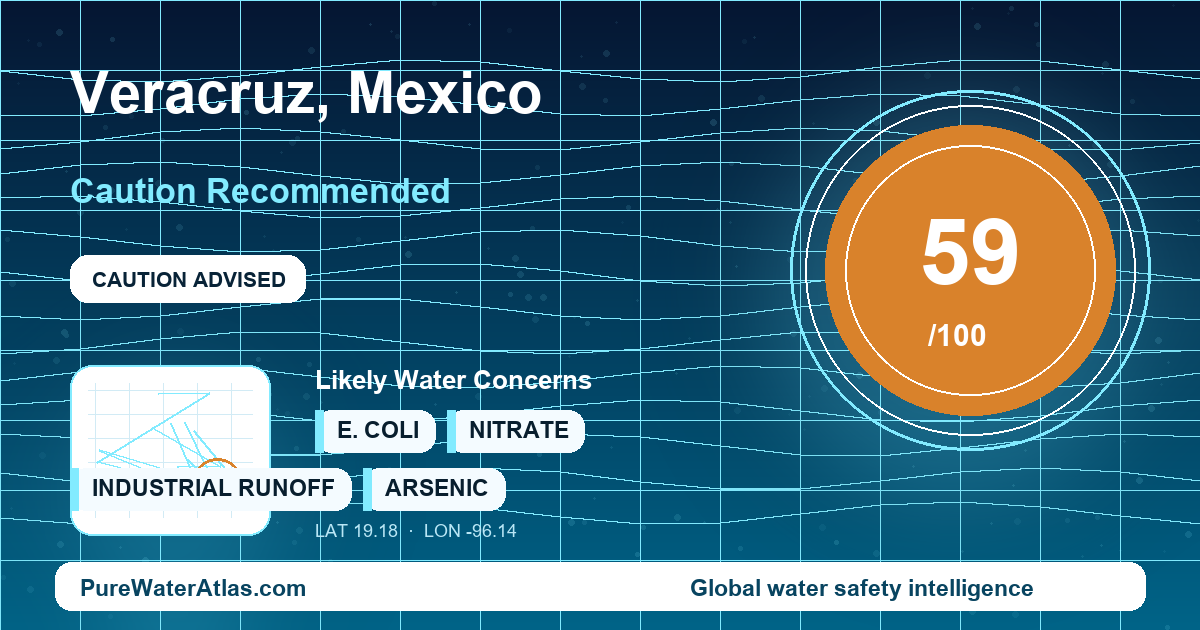
Veracruz, Mexico: a coastal Gulf port city where treated municipal water, river-basin supply, groundwater wells, storms, pressure interruptions, older pipes, and household tanks all affect whether tap water is safe at the point of use.
Quick Answer
| Overall safety status | Caution recommended. Veracruz has a defined municipal water system and treated supply, but tap safety can change after treatment because of distribution pipes, pressure drops, building plumbing, cisterns, and rooftop tanks. Publicly available, current, neighborhood-level tap-water test results are limited. |
|---|---|
| Water safety score | 59 / 100 — Risk level: Caution Recommended. |
| Traveler advice | Do not use tap water as the routine drinking source. Use sealed bottled water, reputable garrafón water, or water that has been boiled, filtered, and disinfected. |
| Resident advice | Treat the public supply as utility water that often needs point-of-use management for drinking. Use reputable garrafón water or a maintained home system matched to actual test results. |
| Main water system | Veracruz is associated with the Jamapa-Cotaxtla river basin, including surface-water capture and treatment around El Tejar in Medellín de Bravo, with supplementary groundwater wells from the coastal aquifer system. |
| Local authority | The main drinking-water service provider for Veracruz municipality is Grupo Metropolitano de Agua y Saneamiento, commonly known as Grupo MAS, operating under a concession arrangement. |
| Filter recommendation | For drinking, consider sediment prefiltration plus activated carbon, followed by UV or ultrafiltration where cisterns or tinacos are used. Reverse osmosis may be appropriate if testing shows high TDS, chloride, nitrate, or salinity-related taste. |
Why Veracruz Is Different
Veracruz is not a generic inland water system. It is a low-lying Gulf of Mexico port city at sea level in a humid tropical coastal setting. That geography matters for drinking water because the system is exposed to storm runoff, flooding, hurricane-season disruption, coastal aquifer stress, and salinity pressure. A short period of heavy rain, a tropical storm, a power outage, a water cut, or sediment disturbance in the distribution network can change the practical risk at the tap even when the municipal supply is normally treated.
The most important point for Veracruz is that safety is not determined only at the treatment plant. Water moves through transmission mains, pumping stations, an aging urban distribution network, and then into building-level cisterns, rooftop tinacos, hotel tanks, private booster systems, and internal plumbing. A clean treated supply can become less reliable if it loses chlorine residual, sits in an unclean tank, flows through corroded building pipes, or enters a building after low-pressure events.
For this reason, PureWaterAtlas classifies Veracruz as Caution Recommended, not as a city where tap water should be treated as universally unsafe for every use, and not as a city where every tap can be assumed safe for direct drinking. The practical local pattern is clear: many people use municipal water for bathing, cleaning, and sometimes cooking after boiling, while relying on garrafón, bottled water, or filtered water for direct drinking.
Where Does Veracruz’s Tap Water Come From?
Veracruz is part of the Veracruz-Boca del Río-Medellín coastal urban area. The principal raw-water system is publicly associated with the Jamapa-Cotaxtla river basin, especially surface-water capture and treatment around El Tejar in the Medellín de Bravo area. This infrastructure is commonly referenced as a major potabilization point for the metropolitan supply. Groundwater wells in the Veracruz coastal aquifer system are also used as complementary supply in the metropolitan network.
The main infrastructure picture includes river-basin surface water, potabilization infrastructure, supplementary coastal wells, transmission mains, pumping stations, and the municipal distribution network. After the public network, a second layer of infrastructure becomes highly important: private cisterns, rooftop tinacos, hotel storage tanks, valves, pipes, and booster pumps. These building-level components can strongly affect tap-water quality after the public meter.
Historically, the metropolitan area relied on a mixture of local wells, Jamapa-system surface water, storage infrastructure, and distribution networks inherited from earlier public operators, including SAS Metropolitano. The later concession model did not remove the practical household risks created by old pipes, intermittent pressure, and private storage tanks. For a household, hotel, or rental apartment in Veracruz, the actual water coming from the kitchen or bathroom tap can differ from the water leaving treatment.
Who Manages Drinking Water in Veracruz?
The main local drinking-water service provider for Veracruz municipality is Grupo Metropolitano de Agua y Saneamiento, or Grupo MAS, operating under a concession arrangement. Local oversight is associated with municipal and metropolitan water governance, including the Instituto Metropolitano del Agua where applicable. The broader water-resource framework is national: CONAGUA manages water resources and water-rights information, while sanitary quality requirements are framed by Mexican health regulations.
Mexico’s federal drinking-water quality requirements include NOM-127-SSA1-2021, which sets permissible limits for water for human use and consumption. COFEPRIS and state health authorities are relevant for sanitary surveillance. CONAGUA resources such as the Sistema Nacional de Información del Agua and the Registro Público de Derechos de Agua provide official hydrologic and water-rights context.
However, this page should not be read as a verified universal compliance finding for every Veracruz tap. Publicly accessible, current, neighborhood-level results for E. coli, total coliform, chlorine residual, turbidity, lead, nitrate, chloride, and tank-level quality are not consistently available in a consolidated public form. That limitation matters because Veracruz water quality can vary building by building.
Main Local Water Concerns
- Microbial risk after treatment: Low-pressure events, pipe intrusion, flooding, and poorly maintained cisterns or tinacos can create conditions where microbial contamination becomes a concern at the tap.
- Turbidity and sediment: Heavy rains, river runoff, pipe repairs, pressure changes, and tank disturbance can increase cloudiness or visible particles. Turbid water can also reduce disinfection reliability.
- Coastal salinity and dissolved solids: Groundwater sources in coastal systems can be vulnerable to elevated salinity, chloride, and total dissolved solids, especially when pumping pressure and drought conditions stress aquifers.
- Chlorine residual loss: Chlorine taste or odor may be noticeable, but from a safety standpoint, the greater concern is loss of residual disinfectant after storage in building tanks.
- Older buildings and plumbing: Properties in the historic center or older neighborhoods may have internal pipes, deposits, valves, or tanks that differ significantly from newer hotels and buildings.
- Data uncertainty: Public evidence is not sufficient to make precise citywide claims about lead, arsenic, nitrate, PFAS, or microbiological compliance at every Veracruz tap.
Season also matters. Rainy season and tropical-storm periods can increase source-water turbidity, runoff, flooding, and sewer cross-contamination risk. Dry-season low flows can strain river and well supplies and may worsen taste, odor, pressure, and salinity issues in some coastal systems. Nortes and hurricanes can cause power outages, pumping interruptions, pipe breaks, and temporary changes in water clarity or disinfection reliability. After water cuts, first-flow water should be treated cautiously because it can carry sediment or have lower disinfectant residual.
For Travelers
For most short-term visitors, tap water in Veracruz is not recommended as the routine drinking choice. The simplest low-risk routine is sealed bottled water for drinking, bottled or purified water for brushing teeth, purified ice only, and hot drinks made with boiled water. This advice is especially important for children, pregnant travelers, immunocompromised people, and anyone with a sensitive stomach.
Brushing teeth with bottled or purified water is the conservative recommendation. Some experienced travelers may tolerate small incidental exposure, but it is not the lowest-risk option. If staying in a hotel, use the complimentary bottled water or garrafón for drinking and do not assume bathroom tap water is equivalent to the water served at breakfast, a bar, or a restaurant.
Ice should be treated as a separate question. In established hotels, higher-end restaurants, and tourist-oriented venues, ice is often made from purified water, but travelers should verify this rather than assume. Be more cautious with street stalls, informal vendors, and locations where the source of ice is not clear.
If staying in an apartment or long-stay rental, ask how the building stores water and when tanks were last cleaned. After outages, run the tap before use, avoid cloudy first-flow water, and do not drink from a building tank unless the owner can document cleaning and treatment. If you need an emergency method during disruptions, see the PureWaterAtlas Boiling Water Purification: Complete Guide.
For Residents
Residents in Veracruz should manage drinking water at the point of use unless they rely entirely on reputable garrafón water. A practical home-treatment approach is sediment prefiltration to protect equipment, activated carbon for taste and chlorine-related issues, and then a microbiological barrier such as UV or ultrafiltration where cisterns or tinacos are part of the system. UV water purification can be useful when properly sized, powered, and maintained, but it should not be treated as a substitute for cleaning dirty storage tanks.
Reverse osmosis can be worth considering if testing shows high TDS, chloride, nitrate, or salinity-related taste. It requires maintenance, cartridge changes, membrane care, and in many homes remineralization may be preferred for taste. The correct system depends on actual test results rather than a citywide assumption. PureWaterAtlas’ guide to Water Treatment Systems explains how to match treatment technology to the problem.
Testing priorities for Veracruz homes should include total coliform and E. coli at the kitchen tap, especially after flooding, tank cleaning, long absences, or repeated gastrointestinal illness in the household. Check free chlorine residual at the tap and after the cistern or tinaco; absent residual can indicate vulnerability to microbial regrowth. Measure turbidity, color, odor, pH, conductivity, total dissolved solids, chloride, and hardness to screen for sediment and salinity problems.
Private-well users or households with infants should add nitrate testing. Older buildings or buildings with unknown plumbing should test lead and copper using appropriate first-draw and flushed samples. If water is reddish, black, metallic, or staining fixtures, add iron and manganese testing and inspect building pipes and tanks. Use an accredited laboratory when results will guide health decisions; field strips are useful for screening but not definitive for microbiology or metals.
Cisterns and tinacos are major control points in Veracruz. Keep lids sealed, prevent insect and dust entry, clean and disinfect tanks on a regular schedule, and retest after cleaning. A municipal supply that leaves treatment in acceptable condition can become unsafe if it is stored in an open, dirty, or stagnant tank.
Relevant Contaminants and Water-Quality Issues
The most relevant Veracruz issues are not limited to one contaminant. They involve a chain of source water, treatment, distribution, pressure, storage, and household plumbing. Start with E. coli in Drinking Water because microbial testing is the most important safety check when tanks, low pressure, or flooding are concerns. Also review Turbidity in Drinking Water and Sediment in Drinking Water, since storms, repairs, and post-outage flushing can disturb particles and cloudiness.
Chlorine in Drinking Water is relevant because disinfectant residual helps indicate whether treated water remains protected through pipes and storage. In older Veracruz buildings, Lead in Drinking Water may be relevant to building plumbing, although citywide lead conditions should not be assumed without testing. Nitrate in Drinking Water is most relevant for private wells, infant households, or situations where sewage or agricultural influence is suspected.
How to Verify Your Water Quality
Because Veracruz lacks consistently public, tap-by-tap monitoring data for every neighborhood and building type, verification should be local and practical. Test the water you actually drink: the kitchen tap, filtered tap, garrafón dispenser, cistern outlet, or rooftop-tank-fed line. If a result will guide health decisions, use an accredited laboratory rather than relying only on field strips.
For a structured testing plan, use the PureWaterAtlas Water Testing guide. To understand what makes tap water safe beyond appearance and taste, see Drinking Water Safety. For microbial risk from tanks, pressure loss, and flooding, review Water Microbiology.
If you receive a lab report and need to look up individual parameters, use the Contaminants Search Engine. Travelers comparing Veracruz with other destinations can also use the Global Water Quality Checker.
Official and Technical Sources
- Grupo MAS Agua official website — local concessionaire information for water and sanitation service in Veracruz and the metropolitan service area.
- NOM-127-SSA1-2021 — Mexican federal drinking-water quality standard for water for human use and consumption.
- COFEPRIS: Agua de uso y consumo humano — federal health authority context for sanitary surveillance.
- CONAGUA Sistema Nacional de Información del Agua — national hydrologic and water-resource information.
- CONAGUA Registro Público de Derechos de Agua — official water-rights and concession information.
- CONAGUA inventory of municipal potabilization and wastewater treatment plants — technical context for municipal treatment infrastructure.
- CONAGUA groundwater availability publications — relevant to coastal aquifer stress and salinity risk.
- CONAGUA Organismo de Cuenca Golfo Centro — regional water-resource management context for the Gulf-center basin area.
- INEGI geographic areas: Veracruz de Ignacio de la Llave — official geographic and demographic context.
- H. Ayuntamiento de Veracruz — municipal government source for local context and public notices.
Bottom Line
Tap water in Veracruz should be approached with caution for direct drinking. The city has a treated municipal supply associated with the Jamapa-Cotaxtla basin, El Tejar treatment infrastructure, supplementary coastal wells, and a concessioned utility operator, but household safety depends heavily on distribution pressure, old pipes, storms, storage tanks, and building maintenance. Visitors should use sealed bottled or purified water for drinking and brushing teeth, and verify that ice is purified. Residents should either use reputable garrafón water or maintain a tested point-of-use system, with special attention to cisterns, tinacos, chlorine residual, E. coli, turbidity, salinity indicators, and older plumbing. Current public neighborhood-level tap data are limited, so the safest answer is building-specific verification.
Read the full guide: Global Water Quality Guide
Explore more in this category: Global Water Quality Articles