
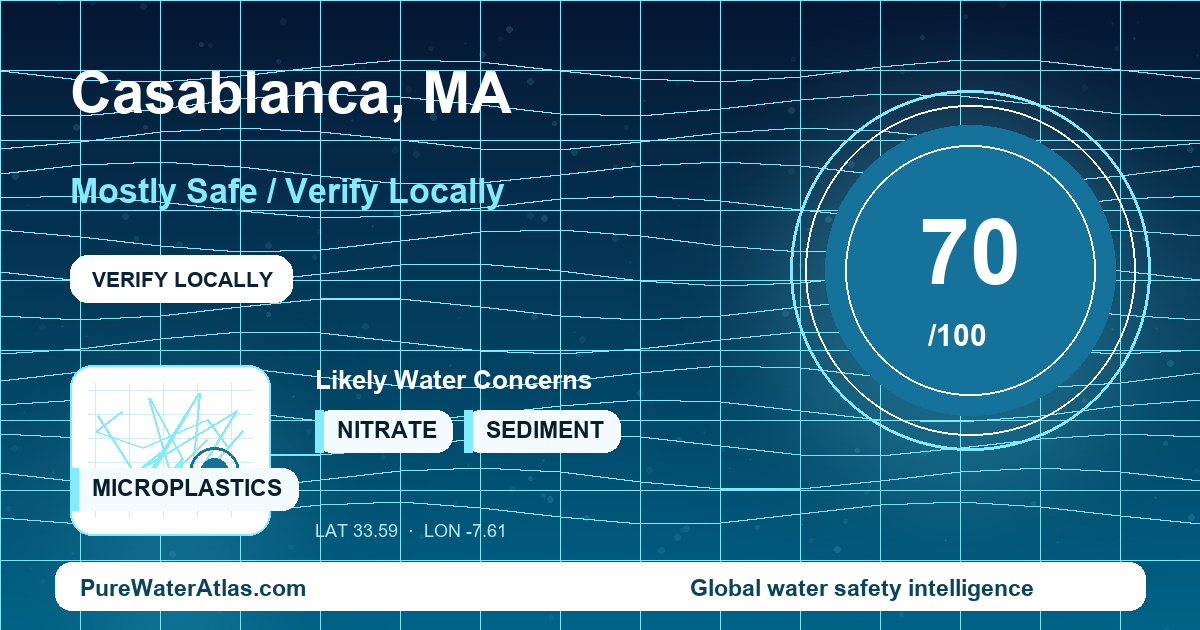
Casablanca tap water is generally treated municipal water, but drought pressure, changing regional source blends, building plumbing, storage tanks, sediment, chlorine taste, and limited neighborhood-level public data make local verification important.
Quick Answer
| City | Casablanca, Morocco |
|---|---|
| PureWaterAtlas safety score | 70 / 100 |
| Risk level | Mostly Safe / Verify Locally |
| Can visitors drink it? | Healthy adult travelers can often use Casablanca tap water, especially in modern hotels and restaurants, but bottled water or a certified point-of-use filter is the lower-risk choice for drinking during a short visit. |
| Brushing teeth | Generally reasonable for most travelers. Use bottled water if immunocompromised, traveling with infants, recovering from stomach illness, or staying in a building with questionable tanks or visible water-quality problems. |
| Main water source | Treated regional surface-water systems, with important inputs associated with the Oum Er-Rbia basin and Bouregreg system depending on hydrology and operations. |
| Water authority context | Bulk drinking-water production and transmission are strongly associated with ONEE; Greater Casablanca distribution has historically been managed by Lydec under delegated public-service arrangements. |
| Filter recommendation | Not automatically required for every household, but a sediment prefilter plus activated carbon is practical for taste, chlorine, and particles. Test before choosing reverse osmosis or specialized treatment. |
PureWaterAtlas rates Casablanca as Mostly Safe / Verify Locally. The issue is not a single confirmed citywide contaminant in the reviewed sources. The practical risk is that water quality at a kitchen tap may differ from water leaving the utility system because of old plumbing, rooftop or underground tanks, private booster systems, stagnation, service interruptions, and local sediment disturbance.
Why Casablanca Is Different
Casablanca is Morocco’s largest urban and economic center on the Atlantic coast, but its coastal location does not mean that city taps simply receive desalinated seawater. The municipal drinking-water system has historically depended on large regional surface-water resources, treatment plants, reservoirs, and long-distance conveyance rather than a single local wellfield or a simple coastal supply.
The most important city-specific feature is the separation between bulk water production and local distribution. ONEE, the Office National de l’Electricité et de l’Eau Potable, is central to Morocco’s national drinking-water production and transmission infrastructure. In Greater Casablanca, local urban distribution has historically been handled by Lydec under delegated management. That means tap water quality can be influenced by two layers: regional raw-water conditions before treatment, and the local distribution network, building plumbing, and private storage after treated water enters the city.
Casablanca’s rapid urban growth and the wider Casablanca-Settat region’s demand have also increased dependence on national water planning. Recent Moroccan drought cycles have made source-water security, reservoir levels, and diversification major policy issues. Desalination is part of the region’s strategic drought-resilience planning, but travelers should not assume that seawater desalination is already the dominant source at every Casablanca tap.
Where Does Casablanca’s Tap Water Come From?
Casablanca is supplied mainly by treated water produced from regional surface-water systems. Bulk water for the Greater Casablanca area is associated with Morocco’s national production system operated by ONEE, with important inputs from the Oum Er-Rbia basin and the Bouregreg system depending on hydrology and operating conditions. Reservoir and river systems relevant to the Casablanca-Settat supply include Oum Er-Rbia dams such as Al Massira and Daourat, and the Bouregreg system associated with the Sidi Mohammed Ben Abdellah dam.
The exact blend can vary over time. Drought years, reservoir status, treatment-plant operations, and system-management decisions can change which source contributes more at a particular moment. For a specific district, date, or property, the current operator is the appropriate place to verify the active supply context.
Key infrastructure serving Casablanca includes ONEE bulk drinking-water production and transmission facilities, surface-water treatment plants connected to the Oum Er-Rbia and Bouregreg raw-water systems, large storage and distribution reservoirs feeding Greater Casablanca, and the urban distribution network historically operated by Lydec. Disinfection, generally including chlorination, is used to maintain a residual through the distribution system.
Coastal groundwater and local aquifers matter in the wider regional water context, but they should not be assumed to be the primary drinking-water source at a municipal tap without current operator confirmation. Casablanca’s water identity is regional, treated, and infrastructure-dependent.
Who Manages Drinking Water in Casablanca?
For Greater Casablanca, drinking-water distribution has historically been managed by Lydec under a delegated public-service contract. Lydec provides customer-facing information on potable water service and water quality for its service area. Bulk water production and transmission are strongly associated with ONEE, Morocco’s national water and electricity utility.
Morocco is also transitioning urban water, electricity, and sanitation services toward regional multiservice companies. Residents should therefore verify the current billing and operational entity for their commune and service year rather than relying on older assumptions about the local operator.
Drinking-water oversight in Morocco involves national water and public-health institutions, including the Ministry of Equipment and Water for water resources, ONEE for national drinking-water production and supply functions, and health authorities for sanitary oversight. Moroccan drinking-water quality is generally framed around national standards and sanitary control. However, PureWaterAtlas did not identify a continuously updated, neighborhood-level public dashboard for Casablanca comparable to some European or North American consumer confidence reports. This limits the confidence of any claim that every tap in every building is safe at all times.
Main Local Water Concerns
The main concerns in Casablanca are practical and local rather than based on one confirmed citywide contaminant. Drought and reservoir stress affecting the Oum Er-Rbia and other regional source systems can put pressure on source-water management and may influence operational choices. During periods of low raw-water availability or changing source blends, users may notice changes in taste, mineral character, or perceived salinity.
Chlorine taste or odor is another common type of concern in treated municipal systems. Chlorination is important for microbial protection, but warm weather, local dosing, and building plumbing can affect how the water smells or tastes at the tap. Temporary turbidity or brown water can occur after pipe works, pressure changes, repairs, or localized network disturbances. In those situations, residents should avoid drinking discolored water until it has run clear and local advice has been checked.
Building-level conditions are especially important in Casablanca. A modern hotel or apartment connected directly to the municipal network may receive acceptable treated water, while an older building with a rooftop tank, basement cistern, corroded plumbing, poorly maintained booster system, or stagnant internal lines may deliver water with more sediment, taste, odor, or microbial risk than the utility water in the main.
Potential lead or metal exposure is best treated as a building-plumbing risk in older properties, not as a proven citywide Casablanca finding from the reviewed sources. Microbial risk can increase where private tanks are uncovered, cracked, warm, rarely cleaned, or exposed to insects and dust. Industrial and urban pressure in the wider Casablanca-Settat region makes source-water protection important, but the reviewed public evidence does not support naming a single confirmed industrial contaminant affecting the whole city’s tap water.
For Travelers
For a healthy adult traveler, Casablanca tap water is usually treated municipal water, but bottled water is the safer default for drinking if you are visiting briefly and cannot verify the building’s plumbing or tank hygiene. This is especially true for first-time visitors, people with sensitive stomachs, infants, pregnant travelers, and immunocompromised travelers.
Brushing teeth with tap water is generally a reasonable practice in Casablanca for most travelers. Use bottled water for brushing if you are immunocompromised, traveling with a baby, recovering from gastrointestinal illness, or staying in an apartment, guesthouse, or older building where storage tanks or visible water-quality issues are present.
Ice in established hotels, cafés, and restaurants is usually lower risk than informal ice sources, but travelers with sensitive stomachs should avoid ice unless they know it is made from treated or bottled water. Avoid ice from street vendors or unknown sources. In modern hotels and established restaurants, municipal supply and internal maintenance practices are more likely to be consistent. Still, cautious travelers should ask whether drinking water and ice are filtered or bottled.
Tap water is typically acceptable for showering, handwashing, and cooked foods. Do not drink water that is brown, cloudy, has a sewage-like odor, or appears immediately after a service outage until it has run clear and local guidance has been checked. If you are staying in an older riad, apartment, or small guesthouse, ask whether the property uses a rooftop tank and when it was last cleaned.
For Residents
A home filter is not automatically required for every Casablanca household connected to the municipal network. However, filtration can be practical for improving taste, reducing chlorine odor, capturing sediment, and adding a margin of safety where internal plumbing or storage tanks are uncertain. A sediment prefilter plus activated carbon is a sensible starting point for visible particles, chlorine taste, and odor.
Reverse osmosis may be considered where salinity, nitrate, or dissolved contaminants are a specific tested concern, but it should not be installed blindly. RO systems require maintenance, membrane replacement, and storage-tank hygiene. Testing before and after installation is the best way to confirm whether the system is solving the actual problem.
Residents should test tap water if they live in an older building, especially where plumbing materials are unknown or the water has a metallic taste after stagnation. Consider lead testing at the kitchen tap in older properties, buildings with old service connections, or homes with brass or unknown plumbing components. Use cold water for drinking and cooking, and flush the tap after long stagnation, particularly in homes with infants, pregnant people, or children.
If your building uses rooftop tanks, underground cisterns, private pumps, or booster systems, microbial testing is important when there has been flooding, tank cleaning problems, unusual odor, or illness concerns. Test for E. coli or total coliforms where tank hygiene is uncertain. Tanks should be sealed, protected from insects and dust, cleaned on a documented schedule, and bypassed for drinking if maintenance cannot be verified.
If water is frequently brown, cloudy, or leaves sediment, test for turbidity, iron, manganese, and basic chemistry. After a major service interruption or pipe repair, flush cold-water taps until clear and avoid using discolored water for drinking or infant formula.
Relevant Contaminants and Water-Quality Issues
Casablanca’s most relevant water-quality issues are linked to treatment, distribution, and building conditions. Chlorine in drinking water is relevant because chlorination can produce noticeable taste or odor even when water is microbiologically treated. Turbidity in drinking water matters when water becomes cloudy after raw-water events, pipe works, or pressure changes. Sediment in drinking water is especially relevant for older buildings, rooftop tanks, and local pipe disturbance.
Lead in drinking water should be considered as a possible older-building plumbing issue, not a confirmed citywide Casablanca finding from the reviewed sources. E. coli in drinking water is relevant when private tanks, cisterns, or plumbing intrusions create microbial risk after treated water has left the public main. Nitrate in drinking water is relevant to wider watershed and agricultural-runoff questions, especially where residents want to verify dissolved contaminants rather than rely on assumptions.
How to Verify Your Water Quality
Because detailed, current, neighborhood-level drinking-water results are not consistently available in a transparent public format, point-of-use verification is important in Casablanca. Start by checking your current local operator or bill for the active service entity in your commune. Review customer information from the local distributor, and ask building management whether water is supplied directly from the municipal network or through rooftop or underground tanks.
For practical decision-making, use the PureWaterAtlas guide to water testing to choose lab parameters based on the suspected problem. If the concern is old plumbing, see lead testing and detection methods. If the concern is tank-related microbial risk, boiling can help during suspected microbial events; review the boiling water purification guide. UV treatment may be relevant for households using storage tanks, but only when turbidity is controlled first; see the UV water purification guide.
Use the PureWaterAtlas Contaminants Search Engine to look up any contaminants mentioned in utility reports or lab results. The Global Water Quality Checker can help compare Casablanca with other cities. For broader decision frameworks, see Drinking Water Safety, Water Treatment Systems, and Global Water Quality.
Official and Technical Sources
- Lydec customer information on potable water quality — local utility information for the Greater Casablanca service area.
- Lydec potable water service information — local potable-water distribution context for Casablanca.
- ONEE Water Branch — national operator source for drinking-water production, supply, and water-sector infrastructure in Morocco.
- Morocco Ministry of Equipment and Water: water resources and dams — official information on water resources, dams, and national water-sector context.
- FAO AQUASTAT Morocco country profile — international overview of Morocco’s water resources, withdrawals, and water-stress context.
- World Bank: Morocco is building resilience to water scarcity — context on drought and water scarcity affecting national planning.
- WHO Guidelines for Drinking-water Quality — international reference for interpreting drinking-water risks where local data are incomplete.
- Moroccan Ministry of Health and Social Protection — national public-health authority relevant to sanitary oversight.
Bottom Line
Casablanca tap water is generally treated municipal water and is commonly usable in the city, but PureWaterAtlas does not rate it as universally safe at every tap. The main local issues are drought pressure on regional surface-water sources, possible changes in taste or mineral character, chlorine odor, temporary turbidity after works or pressure changes, and building-level risks from old plumbing, rooftop tanks, cisterns, and private booster systems. Most travelers can brush teeth with tap water, but bottled water is the lower-risk drinking choice for short visits and sensitive groups. Residents should verify their building system, maintain tanks, flush after stagnation or repairs, and test water in older or tank-fed buildings before choosing specialized filtration.
Read the full guide: Global Water Quality Guide
Explore more in this category: Global Water Quality Articles