
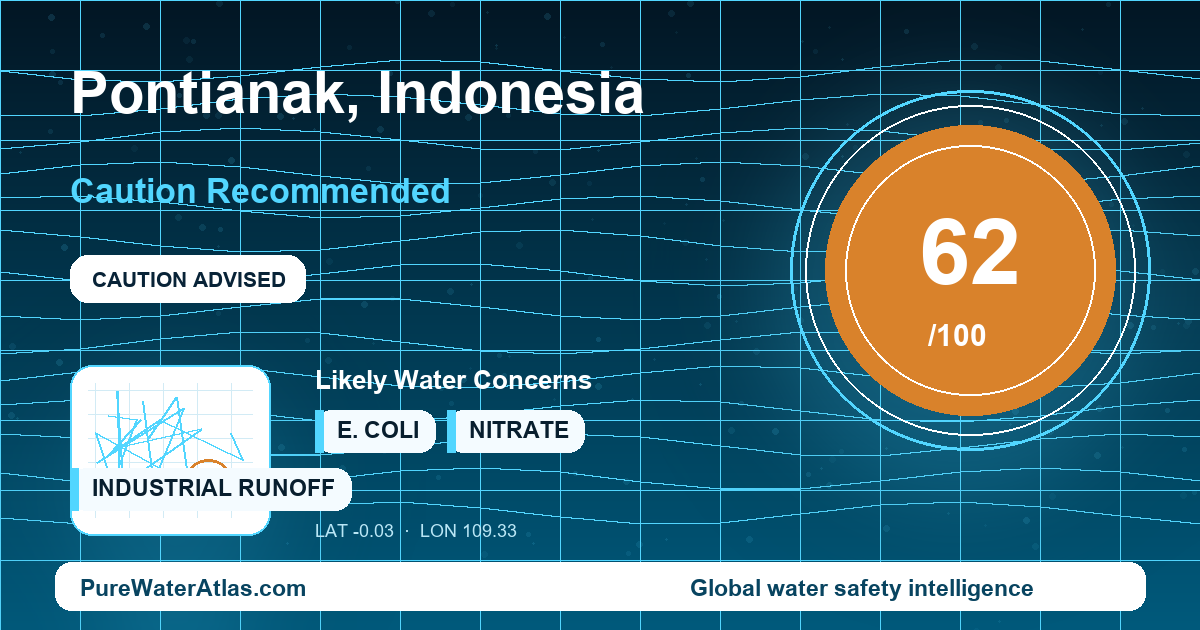
Pontianak’s tap water is utility-treated river water from a low-lying Kapuas system setting where salinity, turbidity, peat-colored organic matter, household storage, and distribution conditions make final-tap drinking safety uncertain without boiling or treatment.
Quick Answer
| Water safety score | 62 / 100 |
|---|---|
| Risk level | Caution Recommended |
| Can visitors drink the tap water? | No. Short-term visitors should not drink Pontianak tap water straight from the tap. Use sealed bottled water, reputable refill-gallon water, or water that has been boiled or reliably filtered. |
| Resident guidance | Municipal water can generally be used for washing and household use, but drinking water should have a household barrier such as boiling, maintained filtration, UV, RO where appropriate, or tested refill water. |
| Main water source | Treated surface water from the Kapuas River system, especially the Kapuas Kecil and Landak river environment. |
| Local authority | Perumda Air Minum Tirta Khatulistiwa Kota Pontianak operates the municipal piped-water system. |
| Filter recommendation | For drinking, use boiling for microbial safety when uncertain. For routine household treatment, consider sediment filtration, activated carbon, UV disinfection, and RO if salinity or dissolved-solids taste is recurring. |
Pontianak has a formal municipal water utility and treated piped-water supply, but PureWaterAtlas classifies the city as Caution Recommended rather than “drink directly from the tap.” The key issue is not only treatment at the plant; it is whether water remains safe at the final tap after river-water variability, dry-season salinity, turbidity, pressure interruptions, pipe work, and household storage tanks.
Why Pontianak Is Different
Pontianak is not an inland city supplied by a deep protected upland reservoir. It is an equatorial, low-lying river city in West Kalimantan, located around the Kapuas and Landak river confluence area. That geography strongly shapes its drinking-water risk profile. The city’s municipal water is principally treated surface water, and the raw-water environment is influenced by river flow, tides, rainfall, peat-colored organic matter, sediment, urban runoff, and dry-season saline intrusion.
This setting makes Pontianak’s water safety more complex than a simple “treated equals drinkable” judgment. During rainy periods, river turbidity, color, runoff, floodwater influence, and sediment disturbance can increase treatment challenges and final-tap concerns. During dry periods or low river-flow conditions, saline intrusion into lower river reaches can affect taste and raw-water suitability. A Pontianak-specific point is important: boiling does not remove salt or chloride taste. Boiling can reduce microbial risk when done correctly, but if the water tastes salty, users need a safe alternative source, blending, or an appropriate treatment technology such as reverse osmosis.
Household practice in Pontianak also reflects the local environment. Historically, residents in Pontianak and surrounding West Kalimantan lowlands have used combinations of river water, rainwater, shallow groundwater, and later municipal piped water. In peat and coastal alluvial settings, shallow groundwater can be acidic, colored, iron-rich, or brackish. That background helps explain why many households still rely on boiling, rainwater storage, refill-gallon water, filters, or dispensers rather than direct tap drinking.
Where Does Pontianak’s Tap Water Come From?
Pontianak’s municipal water supply is a treated surface-water system drawing from the Kapuas River system, particularly the Kapuas Kecil and Landak river environment. The city’s raw-water quality is therefore linked to Kapuas catchment hydrology, rainfall, tides, river mixing, and lowland conditions rather than to a fully protected deep groundwater source.
The municipal system depends on river-water intakes, water treatment plants, pumps, reservoirs, and distribution mains across the city. At the household and building level, water may pass through additional storage or treatment before it is consumed: roof tanks, ground tanks, refill-gallon bottles, sediment filters, activated carbon cartridges, UV units, reverse osmosis systems, kettles, and dispensers are all part of the practical drinking-water landscape.
Raw-water security is a continuing local issue because saline intrusion can affect the lower Kapuas system during dry periods. Indonesian public-works authorities have reported raw-water and intake planning relevant to the wider Pontianak area, and these projects matter because the suitability of river water can change when low river flow allows salinity to move upstream. For households, the practical signal is often taste: if water becomes noticeably salty, boiling is not a solution for drinking quality.
Who Manages Drinking Water in Pontianak?
The local municipal water utility is Perumda Air Minum Tirta Khatulistiwa Kota Pontianak. The utility is responsible for Pontianak’s piped-water service, operational notices, and municipal supply functions. City context and public-service information are also provided by the Pemerintah Kota Pontianak, while official demographic, geographic, sanitation, and infrastructure context can be checked through Badan Pusat Statistik Kota Pontianak.
At the national level, Indonesia’s drinking-water and environmental-health quality framework includes Ministry of Health Regulation No. 2 of 2023. Public-works institutions such as Kementerian Pekerjaan Umum dan Perumahan Rakyat and the Balai Wilayah Sungai Kalimantan I are relevant for water-supply infrastructure, raw-water security, and Kapuas basin water-resources context.
A major limitation for consumers is transparency at the tap. Pontianak has identifiable utility and regulatory structures, but recent public, citywide, tap-level laboratory datasets and neighborhood distribution-zone residual results are limited. For that reason, this profile does not claim that every tap in Pontianak meets or fails a specific drinking-water standard. The assessment is based on the known river-water setting, treatment system, seasonal risks, and final-tap vulnerabilities.
Main Local Water Concerns
- Seasonal saline intrusion: During dry periods or low river-flow conditions, the lower Kapuas system can be affected by saltwater intrusion. Tap water may taste salty, and boiling will not remove that salt taste.
- Turbidity and sediment: Rainfall, runoff, river conditions, pipe disturbance, and household tanks can increase suspended particles. Learn more about turbidity in drinking water and sediment in drinking water.
- Peat-influenced color and organic matter: Pontianak’s lowland peat and alluvial setting can contribute color, natural organic matter, and low-pH tendencies in some raw-water or shallow groundwater sources.
- Microbial risk at the point of use: Even treated water can become risky if pressure is intermittent, pipes are disturbed, storage tanks are dirty, or water is transferred into unclean containers. E. coli in drinking water is a key indicator of fecal contamination.
- Private well variability: For shallow groundwater, iron, manganese, pH, salinity indicators, nitrate, and microbial contamination should be tested rather than assumed. See iron and manganese.
- Localized plumbing metals: Lead is not documented here as a citywide Pontianak crisis, but older buildings, brass fittings, unknown plumbing, or stagnant water justify testing. See lead in drinking water.
For Travelers
Short-term visitors should not drink Pontianak tap water straight from the tap unless it has been boiled or treated with a reliable purifier and stored in a clean container. This is especially important for travelers with sensitive stomachs, children, pregnant travelers, older adults, and immunocompromised people. Use sealed bottled water, reputable refill-gallon water, or boiled and cooled water for drinking.
For brushing teeth, many healthy adults can use tap water if they avoid swallowing it, but cautious travelers should use bottled, boiled, or filtered water. This is particularly sensible after flooding, during stomach illness, after pipe repairs, or whenever the tap water is cloudy, discolored, salty, or has passed through a storage tank.
Use ice only where the source is credible. Established hotels, cafes, and restaurants may use commercial ice, gallon water, or filtration, but visitors should ask if drinking water is bottled, boiled, or filtered. Do not assume that a glass of water served at a restaurant is safe simply because it is clear. Avoid uncertain street ice or ice handled in open containers.
A practical Pontianak travel kit includes sealed water, a refill bottle filled from a trusted source, and access to a kettle. If boiling, bring water to a rolling boil and protect it from recontamination while cooling. If the water tastes salty, switch sources; boiling will not remove salinity.
For Residents
For Pontianak residents, municipal water can generally be used for washing and household purposes, but drinking water deserves an extra barrier. At minimum, boil water when microbial safety is uncertain. For regular use, a sensible household setup may include a sediment prefilter, activated carbon, and either UV disinfection or a well-maintained reverse osmosis system where salinity, taste, or dissolved solids are recurring concerns. Filters must be changed on schedule; neglected cartridges, UV sleeves, storage tanks, and dispenser lines can become contamination sources.
Testing is especially important for homes that drink tap or stored water without boiling, homes with private wells, older buildings, roof tanks, ground tanks, or repeated pressure interruptions. Test for total coliform and E. coli after flooding, pipe work, or pressure loss. During dry months, check turbidity, color, pH, electrical conductivity or TDS, and chloride to detect salinity and treatment stress. Private wells should also be checked for iron, manganese, nitrate, salinity indicators, pH, and microbial contamination before drinking use.
Older buildings should not be assumed safe based on appearance or taste. Pontianak does not have a documented citywide lead-in-water crisis in the available dataset, but localized risks can occur from old pipes, solder, brass fixtures, or stagnant water. Flush stagnant taps, avoid using hot tap water for cooking, and test first-draw and flushed samples if infants, pregnant people, or children will drink the water.
Storage tanks are a major final-tap issue. Roof tanks, ground tanks, and refill dispensers can become unsafe if uncovered, warm, stagnant, dirty, or exposed to insects, dust, or floodwater. Keep tanks sealed, clean them regularly, disinfect after contamination events, and do not assume tank water remains microbiologically safe merely because it originally came from the municipal network.
Relevant Contaminants and Water-Quality Issues
The most relevant Pontianak water-quality issues are not a single contaminant but a combination of river-water variability, treatment challenge, and final-tap handling. Turbidity and sediment matter because river flow, rain, pipe disturbance, and storage tanks can carry particles that interfere with disinfection and reduce consumer confidence. Chlorine is relevant because disinfectant residual helps protect treated water through the distribution network, but residual at the plant does not automatically guarantee every household tap or storage tank remains protected.
Microbial contamination is the most immediate health concern when water is untreated, stored poorly, or affected by pressure loss. E. coli testing is a practical indicator for fecal contamination risk. For private wells and shallow groundwater in lowland settings, iron, manganese, pH, salinity indicators, and microbial results should be confirmed by testing. For older buildings, localized lead risk should be evaluated with first-draw and flushed samples rather than guessed.
How to Verify Your Water Quality
Because public tap-level data for Pontianak is limited, verification at the point of use is the most reliable way to make household decisions. Start with the PureWaterAtlas guide to water testing, then choose tests based on your source: municipal tap, storage tank, refill water, or private well. For microbial risk, testing should include total coliform and E. coli, particularly after flooding, pipe repairs, or pressure drops.
For treatment choices, review Water Treatment Systems, Boiling Water Purification, and UV Water Purification. If salinity is the problem, remember that boiling and UV do not remove salt; testing conductivity, TDS, and chloride helps determine whether RO or an alternative drinking-water source is needed.
You can also compare city-level guidance through the Global Water Quality Checker, browse the Contaminants Search Engine, and use PureWaterAtlas pillar resources on Drinking Water Safety, Water Microbiology, and Global Water Quality.
Official and Technical Sources
- Perumda Air Minum Tirta Khatulistiwa Kota Pontianak — local municipal water utility responsible for Pontianak piped-water service.
- Pemerintah Kota Pontianak — official city government context and public-service information.
- Badan Pusat Statistik Kota Pontianak — official statistics agency for city demographic, geographic, sanitation, and infrastructure context.
- Balai Wilayah Sungai Kalimantan I — Kapuas basin and regional water-resources authority.
- Kementerian Pekerjaan Umum dan Perumahan Rakyat — national public-works authority for water-supply infrastructure programs.
- Ministry of Health Regulation No. 2 of 2023 — Indonesia’s national environmental-health and drinking-water quality framework.
- CDC Travelers’ Health: Indonesia — conservative food and water precautions for travelers.
- WHO Guidelines for Drinking-water Quality — international health-based guidance on microbial safety, turbidity, disinfection, and chemical contaminants.
Bottom Line
Pontianak tap water should be treated as utility-treated domestic water, not guaranteed ready-to-drink water at every final tap. The city’s Kapuas River-based supply, low-lying tidal setting, peat-influenced water conditions, dry-season salinity risk, rainy-season turbidity, and household storage practices create a more cautious profile than many simpler municipal systems. Visitors should use bottled, reputable refill, boiled, or reliably filtered water for drinking and should be careful with ice and restaurant water. Residents should use a maintained treatment barrier for drinking, test private wells and stored water, clean tanks, and watch for salty taste during dry periods. Current public tap-level compliance data is limited, so household verification remains important.
Read the full guide: Global Water Quality Guide
Explore more in this category: Global Water Quality Articles