
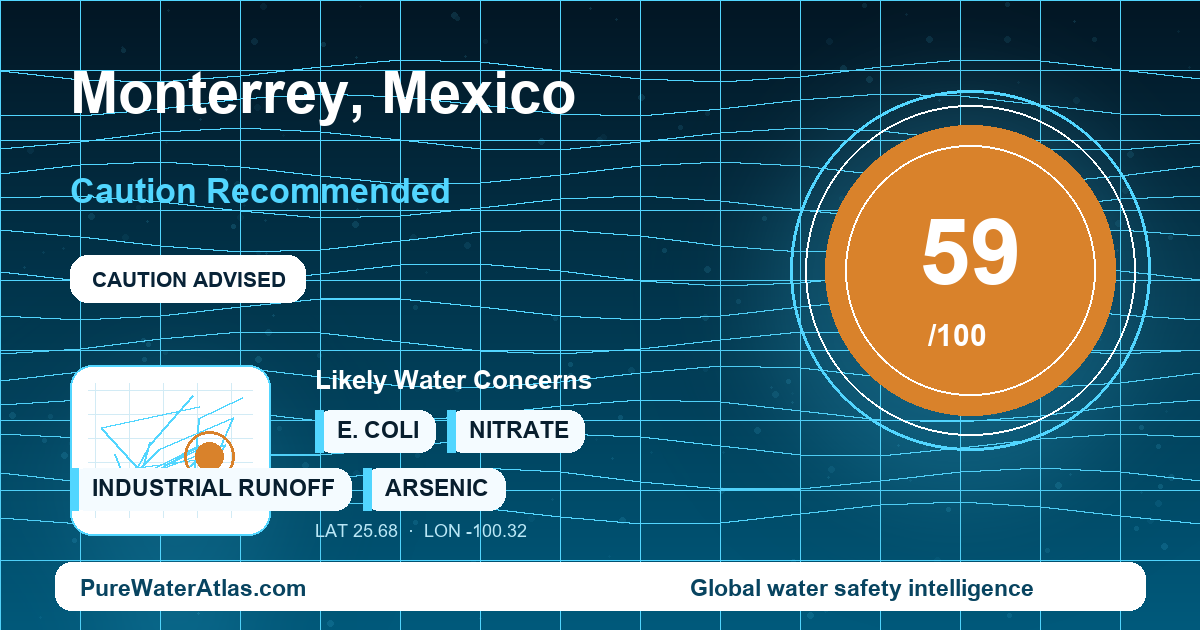
Monterrey, Mexico has a formal metropolitan water utility and treated municipal supply, but drought stress, intermittent-service history, private storage tanks, and limited neighborhood-level public water-quality data make caution appropriate at the tap.
Quick Answer
| Overall safety status | Caution recommended. PureWaterAtlas score: 59/100. Monterrey has treated municipal water, but tap safety can vary by building, storage system, pressure history, and recent service conditions. |
|---|---|
| For short-term visitors | Do not use tap water as the default drinking source. Choose sealed bottled water, garrafón water, or water that has been reliably filtered or boiled. |
| For residents | Residents connected to Servicios de Agua y Drenaje de Monterrey can often use tap water for many household purposes, but drinking decisions should account for building plumbing, cisterns, rooftop tanks, outages, sediment, and maintenance history. |
| Main water sources | A mixed metropolitan system using surface reservoirs such as Presa El Cuchillo, Presa Cerro Prieto, and Presa La Boca, plus groundwater wells and galleries. |
| Water authority | Servicios de Agua y Drenaje de Monterrey, I.P.D. is the public utility responsible for potable water, sewerage, and sanitation service in Monterrey and much of the metropolitan area. |
| Filter recommendation | A maintained point-of-use system is advisable for many homes: sediment prefilter plus activated carbon for taste and particles; reverse osmosis if testing shows dissolved-mineral, salinity, nitrate, arsenic, or other dissolved-contaminant concerns. |
Why Monterrey Is Different
Monterrey is not a simple “safe” or “unsafe” tap-water city. It sits in a semi-arid basin at the foot of the Sierra Madre Oriental, where rainfall variability, heat, reservoir storage, and drought cycles strongly affect water reliability. The city is served by a large, engineered metropolitan system, but the 2022 water emergency showed how quickly reservoir depletion can translate into restrictions, low pressure, and intermittent service.
This matters for drinking-water safety because water quality at the faucet is not determined only by treatment plants. In Monterrey, many households and businesses use garrafón water, point-of-use filters, cisterns, rooftop tinacos, pumps, and building-level storage. Even if water is treated and chlorinated before distribution, quality can change inside private plumbing or storage tanks. Low-pressure periods and service interruptions can also mobilize sediment or increase vulnerability where pipes or tanks are poorly maintained.
The practical verdict is therefore cautious: Monterrey’s municipal water should not be described as universally unsafe, but it also should not be treated as uniformly safe for every traveler, apartment, older building, or household. Publicly accessible, granular, neighborhood-by-neighborhood tap data are limited, so individual verification matters.
Where Does Monterrey’s Tap Water Come From?
Monterrey’s metropolitan supply relies on a mixed system of major surface reservoirs and groundwater sources. Key surface-water sources include Presa El Cuchillo on the Río San Juan system, Presa Cerro Prieto, and Presa La Boca near Santiago, Nuevo León. The system also uses groundwater wells and galleries, along with pumping stations, storage tanks, treatment, chlorination, and distribution infrastructure operated by the metropolitan utility.
Several pieces of infrastructure are central to Monterrey’s supply identity. El Cuchillo and its aqueduct infrastructure, including the newer Cuchillo II project, are intended to increase transfer capacity to the metropolitan area. Cerro Prieto is an important reservoir source but experienced severe depletion during recent drought conditions. La Boca is smaller but highly visible and has also been part of the city’s drought story. The Libertad reservoir project is intended to strengthen long-term reliability for the metropolitan area.
Historically, Monterrey depended on nearby mountain and groundwater sources associated with the Sierra Madre Oriental and local wells before larger reservoirs and aqueducts became central to metropolitan supply. That history still matters: the modern system is much larger, but it remains exposed to regional hydrology, reservoir storage, dry periods, and operational changes during shortage conditions.
Who Manages Drinking Water in Monterrey?
Drinking water and drainage service in Monterrey are managed by Servicios de Agua y Drenaje de Monterrey, I.P.D., commonly referred to as SADM. It is the public utility responsible for potable water, sewerage, and sanitation services in Monterrey and much of the metropolitan area of Nuevo León. State government information about the utility is also available through Gobierno de Nuevo León.
At the national level, Mexico’s water-resource context is overseen by CONAGUA, and hydrologic and reservoir information is available through the Sistema Nacional de Información del Agua. Drought conditions affecting Nuevo León and Monterrey’s source-water reliability are tracked through the CONAGUA Monitor de Sequía en México.
Mexico’s federal drinking-water quality requirements are set through standards such as NOM-127-SSA1-2021 for water for human use and consumption. This regulatory framework is important, but it does not prove that every faucet in every Monterrey building is safe on every day. Users should follow SADM service notices and official advisories, especially after outages, pressure changes, repairs, or visible discoloration.
Main Local Water Concerns
Drought and source-water stress are the highest-profile concerns for Monterrey. Low reservoir storage can force operational changes, pressure management, and greater reliance on alternative sources. These conditions primarily affect reliability, but they can also indirectly affect building-level water quality when service becomes intermittent or pressure is reduced.
Intermittent service and low pressure are especially relevant because Monterrey experienced a widely reported water emergency in 2022 after major reservoir depletion, particularly at Cerro Prieto and La Boca. Loss of continuous pressure can increase the chance of intrusion in compromised pipes and can loosen sediment when flow returns.
Turbidity, sediment, color, and taste changes may occur after outages, pipe work, reservoir shifts, or service restoration. Visible sediment does not automatically prove microbial contamination, but it is a practical warning sign. Water users should flush taps until clear, clean faucet aerators, avoid drinking visibly discolored water, and follow any utility or health-authority instructions.
Private cisterns and rooftop tinacos are a major building-level risk factor in Monterrey. Stored water can lose disinfectant residual and become contaminated if tanks are cracked, uncovered, dirty, or rarely cleaned. Older building plumbing can also introduce premise-plumbing risks such as lead-bearing solder, brass fixtures, galvanized lines, corrosion, or stagnant first-draw water. These are not confirmed citywide reservoir problems; they require tap-specific testing.
Hardness, dissolved minerals, salinity, and scaling can be relevant where groundwater influence or regional geology affects taste and mineral content. If water tastes salty, bitter, or strongly mineral, residents should test for total dissolved solids, hardness, chloride, sulfate, sodium, and conductivity rather than guessing from taste alone.
For Travelers
Short-term visitors to Monterrey should generally avoid untreated tap water as their default drinking source. Use sealed bottled water, garrafón water, or water that has been reliably filtered or boiled. This is a precaution based on traveler vulnerability, variable building plumbing, private storage tanks, and Monterrey’s recent history of supply interruptions, not a claim that all municipal water is unsafe when it leaves treatment.
For brushing teeth, many travelers in modern hotels with maintained plumbing use tap water, but cautious travelers, children, pregnant travelers, and anyone with a sensitive stomach should use bottled or purified water. Ask hotels or rentals whether drinking water comes from a filter, garrafón, or direct tap.
Use ice only in established hotels, restaurants, and cafés where ice is commercially produced or made from purified water. Avoid informal ice when the source is unclear. In restaurants, ask for agua purificada or bottled water. Reputable venues commonly use purified water systems or commercial ice, but visitors should not assume this in small venues unless confirmed.
Carry bottled water during hot weather. During any official advisory, service outage, pressure loss, or visible discoloration, use bottled water or boil water as instructed by authorities. Conservative travel-health guidance for Mexico is available from CDC Travelers’ Health.
For Residents
For Monterrey residents, the key question is not only “Is the city water treated?” but “What happens between the distribution system and my kitchen tap?” If your home has a cistern, rooftop tinaco, building pump, old pipes, or repeated low-pressure events, tap-water safety should be verified at the point of use.
A home filter is advisable for drinking and cooking water in many households. A practical setup is a sediment prefilter plus activated carbon to reduce particles and chlorine taste. If testing identifies dissolved-mineral, salinity, nitrate, arsenic, or other dissolved-contaminant concerns, reverse osmosis may be more appropriate. Filters should be certified for the target contaminant and maintained on schedule; an overdue cartridge can become a weak point rather than a safeguard.
Test kitchen-tap water after moving into a home, after major plumbing work, after repeated low-pressure events, or when water has persistent odor, color, sediment, salty taste, or metallic taste. In older homes or buildings with unknown plumbing, test first-draw and flushed samples for lead and other metals. If using a cistern, rooftop tank, private well, or building-level storage system, test for total coliform and E. coli and clean and disinfect tanks routinely.
After outages or visible sediment events, flush cold taps until clear, clean faucet aerators, replace clogged sediment cartridges, and follow any SADM or health-authority boil-water notice. Infants, pregnant people, elderly residents, and immunocompromised residents justify a more conservative approach and broader laboratory testing.
Relevant Contaminants and Water-Quality Issues
Several PureWaterAtlas contaminant profiles are especially relevant to Monterrey’s practical tap-water questions. Chlorine in drinking water explains why treated municipal systems maintain a disinfectant residual and why chlorine taste may be noticeable. Turbidity and sediment in drinking water are useful after storms, pipe work, pressure changes, or service restoration.
For building storage tanks, pressure-loss concerns, private wells, or suspected microbial contamination, review E. coli in drinking water and the PureWaterAtlas guide to water microbiology. For older buildings, lead in drinking water and lead testing methods are relevant because lead risk is usually tied to premise plumbing, fixtures, and first-draw water rather than reservoirs.
Where groundwater influence, infants, or broader household risk justify additional testing, residents may also want to understand nitrate in drinking water and nitrate testing and detection.
How to Verify Your Water Quality
The most reliable way to answer the tap-water question in a specific Monterrey home, hotel, office, or apartment is to combine official notices with point-of-use verification. Start with SADM service communications for outages, maintenance, pressure changes, and advisories. Then evaluate building-specific factors: cisterns, tinacos, pump maintenance, old plumbing, recent repairs, sediment events, and stagnant water.
PureWaterAtlas resources can help interpret results and choose next steps. Use the Water Testing guide to plan laboratory or field testing, the Contaminants Search Engine to look up substances named in lab reports or utility notices, and the Water Treatment Systems guide to match filters to actual contaminants rather than buying a generic device. The boiling water guide is useful during boil-water advisories or suspected microbial events, while UV purification may be relevant for stored water when turbidity is controlled and equipment is maintained.
For broader context, compare Monterrey with other destinations using the Global Water Quality Checker, and review the general Drinking Water Safety framework.
Official and Technical Sources
- Servicios de Agua y Drenaje de Monterrey, I.P.D. — local water utility for Monterrey service notices and official communications.
- Gobierno de Nuevo León: Agua y Drenaje de Monterrey — state public-service context for Monterrey water and drainage operations.
- CONAGUA Sistema Nacional de Información del Agua — national hydrologic and reservoir information relevant to Nuevo León supply conditions.
- CONAGUA Monitor de Sequía en México — drought monitoring for conditions affecting Monterrey and Nuevo León.
- NOM-127-SSA1-2021 — Mexico’s federal sanitary quality standard for water for human use and consumption.
- CDC Travelers’ Health: Mexico — conservative food and water guidance for travelers.
- Gobierno de México: CONAGUA — national water authority.
- World Bank: Mexico — broader water-security and infrastructure context.
Data limitation: Monterrey has documented source-water, utility, and drought information, but public data do not provide a complete, current, neighborhood-by-neighborhood record of finished-water quality, disinfectant residuals, building storage conditions, or contaminants at individual taps. This profile therefore avoids universal potability claims and emphasizes building-level verification.
Bottom Line
Monterrey’s tap water should be approached with caution. The city has a formal utility, treated municipal supply, major reservoirs, groundwater sources, and a federal drinking-water regulatory framework, but recent drought history, the 2022 water emergency, intermittent-service risk, pressure changes, sediment events, and widespread use of cisterns and rooftop tanks make tap safety highly building-specific. Short-term visitors should choose bottled, garrafón, purified, filtered, or boiled water. Residents should follow SADM notices, maintain filters, clean storage tanks, and test kitchen-tap water after outages, plumbing work, sediment, metallic taste, or low-pressure events. Monterrey is not a city where every tap should be assumed unsafe, but it is also not a city where every tap should be assumed equally safe.
Read the full guide: Global Water Quality Guide
Explore more in this category: Global Water Quality Articles