
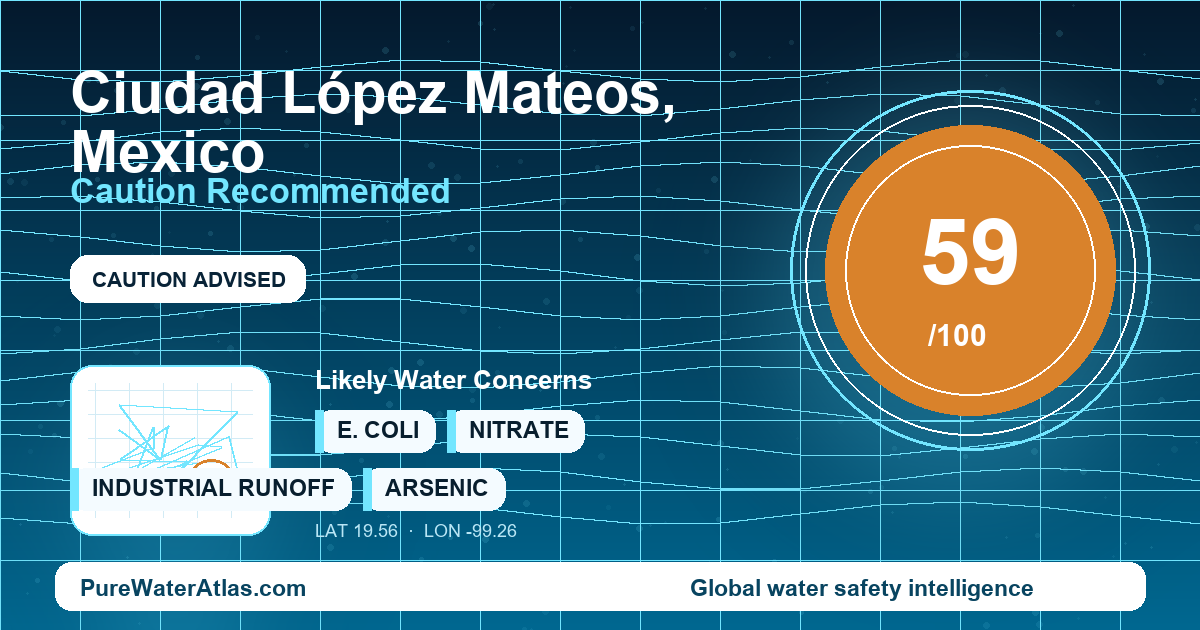
Ciudad López Mateos, the main urban locality of Atizapán de Zaragoza in the State of Mexico, has treated municipal water, but drinking it straight from the tap is not the conservative choice without verifying building storage, disinfection, and recent service conditions.
Quick Answer
| Water safety score | 59 / 100 |
|---|---|
| Risk level | Caution Recommended |
| Can visitors drink the tap water? | Not recommended as a default. Visitors should use sealed bottled water, garrafón water, or properly filtered and disinfected water. |
| Resident guidance | Residents should focus on property-level risks: cisterns, tinacos, rooftop tanks, old plumbing, intermittent service, and water quality after repairs or outages. |
| Main supply identity | Municipal Atizapán de Zaragoza system with a mixed metropolitan supply context: local groundwater wells, State of Mexico bulk-water infrastructure, Presa Madín treatment context, and regional Cutzamala/Lerma imports when allocated. |
| Water authority | SAPASA, the Sistema de Agua Potable, Alcantarillado y Saneamiento de Atizapán de Zaragoza, with state-level infrastructure coordination by CAEM. |
| Filter recommendation | A maintained point-of-use system is advisable for drinking water: sediment prefiltration plus activated carbon, with reverse osmosis or a certified purifier for broader contaminant reduction. UV can help for microbial control only if water is already clear and the unit is maintained. |
Overall verdict: Caution recommended. Ciudad López Mateos is not best treated as a separate city-only water system; it is the municipal seat and principal urban locality of Atizapán de Zaragoza. The water supply should not be treated as automatically unsafe, but travelers and risk-sensitive residents should not rely on unfiltered tap water without confirming the condition of building storage, residual disinfection, and recent service interruptions.
Why Ciudad López Mateos Is Different
Ciudad López Mateos is a hilly, highly urbanized locality on the northwest side of the Mexico City metropolitan area. Its drinking-water reality is therefore metropolitan and municipal, not isolated. The relevant public system is Atizapán de Zaragoza’s municipal water network, and the practical safety of water at the tap depends on more than whether water was treated before entering the distribution system.
The most important local distinction is the “last meters” of the system. In many homes, apartments, hotels, and commercial buildings, water may pass through a cistern, rooftop tinaco, booster pump, in-line filter, internal plumbing, and kitchen fixture before it reaches a glass. Two buildings on the same street can have different risk profiles because one may have a clean, sealed storage tank while another may have sediment, biofilm, insects, stagnant water, or poorly maintained plumbing.
Topography and pressure management also matter. In a hilly urban municipality that depends on pumping, distribution sectors, local wells, bulk water, and regional supply arrangements, pressure changes and service interruptions can be more relevant to the user than the average quality leaving a treatment plant or well. Low pressure, repair work, and flow changes can disturb sediment or reduce the reliability of residual disinfectant by the time water reaches a building.
Where Does Ciudad López Mateos’s Tap Water Come From?
Ciudad López Mateos is served within Atizapán de Zaragoza’s municipal water system. Available official and regional information indicates a mixed water-supply context, including local groundwater wells, bulk water managed through the State of Mexico water system, and regional surface-water sources used in the northwest Mexico City metropolitan area. These include the Cutzamala/Lerma import system and the Presa Madín treatment context. The exact blend can vary by zone, pressure sector, season, and operational conditions.
This matters because a household in one part of the municipality may not receive exactly the same source blend as another household, and operational conditions can change during dry-season stress, maintenance, reduced imports, or local repairs. The city should not be described as having one simple, fixed water source at all taps.
Key infrastructure relevant to Ciudad López Mateos includes the SAPASA municipal distribution network, municipal wells and pumping infrastructure, State of Mexico bulk-water infrastructure coordinated by CAEM, Presa Madín and associated potable-water treatment infrastructure, and the Cutzamala/Lerma regional import system when water is allocated to the municipality or surrounding service areas. At the property level, cisterns, tinacos, rooftop tanks, and booster pumps are also practical parts of the drinking-water pathway.
Historically, Atizapán de Zaragoza developed as part of the northwest Mexico City metropolitan area, where local aquifers, Presa Madín, and later imported water systems became important because local sources alone were not enough for urban expansion. Presa Madín is a locally important surface-water reservoir, while Cutzamala is a major inter-basin transfer system supporting Mexico City and parts of the State of Mexico during normal operations.
Who Manages Drinking Water in Ciudad López Mateos?
The local water utility is SAPASA, the Sistema de Agua Potable, Alcantarillado y Saneamiento de Atizapán de Zaragoza. Because Ciudad López Mateos is the principal urban locality and municipal seat of Atizapán de Zaragoza, SAPASA is the relevant municipal water authority for local drinking-water service, sewerage, and sanitation functions.
State-level water infrastructure and bulk supply are associated with the Comisión del Agua del Estado de México, commonly known as CAEM. National water-resource context, including dams and regional hydrologic conditions, falls under CONAGUA. The Cutzamala system is documented through CONAGUA’s Sistema Cutzamala information and updates.
Mexico’s potable-water quality is governed by NOM-127-SSA1-2021, Agua para uso y consumo humano. Drinking-water health oversight is also connected to federal sanitary authorities such as COFEPRIS, with state and municipal implementation. However, Mexico does not consistently provide U.S.-style annual consumer confidence reports at the neighborhood tap level. For Ciudad López Mateos, that means municipal treatment and regulatory standards are important, but they do not automatically prove the condition of water after it passes through private cisterns, rooftop tanks, and older building plumbing.
Main Local Water Concerns
- Intermittent service and pressure variation: Low-pressure events and service interruptions can increase intrusion risk in weak parts of a distribution system and can disturb sediment when flow is restored. This is a relevant concern for a hilly municipality dependent on pumped and bulk-water systems.
- Turbidity and sediment after repairs, outages, or strong flow changes: Cloudy, brown, or visibly dirty water should not be used as drinking water until it has been flushed, clarified, and treated appropriately. Turbidity can also reduce disinfection effectiveness.
- Private cisterns and rooftop tanks: Even if water enters a property chlorinated, poorly sealed or unwashed storage tanks can introduce microbial contamination, insects, sediment, and biofilm. This is one of the most important controllable risks for households and buildings in Ciudad López Mateos.
- Source-water pressure on Presa Madín and regional imports: Surface reservoirs can face runoff, organic matter, algae, and turbidity challenges, while reduced imported-water availability can increase reliance on other sources or storage. The tap-water impact depends on treatment and distribution operations.
- Lead or metals from old internal plumbing: No citywide lead exceedance is claimed here for Ciudad López Mateos. The concern is property-specific: old solder, fixtures, brass components, or unknown service materials can contaminate otherwise treated water.
Season also matters. During the dry season and late dry season, roughly February to May, lower regional storage and higher demand can increase interruptions, pressure changes, and reliance on stored water. During the rainy season, roughly May to October, storm runoff can increase turbidity and organic load in surface-water sources and stress drainage infrastructure. During regional maintenance or Cutzamala reduction periods, scheduled or emergency reductions can lead to tandeo, greater storage dependence, and more need to protect cisterns and tanks.
For Travelers
Visitors to Ciudad López Mateos should not drink tap water straight from the faucet as a default. The safer choice is sealed bottled water, garrafón water, or water that a hotel or restaurant confirms has been filtered and disinfected. This recommendation is not based on a claim that all municipal water is contaminated; it reflects the uncertainty created by building storage, plumbing, pressure events, and limited neighborhood-level public test data.
For brushing teeth, the risk is generally lower than drinking large volumes, but cautious travelers should use bottled or filtered water. If you use tap water, avoid it when it is cloudy, has an unusual odor, or service has recently returned after an outage.
For ice, use only ice that is commercially produced or that the establishment confirms is made from purified water. Avoid unknown ice from informal vendors or private events. In hotels and better restaurants in the Mexico City metropolitan area, staff are usually familiar with guest expectations for purified drinking water, but it is still worth asking whether drinking water and ice come from garrafón, filtration, or a purification system.
For short stays, bottled or garrafón water is simpler and safer than trying to evaluate a building’s tank, rooftop tinaco, plumbing, and maintenance history. Carry water during the day, especially in warm weather or if you are visiting areas with visible construction, repairs, or water interruptions.
For Residents
Residents should treat the building as part of the water system. A home treatment step is advisable for drinking water in Ciudad López Mateos, especially in older buildings or homes using cisterns and tinacos. A practical setup is sediment prefiltration followed by activated carbon for taste, chlorine-related issues, and some organics. Households that want broader contaminant reduction may consider reverse osmosis or a certified purifier. UV can be useful for microbial control only if the water is already clear and the UV lamp, sleeve, and flow rate are properly maintained.
Testing should be done at the kitchen tap, not only at the building inlet, because storage tanks and internal plumbing can change water quality. Test for total coliform and E. coli if the home uses a cistern or tinaco, has experienced outages, or has had flooding or storage problems. Check free chlorine residual when water reaches the home; very low residual after storage can indicate the need for tank cleaning or disinfection review.
Residents should also observe turbidity after repairs, outages, rainy periods, or sudden flow changes. Do not drink visibly turbid water without appropriate treatment. For older buildings, test first-draw and flushed samples for lead if there are old pipes, brass fixtures, old solder, or unknown service materials. If a home relies heavily on well water or a private source, use an accredited laboratory for basic chemistry such as nitrate, hardness, total dissolved solids, iron, manganese, and arsenic.
Cisterns and tinacos should be sealed, screened, cleaned, and disinfected on a routine schedule. After a water outage, repair, or tanker fill, inspect for sediment and odor before using the water for drinking. Dirty storage is one of the most important preventable water-quality risks in Ciudad López Mateos.
Relevant Contaminants and Water-Quality Issues
The most relevant issues for Ciudad López Mateos are not limited to one contaminant. They involve disinfection, clarity, sediment movement, microbial safety, and building plumbing.
- Chlorine in drinking water is important because residual chlorine helps protect water in distribution and storage, but it can decline in cisterns, tinacos, and stagnant plumbing.
- Turbidity in drinking water is relevant when water becomes cloudy after repairs, storms, outages, or strong flow changes.
- Sediment in drinking water is a practical concern in older pipes, after pressure changes, and when tanks have not been cleaned.
- E. coli in drinking water is the key microbial indicator to test when storage tanks, low pressure, or possible fecal contamination are concerns.
- Lead in drinking water is mainly a property-plumbing issue here; testing is needed before making claims about a specific building.
For background on safe-use decisions, see PureWaterAtlas guides on Drinking Water Safety, Water Microbiology, and Water Treatment Systems.
How to Verify Your Water Quality
The public data picture for Ciudad López Mateos has limits. The relevant service area is Atizapán de Zaragoza, and public sources identify the municipal utility and regional water-system context, but they do not provide a complete, current, neighborhood-by-neighborhood tap-water dataset showing microbial results, metals, disinfection residual, and turbidity at individual homes. Conditions can vary by pressure sector, source blend, outage history, and private storage maintenance.
The most reliable approach is property-level verification. Test at the kitchen tap, and if the building has a cistern or rooftop tank, test after storage. If water has recently been off, if a repair occurred, or if water is cloudy, use bottled, boiled, or properly filtered water until conditions normalize. For emergency microbial uncertainty, review Boiling Water Purification: Complete Guide. For household systems, review UV Water Purification: Complete Guide.
If an older property may have lead-bearing plumbing or fixtures, start with Lead in Drinking Water: Testing and Detection Methods. If testing confirms lead, see Lead in Drinking Water: Best Filters, Systems and Solutions.
To interpret lab results, use the PureWaterAtlas Contaminants Search Engine. For broader comparisons across destinations, use the Global Water Quality Checker. For testing strategy, see the PureWaterAtlas Water Testing guide.
Official and Technical Sources
- SAPASA Atizapán de Zaragoza official portal — local municipal water utility for Atizapán de Zaragoza.
- Comisión del Agua del Estado de México official portal — state-level water authority relevant to bulk supply and regional infrastructure.
- Comisión Nacional del Agua official portal — federal authority for national water resources and hydrologic information.
- Sistema Cutzamala information and updates — official source for the regional imported-water system.
- Inventario nacional de plantas municipales de potabilización y tratamiento — official inventory relevant to potable-water treatment infrastructure.
- NOM-127-SSA1-2021, Agua para uso y consumo humano — federal drinking-water quality standard for Mexico.
- COFEPRIS official portal — federal sanitary-risk authority relevant to drinking-water health oversight.
- Atizapán de Zaragoza municipal government portal — municipal context for Ciudad López Mateos.
Bottom Line
In Ciudad López Mateos, tap water should be approached with caution rather than automatic rejection or automatic trust. The locality is served through Atizapán de Zaragoza’s municipal system, with a mixed metropolitan supply context involving local wells, State of Mexico bulk-water infrastructure, Presa Madín, and regional Cutzamala/Lerma imports when allocated. The main practical risks are often inside the distribution and building system: pressure changes, outages, sediment, cisterns, tinacos, and old plumbing. Visitors should use bottled, garrafón, or verified purified water for drinking and ice. Residents should maintain storage tanks, test at the kitchen tap, and use a suitable point-of-use filter or purifier for drinking water.
Read the full guide: Global Water Quality Guide
Explore more in this category: Global Water Quality Articles