
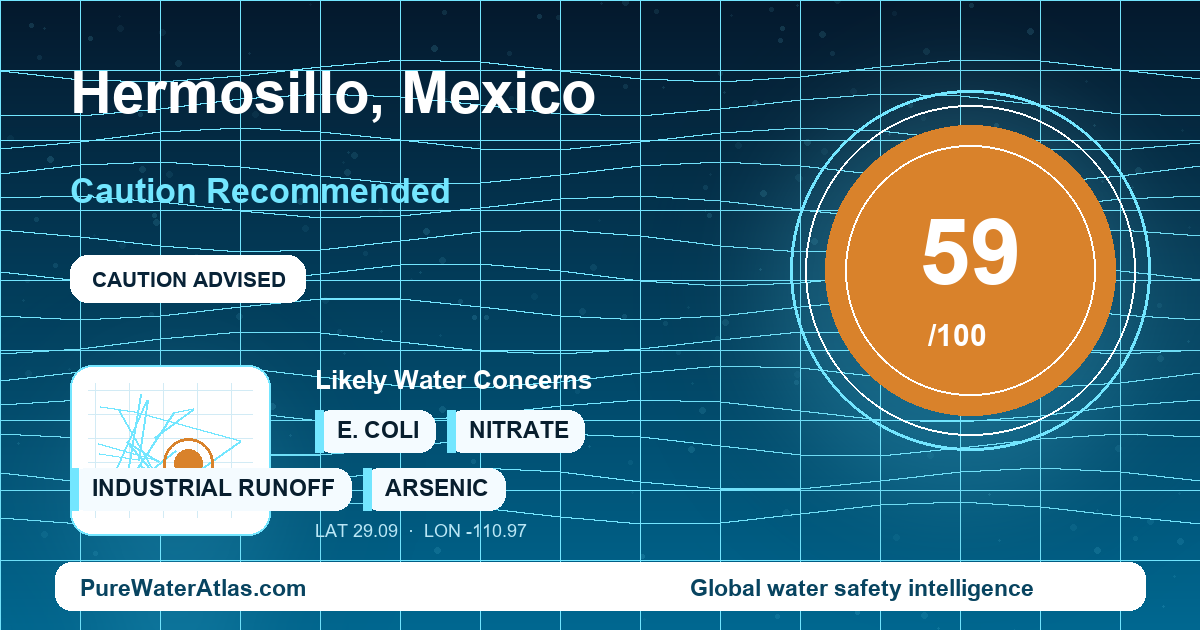
Hermosillo, Sonora has a treated municipal water system, but desert water stress, mixed groundwater and imported surface-water sources, pressure interruptions, household storage tanks, and limited recent tap-level public data mean caution is recommended for drinking water at the point of use.
Quick Answer
| Water safety score | 59 / 100 |
|---|---|
| Risk level | Caution Recommended |
| Can visitors drink the tap water? | Not recommended for most short-term visitors. Use sealed bottled water or a verified purified source such as a hotel garrafón, dispenser, or clearly filtered water system. |
| Resident guidance | Residents should follow Agua de Hermosillo notices, maintain cisterns and rooftop tanks, and consider point-of-use treatment for drinking and cooking, especially after outages or in homes with vulnerable residents. |
| Main water sources | A mixed system of municipal groundwater wells and imported surface water delivered through the Acueducto Independencia from the El Novillo system, formally the Presa Plutarco Elías Calles on the Yaqui River basin. |
| Local water authority | Agua de Hermosillo, the municipal water and sewerage operator for Hermosillo. |
| Filter recommendation | A sediment prefilter plus activated carbon is practical for many municipal connections. If testing shows high total dissolved solids, arsenic, fluoride, nitrate, or microbial risk, use treatment specifically rated for the confirmed problem. |
PureWaterAtlas classifies Hermosillo tap water as caution recommended. This does not mean every tap in the city is unsafe. It means the safest advice depends on the building, pressure history, storage tanks, source mix, and recent local conditions. The city has a real municipal supply and disinfection infrastructure, but the final water quality at a kitchen tap can differ from water leaving a treatment or distribution entry point.
Why Hermosillo Is Different
Hermosillo is an inland Sonoran Desert city with very hot summers, low average rainfall, high evaporation, and strong seasonal water demand. Those conditions make water supply reliability and distribution pressure more challenging than in wetter Mexican cities. The city is not served by one simple, stable source. Its public supply is a mixed system that includes local and nearby groundwater wells as well as imported surface water from the El Novillo-Hermosillo transfer system.
This local geography matters for drinking-water safety because drought, source switching, pumping conditions, and pressure variation can all affect what residents experience at the tap. In arid Sonora, groundwater can be mineralized, which may produce hardness, salty taste, scaling, or elevated total dissolved solids in some supplies. Regional groundwater studies and national water-quality mapping also identify naturally occurring contaminants such as arsenic and fluoride as concerns in Sonora, although that does not prove uniform exceedances at every Hermosillo tap.
Another Hermosillo-specific point is household storage. Many homes and businesses use cisterns, rooftop tinacos, garrafón water, or point-of-use filtration. These practices reflect practical concerns about taste, hardness, water continuity, and trust in building plumbing. A household tank can protect against pressure interruptions, but it can also become a water-quality risk if it is unsealed, uncleaned, or allowed to lose disinfectant residual.
Where Does Hermosillo’s Tap Water Come From?
Hermosillo’s drinking-water system is supplied by a combination of municipal groundwater wells in local and nearby aquifers and imported surface water delivered through the Acueducto Independencia, also known as the El Novillo-Hermosillo transfer system. The imported surface-water source is the El Novillo system, formally the Presa Plutarco Elías Calles on the Yaqui River basin. The balance between wells and imported surface water can vary with drought, infrastructure operations, and reservoir conditions.
Historically, Hermosillo relied heavily on local groundwater and the Sonora River and reservoir system, including the Presa Abelardo L. Rodríguez area. Long-term drought, urban growth, and reduced local surface-water reliability made that older supply model insufficient for a growing metropolitan area. The Acueducto Independencia became a major part of Hermosillo’s water-security strategy after local groundwater stress and unreliable local surface water pushed the city toward a broader supply portfolio.
Key infrastructure for Hermosillo includes the Agua de Hermosillo municipal distribution network, municipal well fields serving the urban area, the Acueducto Independencia, El Novillo as an imported source, and disinfection and treatment infrastructure before distribution. At the household level, cisterns and rooftop tanks are also part of the practical water system because they influence pressure, continuity, and the condition of water at the point of use.
Who Manages Drinking Water in Hermosillo?
Agua de Hermosillo is the local municipal water and sewerage operator responsible for public water service in Hermosillo. Residents should use the utility as the primary source for local service notices, repairs, pressure interruptions, and operational updates.
Drinking-water quality in Mexico is governed nationally by Secretaría de Salud standards, including NOM-127-SSA1-2021, the official Mexican standard for water for human use and consumption. CONAGUA’s Sistema Nacional de Información del Agua provides national water-resource information relevant to aquifers, dams, and water indicators, while CONAGUA water-quality information gives national monitoring context. State-level water-management context is also relevant through the Comisión Estatal del Agua de Sonora.
The important limitation is data granularity. City-level information exists for Hermosillo’s utility identity, water sources, drought context, and regulatory framework. However, a single recent public dataset showing verified tap-water results for every neighborhood, building type, and household storage condition was not identified. Conditions can vary by pressure zone, outages, building plumbing, source mix, cistern maintenance, and rooftop tanks.
Main Local Water Concerns
The main concerns in Hermosillo are practical distribution and point-of-use concerns rather than a simple statement that the entire municipal system is untreated. The city has treated public water, but the final tap condition may be affected by intermittent pressure, repairs, household storage, plumbing materials, and desert-source chemistry.
- Water scarcity and drought stress: Drought can increase operational pressure on wells, reservoirs, pumping, and distribution schedules.
- Intermittent service or low pressure: Loss of pressure can increase the chance of intrusion or sediment mobilization in parts of a distribution network, especially after repairs or outages.
- Mineralized groundwater: Groundwater in arid Sonora can be hard or mineralized, causing salty or bitter taste, scaling, or elevated total dissolved solids in some supplies.
- Regional geogenic contaminants: Arsenic and fluoride are regional groundwater concerns in Sonora, but this does not prove that every municipal tap in Hermosillo exceeds health standards.
- Turbidity and sediment: Rust-colored water, particles, or cloudiness can occur after pipe work, pressure changes, or seasonal runoff events and should be treated as a warning sign until flushed or checked.
- Storage tanks: Cisterns and rooftop tanks can change water quality after it leaves the municipal system, especially if tanks are dirty, open to dust or insects, or low in disinfectant residual.
- Microbial risk after disruptions: Microbial risk is most relevant after loss of pressure, flooding, contaminated tanks, or when chlorine residual is depleted before water reaches the tap.
Season also matters. Extreme summer heat increases water demand and can accelerate chlorine residual decay in stored water. Summer monsoon storms can create short-lived turbidity, runoff, and drainage problems even in a desert city. Network repairs, pump failures, or scheduled interruptions can temporarily increase sediment and microbial risk at the household tap.
For Travelers
For most short-term visitors, the practical answer is simple: do not rely on ordinary tap water for drinking in Hermosillo. Use sealed bottled water or a clearly verified purified-water source. This is a travel-safety recommendation, not proof that every municipal tap is unsafe.
Conservative travelers should also brush teeth with bottled or purified water, especially if they have a sensitive stomach, are traveling with children, are pregnant, are older, or are immunocompromised. Avoid drinking from bathroom taps, outdoor taps, or unknown refill points. In Hermosillo’s hot weather, carry bottled water and plan for higher fluid needs.
Ice should be used only where there is a reasonable expectation that purified water is used, such as reputable hotels, established restaurants, and major chains. Avoid ice from informal sources if the water source is unclear. Most tourist-oriented hotels and established restaurants are accustomed to using purified water for drinking, coffee, and ice, but visitors should ask whether water is from garrafón, filtered, or bottled when uncertain.
If tap water has unusual color, odor, sediment, or appears soon after an outage or repair, do not drink it unless it has been properly boiled, disinfected, or filtered for the specific risk. Travelers can also review general food and water precautions from CDC Travelers’ Health for Mexico.
For Residents
For residents connected to the municipal network, a home filter is not automatically mandatory for every household, but it is practical in Hermosillo. Many homes benefit from a sediment prefilter plus activated carbon for taste, chlorine, and particulates. Learn more about common issues such as chlorine in drinking water, turbidity, and sediment.
If testing shows elevated total dissolved solids, arsenic, fluoride, or nitrate, choose a treatment technology rated for that contaminant. Reverse osmosis is commonly used for drinking water when dissolved contaminants are confirmed. If microbial risk is the main concern after tank contamination or outages, filtration should be paired with appropriate disinfection, such as UV or boiling when applicable. PureWaterAtlas has guides to UV water purification and boiling water purification.
Residents with infants, pregnant people, immunocompromised household members, private wells, peri-urban connections, old plumbing, or recurring outages should not rely on taste or appearance alone. Use an accredited laboratory for health-based decisions. Home test strips can be useful for screening, but they should not be treated as definitive for arsenic, nitrate, fluoride, lead, or microbiology.
Older buildings can add risk even when utility water is properly treated. Old pipes, brass fixtures, solder, dead-end plumbing, and long stagnation time can contribute metals or unpleasant taste. Flush stagnant water before drinking, and test first-draw and flushed samples if lead or copper is a concern. For more detail, see PureWaterAtlas resources on lead in drinking water and lead testing methods.
Cisterns and rooftop tinacos deserve special attention in Hermosillo. Tanks should be sealed against dust, insects, birds, and rodents; cleaned and disinfected on a regular schedule; and inspected after outages, storms, or plumbing work. Stored water that loses disinfectant residual can become unsafe even if the municipal supply was disinfected upstream.
Relevant Contaminants and Water-Quality Issues
The most relevant Hermosillo water-quality issues are those connected to desert-source chemistry, intermittent pressure, storage tanks, and building plumbing. E. coli and total coliform testing are important if water passes through a cistern, rooftop tank, private well, or if service has been interrupted. Microbial contamination is not something to judge by taste.
For mineralized or salty-tasting water, residents should test total dissolved solids, electrical conductivity, hardness, chloride, and sulfate. If regional groundwater quality is uncertain, testing for arsenic and fluoride is prudent, especially for private wells. PureWaterAtlas also provides detailed guidance on arsenic testing and arsenic treatment options.
Nitrate should be tested where infants or pregnant people are present, or where properties are near agricultural, septic, or peri-urban contamination sources. For additional context, see nitrate contamination testing methods.
How to Verify Your Water Quality
The best way to verify Hermosillo tap water is to combine local utility information with household-level testing. Start with Agua de Hermosillo notices for service interruptions, repairs, and pressure issues. Then test the actual water you drink, especially if it passes through a cistern, rooftop tank, old plumbing, or private well.
For a general framework, use the PureWaterAtlas Water Testing guide. To compare city-level risk concepts, use the Global Water Quality Checker. To research individual substances, use the Contaminants Search Engine.
Residents making treatment decisions should also review the PureWaterAtlas pillar guides on Drinking Water Safety, Global Water Quality, Water Treatment Systems, and Water Microbiology. These resources are most useful when paired with Hermosillo-specific testing rather than assumptions based on taste, smell, or neighborhood reputation.
Official and Technical Sources
- Agua de Hermosillo — official municipal water and sewerage operator for Hermosillo.
- CONAGUA Sistema Nacional de Información del Agua — national water information system for water resources, aquifers, dams, and indicators.
- CONAGUA Calidad del Agua — national water-quality monitoring and evaluation context.
- Diario Oficial de la Federación: NOM-127-SSA1-2021 — Mexican drinking-water quality standard for water for human use and consumption.
- Comisión Estatal del Agua de Sonora — state-level water institution relevant to Sonora water management.
- CDC Travelers’ Health: Mexico — traveler food and water precautions.
- WHO Guidelines for Drinking-water Quality — international health-based drinking-water risk-management reference.
Bottom Line
Hermosillo has a municipal water utility, treated public supply, and a defined regulatory framework, but its desert setting makes water reliability and point-of-use quality more complicated than in many cities. The system relies on a changing mix of groundwater and imported surface water, and household cisterns, rooftop tanks, low pressure, repairs, mineralized water, and older plumbing can all affect what comes out of the tap. Visitors should use sealed bottled or verified purified water. Residents should follow Agua de Hermosillo notices, maintain tanks, flush after stagnation, and test when risks are plausible. Because recent neighborhood-level tap data are limited, the most accurate answer is household-specific verification.
Read the full guide: Global Water Quality Guide
Explore more in this category: Global Water Quality Articles