
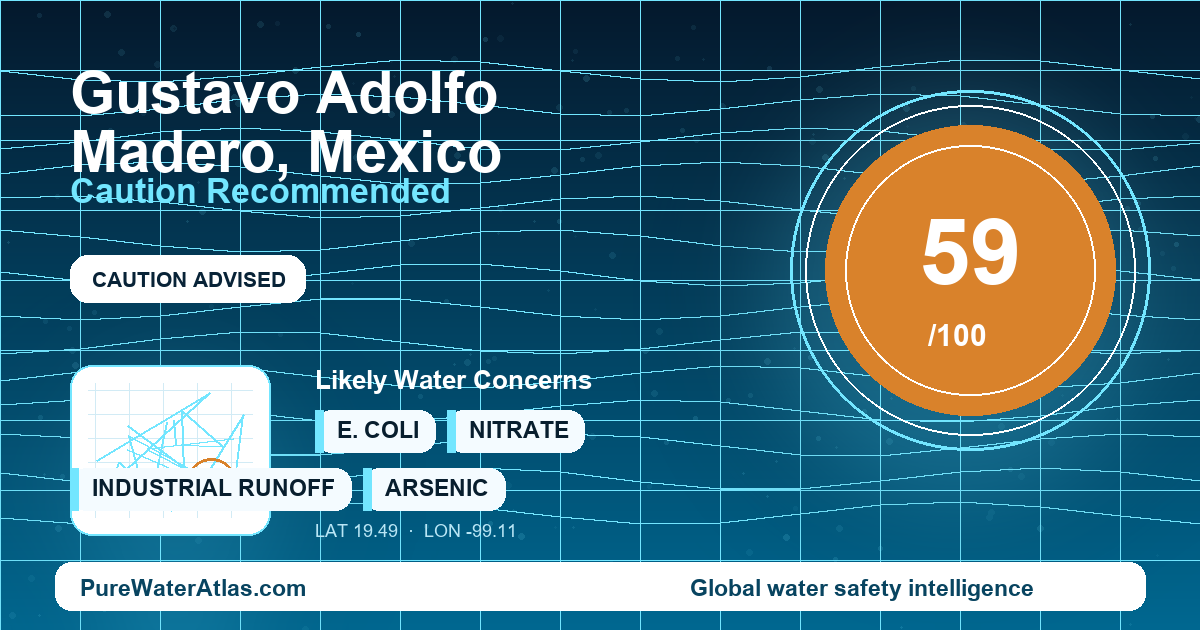
Gustavo Adolfo Madero, Mexico: tap water is municipally supplied and disinfected through Mexico City’s network, but household safety depends heavily on pressure continuity, pipes, cisterns, rooftop tanks, and building-level maintenance.
Quick Answer
| Water safety score | 59 / 100 |
|---|---|
| Risk level | Caution Recommended |
| Can visitors drink the tap water? | Not recommended as a default. Visitors should use sealed bottled water, hotel-provided purified water, or water from a verified filtration and disinfection system. |
| Resident guidance | Many residents can make tap water suitable for daily use with properly maintained treatment, especially where buildings use cisterns or rooftop tinacos. |
| Main supply identity | Part of Mexico City’s integrated SACMEX network, typically using a changing blend of Valley of Mexico groundwater plus imported Cutzamala and Lerma system water when available. |
| Water authority | Sistema de Aguas de la Ciudad de México, known as SACMEX, with sanitary oversight under Mexican federal and local health authorities. |
| Filter recommendation | Sediment prefiltration plus activated carbon is advisable for most households that drink tap water. Add UV or another microbiological barrier where storage tanks, intermittent pressure, or vulnerable residents are involved. |
Verdict: Caution recommended. The main concern in Gustavo Adolfo Madero is not usually the treated water leaving the municipal system, but the “last mile” before it reaches the tap: pressure interruptions, aging distribution lines, sediment disturbance, private cisterns, rooftop tanks, pumps, and old internal plumbing.
Why Gustavo Adolfo Madero Is Different
Gustavo Adolfo Madero is a northern borough of Mexico City bordering the State of Mexico. It includes urban areas near Cerro del Tepeyac and the Sierra de Guadalupe, and it is connected to the broader Valley of Mexico hydraulic system rather than to a single, borough-only drinking-water source. This matters because tap-water conditions can be shaped by metropolitan operations, regional water stress, maintenance work, and the specific storage and plumbing conditions of each building.
The practical question in Gustavo Adolfo Madero is not whether the entire borough has one uniform water quality. Two buildings on the same block can have different household risk if one receives continuous pressure and has clean internal plumbing, while another relies on a poorly maintained cistern or rooftop tinaco. In Mexico City housing, building-level storage is often an important final control point. If a tank is uncovered, dirty, exposed to insects or dust, or left with depleted disinfectant residual, water that was treated before distribution can become less safe by the time it reaches the kitchen tap.
Public data are sufficient to describe the Mexico City water system, regulation, hydrology, and common risk pathways, but they are not detailed enough to certify every street or building in Gustavo Adolfo Madero. This profile therefore gives a risk-based assessment, not a claim that every tap in the borough either meets or fails a specific water-quality limit.
Where Does Gustavo Adolfo Madero’s Tap Water Come From?
Gustavo Adolfo Madero does not have a standalone drinking-water utility or one dedicated raw-water source. It is supplied through Mexico City’s integrated network operated by SACMEX. The operating mix typically includes groundwater from the Valley of Mexico aquifer system and imported water from the Cutzamala and Lerma systems when those sources are available in the supply blend.
The proportions can change. Reservoir levels, drought conditions, pumping operations, well availability, maintenance activities, and pressure-management decisions can all influence which sources are feeding parts of the network at a given time. During periods of reduced Cutzamala availability, Mexico City’s system may rely more heavily on operational changes and groundwater sources, which can affect pressure, continuity, taste, odor, and turbidity in some areas.
Key infrastructure relevant to Gustavo Adolfo Madero includes SACMEX primary and secondary distribution mains, metropolitan groundwater wells and wellfields, imported supply from the Cutzamala and Lerma systems when included in the operating mix, pumping stations, pressure sectors, storage tanks, and distribution mains serving northern Mexico City. At the building level, cisterns, rooftop tinacos, pumps, and internal plumbing are especially important because they are the final stage before water reaches the tap.
The borough sits within the historically lake-based Basin of Mexico. Modern potable supply is no longer based on a local surface-water source in Gustavo Adolfo Madero itself. Instead, the area depends on the metropolitan network, imported inter-basin water, and heavily used groundwater. Long-term over-extraction of the Valley of Mexico aquifer is a recognized regional issue associated with subsidence and water-quality management challenges.
Who Manages Drinking Water in Gustavo Adolfo Madero?
The principal public water operator for Gustavo Adolfo Madero is Sistema de Aguas de la Ciudad de México, commonly known as SACMEX. SACMEX is responsible for Mexico City’s water supply operations, drainage, infrastructure programs, service information, and user attention across the capital, including this borough.
Mexico City water governance also involves the Secretaría de Gestión Integral del Agua de la Ciudad de México. At the federal level, CONAGUA manages national water resources, hydrologic information, aquifers, drought context, and major systems such as Cutzamala. Public health regulation and sanitary surveillance involve federal and local health authorities, including COFEPRIS.
Drinking water for human use in Mexico is regulated under NOM-127-SSA1-2021, the national standard for sanitary quality requirements for water intended for human consumption. However, compliance at the treated-water or system level should not be treated as proof that every individual tap is safe. Private storage tanks, building plumbing, corrosion, stagnant lines, and pressure events are outside the direct control of the central treatment and distribution system.
Main Local Water Concerns
- Intermittent supply and low pressure: Pressure interruptions can increase the chance of intrusion through leaks and can draw sediment into household systems. They also increase reliance on stored water.
- Aging pipes and repairs: Distribution work, emergency repairs, and older service connections can cause temporary turbidity, rust-colored water, visible particles, or sediment resuspension.
- Cisterns and rooftop tinacos: Private storage is one of the most important exposure pathways in Gustavo Adolfo Madero. Damaged covers, poor cleaning, insects, dust, heat exposure, and depleted chlorine residual can create microbiological risk.
- Groundwater-related quality changes: Regional reliance on groundwater can raise concerns about mineral content, hardness, salinity indicators, iron, manganese, and other naturally occurring constituents. Public borough-specific data are not detailed enough to assign uniform contaminant values to Gustavo Adolfo Madero.
- Old internal plumbing: Older buildings may have corroded pipes, fixtures, solder, brass components, or stagnant dead-end lines that affect metals, taste, and corrosion byproducts. Lead risk should be tested rather than assumed.
Seasonal and operational factors also matter. Dry-season and drought stress can reduce reservoir contributions and force changes in source blending or pressure management. Rainy-season runoff and repair activity can coincide with turbidity spikes or sediment disturbance. Warm weather can accelerate loss of disinfectant residual in rooftop tanks exposed to heat and sunlight.
For Travelers
Visitors should not rely on untreated tap water as their default drinking water in Gustavo Adolfo Madero. Short-term travelers are more vulnerable to gastrointestinal disruption from unfamiliar water and usually do not know whether a hotel, rental, or private building has clean storage tanks and reliable pressure.
- Drinking: Use sealed bottled water, hotel-provided purified water, or water from a maintained filtration and disinfection system.
- Brushing teeth: Many residents brush with tap water, but cautious travelers should use bottled or filtered water. This is especially important for children, pregnant travelers, older adults, immunocompromised travelers, and anyone with a sensitive stomach.
- Ice: Use ice only from hotels, restaurants, cafes, or shops that state it is made from purified water. Avoid informal ice if the source is unclear.
- Hotels and restaurants: Established hotels, restaurants, and cafes commonly serve purified or bottled drinking water. Ask for agua purificada or agua embotellada if uncertain. Do not assume bathroom tap water is the same quality as drinking water served at the table.
- Rentals: If water is cloudy, rusty, or earthy-smelling, let the tap run briefly, avoid drinking it untreated, and ask the host about filtration and cistern or tinaco cleaning.
Tap water is generally acceptable for showering and handwashing. Avoid swallowing shower water, and use bottled or purified water for infant formula.
For Residents
A home treatment system is advisable for most Gustavo Adolfo Madero residents who plan to drink tap water, especially in buildings with cisterns, rooftop tinacos, older plumbing, or intermittent pressure. A practical baseline is sediment filtration followed by activated carbon. Sediment filtration helps with particles and turbidity, while activated carbon can improve taste and odor and reduce chlorine-related byproducts depending on the system design and maintenance.
Where microbiological risk is plausible because of storage tanks, pressure interruptions, outages, flooding, or tank maintenance, add a microbiological barrier such as UV disinfection or another certified treatment method. During incidents, boiling is a conservative temporary measure; see PureWaterAtlas guidance on boiling water purification and UV water purification.
Residents should test water after the building’s storage tank, not only at the street connection, because household tanks and internal plumbing can change final quality. If water is cloudy, rusty, or contains visible particles, test turbidity, iron, manganese, pH, conductivity, and residual chlorine. For older buildings or buildings with unknown plumbing materials, test first-draw and flushed samples for lead and copper. If infants, pregnant people, older adults, or immunocompromised residents drink the water, consider testing for total coliform and E. coli, especially after pressure outages, flooding, repairs, or tank cleaning.
Cisterns and tinacos should be covered, protected from insects and dust, cleaned and disinfected routinely, and inspected after outages or nearby construction. Reverse-osmosis systems, if used, should be tested periodically and maintained on schedule because neglected cartridges can lose performance or support bacterial growth.
Relevant Contaminants and Water-Quality Issues
The most relevant issues in Gustavo Adolfo Madero are linked to distribution, storage, and building plumbing rather than a single confirmed borough-wide contaminant. Key topics include turbidity, sediment, chlorine residual, and microbiological indicators such as E. coli.
Rust-colored water or particles after repairs may justify checking iron and manganese. Older buildings should consider lead testing because internal plumbing materials can affect tap-water metals even when municipal water is treated. For more detail, see PureWaterAtlas resources on lead testing and detection methods and lead filters and treatment options.
How to Verify Your Water Quality
Because current public laboratory data are not consistently available at the street or building level for Gustavo Adolfo Madero, the best verification is local testing at the tap you actually use. Start with visual and operational clues: discoloration, cloudiness, sediment, unusual odor, frequent outages, tank dependence, or old plumbing. Then choose testing based on the likely pathway.
- For storage-tank or pressure-related risk, test total coliform and E. coli.
- For cloudy or rusty water, test turbidity, iron, manganese, pH, conductivity, and residual chlorine.
- For older buildings, test first-draw and flushed samples for lead and copper.
- After repairs, outages, or tank cleaning, flush taps until water is clear and re-check odor, color, and chlorine residual if possible.
PureWaterAtlas resources can help you interpret results and choose treatment: Water Testing, Drinking Water Safety, Water Treatment Systems, and Water Microbiology. You can also use the Global Water Quality Checker and browse the Contaminants Search Engine.
Official and Technical Sources
- Sistema de Aguas de la Ciudad de México — official local water operator for Mexico City, including Gustavo Adolfo Madero.
- Secretaría de Gestión Integral del Agua de la Ciudad de México — Mexico City water governance and planning authority.
- CONAGUA — federal water authority for national water resources, aquifers, drought information, and major water systems.
- CONAGUA Sistema Nacional de Información del Agua — official hydrologic data portal for national water statistics and regional context.
- NOM-127-SSA1-2021 — Mexican federal drinking-water quality standard for water intended for human consumption.
- COFEPRIS Agua para uso y consumo humano — federal sanitary authority for drinking-water health protection context.
- Datos Abiertos de la Ciudad de México — official open data portal for Mexico City datasets.
- Alcaldía Gustavo A. Madero — official borough government source for local services and announcements.
- World Health Organization drinking-water fact sheet — international public health context for safe drinking water and microbial risks.
Bottom Line
Tap water in Gustavo Adolfo Madero should be treated with caution, not automatic rejection and not automatic trust. The borough is supplied through Mexico City’s regulated SACMEX system, with water drawn from a changing metropolitan blend that can include Valley of Mexico groundwater and imported Cutzamala and Lerma water. The main safety uncertainty is at the local and building level: pressure interruptions, aging pipes, sediment, cisterns, rooftop tinacos, and old plumbing can change water quality after municipal disinfection. Visitors should use bottled or verified purified water. Residents who drink tap water should maintain sediment and carbon filtration, add UV or another microbiological barrier where tanks or outages are involved, clean storage tanks routinely, and test water at the actual tap used for drinking.
Read the full guide: Global Water Quality Guide
Explore more in this category: Global Water Quality Articles