
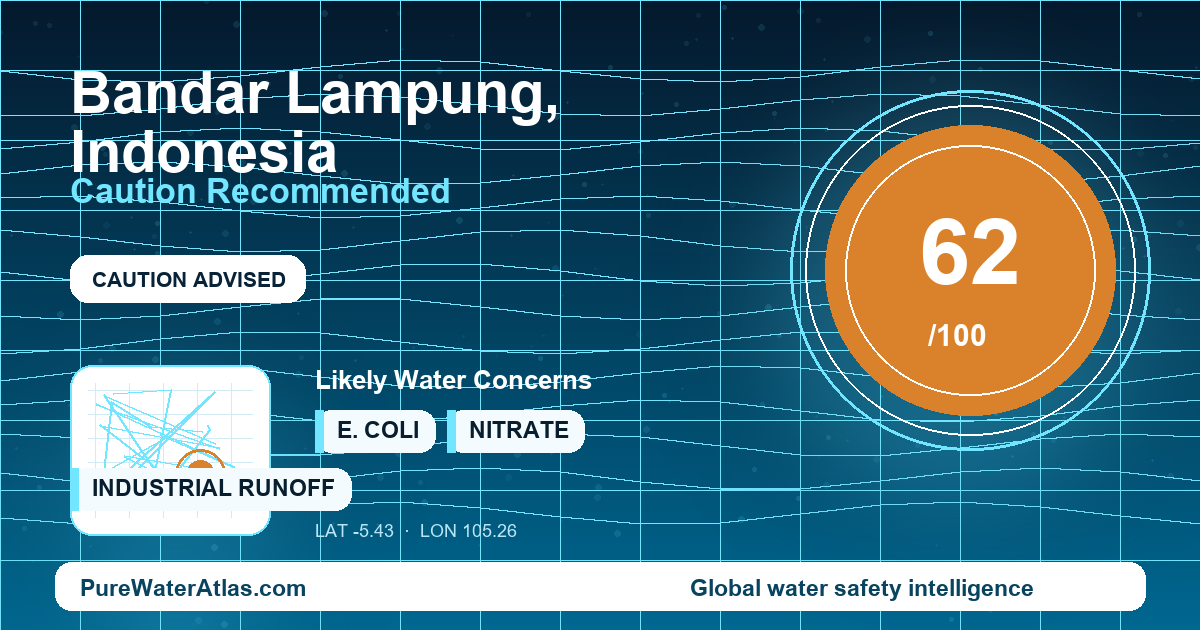
Bandar Lampung, Indonesia: municipal water is treated through a formal utility system, but direct drinking from the tap is not recommended without boiling, reliable filtration, or recent building-specific test results.
Quick Answer
| Water safety score | 62 / 100 |
|---|---|
| Risk level | Caution Recommended |
| Is tap water safe to drink? | Not recommended untreated. Bandar Lampung has a formal municipal water utility and treated surface-water supply, but safety at the tap can be affected by intermittent distribution, household storage tanks, old plumbing, private wells, and limited public release of routine city-level test results. |
| Traveler advice | Use sealed bottled water, reputable refill water, or boiled water for drinking. Do not assume bathroom tap water in hotels is potable. |
| Resident advice | Municipal water from Perumda Air Minum Way Rilau is generally a better starting point than untreated wells, but residents should use point-of-use treatment for drinking unless they have recent microbiological test results. |
| Main water source | Treated surface water, including supply associated with the SPAM Bandar Lampung system drawing from the Way Sekampung river system, plus older local catchments and supplementary sources. |
| Water authority | Perumda Air Minum Way Rilau, also commonly referred to as PDAM Way Rilau Bandar Lampung. |
| Filter recommendation | For utility water: sediment prefilter, activated carbon, and a final microbial barrier such as UV, ultrafiltration, or boiling. For private wells: test first, then select treatment based on results. |
Why Bandar Lampung Is Different
Bandar Lampung is a coastal city on Lampung Bay at the southern end of Sumatra. Its water-safety profile is shaped by the combination of hilly urban terrain, coastal districts, river catchments, dense neighborhoods, port and commercial areas, and surrounding agricultural or peri-urban land uses. This is not a city where the drinking-water question can be answered only by asking whether a treatment plant exists. Bandar Lampung does have a formal municipal drinking-water company and treated surface-water infrastructure, but household safety depends heavily on the final route the water takes: municipal distribution pipes, building plumbing, rooftop or ground storage tanks, private wells, refill water, bottled water, or a combination of these sources.
The most important practical distinction is between treated utility water and private groundwater. Treated utility water may still need point-of-use treatment because distribution pressure, pipe condition, and building storage can affect microbial safety before water reaches a glass. Private wells can have a different risk profile: microbial contamination from poor wellhead protection or septic influence, salinity in coastal or low-lying areas, mineral issues such as iron and manganese, nitrate near drains or dense settlement, and variable chemistry from one property to another.
PureWaterAtlas classifies Bandar Lampung as Caution Recommended, not because every tap is known to fail a standard, but because public access to current neighborhood-level drinking-water results is limited and point-of-use conditions are highly variable. The safer assumption for visitors and residents is that water intended for drinking should be boiled, filtered through a well-maintained system, or confirmed by recent testing.
Where Does Bandar Lampung’s Tap Water Come From?
Bandar Lampung’s municipal supply is operated by Perumda Air Minum Way Rilau. The city’s piped-water system is primarily a treated surface-water system. The expanded urban supply is associated with the SPAM Bandar Lampung system, which Indonesian infrastructure sources commonly describe as drawing raw water from the Way Sekampung river system and treating it before distribution. Older local supply has also been associated with local surface-water catchments such as Way Rilau and Way Kuripan, along with supplementary local sources.
Key infrastructure includes raw-water intake and transmission works linked to the Way Sekampung system, treatment plant or IPA facilities using conventional treatment steps such as clarification, filtration, and disinfection, urban distribution mains, service connections, reservoirs, and household or building-level storage tanks. These components matter because the quality of treated water at the plant is not always the same as the quality of water after it has passed through distribution pipes and storage tanks.
Bandar Lampung also has a long history of mixed water use. Municipal piped-water coverage has historically been limited relative to demand, so many households have relied on shallow wells, boreholes, small local intakes, purchased water, refill depots, bottled water, or boiling at home. This mixed supply pattern is central to understanding water safety in the city: one household may receive utility water, another may rely mainly on a private well, and another may use municipal water for washing while buying gallon or refill water for drinking.
Who Manages Drinking Water in Bandar Lampung?
The local municipal drinking-water company is Perumda Air Minum Way Rilau Bandar Lampung, also commonly referred to as PDAM Way Rilau Bandar Lampung. Local government context is provided by the Pemerintah Kota Bandar Lampung, while demographic and city statistics are available through Badan Pusat Statistik Kota Bandar Lampung.
Drinking-water health standards in Indonesia are set nationally by the Ministry of Health. The current regulatory context includes Permenkes No. 2 Tahun 2023 for environmental health and water-quality standards, available through the Kementerian Kesehatan Republik Indonesia JDIH. Water-resource and SPAM infrastructure roles also involve local government and Indonesia’s Ministry of Public Works and Housing, represented by Kementerian Pekerjaan Umum dan Perumahan Rakyat Republik Indonesia.
A key limitation for consumers is transparency at the tap level. Indonesia does not provide the same type of easily accessible consumer confidence report system that residents may know from some other countries. For Bandar Lampung, some city-level identity and infrastructure information is public, but routine finished-water results, residual chlorine by distribution zone, E. coli results, turbidity logs, household storage conditions, and neighborhood-level private-well chemistry are not consistently available in a simple public format. This guide therefore does not claim that every Bandar Lampung tap meets or fails a specific legal limit at all times.
Main Local Water Concerns
- Microbial contamination at the point of use: Even if water is disinfected at a treatment plant, contamination can occur after treatment through intermittent pressure, leaking pipes, cross-connections, rooftop tanks, ground storage tanks, dirty dispensers, or unsafe handling. This is one of the highest-priority concerns for Bandar Lampung households.
- Rainfall-driven turbidity: Surface-water systems drawing from river catchments can experience higher suspended sediment after heavy rain. In Bandar Lampung, wet-season storms can increase runoff, microbial loading, drain overflow, and cloudiness. Turbidity can make disinfection less reliable if not managed properly and may also create visible sediment complaints.
- Private-well vulnerability: Shallow wells in dense or low-lying parts of the city can be affected by septic leakage, drains, flooding, runoff, or poor wellhead protection. Coastal or low-lying wells may also experience salinity or brackish taste. Testing is essential because private-well safety varies property by property.
- Sediment, iron, and manganese: Discolored water, metallic taste, staining, or particles can come from groundwater minerals, corroded plumbing, or disturbed distribution sediment. These signs do not automatically prove a health hazard, but they do indicate that testing and filtration may be needed.
- Lead from building plumbing: Lead is not identified here as a proven citywide source-water problem. In Bandar Lampung, the more relevant precaution is property-specific plumbing: old solder, fixtures, brass parts, or unknown service plumbing. Older buildings, schools, clinics, and childcare settings should test if tap water is used for drinking.
Season also matters. During the wet season and storm periods, surface-water turbidity and private-well vulnerability can increase. During the dry season, lower river flows may concentrate pollutants and stress supply reliability, while some coastal or shallow groundwater users may notice stronger mineral or saline taste. After pipe repairs, outages, or pressure drops, residents should flush taps until clear and avoid using visibly dirty first-flow water for drinking.
For Travelers
Short-term visitors should not drink untreated tap water in Bandar Lampung unless the specific building provides properly maintained drinking-water treatment and that treatment is trustworthy. The safest everyday approach is sealed bottled water, reputable refill water, or water that has been boiled. This applies even in areas served by municipal supply because hotel storage tanks, internal plumbing, pressure interruptions, and local handling can affect water quality after treatment.
For brushing teeth, most healthy adults can use tap water if they avoid swallowing it. More cautious travelers, children, pregnant travelers, and immunocompromised people should use bottled, boiled, or reliably filtered water. For ice, choose commercially produced ice that is tube-shaped or clearly factory-made, especially in reputable hotels or restaurants. Avoid crushed or homemade ice when the water source is unclear.
In hotels and restaurants, ask directly whether drinking water is bottled, boiled, filtered, or from a sealed gallon dispenser. Many better establishments provide bottled water, dispenser water, or boiled water, but bathroom tap water should not be assumed potable. If water is cloudy, let sediment settle and prefilter before disinfection. Boiling is useful for microbial control, but boiling cloudy water without filtration does not remove particles or chemical taste. For travel-specific disinfection methods, see the CDC Yellow Book guidance on water disinfection for travelers and PureWaterAtlas’ Boiling Water Purification: Complete Guide.
For Residents
For Bandar Lampung residents, a home treatment setup is advisable for drinking water. If your home uses municipal water from Perumda Air Minum Way Rilau, a practical baseline is a sediment prefilter, activated carbon, and a final microbial barrier such as UV, ultrafiltration, or boiling. UV can be useful for clear water that needs microbial control, but it requires proper maintenance and low turbidity to work effectively. See UV Water Purification: Complete Guide for treatment basics.
If your household uses a private well or borehole, do not choose treatment blindly. Test first. At minimum, private wells should be tested for E. coli or thermotolerant coliforms at least annually and after flooding, well repairs, or illness clusters. Also test nitrate, nitrite, iron, manganese, hardness, chloride or salinity indicators, pH, conductivity or TDS, and basic microbiology. Reverse osmosis may be appropriate only where results confirm salinity, nitrate, arsenic, or dissolved metals that require membrane treatment.
Older buildings deserve extra caution. Corroded internal pipes, old fixtures, sediment accumulation, and metal leaching from plumbing components can change the water between the street connection and the tap. Flush stagnant water in the morning, avoid using hot tap water for cooking or infant formula, and test for lead if plumbing history is unknown. PureWaterAtlas’ Lead in Drinking Water: Testing and Detection Methods explains how property-level sampling works.
Storage tanks are one of the most important household risk points in Bandar Lampung. Rooftop and ground tanks should be cleaned and disinfected periodically, kept sealed, and protected from insects, animals, and debris. Screen vents and overflows. Avoid connecting well water and municipal water lines in a way that could allow backflow. If municipal water is stored, check turbidity, color, odor, pH, conductivity or TDS, and residual chlorine where possible, and retest after installing filters to confirm that the system is reducing the target contaminant.
Relevant Contaminants and Water-Quality Issues
The most relevant Bandar Lampung concerns are not a single confirmed citywide contaminant, but several source-to-tap risks. E. coli is the priority indicator for fecal contamination in wells, storage tanks, and intermittently pressured distribution systems. Turbidity matters because the city’s surface-water supply can be influenced by tropical rainfall and river runoff, while sediment is relevant after pipe disturbance, old plumbing, or private-well particle issues.
For private groundwater users, nitrate is important near septic systems, drains, agriculture, or dense settlement. See also Nitrate Contamination in Drinking Water: Testing and Detection Methods. Iron and manganese are relevant where water has metallic taste, staining, black or brown particles, or discoloration. Lead should be treated as a property-specific plumbing risk, especially in older buildings or facilities serving children.
How to Verify Your Water Quality
The only reliable way to know whether a specific Bandar Lampung tap is safe for drinking is to test that tap or verify the exact treatment and storage system serving it. For a structured overview, start with PureWaterAtlas’ Drinking Water Safety guide and Water Testing guide. If a result identifies a contaminant, use the Contaminants Search Engine to interpret possible sources and treatment options.
For microbial concerns, consult Water Microbiology. For choosing between boiling, UV, filtration, activated carbon, ultrafiltration, or reverse osmosis, use the Water Purification guide. Travelers comparing destinations can also use the Global Water Quality Checker. For broader category browsing, see Global Water Quality, Drinking Water Safety, Water Testing, and Water Purification.
Official and Technical Sources
- Perumda Air Minum Way Rilau Bandar Lampung — local municipal water utility context.
- Pemerintah Kota Bandar Lampung — official city-government context and public-service administration.
- Badan Pusat Statistik Kota Bandar Lampung — official city statistics and geographic-demographic context.
- Kementerian Pekerjaan Umum dan Perumahan Rakyat Republik Indonesia — national SPAM infrastructure and public-works oversight context.
- Kementerian Kesehatan Republik Indonesia JDIH — Indonesian health regulations, including drinking-water and environmental health standards such as Permenkes No. 2 Tahun 2023.
- World Health Organization drinking-water fact sheet — public-health basis for concern about microbial contamination and safely managed drinking water.
- WHO Guidelines for Drinking-water Quality — scientific framework for source-to-tap drinking-water risk assessment.
- CDC Yellow Book: Water Disinfection for Travelers — traveler guidance on boiling, filtering, disinfecting, and avoiding unsafe water.
Bottom Line
Bandar Lampung’s tap water should be treated with caution for drinking. The city has a formal municipal supplier, Perumda Air Minum Way Rilau, and treated surface-water infrastructure associated with the Way Sekampung river system and SPAM Bandar Lampung. However, point-of-use safety can be affected by intermittent pressure, pipe condition, household storage tanks, private wells, heavy-rain turbidity, and limited public access to routine neighborhood-level test results. Visitors should use sealed bottled water, reputable refill water, or boiled water. Residents should treat municipal water before drinking unless they have recent test confirmation, and private-well users should test for microbes, nitrate, minerals, salinity indicators, and relevant metals before choosing treatment.
Read the full guide: Global Water Quality Guide
Explore more in this category: Global Water Quality Articles