
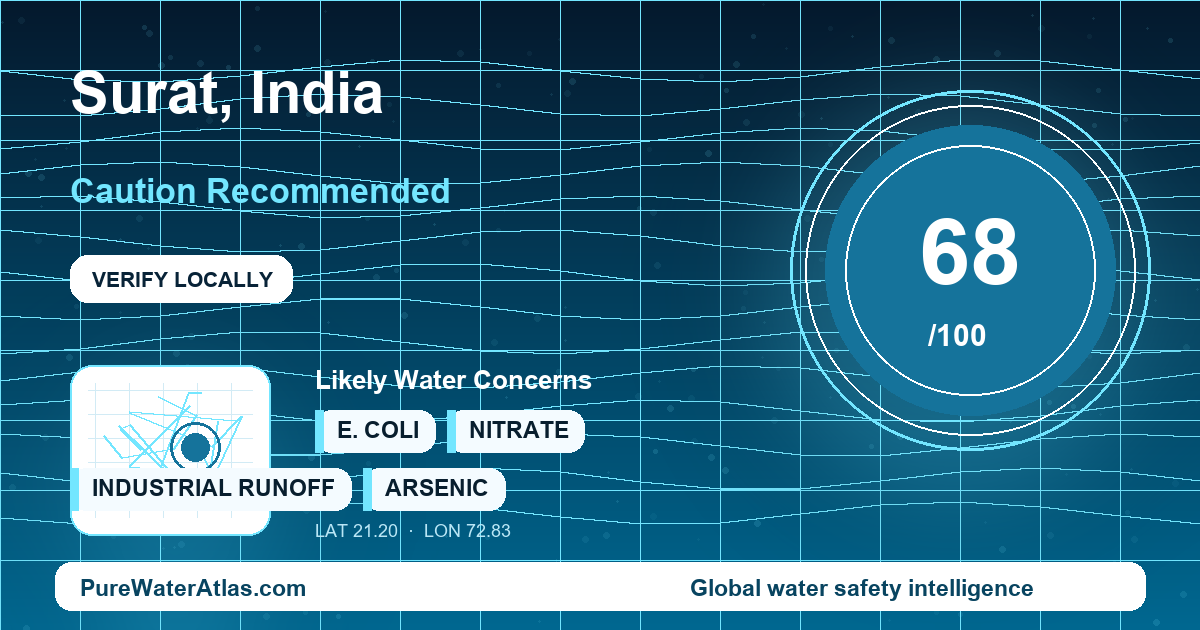
Surat, Gujarat: a Tapi River municipal surface-water system with treated supply, but tap-level caution is recommended because monsoon turbidity, flooding, distribution conditions, and private storage tanks can affect the water that reaches homes and hotels.
Quick Answer
| Overall safety status | Caution Recommended — PureWaterAtlas score: 68/100. Surat has a formal municipal water system, but public, routinely updated, neighborhood-level tap-water data are limited. |
|---|---|
| Can tourists drink the tap water? | Not recommended untreated. Visitors should use sealed bottled water, boiled water, or water from a clearly maintained hotel or restaurant purifier. |
| Resident guidance | Municipal users generally start with treated Surat Municipal Corporation water, but a maintained point-of-use purifier or boiling is prudent during monsoon turbidity, flooding, low-pressure periods, pipe repairs, discoloration, odor, or after storage-tank problems. |
| Main source | Surface water from the Tapi River system, influenced by upstream regulation from Ukai Dam and freshwater storage near Surat through the weir-cum-causeway system. |
| Water authority | Surat Municipal Corporation, especially its Hydraulic Department or water-supply function. |
| Filter recommendation | For many homes: sediment prefilter plus activated carbon and UV or ultrafiltration. Use reverse osmosis only when measured total dissolved solids or specific contaminants justify it. |
Why Surat Is Different
Surat is not a city where the main urban water picture is based on untreated household collection or isolated private wells. Its core drinking-water identity is a municipal surface-water system tied to the Tapi River and operated through Surat Municipal Corporation infrastructure. That gives Surat an important baseline advantage: water is abstracted, treated, stored, pumped, and distributed through a formal urban utility system.
The caution comes from where Surat sits and how water reaches the final tap. Surat is a low-lying city on the Tapi River near the Gulf of Khambhat. That means the system must manage upstream river-water quality, monsoon hydrology, flood risk, and downstream estuarine or tidal salinity pressure. The city has a long relationship with the Tapi River, including major flood history such as the 2006 Tapi River flood, which illustrates how strongly local water safety is tied to river regulation, stormwater, drainage, and seasonal conditions.
For a household or traveler, the important point is that treatment-plant water quality is only one part of safety. Long distribution mains, service reservoirs, underground sumps, rooftop tanks, older plumbing, and stagnant storage can all change the quality of water by the time it reaches a glass. In Surat’s hot climate, stored water can lose disinfectant residual faster and support biofilm growth if tanks are not cleaned and protected.
Where Does Surat’s Tap Water Come From?
Surat’s main drinking-water source is surface water from the Tapi River system. Upstream, Ukai Dam and reservoir are important for regulating river flow and supporting dry-season availability. Near the city, the freshwater reach around Surat is associated with the weir-cum-causeway or Singanpor-area impoundment, which helps maintain freshwater storage and reduce the upstream movement of tidal salinity from the lower Tapi and Gulf of Khambhat zone.
The modern city depends on municipal abstraction, treatment, pumping stations, underground and elevated service reservoirs, and a distribution network. This is different from direct river collection: municipal water is intended to pass through treatment and disinfection before being supplied. However, some peri-urban users or properties outside reliable network service may still depend on borewells, tankers, or mixed local storage arrangements. Those sources should not be treated as equivalent to municipal treated water without testing.
Surat’s water system therefore has several layers: the Tapi River source, upstream flow regulation, local freshwater impoundment, municipal treatment and storage, distribution pipelines, and finally private building storage. The last layer is especially important. A clean municipal supply can become unsafe if an underground sump or rooftop tank is uncovered, poorly screened, affected by sewage seepage or floodwater, or not cleaned and disinfected on a regular schedule.
Who Manages Drinking Water in Surat?
The local urban water utility is Surat Municipal Corporation, with its Hydraulic Department being the most directly relevant municipal function for abstraction, treatment, pumping, storage, and distribution. Upstream water-resource context, including Ukai Dam on the Tapi River, falls within Gujarat’s state water-resources framework, referenced through the Narmada, Water Resources, Water Supply and Kalpsar Department, Government of Gujarat.
Drinking water in India is commonly managed against Indian drinking-water specifications such as BIS IS 10500. Ambient river-water monitoring and pollution oversight are also relevant because Surat depends on a river source; those roles involve agencies such as the Gujarat Pollution Control Board and the Central Pollution Control Board’s National Water Quality Monitoring Programme.
A key limitation for Surat is public disclosure. The city-level source and authority are clear, but publicly available, frequently updated, ward-by-ward tap-water results are not consistently available in a format that allows an audit-ready statement about every neighborhood. In particular, public data are limited for residual chlorine at the tap, microbial noncompliance history, turbidity excursions, metals, pesticides, PFAS, and building-level storage conditions. Absence of an easy public report should not be read as proof that all taps are safe or unsafe.
Main Local Water Concerns
Monsoon turbidity: From June to September, Tapi River water can become more turbid. Higher turbidity increases the treatment challenge and can also show up as visible muddiness if there are distribution or storage problems. Learn more about turbidity and why cloudy or muddy water matters for disinfection.
Microbial contamination after pressure changes or flooding: Pipe repairs, low-pressure episodes, backflow, flooding, and contaminated building tanks can allow microbial contamination at the point of use. This is why E. coli and other coliform indicators are important when testing water after floods, repairs, or repeated stomach-illness complaints.
Storage-tank risk: Many Surat buildings use underground sumps or rooftop tanks. Insects, rodents, dust, sewage seepage, floodwater, warm stagnant water, and biofilm can undermine municipal treatment. Tank hygiene is one of the most practical final-barrier issues in the city.
Salinity and high dissolved solids in non-municipal sources: Surat is near the tidal lower Tapi and the Gulf of Khambhat. Municipal river impoundment helps manage salinity movement, but private borewells or tanker supplies in coastal or peri-urban settings may have salty taste, higher conductivity, chloride, hardness, or total dissolved solids. Groundwater users should consult context from the Central Ground Water Board and test their own source.
Chlorine taste versus warning odors: A mild chlorine taste or smell can indicate a disinfectant residual. Strong chemical odor, sewage smell, unusual color, or heavy sediment should be treated as warning signs, not as normal municipal-water variation.
Older-building metals: Surat’s main source-water concern is not documented here as citywide lead contamination, but building plumbing can still matter. Older pipes, brass fittings, solder, and stagnant first-draw water can add metals risk at individual taps. See PureWaterAtlas on lead and lead testing methods if plumbing age is uncertain.
For Travelers
For short-term visitors, the safest practical answer is simple: do not drink untreated tap water in Surat. Use sealed bottled water, boiled water, or water from a clearly maintained purification system, such as RO plus UV or ultrafiltration with disinfection. Do not rely on taste or clarity alone; water can look clear and still carry microbial risk.
For brushing teeth, many healthy travelers can use treated hotel water if the hotel has a credible, maintained purifier. More cautious travelers, children, pregnant travelers, and immunocompromised travelers should use bottled or boiled water for brushing as well. If you are unsure whether a bathroom tap is connected to treated or stored water, use bottled water.
Be careful with ice. Avoid ice from street stalls or informal vendors unless you can verify it was made from purified water. Ice in higher-standard hotels and restaurants is generally lower risk, but it is still a common pathway for traveler stomach illness when source control and storage hygiene are uncertain.
In hotels and restaurants, ask whether drinking water is sealed bottled water or purified on site. Prefer sealed bottles opened in front of you, or filtered water from a maintained system. In budget lodging, do not assume that a jug, cooler, or refill container is microbiologically safe unless filter maintenance and storage hygiene are credible. During monsoon, flooding, or visible discoloration, be more conservative.
If tap water must be used, bring it to a rolling boil and let it cool in a clean, covered container. PureWaterAtlas has a detailed guide to boiling water purification for situations where bottled or professionally filtered water is not available.
For Residents
For residents connected to the Surat Municipal Corporation network, the starting point is treated municipal water. The final risk depends heavily on the building. A home purifier is commonly justified where water passes through private tanks, older plumbing, or periods of stagnant storage. For many municipal-supply homes, a sediment prefilter plus activated carbon and UV or ultrafiltration can help address turbidity, chlorine taste, and microbial risk after storage. See the PureWaterAtlas UV water purification guide for when UV is useful and what maintenance it requires.
Reverse osmosis should be chosen based on measured total dissolved solids or specific contaminants, not used blindly. RO can waste water and remove minerals, so it is most appropriate when testing shows high TDS, salinity, or contaminants that require membrane treatment. If municipal water tastes normal and has moderate dissolved solids, UV or ultrafiltration may be a more practical final barrier than unnecessary RO.
Residents using borewells, tankers, or mixed sources should test at least annually for total dissolved solids, electrical conductivity, hardness, chloride, nitrate, fluoride, iron, manganese, and microbiological indicators such as E. coli or thermotolerant coliforms. Municipal-only households with rooftop or underground tanks should test after tank cleaning and whenever water develops odor, slime, sediment, discoloration, or recurring illness complaints.
After floods, major pipe repairs, repeated low-pressure episodes, or backflow concerns, boil water or otherwise disinfect it until clarity, pressure, and local conditions are normal. If possible, test for E. coli or total coliforms. Older apartments, schools, clinics, and homes with infants or pregnant residents should consider first-draw and flushed-sample testing for lead and other metals when plumbing age or fittings are uncertain.
Storage tanks are a major Surat-specific final-barrier issue. Underground sumps and rooftop tanks should be covered, screened, cleaned, and disinfected on a regular schedule. Flush stagnant water before drinking, use cold water for cooking and drinking, and investigate metallic taste, discoloration, sewage odor, or persistent sediment instead of treating those signs as routine.
Relevant Contaminants and Water-Quality Issues
The most relevant PureWaterAtlas topics for Surat are not one single citywide contaminant, but a set of issues tied to river source water, monsoon season, distribution conditions, and building storage. Start with turbidity for muddy or cloudy water during heavy rain, sediment for visible particles after pipe repairs or tank disturbance, and E. coli for microbial risk after flooding, tank contamination, or low-pressure events.
Chlorine is also relevant because disinfected municipal water may have a mild chlorine taste. That can be normal, but loss of residual chlorine in warm, stagnant storage can reduce protection. Lead is included because premise plumbing can affect individual taps, especially in older buildings, even when the municipal source is surface water.
How to Verify Your Water Quality
For a broader safety framework, use PureWaterAtlas guides on drinking water safety, water testing, water microbiology, and water purification methods. Residents comparing possible contaminants can use the Contaminants Search Engine, and travelers or households can cross-check country and city context in the Global Water Quality Checker.
For health-critical decisions, use a laboratory recognized by a government department, municipal body, NABL accreditation system, university, or reputable public-health institution. Home strips can be useful for screening some parameters, but they should not be the only basis for decisions about microbial safety, metals, or borewell potability.
Official and Technical Sources
- Surat Municipal Corporation — official city authority for municipal services.
- Surat Municipal Corporation Hydraulic Department — local water-supply function for treatment, storage, pumping, and distribution.
- Government of Gujarat water-resources department — state context for major infrastructure including Ukai Dam on the Tapi River.
- Gujarat Pollution Control Board — pollution-control regulator relevant to river-water quality and industrial or urban discharges.
- Central Pollution Control Board National Water Quality Monitoring Programme — ambient water-quality monitoring data for river context.
- BIS Drinking Water Specification IS 10500 — Indian potable-water benchmark parameters.
- Central Ground Water Board — groundwater context for borewell, tanker, or mixed-source users.
- World Health Organization drinking-water fact sheet — public-health background on safe drinking water and contamination pathways.
Bottom Line
Surat’s tap water begins from a formal municipal system based mainly on the Tapi River, supported by upstream regulation and city water-supply infrastructure. That makes it more structured than untreated private-source water, but it does not justify treating every tap as reliably drinkable. The main practical risks are monsoon turbidity, flooding or pipe-repair contamination, loss of disinfectant in warm storage, private tank hygiene, older plumbing, and salinity or high dissolved solids where borewells or tankers are used. Tourists should stick to sealed bottled, boiled, or verified purified water. Residents should maintain tanks, use an appropriate purifier, and test water after floods, repairs, unusual taste, odor, sediment, discoloration, or source changes.
Read the full guide: Global Water Quality Guide
Explore more in this category: Global Water Quality Articles