
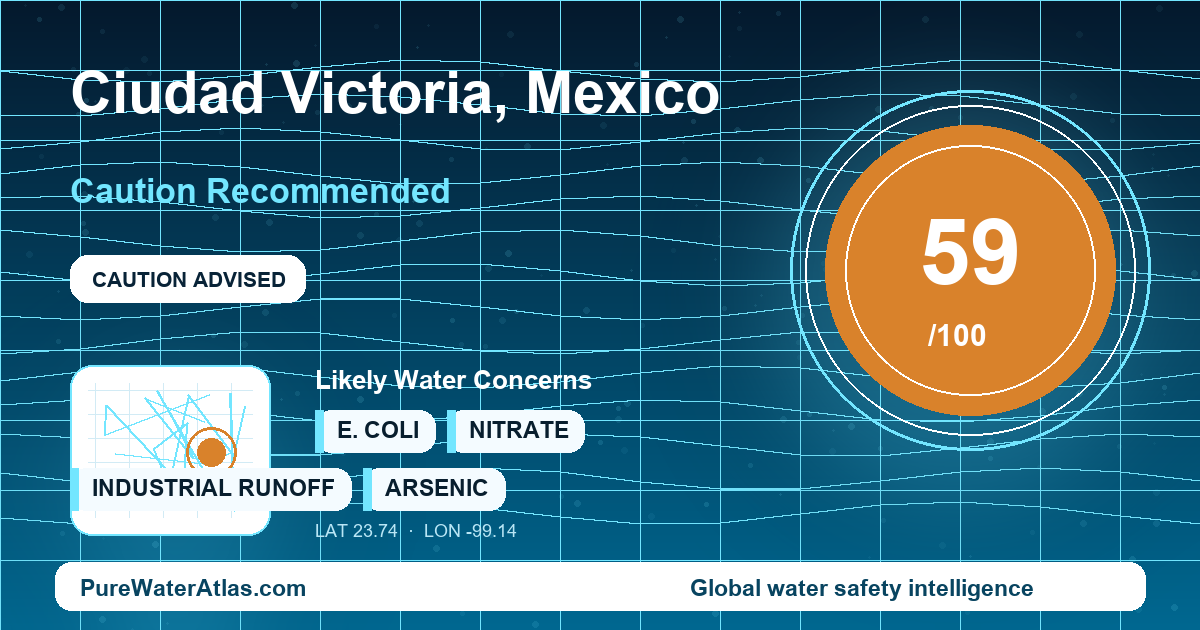
Ciudad Victoria, Tamaulipas: municipal supply from a dam-and-aqueduct system, drought-sensitive service, and point-of-use caution for drinking water.
Quick Answer
| Overall safety status | Caution recommended. PureWaterAtlas assigns Ciudad Victoria a water safety score of 59/100, reflecting a treated municipal system but meaningful reliability and point-of-use risks. |
|---|---|
| Can tourists drink the tap water? | Not recommended as a default. Short-term visitors should use sealed bottled water, properly filtered water, or water boiled for at least 1 minute. |
| Resident guidance | Municipal tap water is commonly usable for washing, bathing, and cooking with caution, but drinking water is best managed with maintained filtration, household testing, and clean tinacos or cisterns. |
| Main water source | A mixed municipal system operated by COMAPA Victoria, with a backbone supply associated with the Vicente Guerrero Dam system and the Guadalupe Victoria aqueduct, plus supplemental local wells and spring-source context. |
| Water authority | Comisión Municipal de Agua Potable y Alcantarillado de Victoria, commonly known as COMAPA Victoria. |
| Filter recommendation | For drinking and cooking, use sediment prefiltration plus activated carbon. Reverse osmosis is more appropriate if testing shows elevated dissolved minerals, nitrate, arsenic, or similar dissolved contaminants. UV can help after storage tanks when turbidity is controlled first. |
The practical answer is conservative: Ciudad Victoria has a formal utility and treated public supply, but intermittent service, pressure changes, drought stress, and household storage mean that water quality at the kitchen tap may not match water quality leaving the utility system.
Why Ciudad Victoria Is Different
Ciudad Victoria is not a coastal city. It sits inland in central Tamaulipas at the foot of the Sierra Madre Oriental, so its drinking-water risk profile is not primarily about direct seawater intrusion at the tap. The more relevant issues are reservoir drought, imported surface water, distribution pressure, wells, and household storage.
The city depends heavily on a regional supply system rather than only on water immediately within the urban area. The Vicente Guerrero Dam system and the Guadalupe Victoria aqueduct are central to the local water story. That makes Ciudad Victoria sensitive to reservoir levels, regional drought patterns, pumping conditions, and operating decisions made beyond a single neighborhood.
Another important local factor is the way many homes and buildings manage unreliable or intermittent water. Tinacos, cisterns, pumps, and rooftop tanks are practical parts of daily water use in Ciudad Victoria. These systems can improve availability, but they also create a final point where drinking water can be contaminated if tanks are uncovered, dirty, stagnant, or poorly disinfected. For that reason, the question is not only whether municipal water is treated. It is also whether the water remained protected through distribution, storage, and building plumbing.
PureWaterAtlas does not make a universal potability claim for every neighborhood or every day in Ciudad Victoria. The available evidence supports a “caution recommended” rating: official utility identity and supply-system context are documented, drought and service-stress concerns are well supported, but recent comprehensive public tap-water test results by zone were not found in the reviewed sources.
Where Does Ciudad Victoria’s Tap Water Come From?
Ciudad Victoria is supplied by a mixed municipal water system operated locally by COMAPA Victoria. The backbone source is surface water imported from the Vicente Guerrero Dam system through the Guadalupe Victoria aqueduct. Local water-supply discussions also identify supplemental sources such as wells and the La Peñita spring area, particularly when demand or drought stresses the main supply.
The key infrastructure relevant to drinking-water reliability includes the Vicente Guerrero Dam, the Guadalupe Victoria aqueduct, COMAPA Victoria pumping and distribution facilities, chlorination and storage components, supplemental groundwater or spring-source elements, and private household storage tanks. In practical terms, water may pass through several stages before it reaches a glass: reservoir or local source, conveyance, treatment or chlorination, pumping, municipal pipes, building plumbing, and often a tinaco or cistern.
Historically, before the dam-and-aqueduct system became the main supply backbone, Ciudad Victoria relied more heavily on local springs, wells, and nearby surface-water features associated with the San Marcos area and foothill hydrology of the Sierra Madre Oriental. Those local sources remain relevant as backup and context, but the present urban system is strongly shaped by imported surface water and distribution infrastructure.
This matters for water safety because surface-water systems can experience changes in turbidity and sediment after heavy rains, runoff events, reservoir quality changes, or operational shifts. It also matters for reliability because low reservoir levels and drought conditions can contribute to rationing, pressure management, and service interruptions. Official reservoir information from CONAGUA’s Presa Vicente Guerrero reservoir data and drought status from the Monitor de Sequía en México are directly relevant to understanding Ciudad Victoria’s water reliability.
Who Manages Drinking Water in Ciudad Victoria?
The municipal water and sewer utility for Ciudad Victoria is the Comisión Municipal de Agua Potable y Alcantarillado de Victoria, commonly known as COMAPA Victoria. COMAPA Victoria is the local entity residents should follow for service announcements, operational updates, repairs, and customer advisories.
At the national level, drinking-water quality in Mexico is governed by health standards including NOM-127-SSA1-2021, Agua para uso y consumo humano. Oversight roles also involve federal health authorities, CONAGUA for national water resources, and state or local sanitary authorities.
For consumers, the important distinction is between water quality at a treatment or chlorination point and water quality at the tap. Even when utility water is disinfected, low-pressure periods, pipe repairs, private plumbing, stagnant building lines, and dirty storage tanks can change the risk at the point of use. This is especially relevant in Ciudad Victoria because intermittent service and household storage are practical parts of the local water experience.
Main Local Water Concerns
- Intermittent supply and low pressure: Ciudad Victoria has experienced recurring water-stress problems, including low supply, pressure management, and service interruptions. Low pressure can increase practical contamination risk if leaks allow intrusion into pipes.
- Turbidity and sediment: Discolored, gritty, or cloudy water may occur after pipe repairs, pressure changes, heavy rain runoff, or reservoir-quality shifts. These events do not prove a specific contaminant, but they are a reason to avoid drinking the water until it clears and is handled safely.
- Microbial risk after storage: Tinacos and cisterns can become the weak link if they are uncovered, dirty, or not disinfected. Microbial risk becomes more important after outages, flooding, long stagnation, or loss of disinfectant residual.
- Chlorine taste and odor variation: Chlorine levels can vary with disinfection adjustments, long distribution paths, water age, and household storage. A chlorine smell is not by itself proof of unsafe water, but sudden changes should be treated cautiously.
- Older private plumbing: Older fixtures, solder, galvanized pipe, corroded plumbing, or stagnant building lines can create tap-specific metal and sediment risks. This profile does not claim a proven citywide lead problem.
- Supplemental groundwater concerns: Where wells, hauled water, or non-COMAPA sources are used, nitrate, dissolved minerals, hardness, arsenic, fluoride, and microbial indicators may need testing. Public citywide data are not sufficient to assign a specific neighborhood risk.
Season also matters. Dry-season and drought periods can reduce reservoir availability and increase low-pressure events. Summer heat can raise demand and reduce disinfectant persistence in tanks and long distribution paths. Heavy rains and tropical storm remnants can increase raw-water turbidity. After outages or repairs, first-flow water may contain sediment, so flushing and boiling guidance become more important.
For Travelers
Short-term visitors should not treat Ciudad Victoria tap water as reliably drinkable by default. Use sealed bottled water, water from a professionally maintained purification system, or water boiled for at least 1 minute. This is a travel-risk recommendation, not a claim that all municipal water is unsafe.
For brushing teeth, use bottled or filtered water if you have a sensitive stomach, are immunocompromised, are traveling with children, or are staying in a building with visible storage tanks or recent water outages. Many residents may brush with tap water, but visitors have less time to adapt and less knowledge of building plumbing and storage conditions.
Use ice only in established hotels, restaurants, and cafés that can confirm it is made from purified water. Avoid informal ice when the source is unclear. Better hotels and restaurants commonly use garrafón water, commercial ice, or internal filtration for drinking water, but it is still reasonable to ask whether the drinking water and ice are purified.
Practical traveler rules for Ciudad Victoria are simple: carry bottled water during the day, avoid drinking from bathroom taps, do not assume rooftop-tank water is potable, and switch to bottled or boiled water immediately after outages, pipe repairs, flooding, or discolored water. The U.S. CDC’s Mexico Traveler View supports conservative food and water precautions for travelers.
For Residents
Residents should think in terms of point-of-use management. A practical home setup for drinking and cooking water is sediment prefiltration followed by activated carbon. Sediment control helps protect downstream devices and improves performance when water carries grit or discoloration after pressure changes. Activated carbon can improve taste and address chlorine-related issues and some organic compounds.
Reverse osmosis is more appropriate where household testing shows elevated dissolved minerals, nitrate, arsenic, or other dissolved contaminants. UV can be useful after tinacos or cisterns, but only when turbidity is controlled first, because particles can shield microorganisms from UV exposure. For background on options, see PureWaterAtlas guides to Water Treatment Systems, Water Purification, and UV Water Purification.
Household testing is especially important in Ciudad Victoria homes that use tinacos or cisterns. Test point-of-use water for total coliform and E. coli after cleaning, flooding, long outages, or any event that may have allowed contamination. Check free chlorine residual at the tap during normal service and after interruptions to verify that disinfectant is reaching the home.
If the building is older or plumbing materials are unknown, test first-draw and flushed samples for lead and other metals. If the home uses private wells, hauled water, or supplemental non-COMAPA sources, test for nitrate, total dissolved solids, hardness, arsenic, fluoride, and microbiological indicators. After repeated brown, yellow, or gritty water events, test turbidity, iron, manganese, and sediment, and inspect tanks and filters.
Tinacos and cisterns should be covered, screened, cleaned, and disinfected on a regular schedule. A clean municipal supply can become unsafe if stored in a dirty or open tank, especially during hot weather or after low-pressure events.
Relevant Contaminants and Water-Quality Issues
The most relevant Ciudad Victoria water-quality issues are not a single confirmed citywide contaminant, but a pattern of distribution, storage, and drought-related concerns.
- Chlorine is relevant because disinfectant residual can vary across long distribution lines, low-pressure periods, and household storage.
- Turbidity matters after heavy rain, reservoir changes, pressure disturbances, and pipe repairs.
- Sediment is relevant when tap water appears brown, yellow, gritty, or disturbed after outages.
- E. coli is a key indicator for microbial safety, especially where private storage tanks, low-pressure intrusion, or post-outage conditions are involved.
- Lead is relevant for older private plumbing and first-draw tap testing, without implying a proven citywide lead issue.
- Nitrate is relevant for groundwater, hauled water, agricultural watershed context, or supplemental non-municipal sources.
For specific response steps, PureWaterAtlas also provides guides on boiling water purification, lead testing and detection, lead filters and solutions, and nitrate testing.
How to Verify Your Water Quality
Because public neighborhood-level tap-water results for Ciudad Victoria were not readily available in the reviewed official sources, the most reliable approach is to verify water at the point where you actually use it: the kitchen tap, filtered tap, or storage-tank outlet.
- Check local utility information: Follow COMAPA Victoria for service interruptions, repairs, pressure changes, and advisories.
- Test after events: After outages, flooding, tank cleaning, long stagnation, or discolored water, test for microbial indicators and basic physical parameters.
- Separate first-draw and flushed samples: In older buildings, compare first-draw water with flushed water to evaluate plumbing-related metals.
- Match treatment to test results: Do not buy a reverse osmosis, UV, or carbon system based only on taste. Choose treatment based on verified contaminants and maintenance capacity.
Useful PureWaterAtlas resources include the Complete Guide to Water Testing, the Drinking Water Safety pillar, the Water Microbiology guide, the Contaminants Search Engine, and the Global Water Quality Checker. Related category pages include Drinking Water Safety, Global Water Quality, Water Testing, and Water Purification.
Official and Technical Sources
- COMAPA Victoria official website — local municipal water and sewer utility for Ciudad Victoria service information and announcements.
- Presa Vicente Guerrero reservoir information, CONAGUA Sistema Nacional de Información del Agua — reservoir storage data relevant to Ciudad Victoria’s dam-linked supply.
- Monitor de Sequía en México, Servicio Meteorológico Nacional and CONAGUA — official drought-monitoring information for Tamaulipas and regional supply stress.
- NOM-127-SSA1-2021, Agua para uso y consumo humano, Diario Oficial de la Federación — national Mexican drinking-water quality standard.
- Áreas geográficas: Victoria, Tamaulipas, INEGI — official geographic and municipal reference.
- Mexico Traveler View, U.S. Centers for Disease Control and Prevention — travel health guidance supporting conservative water precautions.
- Drinking-water fact sheet, World Health Organization — public-health reference on safe drinking water and contamination pathways.
Bottom Line
Ciudad Victoria’s tap water deserves caution, not a blanket unsafe label. The city has a formal municipal utility, COMAPA Victoria, and a treated public supply connected to the Vicente Guerrero Dam system and Guadalupe Victoria aqueduct. The main concern is reliability at the point of use: drought stress, low pressure, intermittent service, pipe disturbance, and household storage can affect water before it reaches the faucet. Travelers should use sealed bottled, professionally purified, or boiled water for drinking. Residents should maintain tinacos and cisterns, test water after outages or storage problems, and use a properly maintained filter for drinking and cooking. Because recent public neighborhood-level tap-water datasets were not found, household verification is the safest approach.
Read the full guide: Global Water Quality Guide
Explore more in this category: Global Water Quality Articles