Campeche’s municipal water comes mainly from groundwater in the karstic Yucatán Peninsula aquifer system, but household safety can vary because of cisterns, rooftop tinacos, intermittent pressure, older plumbing, and limited public neighborhood-level tap-water data.
Quick Answer
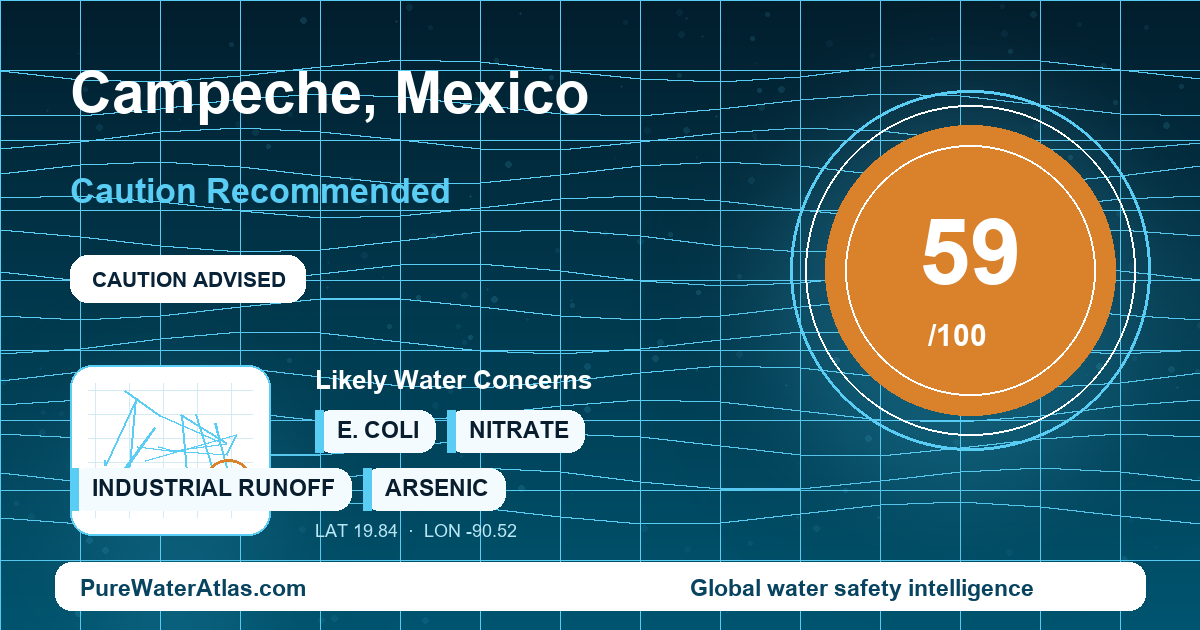
| Water safety score | 59 / 100 |
|---|---|
| Risk level | Caution Recommended |
| Is Campeche tap water safe to drink? | Caution recommended. Campeche water is expected to be disinfected under Mexican drinking-water rules, but recent, public, city-specific finished-water laboratory results are not easy to verify. Safety at the tap can also change after the water passes through distribution pipes, cisterns, rooftop tanks, and building plumbing. |
| Traveler advice | Most visitors should use sealed bottled water, hotel-provided purified water, or properly treated water for drinking. Tap water is generally acceptable for handwashing and showers; cautious travelers should also use bottled or purified water for brushing teeth. |
| Resident advice | Treat Campeche tap water as a municipal supply that may be usable after point-of-use treatment, not as water to assume is drinkable directly from every tap. Maintain filters, clean storage tanks, and test when conditions change. |
| Main source | Municipal groundwater wells and wellfields drawing from the Campeche aquifer area of the karstic Yucatán Peninsula aquifer system. |
| Water authority | Sistema Municipal de Agua Potable y Alcantarillado de Campeche, commonly referenced as SMAPAC, with state-level support from CAPAE and federal groundwater administration by CONAGUA. |
| Filter recommendation | For drinking, use at least a sediment prefilter plus certified activated carbon. Consider reverse osmosis if testing shows high dissolved solids, salinity, nitrate, arsenic, or other inorganic concerns. UV can help with microbes only when water is clear and the device is properly maintained. |
Why Campeche Is Different
Campeche is not a city whose drinking-water profile can be understood by looking for a large river or reservoir. San Francisco de Campeche sits on the Gulf of Mexico in a low-lying limestone region where rainwater tends to infiltrate rather than remain as permanent surface drainage. That geography makes groundwater the logical main source for the city, and the municipal supply is understood to depend primarily on wells and pumping systems connected to the Campeche aquifer area.
This groundwater identity is important for safety. Karstic limestone aquifers can move water quickly through underground openings and fractures, which means aquifer protection, wastewater management, and well integrity matter. The same coastal setting also creates a practical concern for salinity pressure and elevated dissolved solids if pumping or local conditions affect the freshwater-saltwater balance. These are not claims that every tap in Campeche has a specific contaminant problem; they are credible local risk factors for a coastal city dependent on groundwater.
The other Campeche-specific issue is the path from the municipal system to the glass. Many homes, rentals, and hotels in Mexico use cisterns or rooftop tinacos. Two buildings on the same street can therefore have different water quality. A hotel with a clean, covered tank and internal treatment may deliver better tap water than a poorly maintained private residence, even when both receive municipal water.
Where Does Campeche’s Tap Water Come From?
Campeche city is supplied primarily by groundwater from the karstic Yucatán Peninsula aquifer system, within the CONAGUA-designated Campeche aquifer area. Water is extracted through municipal wells and wellfield or pumping systems, then moved through pumping stations, conduction lines, storage tanks, and distribution mains serving the urban area and surrounding localities. There is no evidence in the dataset that Campeche relies on a large river or surface reservoir as its main drinking-water source.
Historically, San Francisco de Campeche depended on underground freshwater because the regional limestone terrain has limited permanent surface water. Modern service expanded from local wells and galleries to pumped municipal well systems and distribution tanks. That history still shapes current risk: the main raw-water question is groundwater quality, while the tap-water question also depends on disinfection, pressure stability, pipe condition, storage tanks, and household maintenance.
Key infrastructure elements for Campeche include municipal groundwater wells and wellfields, pumping stations, conduction lines, distribution mains, storage tanks, household cisterns, rooftop tinacos, and the broader state and federal groundwater management framework for the Campeche aquifer. For households, the cistern or tinaco is often the last and most controllable part of the water system before the kitchen tap.
Who Manages Drinking Water in Campeche?
The local water and sewerage operator for Campeche is SMAPAC, the Sistema Municipal de Agua Potable y Alcantarillado de Campeche. SMAPAC is the primary city-level institution for water service, billing, and operational notices. State-level water infrastructure and policy support is associated with CAPAE, the Comisión de Agua Potable y Alcantarillado del Estado de Campeche.
At the federal level, CONAGUA publishes aquifer availability information and administers national waters, groundwater concessions, and aquifer management. Mexico’s national water information system is also available through CONAGUA’s Sistema Nacional de Información del Agua.
Drinking-water quality in Mexico is governed by national health standards, including NOM-127-SSA1-2021 for water for human use and consumption. Water providers are expected to disinfect and monitor potable supplies, while health surveillance involves Mexican health authorities such as Secretaría de Salud and COFEPRIS. For Campeche consumers, however, the practical limitation is that recent, public, neighborhood-level finished tap-water laboratory data are not easy to verify.
Main Local Water Concerns
The leading concern in Campeche is not a single confirmed citywide contaminant concentration. The concern is a combination of groundwater dependence, coastal hydrogeology, and variable building-level storage. Because the city relies on a karst aquifer, groundwater can be vulnerable to contamination from septic leakage, wastewater infiltration, urban runoff, and agricultural inputs. In a coastal aquifer, salinity or elevated dissolved solids may also become relevant where pumping or local aquifer conditions alter the freshwater-saltwater balance.
Nitrate is a plausible groundwater concern where wastewater infiltration, septic influence, or agricultural inputs affect an aquifer. It should be tested rather than assumed. Microbial risk is more strongly tied to storage and pressure conditions: intermittent pressure, pipe work, uncovered tanks, dirty cisterns, damaged tinaco covers, and loss of chlorine residual can allow sediment accumulation and microbial regrowth before water reaches the tap.
Seasonal conditions can make these issues more visible. Rainy-season runoff and flooding can increase pressure on wells, drainage, septic systems, and distribution infrastructure. Tropical storms and hurricanes can cause interruptions, low pressure, turbidity, and contamination risk from damaged infrastructure. Dry-season demand and groundwater pumping can increase stress on coastal aquifers and may worsen taste, hardness, or salinity-related concerns in some systems.
Lead risk in Campeche is more likely to be building-plumbing related than source-water related. Older homes, historic-center buildings, unknown fixtures, solder, brass components, and long stagnation periods can contribute metals or unpleasant taste even if water leaving the municipal system is acceptable.
For Travelers
Most short-term visitors should not use Campeche tap water as a routine drinking source. Choose sealed bottled water, hotel-provided purified water, or water treated with a reliable filter, UV purifier, or boiling method when microbial safety is uncertain. The CDC Travelers Health guidance for Mexico supports conservative food and water precautions for visitors.
For brushing teeth, risk tolerance matters. Many lower-risk travelers brush with tap water without incident, but cautious travelers should use bottled or purified water, especially in budget lodging, older buildings, places with visible storage tanks, or locations with low water pressure. Children, pregnant travelers, immunocompromised travelers, and anyone with a sensitive stomach should be more conservative.
Use ice only in established hotels, restaurants, and cafes that state or visibly indicate they use purified water. Avoid informal ice of unknown origin, especially in street settings. In hotels and restaurants, ask for agua purificada or bottled water if unsure. Do not assume that water served in a pitcher is tap-safe unless the establishment confirms it is purified.
For daily precautions, carry bottled water for drinking, use purified water for infant formula and medical devices, avoid swallowing shower water, and keep oral rehydration salts available in case of diarrhea. During heavy rain, flooding, outages, pipe repairs, or visible discoloration, avoid drinking tap water unless it has been boiled or otherwise disinfected according to reliable guidance.
For Residents
Residents should think of Campeche tap water as a municipal supply that may need household control before drinking. A practical baseline is a sediment prefilter followed by a certified activated carbon filter. Sediment filtration helps with particles released after repairs, pressure changes, or tank disturbance, while activated carbon can improve taste and reduce chlorine-related taste and some organic compounds.
Reverse osmosis is reasonable when testing shows high total dissolved solids, chloride, salinity, nitrate, arsenic, or other inorganic contaminants. It should not be selected only because water tastes different; testing is the best way to know whether mineral, nitrate, or metal reduction is needed. UV treatment can help with microbial control, but only when the water is already clear and the lamp, sleeve, flow rate, and maintenance schedule are correct. For background on options, see PureWaterAtlas guides to water treatment systems, UV water purification, and boiling water purification.
Households using cisterns or rooftop tinacos should clean, seal, screen, and disinfect them on a regular schedule. A dirty, uncovered, or stagnant tank can turn otherwise disinfected municipal water into unsafe water before it reaches the kitchen. Repeat bacteriological testing after cleaning tanks, after long vacancies, after flooding, and after major service interruptions.
Older buildings require extra caution. Flush taps after overnight stagnation, especially before collecting drinking or cooking water. Test lead and copper if plumbing materials are unknown, and use both first-draw and flushed samples when investigating building-plumbing metals. This is especially important where children, pregnant people, or immunocompromised residents drink the water.
Relevant Contaminants and Water-Quality Issues
For Campeche, the most relevant issues are linked to groundwater, disinfection, storage tanks, and building plumbing. Chlorine matters because municipal water is expected to be disinfected, but chlorine residual can dissipate during storage or long distribution time. Turbidity and sediment can appear after pipe repairs, pressure changes, tank disturbance, or storm-related infrastructure stress.
Microbial risk is best represented by indicators such as E. coli, especially for homes with cisterns, tinacos, flooding exposure, or low-pressure events. Nitrate is relevant in groundwater settings where wastewater infiltration or agricultural influence may be present, but Campeche tap-water nitrate levels should be tested rather than assumed. Residents can also review PureWaterAtlas guidance on nitrate testing and detection.
Lead is more likely to come from building plumbing than from Campeche’s groundwater source. Older homes and unknown fixtures deserve targeted testing; see lead testing methods. Arsenic should be considered when private wells or long-term reverse-osmosis decisions are involved, and residents can consult arsenic testing methods for sampling context.
How to Verify Your Water Quality
Because public, recent, tap-specific laboratory data for Campeche neighborhoods are limited, verification should be local and household-specific. Start by checking operational notices from SMAPAC and broader water-sector information from CAPAE and CONAGUA’s national water information system. Geographic context for Campeche water resources is available from INEGI Cuéntame.
For household verification, test total coliform and E. coli if water is stored in a cistern or tinaco, after flooding, after plumbing work, or whenever odor, slime, or unusual taste appears. Test nitrate near septic systems, agricultural influence, or private or semi-private well connections. Test conductivity, total dissolved solids, chloride, and hardness if water tastes salty, bitter, or strongly mineralized. Test lead and copper in older buildings or where plumbing is unknown. Test arsenic and other metals when relying on private wells or choosing long-term reverse osmosis.
PureWaterAtlas resources that may help include the complete guide to water testing, the drinking water safety guide, the water microbiology guide, the Global Water Quality Checker, and the Contaminants Search Engine. Related categories include Global Water Quality, Drinking Water Safety, Water Testing, and Water Contamination.
Official and Technical Sources
- SMAPAC – Sistema Municipal de Agua Potable y Alcantarillado de Campeche: municipal water and sewerage operator for Campeche.
- CAPAE – Comisión de Agua Potable y Alcantarillado del Estado de Campeche: state-level water and sanitation institution.
- CONAGUA aquifer availability updates: federal aquifer and groundwater management reference.
- CONAGUA Sistema Nacional de Información del Agua: national water information portal.
- Diario Oficial de la Federación – NOM-127-SSA1-2021: Mexican drinking-water quality standard.
- INEGI Cuéntame – Agua, Campeche: geographic context for state water resources.
- CDC Travelers Health – Mexico: travel-health water and food precaution context.
- WHO Guidelines for Drinking-water Quality: international reference for microbial safety, disinfection, and water-treatment principles.
Bottom Line
Campeche’s tap water deserves a cautious rating because the city relies mainly on municipal groundwater from a coastal karst aquifer, and recent neighborhood-level finished tap-water data are not easy to verify publicly. The water is expected to be disinfected under Mexican rules, but safety at the faucet can change because of distribution interruptions, cisterns, rooftop tinacos, older plumbing, sediment, and loss of chlorine residual. Visitors should use sealed bottled or purified water for drinking and be conservative with ice and brushing teeth. Residents who drink the water should use maintained point-of-use treatment, clean and disinfect storage tanks, and test for microbes, nitrate, salinity indicators, metals, and building-plumbing contaminants when conditions warrant.
Read the full guide: Global Water Quality Guide
Explore more in this category: Global Water Quality Articles