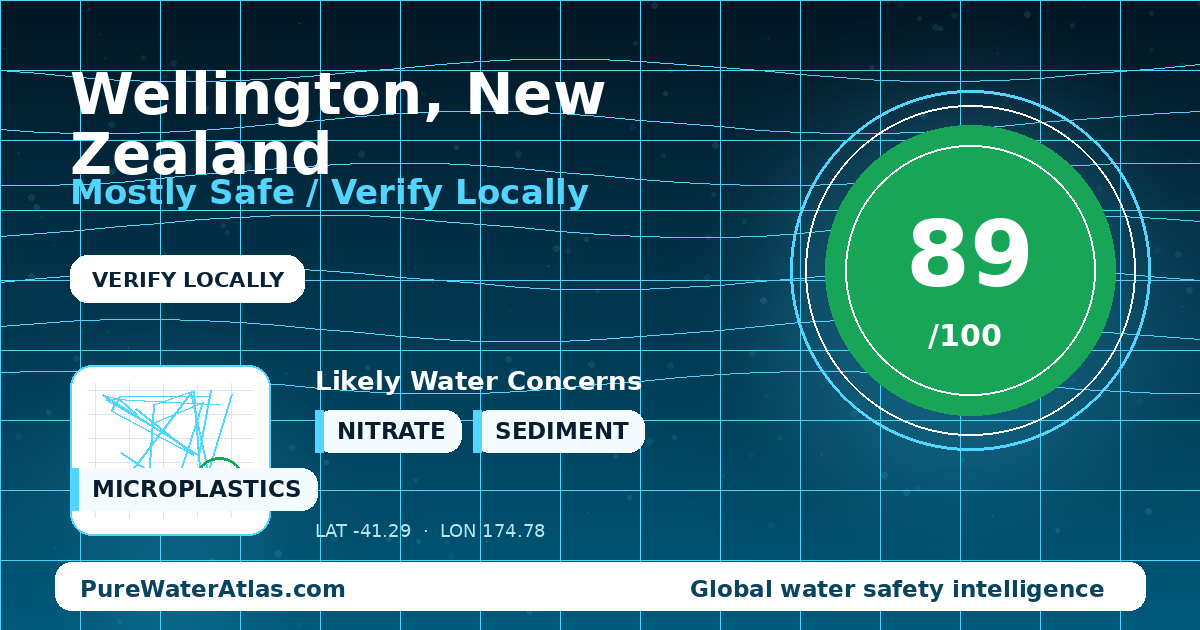
Wellington’s public tap water is ordinarily suitable for drinking. It comes from protected river catchments and the Waiwhetū aquifer, passes through treatment appropriate to each source, and receives chlorine for protection in the distribution network. That conclusion applies to the public reticulated supply under normal operating conditions—not automatically to every building, private bore, rainwater tank or temporary water tanker.
Quick Answer
| Overall safety status | Generally suitable to drink from the public supply, subject to current local advisories and the condition of the plumbing at the property. |
|---|---|
| Can visitors drink the tap water? | Yes, ordinarily. Check Tiaki Wai’s fault and outage page for the accommodation address after a main break, pressure loss or severe weather. |
| Resident advice | Use the cold tap for drinking and cooking. Report persistent discoloration, unusual odour or pressure changes. In buildings with old or uncertain plumbing, consider first-draw and flushed-water testing for lead and copper. |
| Main water source | An interconnected mix of the Hutt River/Te Awa Kairangi at Kaitoke, the Wainuiomata and Orongorongo rivers and smaller catchment streams, and the Waiwhetū aquifer. |
| Responsible authority | Tiaki Wai, a council-owned regional water organisation operating since 1 July 2026. The national regulator is the Water Services Authority – Taumata Arowai. |
| Filter recommendation | No routine filter is necessary solely because the property is in Wellington. Select treatment only for a measured problem or a specific taste objective. |
Where Does Wellington’s Tap Water Come From?
Wellington’s supply is regional and interconnected. Greater Wellington’s description of the bulk network says northern Wellington is normally supplied from Kaitoke, the central business district from Waterloo, and southern and eastern suburbs from a combination of Waterloo and Wainuiomata. A connection between the Kaitoke–Karori and Wainuiomata–Wellington trunk systems allows water to be transferred when operating conditions require it. A household’s source can therefore change, and percentages published for the wider metropolitan region should not be presented as a fixed Wellington City supply mix.
- Hutt River/Te Awa Kairangi: Water is collected at Kaitoke and treated at Te Mārua. The plant normally supplies western Wellington as far south as Karori, with mixing beyond that point.
- Wainuiomata and Orongorongo catchments: These rivers and the Georges, Big Huia and Little Huia streams feed the Wainuiomata plant, which contributes to Wellington’s central, southern and eastern supply.
- Waiwhetū aquifer: Eight Waterloo wells abstract naturally filtered groundwater beneath Lower Hutt. Waterloo water commonly reaches Wellington’s business district and southern and eastern suburbs after mixing with Wainuiomata water.
- Gear Island: This aquifer-fed plant is mainly a standby and boost facility rather than a continuous primary source.
The metropolitan proportions published by the operator—roughly 40% each from Te Mārua and Waterloo and just under 20% from Wainuiomata in a typical year—describe the wider regional system, not Wellington City alone.
How is the water treated?
At Te Mārua and Wainuiomata, river water is screened, chemically conditioned, coagulated, clarified and filtered before chlorination and final pH adjustment. Waterloo aquifer water receives ultraviolet treatment, aeration, pH and alkalinity adjustment, chlorine and fluoride. Gear Island uses aeration, chemical adjustment, chlorination and fluoridation. The operator explains that lime, carbon dioxide or caustic soda is used at different plants to reduce the corrosive effect of Wellington’s naturally soft water. Chlorine is intended to maintain protection after treatment and through the pipe network.
Who Manages Drinking Water?
Tiaki Wai took over water assets, funding and service delivery from the participating councils and Wellington Water on 1 July 2026. It serves Wellington, Porirua and the Hutt Valley. Older technical reports and 2024/25 performance results on this page were produced by Wellington Water, the predecessor operator, and remain useful evidence about the same metropolitan plants and networks.
The Water Services Authority – Taumata Arowai regulates drinking-water suppliers nationally, administers the Drinking Water Standards for New Zealand 2022 and receives safety and compliance notifications. Wellington City Council’s legacy bylaw also documents the division between public and private responsibility: the public operator is responsible up to the point of supply, while the property owner is responsible for the supply pipe and fittings on the private side.
Main Local Water Concerns
Ageing pipes, leakage and local pressure loss
The principal well-documented concern is infrastructure reliability rather than evidence of routine citywide contamination. Wellington Water reported that metropolitan water loss fell from about 41% to 37% in 2024/25 after saving approximately 11 million litres per day. Although this was an improvement, 37% remained a substantial regional loss. The same report warned that renewal and upgrade work was not keeping pace with asset condition and that disruptions and leakage would continue.
A leak does not itself prove contaminated tap water. The public-health concern arises when a burst pipe or repair causes depressurisation or creates an entry pathway. Local precautionary boil-water notices have occurred after pipe repairs; for example, a June 2025 notice covered Thompson Street and one Nairn Street property in Mount Cook. That was a small, defined incident—not evidence that all Wellington water was unsafe.
Treatment compliance and the limits of regional reporting
For 2024/25, the predecessor operator reported 100% bacteriological, protozoal and microbiological treatment compliance at Te Mārua, Wainuiomata and Gear Island. Waterloo was reported as 100% compliant for protozoal and microbiological measures but 92% for the bacteriological treatment measure because of insufficient chlorine contact time for about 800 households. The report links the remedy to Hutt City Council. It does not establish that those households were in Wellington City, so the non-compliance should not be transferred to Wellington residents without address-level evidence. The operator stated that the affected water remained safe to drink.
All four metropolitan plants met the operator’s 2024/25 fluoride performance target, with annual averages reported between 0.80 and 0.84 mg/L. Fluoride equipment has had reliability problems in earlier years, so fluoride concentration should not be treated as perfectly constant at every tap.
Soft water and private plumbing
Wellington water is generally soft. The plants adjust pH and alkalinity to reduce corrosion, but treatment-plant control cannot eliminate every plumbing-related risk inside a building. Lead may come from old fittings, brass components, solder or premise pipes after the water passes the public point of supply. The operator’s online chemical tables are useful but do not display an obvious sampling period and include isolated maxima above some listed values, including a maximum lead result at Te Mārua. Because the table is undated and plant-level, it cannot establish current exposure at a Wellington household. It does strengthen the case for transparent, dated chemical reporting and for household testing where plumbing is suspect.
For background on plumbing-related exposure, see PureWaterAtlas’s lead in drinking water guide and home lead safety checklist.
Earthquake and emergency resilience
Wellington’s earthquake exposure makes stored emergency water particularly important. Wellington City Council says households may need to be self-sufficient for at least seven days before distribution points are established and that restoration after a major earthquake could take weeks. WREMO’s cited planning amount is 20 litres per person per day for seven days, while 3 litres per person per day is described as a drinking-and-basic-hygiene minimum.
For Travelers
- Tap water at a normally operating hotel, hostel or home connected to the public system is generally appropriate for drinking, brushing teeth and making ice.
- Ask the accommodation provider whether the building is on the public supply and whether an active notice affects the address. Do not assume a sign about beach or harbour water applies to the drinking-water network.
- After an outage or pipe repair, follow the operator’s flushing or boiling instructions exactly. A notice can cover only a street or group of properties.
- Water at hiking huts, campsites, rural properties or roof-fed accommodation is not necessarily Wellington municipal water. Follow the notice posted for that particular supply.
- A chlorine taste is not, by itself, evidence that the water is unsafe. Chilling water in a clean covered container may improve taste.
For Residents
- Check the address-based network status after low pressure, a burst main, severe weather or nearby repair work.
- Use cold water for drinking and food preparation. Hot water can dissolve metals more readily and may have spent longer in building plumbing.
- If water is cloudy, fill a clear glass. Cloudiness that clears from the bottom upward is often trapped air after network work; persistent colour, sediment or odour should be reported and investigated rather than assumed harmless.
- Property owners should maintain the private supply pipe and premise plumbing. Multi-unit buildings should also verify that any private tank, booster system and backflow device are maintained hygienically.
- Do not directly cross-connect a rainwater tank, bore or other non-potable source to the public plumbing. Wellington’s bylaw specifically identifies cross-connections and storage tanks as backflow risks.
- Maintain an emergency water supply. Rotate stored container water as directed by local emergency guidance and keep containers sealed and protected from chemicals and sunlight.
Relevant Contaminants and Water-Quality Issues
| Issue | Evidence level | Where it applies | Practical interpretation |
|---|---|---|---|
| Microbial contamination | Controlled by filtration, UV at Waterloo, chlorination and monitoring; local vulnerability exists after pressure loss or pipe damage. | Source, treatment and distribution network | Do not infer routine contamination. Follow any local boil-water notice immediately. Learn more about E. coli treatment limitations. |
| Lead and copper | Potentially relevant because of soft water and private plumbing; current address-level evidence was not found. | Mostly premise plumbing and fittings | Test first-draw and flushed samples in older or suspect buildings. A plant sample cannot predict an individual tap. |
| Chlorine taste or odour | Expected because all metropolitan water is chlorinated. | Treatment and distribution | Usually an aesthetic issue within the operator’s normal range, but a sudden strong change should be reported. |
| Discoloration and sediment | Can occur after main work or flow changes. | Distribution and premise plumbing | Follow official flushing advice. Persistent or unexplained discoloration warrants investigation and possibly testing. |
| Fluoride variability | 2024/25 plant performance improved, but earlier equipment outages show dosing can vary. | Treatment plant and mixed network | This is mainly an oral-health performance issue, not evidence that the water is microbiologically unsafe. |
| Nitrate, arsenic and PFAS | No current city-specific evidence found showing these are leading Wellington public-supply problems. | Unconfirmed for Wellington taps | National reports or concerns in other New Zealand supplies must not be attributed to Wellington without local results. |
How to Verify Your Water Quality
- Identify the supply. Confirm whether the property receives public water, rainwater, bore water or a mixed system.
- Check active notices. Use Tiaki Wai’s address-based outage page rather than relying on a general search result or an old notice.
- Compare observations between taps. A problem at only one fixture points more strongly to the fixture or premise plumbing; a whole-building or neighbourhood issue should be reported to the operator.
- Use an accredited laboratory. For plumbing concerns, request paired first-draw and flushed samples for lead and copper. Following a private tank, bore or contamination incident, test E. coli or another appropriate microbial indicator. Add pH, turbidity, iron and manganese when colour, corrosion or sediment is involved.
- Choose treatment after results. PureWaterAtlas’s water-testing guide, home water-testing resource and contaminant search tool can help interpret the next step.
Treatment guidance
- Normal public supply: No additional treatment is routinely required.
- Chlorine taste: A maintained activated-carbon filter can reduce chlorine taste and odour. Carbon does not reliably disinfect water and can support microbial growth if cartridges are neglected.
- Confirmed lead: Use a device independently certified for lead reduction and replace cartridges on schedule. Depending on the product and water chemistry, suitable technologies may include certified adsorption media or reverse osmosis. See the lead removal comparison. A filter does not repair the plumbing source.
- Boil-water notice: Follow the exact official boiling instructions. Ordinary carbon filters are not substitutes for boiling. Boiling does not remove lead, nitrate, salts or most other dissolved chemicals.
- Private rainwater or bore: Treatment should be designed from sanitary inspection and laboratory results. UV requires sufficiently clear water and provides no residual protection; sediment filtration or other pretreatment may be necessary.
For broader decision support, use PureWaterAtlas’s water treatment systems guide, browse the drinking-water safety category, or check destination information with the Global Water Quality Checker.
Official and Technical Sources
- Our story — Tiaki Wai
- Water treatment plants in Wellington — Tiaki Wai
- What's in your water — Tiaki Wai
- Faults and Outages — Tiaki Wai
- Water collection areas, pumping stations and pipelines — Greater Wellington
- Annual Report for year ended 30 June 2025 — Wellington Water
- Drinking Water Regulation Report 2024 — Water Services Authority – Taumata Arowai
- Water tanks and water containers — Wellington City Council
- Water Services Bylaw 2024 — Wellington City Council
Related Contaminant Profiles
Explore PureWaterAtlas
Bottom Line
Wellington’s public tap water is generally appropriate to drink under normal conditions. It receives multi-barrier treatment and residual chlorination, and recent official reporting was broadly positive for the metropolitan treatment plants. The most important qualifications are local: ageing pipes can produce outages and occasional precautionary advisories, while private plumbing, tanks and cross-connections can change water quality after it leaves the public network. Check the current notice for the exact address, test when plumbing or a private source creates a credible concern, and avoid buying treatment equipment without identifying what it needs to remove.
Read the full guide: Global Water Quality Guide
Explore more in this category: Global Water Quality Articles