
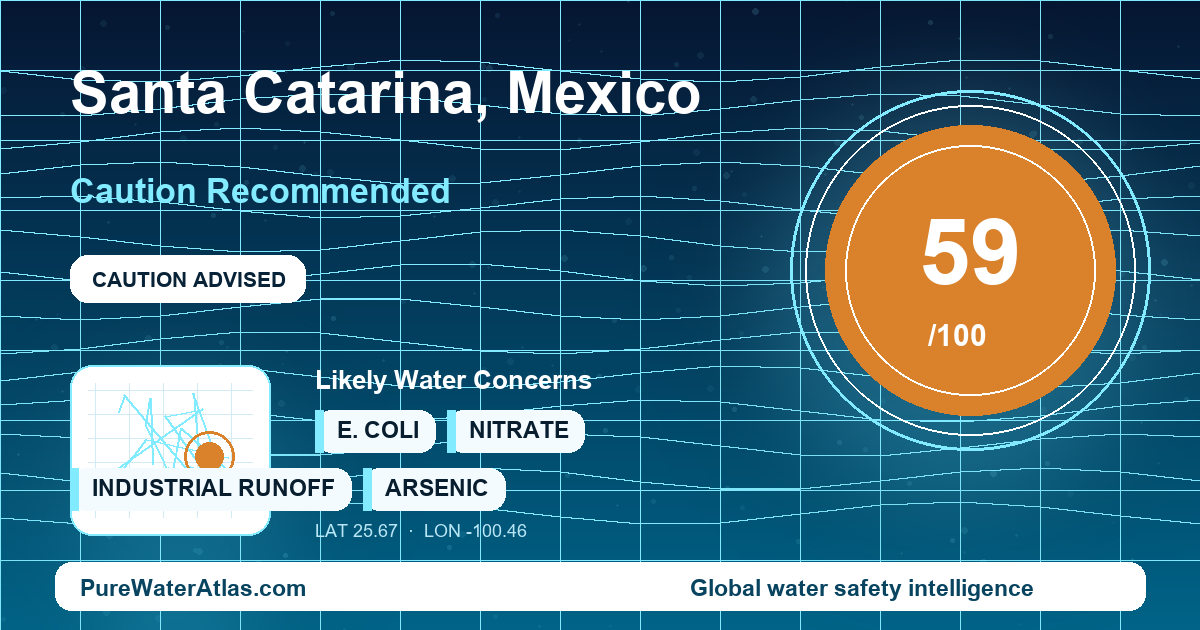
Santa Catarina, Nuevo León is served by the Monterrey metropolitan water system. Treated utility water is available, but drought stress, intermittent pressure, household storage tanks, sediment after service cuts, and limited neighborhood-level tap reporting mean caution is recommended for drinking.
Quick Answer
| Overall safety status | Caution recommended. Santa Catarina’s tap water is treated and disinfected through the Monterrey metropolitan system, but it should not be assumed safe to drink directly in every building or neighborhood. |
|---|---|
| Water safety score | 59 / 100 |
| Risk level | Caution Recommended |
| Traveler advice | Short-term visitors should use sealed bottled water or a trusted filtered source for drinking, especially in rentals, small hotels, or older buildings where cistern or rooftop tank maintenance is unknown. |
| Resident advice | Residents with stable SADM service can often use tap water after appropriate point-of-use filtration, but should maintain tinacos and cisterns, flush lines after outages, and test water when storage, old plumbing, or private wells are involved. |
| Main supply identity | Part of the Monterrey metropolitan drinking-water network, supplied by a regional blend of reservoirs, aqueducts, treatment infrastructure, and supplemental groundwater. |
| Water authority | Servicios de Agua y Drenaje de Monterrey, I.P.D. — commonly called SADM or Agua y Drenaje de Monterrey. |
| Filter recommendation | Sediment prefiltration plus activated carbon is a practical baseline. Reverse osmosis may be useful for broader reduction of dissolved minerals, metals, nitrate, and some industrial contaminants, but only if maintained properly. |
Why Santa Catarina Is Different
Santa Catarina should be evaluated as part of the Monterrey metropolitan water system, not as a small stand-alone municipal supply. The city is a western municipality of the Monterrey metropolitan area in Nuevo León, near the Sierra Madre Oriental and the La Huasteca canyon area. That geography matters for drinking water because the broader metro supply is exposed to both drought stress and sudden storm runoff from steep terrain.
The most important local point is that the public water may be treated at the utility level, but the practical risk at the tap can change after water enters the local distribution system and individual buildings. In Santa Catarina, household cisterns, rooftop tinacos, apartment storage systems, older internal plumbing, and poorly maintained filters can all affect water quality after it leaves the SADM network.
The Monterrey metropolitan area experienced severe water stress and scheduled service restrictions during the 2022 drought. That history is directly relevant to Santa Catarina because intermittent pressure, service cuts, and emergency source adjustments can mobilize pipe sediment and increase reliance on household storage. For this reason, PureWaterAtlas classifies Santa Catarina as Caution Recommended, not as a city where visitors should automatically drink straight from the tap.
Where Does Santa Catarina’s Tap Water Come From?
Santa Catarina is supplied through the Monterrey metropolitan drinking-water network managed by SADM. The raw-water system is regional and blended. It is dominated by surface reservoirs and aqueducts serving the metro area, including El Cuchillo on the Río San Juan, Cerro Prieto, and La Boca. Groundwater wells and well fields may also supplement reservoir water during scarcity or system balancing.
Key infrastructure relevant to Santa Catarina includes the Servicios de Agua y Drenaje de Monterrey metropolitan distribution network, the El Cuchillo reservoir and aqueduct system, the newer El Cuchillo II augmentation project, Cerro Prieto and La Boca reservoirs, groundwater wells, treatment and chlorination facilities, pumping systems, storage tanks, and pressure zones across the metropolitan area.
Historically, the Monterrey area relied more heavily on nearby springs, wells, galleries, and mountain runoff sources. Santa Catarina sits near the Sierra Madre Oriental and La Huasteca, but modern municipal tap water should be understood as part of the regional SADM system. The Santa Catarina River is an important flood and drainage corridor through the metro area; it should not be treated as the normal direct drinking-water source for household taps.
Who Manages Drinking Water in Santa Catarina?
Potable water and sewer service in Santa Catarina are operated by Servicios de Agua y Drenaje de Monterrey, the public utility responsible for the Monterrey metropolitan area. This regional structure gives Santa Catarina access to large reservoirs, aqueducts, treatment, storage, and distribution infrastructure. It also means that shortages, low-pressure periods, repairs, maintenance, or turbidity events in the broader Monterrey system can affect local households.
Drinking water in Mexico is governed by federal health standards, especially NOM-127-SSA1-2021, the standard for water for human use and consumption. National water-resource and water-quality context is provided by CONAGUA through resources such as the Sistema Nacional de Información del Agua and CONAGUA water-quality information.
Data limitations are important. Public information is strong enough to identify Santa Catarina’s utility, regional raw-water system, drought context, and regulatory framework. However, routine public datasets are not consistently presented as Santa Catarina-specific consumer-tap results by neighborhood. This profile does not claim exact current contaminant concentrations, compliance percentages, or street-by-street conditions.
Main Local Water Concerns
Drought and source-water pressure: Nuevo León and the Monterrey metropolitan system have documented vulnerability to drought, reservoir dependence, and emergency augmentation projects such as El Cuchillo II. During shortages or low-pressure periods, Santa Catarina residents should flush taps after service returns, avoid drinking visibly discolored water, and keep household storage tanks clean and sealed.
Sediment and turbidity after outages: Large distribution systems can mobilize sediment when pressure changes, repairs occur, or flows reverse. This is especially relevant in a metro area that has experienced drought restrictions and pressure management. If tap water appears brown, cloudy, or gritty, do not drink it until it clears. Flush cold taps and clean faucet aerators after service interruptions.
Microbial risk in household storage: Treated chlorinated water can lose disinfectant residual in poorly maintained cisterns or rooftop tinacos. This is a building-specific risk, especially where residents store water because of intermittent supply. Tanks should be covered, sealed, screened against insects and dust, and cleaned periodically.
Chlorine taste and odor: SADM-treated water is disinfected. Some households may notice chlorine taste or odor, particularly after operational changes or in stored water. Activated carbon can reduce chlorine taste, but cartridges must be replaced on schedule.
Hardness and mineral content: The Monterrey region uses a blend that can include groundwater and water influenced by carbonate geology. Santa Catarina-specific hardness values are not consistently published in a simple public format. Hardness is usually more of an aesthetic and scaling issue than an acute health issue.
Premise plumbing metals: This profile does not make a verified citywide lead exceedance claim. However, lead and other metals can enter drinking water from older internal plumbing, solder, brass fixtures, or building pipes. Older homes, schools, daycare settings, or buildings with metallic taste should test first-draw and flushed samples through a certified laboratory.
For Travelers
Visitors should not default to drinking Santa Catarina tap water directly. Use sealed bottled water or a trusted filtered source for drinking, particularly in short-term rentals, small hotels, older buildings, or any property where the maintenance of rooftop tanks and cisterns is unknown.
For brushing teeth, most healthy adults can use tap water if it is clear and has no unusual odor. More cautious travelers, children, pregnant travelers, and people with sensitive stomachs should use bottled or filtered water. This is a practical precaution rather than a claim that every tap is unsafe.
Use ice only from reputable hotels, established restaurants, or packaged ice suppliers. Avoid informal ice if you cannot confirm it was made from purified water. Larger hotels and established restaurants commonly use garrafón water, commercial ice, or internal filtration, but this should not be assumed in every small eatery or rental property.
During hot weather, carry bottled water. Avoid drinking from bathroom taps in older properties. If a service interruption occurs, let the cold tap run until the water is clear and cold before using it for non-boiled kitchen purposes. Treat cloudy, brown, gritty, or unusual-smelling water as not potable until the condition is resolved.
For Residents
A home filter is recommended for many Santa Catarina households as a risk-reduction and taste measure. A practical setup is sediment prefiltration followed by activated carbon for chlorine taste, odor, and particles. Reverse osmosis can be reasonable where households want broader reduction of dissolved minerals, metals, nitrate, and some industrial contaminants, but membranes and cartridges must be changed on schedule.
Testing is especially important if your home uses a private well, cistern, rooftop tinaco, water truck supply, or experiences frequent service interruptions. Test for total coliform and E. coli when microbial contamination is possible. If the building is older or children drink the water daily, test first-draw and flushed samples for lead and copper. If water is cloudy, stains fixtures, smells metallic, or leaves heavy scale, test turbidity, total dissolved solids, hardness, iron, and manganese.
Private wells or peri-urban properties not clearly supplied only by SADM municipal water should also consider nitrate testing. Home strips can screen for chlorine, hardness, or TDS, but health decisions should rely on a certified laboratory.
Old internal plumbing can create household-specific risk even when the public supply is treated. If water sits overnight, flush the cold tap before drinking. Do not use hot tap water for cooking or infant formula. Tinacos and cisterns should be kept covered, cleaned and disinfected regularly, and inspected after storms, construction dust, or long outages.
Relevant Contaminants and Water-Quality Issues
Santa Catarina’s most relevant tap-water issues are not limited to one contaminant. They involve the interaction of treated metropolitan water, drought pressure, storage tanks, sediment movement, and building plumbing.
- Chlorine in Drinking Water explains disinfectant taste and odor that may be noticeable in treated SADM water.
- Turbidity in Drinking Water is relevant after storms, pipe repairs, service cuts, or pressure changes.
- Sediment in Drinking Water applies when water is brown, gritty, or particle-filled after low-pressure events.
- E. coli in Drinking Water is important for cisterns, tinacos, private wells, and any water with suspected fecal contamination.
- Lead in Drinking Water is relevant to older building plumbing and fixtures, not as a verified citywide Santa Catarina exceedance claim.
How to Verify Your Water Quality
The best way to verify drinking water in a specific Santa Catarina home is to combine source awareness with property-level checks. Confirm whether the property is connected to SADM, inspect storage tanks, review filter maintenance, and test when water is stored, discolored, odorous, or used by children or vulnerable residents.
PureWaterAtlas resources that are especially useful for Santa Catarina include the Water Testing guide, the Water Treatment Systems guide, and the Drinking Water Safety framework. Households concerned about microbial risks in tanks or cisterns can also review Water Microbiology.
For specific treatment scenarios, see Boiling Water Purification, UV Water Purification, and Lead in Drinking Water: Testing and Detection Methods. To compare Santa Catarina with other locations, use the Global Water Quality Checker. To research individual contaminants, use the Contaminants Search Engine.
Official and Technical Sources
- Servicios de Agua y Drenaje de Monterrey official portal — operating utility for potable water and sewer service in the Monterrey metropolitan area, including Santa Catarina.
- CONAGUA Sistema Nacional de Información del Agua — national water information platform for reservoir and water-resource context.
- CONAGUA Calidad del Agua — official Mexican water-quality monitoring context.
- NOM-127-SSA1-2021 — federal drinking-water standard for water for human use and consumption.
- Gobierno de Nuevo León Plan Hídrico Nuevo León — state water-planning source relevant to Monterrey-area scarcity and infrastructure.
- INEGI Nuevo León municipal information — geographic context for Nuevo León municipalities.
- CDC Travelers Health Mexico — traveler health guidance supporting cautious food and water practices.
- WHO Guidelines for Drinking-water Quality — international reference for microbial and chemical drinking-water risk management.
Bottom Line
Santa Catarina’s tap water comes from the treated Monterrey metropolitan system operated by SADM, not from a small isolated municipal source. That regional system provides professional treatment and disinfection, but the city’s practical drinking-water risk is shaped by drought stress, pressure interruptions, sediment after outages, storage tanks, and building-level plumbing. Visitors should use sealed bottled water or a trusted filtered source for drinking. Residents can often manage risk with sediment and carbon filtration, regular tinaco and cistern cleaning, flushing after outages, and targeted laboratory testing when wells, old plumbing, discoloration, or microbial concerns are present. Because neighborhood-level consumer-tap results are not consistently public, caution remains the most defensible Santa Catarina-specific verdict.
Read the full guide: Global Water Quality Guide
Explore more in this category: Global Water Quality Articles