
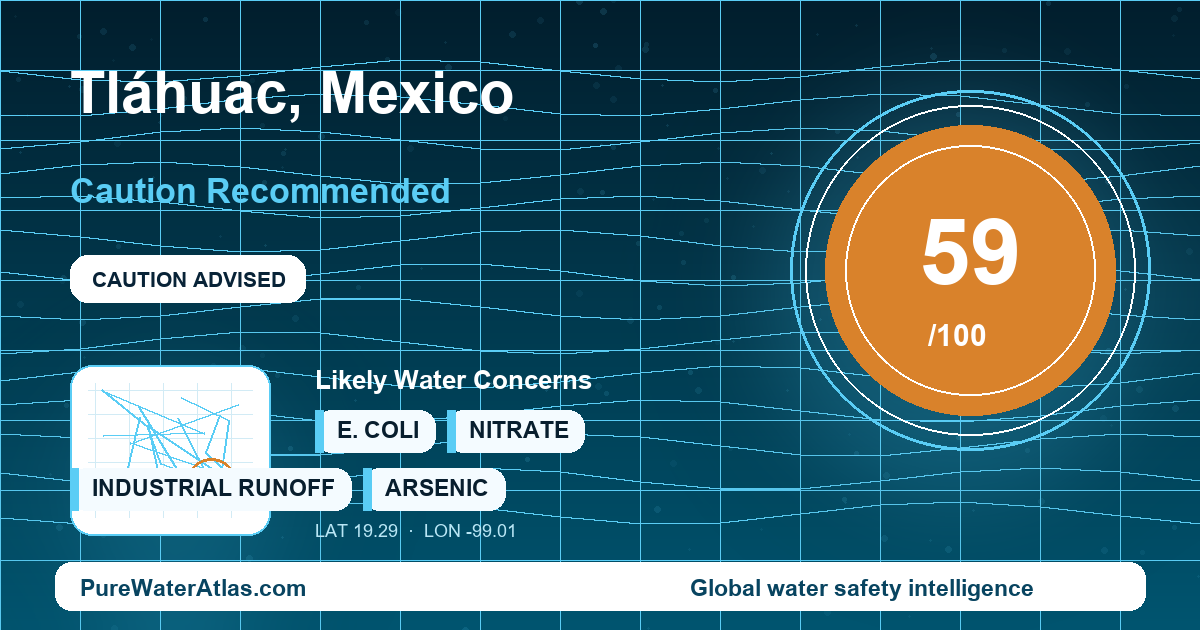
Tláhuac, Mexico City: a southeastern alcaldía where formal SACMEX supply, groundwater dependence, intermittent pressure, household storage tanks, and former lakebed conditions make tap-water safety highly dependent on the last meters of infrastructure.
Quick Answer
| Water safety score | 59 / 100 |
|---|---|
| Risk level | Caution Recommended |
| Is Tláhuac tap water drinkable? | Caution recommended. Tláhuac is inside Mexico City’s formal public water system, but ordinary untreated tap water should not be assumed drink-ready at every household tap because reliability, pressure, storage-tank hygiene, pipe condition, and groundwater-quality factors can vary locally. |
| Traveler advice | Short-term visitors should use sealed bottled water, garrafón water, or water from a maintained purifier. Tap water is generally suitable for bathing and handwashing, but drink it only if boiled, filtered, or supplied by a trusted hotel or restaurant treatment system. |
| Resident advice | Residents should treat tap water as usable but not automatically potable at the final tap. Point-of-use treatment, cistern and tinaco maintenance, and periodic testing are sensible, especially after outages, pressure drops, repairs, flooding, or unusual taste or sediment. |
| Main supply identity | SACMEX public water network, with Mexico City’s broader portfolio including Valley of Mexico groundwater plus imported Cutzamala and Lerma water. In southeastern Mexico City, including Tláhuac, service is generally more dependent on local and regional groundwater wells and distribution-sector storage. |
| Water authority | Sistema de Aguas de la Ciudad de México, known as SACMEX. |
| Filter recommendation | A sediment prefilter plus certified activated carbon is a practical baseline for drinking water. Reverse osmosis should be considered where testing shows high dissolved solids, salinity, nitrate, arsenic, or other dissolved contaminants. UV can help with microbes only after sediment removal and proper maintenance. |
Why Tláhuac Is Different
Tláhuac is not just another Mexico City neighborhood from a water-safety perspective. It is a southeastern alcaldía with urban areas next to conservation land, agricultural zones, canals, wetlands, and the former lakebed environment of the Xochimilco-Chalco zone. That setting matters because soft lacustrine soils, subsidence vulnerability, and water-management stress can affect pipes, joints, storage, drainage interaction, and service reliability.
The practical water issue in Tláhuac is not simply whether the central utility treats water. The more important question is what happens between the public network and the glass: pressure drops, intermittent service, distribution-pipe condition, household cisterns, rooftop tinacos, pumps, and old building plumbing can all change water quality at the point of use. Low or negative pressure can increase intrusion risk if pipes or household storage are compromised, while long storage time can reduce disinfectant residual and allow microbial regrowth if tanks are dirty or poorly sealed.
Tláhuac also carries a distinct historical water context. The area developed in a landscape shaped by former lakes, canals, chinampas, and agricultural settlements. Those features remain environmentally and culturally important, but they should not be confused with the modern drinking-water source. Today, drinking water comes through the SACMEX potable network, not directly from canals or wetlands.
Where Does Tláhuac’s Tap Water Come From?
Tláhuac is supplied as part of the Mexico City public water network operated by SACMEX. Mexico City’s overall raw-water portfolio includes heavily used groundwater from the Valley of Mexico aquifer system and imported surface water from the Cutzamala and Lerma systems. The exact blend at an individual Tláhuac tap can change with utility operations, drought restrictions, repairs, pressure management, and local distribution routing.
Within the citywide system, southeastern areas such as Tláhuac are generally more dependent on local and regional groundwater wells and distribution-sector storage than western areas that receive more imported water. This does not mean every Tláhuac tap has the same chemistry or the same risk. It means household-level decisions should account for groundwater-influenced taste, mineralization, possible salinity concerns in parts of the eastern and southeastern Valley of Mexico supply area, and the condition of the building’s own storage and plumbing.
Important infrastructure affecting Tláhuac includes SACMEX distribution mains, local pressure zones, pumps, valves, storage tanks, groundwater wells in the broader Valley of Mexico supply system, and the metropolitan imported-water infrastructure from Cutzamala and Lerma. At the property level, cisterns, rooftop tinacos, building pumps, and private plumbing can be just as important as the utility main. During outages, low-pressure episodes, or emergency restrictions, pipa water-truck support may be used, adding another handling and storage step that residents should manage carefully.
Who Manages Drinking Water in Tláhuac?
The principal drinking-water operator for Tláhuac is Sistema de Aguas de la Ciudad de México, SACMEX. SACMEX manages Mexico City’s potable supply operation, service notices, infrastructure programs, and distribution-system management affecting the alcaldía. The Alcaldía Tláhuac may support local reporting, public complaints, and pipa coordination, but it is not the main potable-water utility.
Mexico’s federal drinking-water quality framework is based on sanitary standards, especially NOM-127-SSA1-2021, which defines quality requirements for water for human use and consumption. Federal public-health oversight is associated with Secretaría de Salud and COFEPRIS, while CONAGUA is the national authority for water resources, aquifer information, concessions, and major hydraulic systems. For local service status, residents can check SACMEX Agua en tu Colonia.
Data limitations matter. Mexico City information may exist at city, alcaldía, or colonia scale, and open datasets may be published through Datos Abiertos de la Ciudad de México. However, public data do not provide continuous building-level proof that water remains safe after a household cistern, rooftop tank, pump, or old interior plumbing. This profile is therefore a practical risk assessment, not a claim that every Tláhuac tap is either compliant or non-compliant.
Main Local Water Concerns
- Intermittent supply and low pressure: Parts of southeast Mexico City, including areas of Tláhuac, can experience low-pressure or intermittent service during drought stress, repairs, rationing, or operational changes. Pressure instability increases the importance of storage hygiene and pipe integrity.
- Turbidity and sediment: Cloudiness, discoloration, or particles can appear after pipe work, valve changes, pressure shifts, or disturbance of cisterns and tinacos. Visible sediment is a reason to avoid drinking the water until the cause is understood and treatment is appropriate.
- Microbial risk after storage or intrusion: Water stored in unclean tanks, poorly sealed cisterns, or rooftop tinacos can lose disinfectant residual and become contaminated. Pressure drops can also raise intrusion concerns where pipes or connections are damaged.
- Groundwater taste and mineralization: Groundwater-influenced supply in the eastern and southeastern Valley of Mexico can have mineralized taste, hardness, or possible salinity concerns. This is a source-water and taste concern, not a claim that every Tláhuac tap exceeds a health standard.
- Subsidence stress: Tláhuac’s former lakebed setting and regional groundwater pumping make subsidence and ground movement relevant to pipes, joints, drainage lines, and household connections.
- Building-level metals: Lead or other metals can come from older building plumbing, faucets, solder, or fixtures. Citywide utility monitoring cannot prove the final tap in an older building is lead-free.
- Agricultural and conservation-land context: Because Tláhuac includes agricultural and conservation surroundings, nitrate, pesticides, or runoff are reasonable screening considerations, although the available public evidence is not sufficient to claim a borough-wide tap-water exceedance.
For Travelers
For short-term visitors, the conservative answer is: do not use untreated Tláhuac tap water as your regular drinking water. Choose sealed bottled water, garrafón water, or water from a maintained purifier. If no safer option is available, bring water to a rolling boil before drinking. Boiling is useful for microbial risk, but it does not remove dissolved salts, metals, nitrate, arsenic, or chemical contaminants.
Use bottled or purified water for brushing teeth if you are immunocompromised, pregnant, traveling with infants, prone to stomach illness, or simply visiting for a short time. Many residents may brush with tap water, but travelers can be more sensitive to microbial changes and unfamiliar local water conditions.
Avoid ice of uncertain origin from street vendors or informal stands. Established restaurants commonly use purified water, bottled water, or garrafón systems for drinks and ice, but it is reasonable to ask. Prefer factory-made bagged ice or drinks without ice when the source is unclear. In hotels, restaurants, rentals, and small eateries, ask whether drinking water, coffee, and ice are made with purified water, especially during outages or service interruptions.
If water is cloudy, colored, fuel-smelling, sewage-smelling, or visibly full of particles, do not drink it even after boiling unless it has also been appropriately filtered and chemical contamination has been ruled out.
For Residents
Residents in Tláhuac should treat tap water as a household system issue, not only a utility issue. A practical drinking-water setup is a sediment prefilter followed by certified activated carbon for chlorine taste, some organics, and general polishing. Reverse osmosis is worth considering when testing shows high total dissolved solids, salinity, nitrate, arsenic, or other dissolved contaminants. UV treatment can help control microbes only if the water is already clear and the lamp is maintained; it does not remove metals, nitrate, salts, or sediment.
Testing should be done after the household cistern or tinaco, not only at the incoming line, because storage is often the final quality-control point in Mexico City homes. At least once, run a potable-water laboratory panel including total coliforms, E. coli, residual chlorine, turbidity, pH, conductivity or total dissolved solids, hardness, chloride, sulfate, nitrate, iron, manganese, arsenic, and lead. Repeat microbiological testing after major outages, flooding, repairs, poor tank-cleaning events, unusual odor, or visible sediment.
Older buildings and apartments deserve extra caution. Galvanized pipes, brass fixtures, lead-containing solder, corroded plumbing, old service connections, and poorly maintained pumps can create localized risk. Flush stagnant water, avoid using hot tap water for cooking or infant formula, and test first-draw and flushed samples if plumbing materials are unknown.
Cisterns and rooftop tinacos are a major practical risk point in Tláhuac. Keep lids sealed, screens intact, vents protected, and tanks cleaned and disinfected regularly, commonly every six months or after contamination events. A dirty tank can turn otherwise disinfected network water into unsafe household water.
Relevant Contaminants and Water-Quality Issues
For Tláhuac, the most relevant water-quality issues are those linked to pressure instability, storage, groundwater influence, and old plumbing. Turbidity and sediment matter when water becomes cloudy, colored, or particle-laden after repairs, tank disturbance, or pressure changes. E. coli is a key indicator to test after outages, flooding, intrusion concerns, or poorly maintained cisterns and tinacos.
Chlorine residual is important because it helps protect water in the network, but residual can decline during long storage in rooftop tanks or cisterns. Lead is primarily a building-level concern in older plumbing and cannot be ruled out by general citywide data. Nitrate is a priority screening parameter for households with infants or agricultural-runoff concerns, while arsenic is important to screen in groundwater-influenced supplies before selecting reverse osmosis or another dissolved-contaminant treatment system.
How to Verify Your Water Quality
The best way to verify safety in Tláhuac is to test the water you actually drink: after the cistern, tinaco, pump, and kitchen plumbing. Start with the PureWaterAtlas guide to water testing, then compare your results with the broader principles in drinking water safety. For treatment selection, use Water Treatment Systems and, where microbial risk is central, Water Microbiology.
During outages or suspected microbial contamination, the boiling water purification guide explains what boiling can and cannot solve. If considering UV, review the UV purification guide. For specific lab questions, see the PureWaterAtlas guides to lead testing, arsenic testing, and nitrate testing.
You can also use the Global Water Safety Checker and the Contaminants Search Engine to interpret local concerns. Related PureWaterAtlas sections include Drinking Water Safety, Global Water Quality, Water Testing, and Water Purification.
Official and Technical Sources
- Sistema de Aguas de la Ciudad de México, SACMEX — official local water operator for Mexico City.
- SACMEX Agua en tu Colonia — official service-information tool for local supply status and interruptions.
- Datos Abiertos de la Ciudad de México — official open-data portal for Mexico City datasets.
- NOM-127-SSA1-2021 — federal sanitary standard for water for human use and consumption.
- CONAGUA — national water authority for water resources and major hydraulic information.
- CONAGUA Sistema Cutzamala information — official source on the imported surface-water system serving part of the metropolitan area.
- CONAGUA aquifer availability publications — official groundwater-resource context.
- PAOT Ciudad de México — environmental and territorial context relevant to Tláhuac’s canals, wetlands, agricultural land, and former lakebed setting.
- Instituto de Ingeniería, UNAM — technical research context for Mexico City hydrology, subsidence, and infrastructure stress.
- World Health Organization drinking-water fact sheet — public-health context for safe drinking water and household treatment.
Bottom Line
Tláhuac tap water should be approached with caution. The alcaldía is served by the formal SACMEX Mexico City system, but its southeastern location, groundwater influence, intermittent pressure, storage dependence, former lakebed soils, and household cistern or tinaco conditions make final tap quality variable. Travelers should use bottled, garrafón, or reliably purified water for drinking and brushing teeth. Residents should maintain tanks, watch for turbidity or odor after outages and repairs, and test water after household storage. A sediment filter plus certified activated carbon is a practical baseline, with reverse osmosis or UV added only when testing and maintenance needs support it. Public data help, but they do not prove safety at every Tláhuac tap.
Read the full guide: Global Water Quality Guide
Explore more in this category: Global Water Quality Articles