
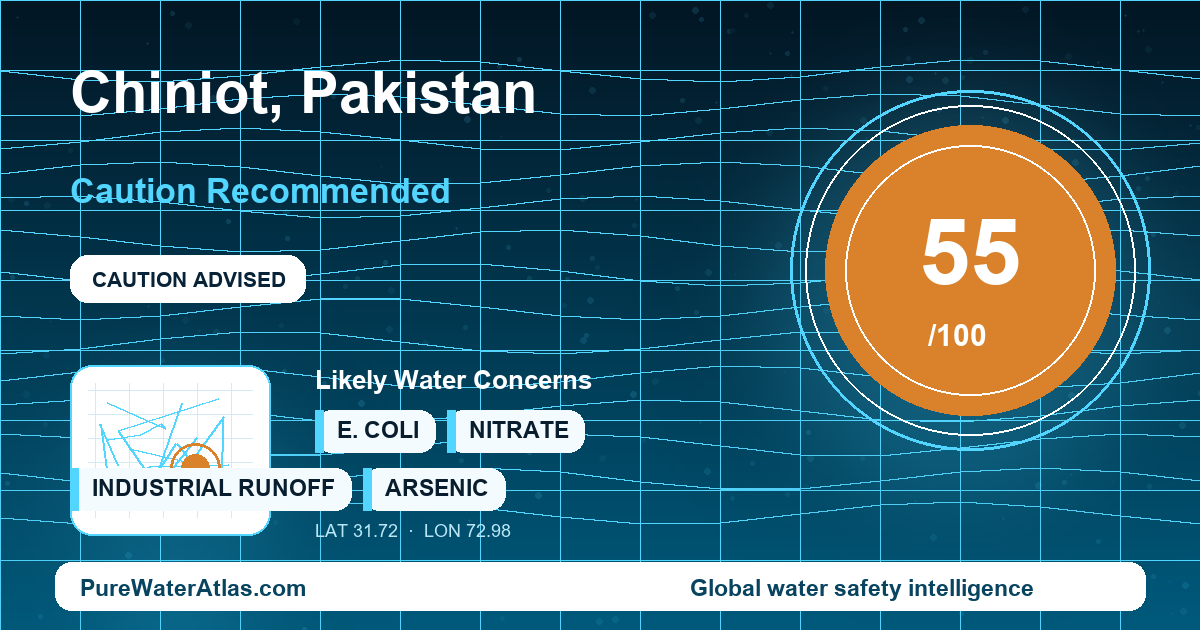
Chiniot, Punjab: groundwater-based urban water supply near the Chenab River, with safety depending on tube-well quality, pipe condition, chlorination, storage tanks, and household treatment.
Quick Answer
| Overall safety status | Caution recommended. Chiniot’s tap water should not be assumed safe at the point of use without treatment or recent testing. |
|---|---|
| Water safety score | 55 / 100 — risk level: Caution Recommended. |
| Can travelers drink it? | Not recommended untreated. Visitors should use sealed bottled water, boiled water, or water treated by a maintained purifier. |
| Resident guidance | Residents should test the actual drinking tap or storage-tank outlet and use treatment matched to results, especially for microbiology, TDS, arsenic, nitrate, fluoride, turbidity, and chlorine residual where relevant. |
| Main water source | Predominantly groundwater from municipal tube wells and private or institutional boreholes in the Indus Basin alluvial aquifer near the Chenab River. |
| Local water authority context | Urban water-supply functions are associated with Municipal Committee Chiniot under Punjab’s local government framework, with provincial and national bodies relevant for schemes, testing, standards, or oversight. |
| Filter recommendation | A home treatment system is advisable unless recent lab results confirm the specific tap, bore, or storage-tank water is safe. Sediment filtration plus UV or boiling can address microbial risk; RO should be used when testing shows a chemical need such as high TDS, salinity, nitrate, arsenic, or fluoride. |
Confidence level: medium-low. The groundwater and institutional setting for Punjab intermediate cities is well supported, but a recent public, Chiniot-specific tap-water compliance report covering sampling locations, dates, microbiology, residual chlorine, metals, and chemistry was not identified.
Why Chiniot Is Different
Chiniot is not best understood as a city with one simple, uniformly verified drinking-water source. It is an old Punjab riverine city located on or near the Chenab River within the Indus Basin alluvial plain. That setting supports groundwater abstraction, but it also makes shallow groundwater vulnerable to river flooding, irrigation recharge, seepage, and surrounding agricultural land use.
The practical safety question in Chiniot is not just “Is the municipal source clean?” It is the entire point-of-use chain: the tube well or borehole, pumping conditions, distribution pipes, intermittent pressure, possible sewage cross-contamination, chlorination where used, rooftop or underground storage tanks, and any household filter. Clear water at the tap does not rule out E. coli, total coliform, nitrate, arsenic, fluoride, hardness, salinity, or plumbing-related metals.
Chiniot’s older urban fabric also matters. Dense lanes, mixed residential-commercial activity, and legacy water and sanitation networks can create conditions where water pipes and drains run close together. This is a common risk pattern in older South Asian cities, but the safety of any specific home, hotel, shop, or restaurant in Chiniot must be checked locally rather than assumed.
Where Does Chiniot’s Tap Water Come From?
Chiniot’s drinking water supply is predominantly groundwater based. Municipal tube wells and pumping stations serve parts of the urban area, while many households, institutions, and businesses also use private boreholes, hand pumps, motor pumps, small commercial water vendors, or public filtration points where available. The aquifer is part of the Indus Basin alluvial system influenced by the Chenab River, canals, irrigation return flow, and monsoon recharge.
This profile does not describe Chiniot as having a single confirmed centralized river-water treatment plant because the dataset does not include a current local engineering document verifying such a system. Instead, the city’s water identity is a mixed groundwater and point-of-use system, with safety changing from one neighborhood, building, bore depth, and storage arrangement to another.
Important Chiniot water infrastructure includes municipal groundwater tube wells, pumping stations, storage reservoirs where present, distribution pipelines, community or public filtration points, private bores and hand pumps, and rooftop or underground household tanks. The last part of that chain is especially important: even if a bore or municipal source is acceptable when pumped, poorly sealed or unclean storage tanks can reintroduce microbial contamination before the water is consumed.
Who Manages Drinking Water in Chiniot?
The local urban water-supply function is associated with Municipal Committee Chiniot under Punjab’s local government framework. Provincial bodies may also be relevant depending on the scheme, location, or service type. These include the Local Government and Community Development Department, Government of Punjab, the Public Health Engineering Department Punjab, the Punjab Aab-e-Pak Authority, Punjab environmental institutions, and national bodies such as the Pakistan Council of Research in Water Resources.
Pakistan uses national drinking-water quality standards and provincial implementation arrangements. However, Chiniot does not have a routine, publicly available, U.S.-style consumer confidence report that verifies annual compliance by neighborhood. This limitation is important: it means a household should not interpret the absence of a warning as proof that water is safe at the tap. Private bores, storage tanks, old plumbing, and filter maintenance can all change water quality after the source.
For official district context, readers can consult the District Chiniot official portal. For wider environmental and standards context, the Pakistan Environmental Protection Agency and national water-testing institutions remain relevant, but household-level lab testing is still the most practical way to verify a specific drinking-water point in Chiniot.
Main Local Water Concerns
The main water concern in Chiniot is microbial risk from sewage intrusion, pipe leakage, intermittent pressure, and storage-tank contamination. If distribution pipes lose pressure or run near drains and sewers, contaminated water can enter through leaks. Rooftop tanks, underground tanks, and household containers can also become contamination points, especially during hot weather or when lids, vents, or cleaning practices are poor.
Turbidity and sediment may increase after pipe repairs, pump restarts, flooding, or disturbance of storage tanks. Visible particles, cloudy water, or sudden discoloration should be treated as a warning sign, but the reverse is also true: clear water does not guarantee safety.
Chemical concerns in Chiniot are groundwater-related and source-specific. TDS, hardness, and salinity may vary by bore depth and location. Arsenic risk cannot be dismissed in Punjab groundwater, although Chiniot-specific household or supply-zone testing is needed before making claims about a specific tap. Nitrate is plausible in shallow groundwater influenced by agriculture, fertilizer, livestock waste, septic leakage, or sewage seepage, and it is especially important for households with infants.
Fluoride, iron, and manganese may also matter where local testing, staining, taste, or dental concerns indicate them. Lead is more building-specific than citywide in this context and may come from older plumbing, brass fittings, solder, or contaminated fixtures rather than the aquifer itself. Where municipal disinfection is used, chlorine residual at the tap is an important indicator, because no residual can increase microbial risk in vulnerable distribution systems.
Seasonal conditions increase risk. Monsoon rain and Chenab flood conditions can mobilize sewage and animal waste, affect shallow wells, and increase turbidity. Hot-season storage can promote microbial regrowth in rooftop tanks and containers. Power outages or intermittent pumping can create negative pressure in pipes, allowing contaminated water to enter through leaks.
For Travelers
Visitors to Chiniot should not drink untreated tap water. Use sealed bottled water from reliable shops, boiled water, or water treated by a maintained purifier. Check bottle seals before drinking, and avoid assuming that hotel tap water is safe unless the hotel can clearly confirm point-of-use treatment and recent maintenance.
For brushing teeth, bottled or treated water is the safer choice for short-term travelers, pregnant travelers, immunocompromised visitors, young children, and anyone prone to stomach illness. Local residents may be acclimatized to some routine exposures, but visitors are more vulnerable to sudden microbial illness from unfamiliar water.
Avoid ice from unknown sources in Chiniot. Ice in roadside drinks, juices, and informal food stalls should be treated as unsafe unless it is clearly made from bottled or treated water. Hot tea and boiled drinks are generally safer when boiling is visible, but drinks diluted after boiling with unknown water can still pose a risk.
Higher-end hotels and restaurants may use filters, bottled water, RO, UV, or boiled water, but maintenance is not externally verified. Ask specifically whether drinking water and ice are from sealed bottles, boiled water, RO, UV, or a maintained filtration system. For stays longer than a few days, consider a portable purifier that handles bacteria and protozoa, or combine boiling with safe storage. PureWaterAtlas has a practical guide to boiling water purification for short-term risk reduction.
For Residents
Residents in Chiniot should make water-safety decisions based on testing of the actual drinking point, not on taste, clarity, or the reputation of a source. A home treatment system is strongly advisable unless recent lab results show that the specific tap, bore, or storage-tank water is safe.
For many households, a sediment prefilter followed by UV disinfection or boiling can reduce microbial risk after particles are removed. A UV water purifier can be useful, but it requires electricity, clean water passing through the UV chamber, and maintenance. Reverse osmosis may be appropriate when tests show high TDS, salinity, nitrate, arsenic, or fluoride, but RO should not be chosen blindly because it requires maintenance, wastes water, and may need remineralization.
Testing should include E. coli and total coliform at least annually and after flooding, sewage overflow, pipe repair, or tank cleaning. Also test TDS or electrical conductivity, pH, hardness, turbidity, and residual chlorine if using a municipal supply. Test arsenic at least once for each bore or source, and repeat when the source changes or a new or deeper bore is installed. Test nitrate especially for shallow bores, homes near agricultural land, livestock areas, septic systems, open drains, or infants in the household.
Older buildings in Chiniot should be treated as higher risk until checked. Old galvanized pipes, corroded plumbing, poorly sealed underground tanks, brass fittings, and cross-connections can affect water after it leaves the source. If the first water in the morning is discolored, metallic, or stale, flush the tap before use and consider testing for lead and other metals, especially where children or pregnant people live.
Rooftop and underground tanks are critical control points. Keep lids sealed, screen vents, prevent bird and rodent entry, and clean and disinfect tanks on a routine schedule. Do not assume tank water is safe just because municipal or bore water was originally clean.
Relevant Contaminants and Water-Quality Issues
The most important immediate health issue for Chiniot is microbial contamination, especially E. coli and total coliform from sewage intrusion, pipe leakage, or storage tanks. For background on bacteria, viruses, and stored-water risk, see PureWaterAtlas’s guide to water microbiology.
Cloudy water, grit, or particles should be assessed through turbidity and sediment guidance. For groundwater chemistry, Chiniot households should pay particular attention to arsenic, nitrate, fluoride where indicated, hardness, salinity, iron, and manganese. If arsenic is detected, review arsenic testing methods and arsenic treatment options. For shallow wells or infant-health concerns, see nitrate testing and detection methods.
For homes with older plumbing, lead should be considered a building-level issue. PureWaterAtlas also provides a guide to lead testing in drinking water. Where municipal chlorination is present, chlorine residual helps indicate whether disinfectant protection is reaching the tap.
How to Verify Your Water Quality
The most reliable way to verify drinking-water safety in Chiniot is to test the water people actually drink: the kitchen tap, filter outlet, storage-tank outlet, or bore connection after normal household storage and plumbing. Testing only the source well can miss contamination introduced by pipes, tanks, or fixtures.
Use an accredited or reputable laboratory where possible, such as PCRWR-linked testing services, Punjab government laboratories, university laboratories, or qualified private labs. Start with E. coli, total coliform, TDS or electrical conductivity, pH, hardness, turbidity, nitrate, arsenic, fluoride, and residual chlorine if on a chlorinated supply. Add iron, manganese, and lead where taste, staining, older plumbing, or household vulnerability suggests them.
For a broader decision framework, use the PureWaterAtlas guide to drinking-water testing, the drinking water safety guide, and the water treatment systems guide. To research likely contaminants, use the Contaminants Search Engine. Travelers comparing destinations can also consult the Global Water Quality Checker. For broader contamination pathways, see water contamination in drinking water.
Official and Technical Sources
- District Chiniot official portal, Government of Punjab — official district context for Chiniot and its Punjab location.
- Local Government and Community Development Department, Government of Punjab — municipal service and local-government framework.
- Public Health Engineering Department Punjab — public water-supply engineering and scheme context.
- Punjab Aab-e-Pak Authority — Punjab drinking-water filtration and safe-water project context.
- Pakistan Council of Research in Water Resources — national water research, monitoring, and testing authority.
- Pakistan Environmental Protection Agency — national environmental and standards context.
- World Health Organization Guidelines for Drinking-water Quality — international health-based drinking-water guidance.
- WHO/UNICEF Joint Monitoring Programme: Pakistan household WASH data — national WASH context, not a substitute for Chiniot tap testing.
- Podgorski et al., Groundwater arsenic contamination throughout Pakistan — peer-reviewed arsenic-risk context for Pakistan groundwater.
- Punjab Irrigation Department — Chenab River, canals, and irrigation context.
- Punjab Disaster Management Authority — monsoon and flood context relevant to water safety.
- Pakistan Meteorological Department — monsoon and heat conditions affecting storage, flooding, and microbial risk.
Bottom Line
Chiniot’s tap water deserves a cautious, location-specific approach. The city relies mainly on groundwater from municipal tube wells and private bores in a Chenab River and Indus Basin setting, with safety affected by source depth, pipe condition, intermittent supply, chlorination, storage tanks, and household filtration. Visitors should avoid untreated tap water and use sealed bottled, boiled, or properly purified water. Residents should test the actual drinking tap or storage-tank outlet for microbiology, TDS, arsenic, nitrate, fluoride, turbidity, and other relevant parameters before choosing treatment. Because no recent public neighborhood-level compliance dataset was identified for Chiniot, the safest conclusion is not that all tap water is unsafe, but that untreated tap water should not be assumed safe without verification.
Read the full guide: Global Water Quality Guide
Explore more in this category: Global Water Quality Articles