
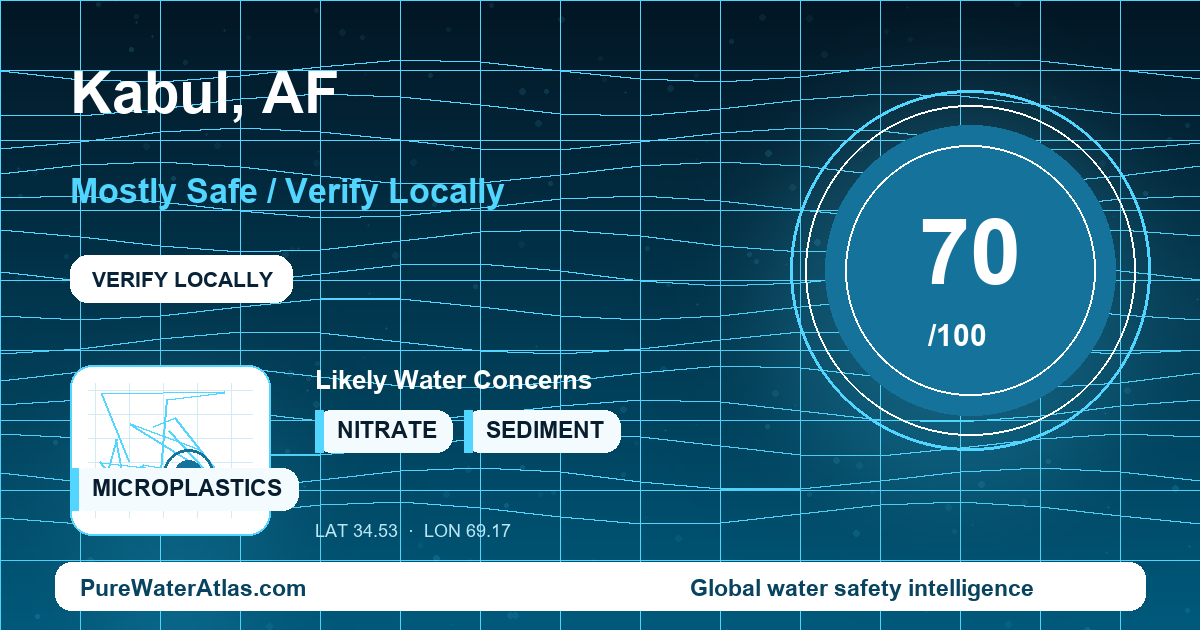
Kabul’s tap water is best treated as conditionally safe: groundwater-based supplies, private wells, intermittent distribution, storage tanks, and limited public compliance data mean safety can vary sharply from one building to another.
Quick Answer
| Overall safety status | Mostly Safe / Verify Locally — PureWaterAtlas score: 70/100. Kabul tap water should not be treated as universally safe. The risk depends on the actual source, disinfection, plumbing condition, storage tank hygiene, and recent interruptions or repairs. |
|---|---|
| Short-term visitors | Do not assume ordinary tap water is safe to drink. Use sealed bottled water, properly boiled water, or water treated by a reliable purifier, especially outside major hotels, compounds, or hosts that can verify treatment and hygienic storage. |
| Residents | Verify your building’s source. A maintained municipal connection with a clean tank is lower risk than a shallow private well near sanitation sources, but routine testing and point-of-use treatment are strongly advisable in many Kabul homes. |
| Main water source | Kabul relies predominantly on groundwater from the Kabul Basin aquifer system, including municipal wellfields, institutional boreholes, private wells, localized systems, and tanker water in areas without reliable piped supply. |
| Water authority | The main urban water utility is the Afghanistan Urban Water Supply and Sewerage Corporation, commonly abbreviated AUWSSC. Kabul water operations have also historically been associated with the Central Authority for Water Supply and Sewerage. |
| Filter recommendation | For many homes, use sediment prefiltration plus disinfection such as UV or chlorination. Consider reverse osmosis only where laboratory testing shows high nitrate, salinity, arsenic, or other dissolved contaminants. |
Why Kabul Is Different
Kabul is not a city where a single tap-water label accurately describes every household. It sits in a high-elevation intermontane basin, and drinking water is heavily dependent on local groundwater storage and recharge from mountain runoff and seasonal snowmelt. Unlike cities supplied mainly by large treated surface-water reservoirs, Kabul’s drinking-water picture is shaped by the Kabul Basin aquifer system, private pumping, limited piped coverage, and building-level storage.
The most important Kabul-specific question is not simply, “Is the city water treated?” It is, “Where does this building’s water actually come from?” A home, hotel, school, office, or compound may receive water from a municipal connection, a private deep well, a shallow well, a tanker, or a combination of these sources stored in roof or ground tanks. Those differences matter because each source has a different exposure pathway for microbial contamination, dissolved minerals, nitrate, sediment, and plumbing-related metals.
Kabul’s rapid urban growth, limited sewerage coverage, private wells, intermittent supply, and widespread household storage tanks create a practical reality: one building can have safer water than another building nearby. A managed groundwater source with disinfection and a clean tank is lower risk than a shallow well influenced by latrines, septic pits, drainage channels, or flood-prone ground. Because recent routine neighborhood-level tap compliance data are not consistently public, PureWaterAtlas rates Kabul with medium confidence and recommends local verification.
Where Does Kabul’s Tap Water Come From?
Kabul relies predominantly on groundwater from the Kabul Basin aquifer system. Municipal and institutional supplies use boreholes and wellfields, while many households, compounds, and businesses also use private wells, tanker water, or localized distribution systems. Groundwater recharge is linked to mountain snowmelt, streamflow, and the Kabul, Logar, Paghman, and related sub-basins.
The city’s water infrastructure includes groundwater wellfields and boreholes serving municipal supply, private household and institutional wells, limited piped distribution networks with variable pressure and coverage, rooftop or ground storage tanks, and water trucking where piped supply is unavailable or unreliable. On-site sanitation systems, septic pits, and latrines are also part of the water-safety picture because they can affect vulnerable shallow groundwater.
Historically, before expansion of modern piped systems, Kabul residents commonly depended on shallow wells, hand pumps, karezes, springs, and small local networks. That legacy still matters: many homes continue to depend partly or entirely on private groundwater rather than a continuously managed utility connection. International hydrogeology work on the Kabul Basin has repeatedly identified pressure on groundwater resources from population growth and pumping, making local water-source verification especially important.
Who Manages Drinking Water in Kabul?
The main urban water utility is the Afghanistan Urban Water Supply and Sewerage Corporation, commonly known as AUWSSC. Kabul municipal water operations have also historically been associated with the Central Authority for Water Supply and Sewerage. These institutions are central to the formal urban water supply, but Kabul also contains many non-utility water arrangements, including private wells, compounds with their own boreholes, local distribution systems, and tanker water.
Afghanistan has national water institutions and urban water supply authorities, but Kabul does not provide the same kind of routinely accessible, neighborhood-level consumer confidence reporting that some cities publish. That limits how precisely a citywide public page can characterize any individual tap. The correct risk assessment must include the supplier, well depth and location where relevant, plumbing condition, storage tank hygiene, pressure continuity, recent repairs, and any local advisories.
For broader interpretation of drinking-water risks where local public compliance data are limited, PureWaterAtlas uses international principles consistent with the World Health Organization Guidelines for drinking-water quality, while keeping the conclusion Kabul-specific: verify locally before drinking untreated tap water.
Main Local Water Concerns
The main water-quality concern in Kabul is not one single contaminant. It is the combination of groundwater dependence, sanitation pressure, intermittent distribution, and storage practices. Documented local concerns include microbial contamination risk from fecal indicators such as E. coli, especially where shallow groundwater is influenced by latrines, septic pits, drainage channels, poor tank hygiene, or flooding.
Nitrate is another important groundwater concern in densely populated, unsewered, or sanitation-impacted areas. Nitrate can be associated with on-site sanitation, wastewater leakage, and shallow groundwater vulnerability. Kabul groundwater may also present high dissolved solids, hardness, salinity, or taste issues in some locations. These issues do not always mean immediate microbial danger, but they can affect palatability and indicate the need for laboratory testing before choosing treatment.
Turbidity and sediment can occur after pipe repairs, low-pressure events, tank disturbance, seasonal runoff impacts, or changes in pumping. Intermittent pressure can allow contamination to enter distribution pipes through leaks or cross-connections. Building-level plumbing may also add risk: possible metal exposure can come from old internal pipes, fixtures, pumps, solder, or building-level components. Citywide lead levels should not be assumed without testing.
Season also matters. Spring snowmelt and runoff can change recharge conditions and may increase turbidity or microbial loading in vulnerable shallow sources. Dry-season groundwater stress can concentrate dissolved minerals and increase reliance on private wells or trucked water. Heavy rain or flooding can overwhelm drainage and raise the risk of fecal contamination entering shallow wells or damaged pipes. Cold-season pipe breaks and storage practices can also create building-level contamination risks if repairs and disinfection are poor.
For Travelers
Short-term visitors should avoid drinking untreated tap water in Kabul unless the hotel, compound, or host can verify that the water comes from a managed source and is treated and stored hygienically. The safer default is sealed bottled water, properly boiled water, or water treated with a reliable purifier. Check that bottle caps are intact, avoid unverified refills, and use safe water for medications, infant formula, and oral rehydration.
For brushing teeth, visitors should use bottled, boiled, or filtered water, especially if immunocompromised, pregnant, or prone to stomach illness. Avoid ice unless you can confirm it was made from treated water. Freezing does not reliably make contaminated water safe, so ice can be a common exposure route even when the drink itself appears safe.
Higher-end hotels, embassies, compounds, and major restaurants may use private treatment systems, but this should not be assumed automatically. Ask whether drinking water is filtered, disinfected, and stored in cleaned tanks. If staff cannot clearly confirm the source, treatment, and tank maintenance, choose sealed bottled water. Travelers using a portable purifier should combine particulate filtration with disinfection because Kabul’s risks may involve both sediment and microbes.
Visitors should also consider general Afghanistan travel risk context from official sources such as the U.S. Department of State Afghanistan Travel Advisory, while making separate, practical decisions about drinking water, food hygiene, and medical preparedness.
For Residents
Kabul residents should begin by identifying their actual water source. A maintained municipal line with a clean storage tank is lower risk than a shallow private well near latrines, septic pits, drainage channels, animal areas, or flood-prone ground. However, even a good source can become unsafe if water sits in a dirty rooftop or ground tank, if pressure is intermittent, or if internal plumbing is deteriorated.
For many households, a home treatment barrier is advisable. A practical setup is sediment prefiltration followed by disinfection such as UV or chlorination. UV systems require reasonably clear water, so sediment control and maintenance matter. Reverse osmosis may be appropriate where laboratory testing shows high nitrate, salinity, arsenic, or other dissolved contaminants, but RO should be selected based on test results rather than taste alone.
Private wells should be tested at least for E. coli or thermotolerant coliforms, nitrate, electrical conductivity or total dissolved solids, pH, turbidity, hardness, and residual chlorine if chlorinated water is used. If the well is shallow or near sanitation sources, prioritize microbial and nitrate testing. If water tastes salty, bitter, metallic, red-brown, black, or sulfur-like, add iron, manganese, sulfate, chloride, and metals to the laboratory panel.
Old buildings require special caution. Do not assume internal plumbing is safe just because the source water is acceptable. Pipes, fittings, solder, pumps, and fixtures can add metals or sediment. Flushing the tap before use can reduce stagnant-water exposure, but testing first-draw and flushed samples is needed to understand actual plumbing-related risk.
Storage tanks are a critical control point in Kabul. Tanks should be covered, screened against insects and dust, cleaned and disinfected periodically, protected from sewage or drainage intrusion, and checked after interruptions or repairs. A clean municipal connection can become unsafe if stored in a dirty household tank.
Relevant Contaminants and Water-Quality Issues
The most relevant Kabul water-quality issues are microbial safety, sanitation-related groundwater impacts, sediment, and building-level plumbing. Read more about E. coli for fecal contamination risk, nitrate for groundwater affected by sanitation or wastewater, turbidity and sediment for cloudy or particle-laden water, and lead for plumbing-related exposure. Where local testing indicates dissolved contaminants, the PureWaterAtlas profiles on arsenic and chlorine can help interpret results and treatment choices.
For treatment background, see Boiling Water Purification: Complete Guide, UV Water Purification: Complete Guide, Nitrate Contamination in Drinking Water: Testing and Detection Methods, Lead in Drinking Water: Testing and Detection Methods, and Arsenic in Drinking Water: Testing and Detection Methods.
How to Verify Your Water Quality
Because Kabul conditions vary by source, building, season, and maintenance, testing is more useful than relying on a citywide assumption. Start with the PureWaterAtlas Water Testing guide and the broader Drinking Water Safety guide. If microbial risk is the main concern, review Water Microbiology. For treatment planning, use the Water Purification pillar.
Use the Global Water Quality Checker for a quick city-level reference, and search specific contaminants in the Contaminants Search Engine. For broader country and city comparisons, see Global Water Quality. Related category archives include Drinking Water Safety, Global Water Quality, Water Testing, and Water Microbiology.
Retest after well deepening, pump replacement, pipe repairs, flooding, tank cleaning, or any noticeable change in taste, odor, color, or turbidity. In Kabul, the safest verification combines source identification, laboratory testing, tank inspection, and treatment matched to the measured contaminants.
Official and Technical Sources
- Afghanistan Urban Water Supply and Sewerage Corporation — identifies the national urban water utility responsible for urban water supply and sewerage services, including Kabul-related operations.
- Hydrogeology and simulation of groundwater flow in the Kabul Basin, Afghanistan, United States Geological Survey — technical source describing the Kabul Basin aquifer system, groundwater dependence, recharge, and pumping pressure.
- Conceptual model of water resources in the Kabul Basin, Afghanistan, United States Geological Survey — basin-scale context for Kabul water resources and groundwater and surface-water interactions.
- Water, sanitation and hygiene, UNICEF Afghanistan — summarizes Afghanistan WASH challenges relevant to safe drinking water, sanitation, and public health risk.
- World Bank: Afghanistan Urban Water Sector Project (Kabul water supply), World Bank — project documentation for Kabul urban water supply infrastructure and service improvement.
- Guidelines for drinking-water quality, World Health Organization — international reference for interpreting microbial and chemical drinking-water risks where local public compliance data are limited.
- Afghanistan Travel Advisory, U.S. Department of State — travel risk context for Afghanistan.
Bottom Line
Kabul tap water should be treated as conditionally safe, not automatically safe. The formal municipal supply is groundwater-based and may be chlorinated in parts of the network, but household safety depends on the actual source, pressure continuity, pipe condition, storage tank hygiene, and whether the building uses a managed supply, private well, tanker water, or a combination. Visitors should use sealed bottled, boiled, or reliably treated water and avoid unverified ice. Residents should test wells and household taps, maintain tanks, and consider sediment filtration plus disinfection, with reverse osmosis only when testing shows dissolved contaminants such as nitrate, salinity, or arsenic. Because recent neighborhood-level compliance data are limited, Kabul water safety must be verified locally.
Read the full guide: Global Water Quality Guide
Explore more in this category: Global Water Quality Articles