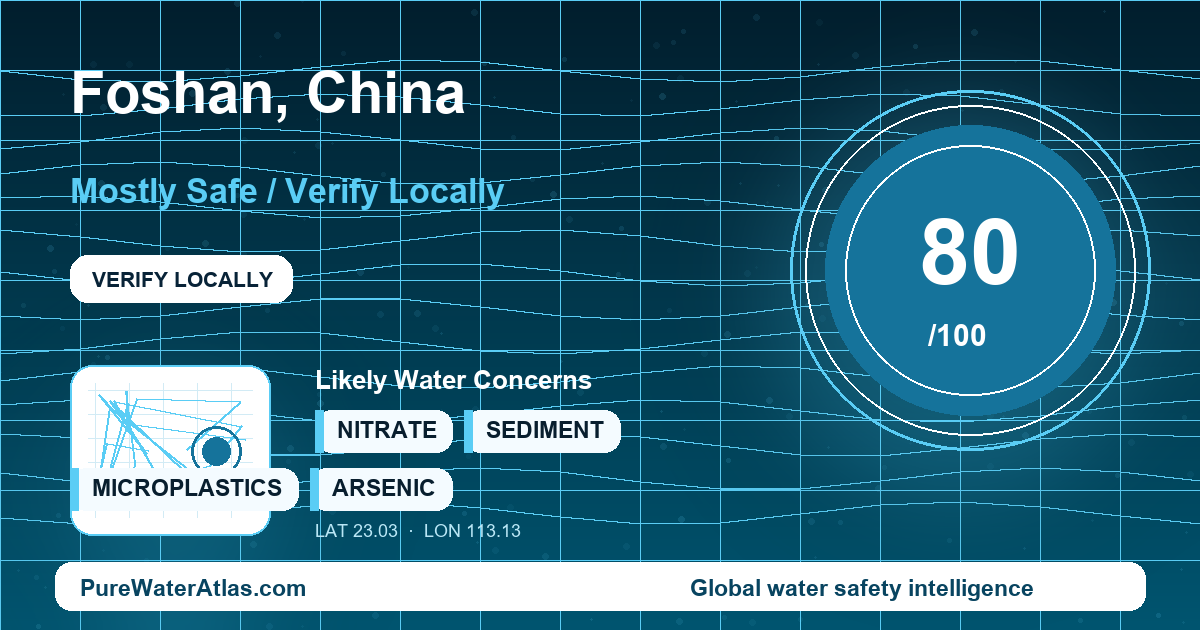
Foshan’s municipal tap water is supplied through a modern Pearl River Delta surface-water network, but drinking it straight from the tap should be verified by district, building plumbing, and recent utility notices.
Quick Answer
| City | Foshan, Guangdong, China |
|---|---|
| Water safety score | 80 / 100 |
| Risk level | Mostly Safe / Verify Locally |
| Can you drink the tap water? | For conservative use, drink bottled water, boiled tap water, or water from a trusted filtered dispenser. Direct-from-tap drinking should be confirmed for the specific hotel, apartment, building, and district. |
| Traveler advice | Use bottled or boiled water for drinking. Tap water is generally acceptable for brushing teeth in modern hotels, but sensitive travelers may prefer bottled or boiled water. |
| Resident advice | Municipal tap water can generally be used for cooking and drinking after boiling. Consider a maintained point-of-use filter if taste, chlorine odor, sediment, old plumbing, or storage tanks are concerns. |
| Main raw-water context | Pearl River Delta surface-water systems, especially the Xijiang / West River and Beijiang / North River network, with district-level supply arrangements. |
| Water authority | Foshan Water Group Co., Ltd. and district water companies, with oversight from municipal water, health, ecological-environment, and urban-rural construction authorities. |
| Filter recommendation | Not automatically required for every household, but useful for chlorine taste, sediment control, and added protection where building plumbing or secondary storage tanks are uncertain. |
Why Foshan Is Different
Foshan is not a groundwater-dominated city. It is an inland but delta-connected city in Guangdong’s Pearl River Delta, immediately west and southwest of Guangzhou, and its drinking-water security is tied to large surface-water systems in the Pearl River basin. The most important local water identity is the Xijiang, or West River, and Beijiang, or North River, network that supports central and western Pearl River Delta supply.
This matters because the water reaching a Foshan apartment or hotel has two different risk layers. The first is the municipal layer: raw river water, treatment plants, disinfection, distribution mains, and district-level utility operations. The second is the building layer: internal pipes, booster pumps, rooftop or basement tanks, valves, fixtures, and low-use branches inside a high-rise or older neighborhood. In Foshan, as in many dense urban areas of southern China, the practical weak point for many users is often not the central treatment plant but the final delivery path after treated water enters the property.
The local drinking norm also matters. Visitors should not assume that clear tap water is meant to be consumed untreated. In Foshan, as in much of urban China, people commonly drink boiled water, bottled water, or water from a hotel, office, or household dispenser. That practice reflects taste preferences and residual chlorine, but it is also a reasonable precaution because building plumbing and storage conditions vary.
Where Does Foshan’s Tap Water Come From?
Foshan’s municipal supply is part of the Pearl River Delta water-supply environment. The city draws municipal raw water primarily from surface-water systems associated with the Pearl River basin, especially the Xijiang / West River and Beijiang / North River river networks. Additional local river-channel and reservoir-linked arrangements can vary by district.
The Xijiang and Beijiang systems are strategically important high-volume raw-water sources for the central and western Pearl River Delta, including Foshan districts such as Chancheng, Nanhai, Shunde, Sanshui, and Gaoming. Historically, Foshan urban supply depended more on nearby delta channels and local river sections, including waterways connected with the Dongping waterway and other Pearl River Delta distributaries. As the city urbanized and industrialized, supply strategy shifted toward larger and more protected raw-water corridors and inter-district networks, especially Xijiang and Beijiang source-water systems.
Foshan’s water infrastructure includes municipal treatment and distribution assets operated by Foshan Water Group Co., Ltd. and district-level water companies. Service responsibility can differ by district, development zone, or local retail provider. Major raw-water intakes and treatment plants are linked to Pearl River Delta surface-water corridors, while cross-district transfer and emergency-supply planning are important because Foshan sits inside a dense, interconnected regional urban water grid.
For household users, the final infrastructure stage deserves attention. High-rise residential buildings often depend on secondary water-supply systems, including storage tanks, booster pumps, and internal building pipework. These systems can affect water quality after water leaves the municipal network, especially if tanks are poorly cleaned, pipes are old, or pressure interruptions disturb sediment.
Who Manages Drinking Water in Foshan?
Municipal supply in Foshan is associated with Foshan Water Group and district-level water-supply companies. Government oversight involves several municipal and provincial functions rather than a single English-language source. Relevant local authorities include the Foshan Municipal Water Conservancy Bureau, the Foshan Municipal Ecology and Environment Bureau, and the Foshan Municipal Health Bureau / Health Commission portal.
China’s urban drinking water is governed by national drinking-water hygiene and quality requirements, including the national Standard for Drinking Water Quality GB 5749-2022. The National Health Commission of the People’s Republic of China is relevant to national drinking-water sanitation requirements, and the current standard can be checked through the China national standards reference portal.
Source-water management and regional river-basin issues also involve broader authorities, including the Guangdong Provincial Department of Ecology and Environment, the Guangdong Provincial Water Resources Department, and the Pearl River Water Resources Commission. Foshan-specific public reporting is more accessible in Chinese than English, and district-level compliance data or building-level potability data may not be easy for travelers to obtain. This is a key limitation: a citywide assessment cannot prove that every individual faucet is safe.
Main Local Water Concerns
- Surface-water dependence: Foshan relies on Pearl River basin surface-water systems. River-source water can be affected by upstream rainfall, runoff, navigation, urban discharge, and industrial activity in the Pearl River Delta.
- Flood-season turbidity: Heavy rain, typhoons, flood-season runoff, and river disturbance can raise raw-water turbidity. Treatment plants adjust for this, but temporary changes in taste, odor, color, or sediment can still be noticed by users.
- Chlorine taste and odor: Treated municipal water is commonly chlorinated. Some residents notice disinfectant taste, especially after maintenance, flushing, or seasonal treatment changes.
- Secondary water supply: Tanks, booster systems, and building plumbing can introduce risk if poorly sealed, poorly cleaned, or poorly maintained, even when water leaving the treatment plant meets requirements.
- Older internal plumbing: Older buildings may have corroded galvanized pipes, scale, sediment release, old valves, or metal leaching from fixtures and solder. Building-specific testing is needed for certainty.
- Industrial and urban pressure: Foshan is a major manufacturing and urban-industrial center. That does not mean treated tap water is unsafe, but it makes source-water protection, industrial discharge control, urban runoff management, and emergency pollution response important.
- Dry-season source stress: Foshan is less exposed than coastal Pearl River Delta cities, but the wider delta can experience saline-intrusion management challenges during drought and low-flow periods. Users should follow official notices if dry-season salt tide or source-water switching is reported.
For Travelers
Short-term visitors should not make straight-from-tap drinking the default in Foshan. Use sealed bottled water, boiled tap water, or water from a trusted filtered dispenser. If a modern hotel explicitly provides potable filtered water or confirms that a specific tap is safe to drink, the risk is lower, but the safer general rule is to avoid untreated tap water for drinking.
Brushing teeth with tap water is generally acceptable for most travelers in modern urban hotels and apartments. Travelers with sensitive stomachs, infants, immunocompromised people, or people staying in older buildings may prefer bottled or boiled water even for brushing teeth.
For ice, use caution with small street vendors or unknown sources. Ice in reputable hotels, chain restaurants, and established cafes is usually lower risk, but if avoiding stomach illness is a priority, choose sealed bottled drinks, hot tea, or boiled water. Most hotels in Foshan provide bottled water, kettles, or filtered dispensers. In restaurants, hot tea and boiled water are common and are usually safer choices than plain tap water.
Carry bottled water during sightseeing, especially in hot and humid weather. If you use tap water, bring it to a rolling boil and let it cool in a clean container. Avoid drinking from taps immediately after a building outage, pipe repair, pressure interruption, or visible discoloration until the water runs clear and any local notice has been checked.
For Residents
For Foshan residents connected to the municipal network, tap water can generally be used for cooking and drinking after boiling. A home filter is not automatically required for every household, but it can be practical for taste, chlorine odor, sediment control, and added protection where building plumbing conditions are uncertain.
If you want to drink water without boiling, consider a certified point-of-use system appropriate to the concern. Activated carbon can help with chlorine taste and odor; ultrafiltration or reverse osmosis may be considered where additional particulate or microbial protection is desired. Filters must be replaced and maintained on schedule. A neglected filter can become a microbial risk rather than a safety upgrade.
Older Foshan buildings deserve special attention. Corrosion, scale, old valves, galvanized pipes, stagnant branch lines, and aged fixtures can create discoloration, sediment, or metal exposure. If there is any concern about older pipes, solder, brass fixtures, unexplained taste, or discoloration, test both first-draw and flushed water. If water is yellow, brown, or contains particles, document the condition and ask the property manager whether tank cleaning, pipe work, or network flushing occurred.
High-rise secondary water-supply systems are a major practical issue. Residents should ask property management for the most recent rooftop or underground tank-cleaning and disinfection records. If records are unclear, microbial testing is reasonable, especially for households with infants, pregnant people, elderly residents, or immunocompromised residents. After long absences, flush taps before using water for cooking or drinking. After floods, pipe repairs, pressure loss, or announced supply switching, check notices from Foshan Water Group or the relevant district water company.
Relevant Contaminants and Water-Quality Issues
The most relevant Foshan issues are not a single confirmed citywide contaminant exceedance, but a set of local conditions: surface-water turbidity, chlorination, sediment from pipes and tanks, old-building metals, and microbial concerns in secondary supply systems.
- Chlorine in Drinking Water: relevant because Foshan’s municipal water is disinfected and residents may notice chlorine taste or odor.
- Turbidity in Drinking Water: relevant during Pearl River Delta heavy rain, flood season, typhoons, and pipe work.
- Sediment in Drinking Water: relevant for old internal pipes, tank sediment, and temporary discoloration after maintenance.
- Lead in Drinking Water: relevant for building-specific plumbing risk, especially where pipe materials, fixtures, or solder are uncertain.
- E. coli in Drinking Water: relevant for secondary water-supply tanks, post-contamination testing, and microbial safety after pressure interruptions.
For background on safer household practices, see Boiling Water Purification: Complete Guide, UV Water Purification: Complete Guide, and Water Treatment Systems.
How to Verify Your Water Quality
The strongest Foshan-specific limitation is that public information is fragmented across Chinese-language municipal, district, utility, health, and environmental portals. This profile identifies the city’s source-water context, governance structure, and practical risks, but it does not verify neighborhood-by-neighborhood compliance or the water quality at an individual apartment tap.
To verify your own water, start with current utility notices from Foshan Water Group or your district water company. Look for pipe repair notices, pressure interruptions, flushing, maintenance shutdowns, or supply switching. In a building with storage tanks, ask property management for cleaning and disinfection records. If water looks, smells, or tastes unusual, do not rely on appearance alone; test for the likely issue.
For older buildings, metal testing is important. The PureWaterAtlas guide Lead in Drinking Water: Testing and Detection Methods explains how first-draw and flushed samples can reveal plumbing-related exposure. For broader testing strategy, use How to Test Drinking Water and the Drinking Water Safety framework.
Travelers comparing destinations can use the Global Water Quality Checker. Residents researching specific contaminants can use the Contaminants Search Engine. For microbial concerns linked to tanks, outages, or pressure loss, see Water Microbiology. Relevant PureWaterAtlas categories include Drinking Water Safety, Water Testing, and Water Purification.
Official and Technical Sources
- Foshan Water Group Co., Ltd. — local utility source for service notices, utility information, and municipal supply context.
- Foshan Municipal Water Conservancy Bureau — local water resources, flood control, water projects, and source-water management.
- Foshan Municipal Ecology and Environment Bureau — environmental quality, pollution control, and drinking-water source protection.
- Foshan Municipal Health Bureau / Health Commission portal — drinking-water sanitation supervision and health-related notices.
- Guangdong Provincial Department of Ecology and Environment — provincial environmental water-quality and source-protection context.
- Guangdong Provincial Water Resources Department — Guangdong water-resource planning, drought, flood, and raw-water management.
- Pearl River Water Resources Commission — Pearl River basin water-resource management affecting Foshan.
- National Health Commission of the People’s Republic of China — national public-health authority relevant to drinking-water sanitation standards.
- China National Standards Reference Portal — official lookup for national standards, including GB 5749-2022.
- World Health Organization drinking-water fact sheet — international context for microbial contamination, safe distribution, and household storage risks.
Bottom Line
Foshan’s tap water comes from a modern municipal system tied to Pearl River Delta surface-water sources, especially the Xijiang and Beijiang networks, and it is expected to be managed under China’s national drinking-water standards. For everyday use, the conservative local practice is still the best guidance: use tap water for cooking and drink it after boiling, or use bottled or trusted filtered water. The biggest practical uncertainty is often the building, not the citywide supply: older pipes, storage tanks, booster systems, recent repairs, and district-level notices can change faucet-level quality. Travelers should avoid untreated tap water as a default. Residents should verify their district utility notices, maintain filters properly, and test when plumbing, tanks, discoloration, sediment, or vulnerable household members make extra certainty important.
Read the full guide: Global Water Quality Guide
Explore more in this category: Global Water Quality Articles