London mains tap water is generally safe to drink, with the most important risks usually coming from older building plumbing, lead pipework, private storage tanks, stagnation, temporary discoloration, hard water, and chlorine taste rather than from the treated public supply.
Quick Answer
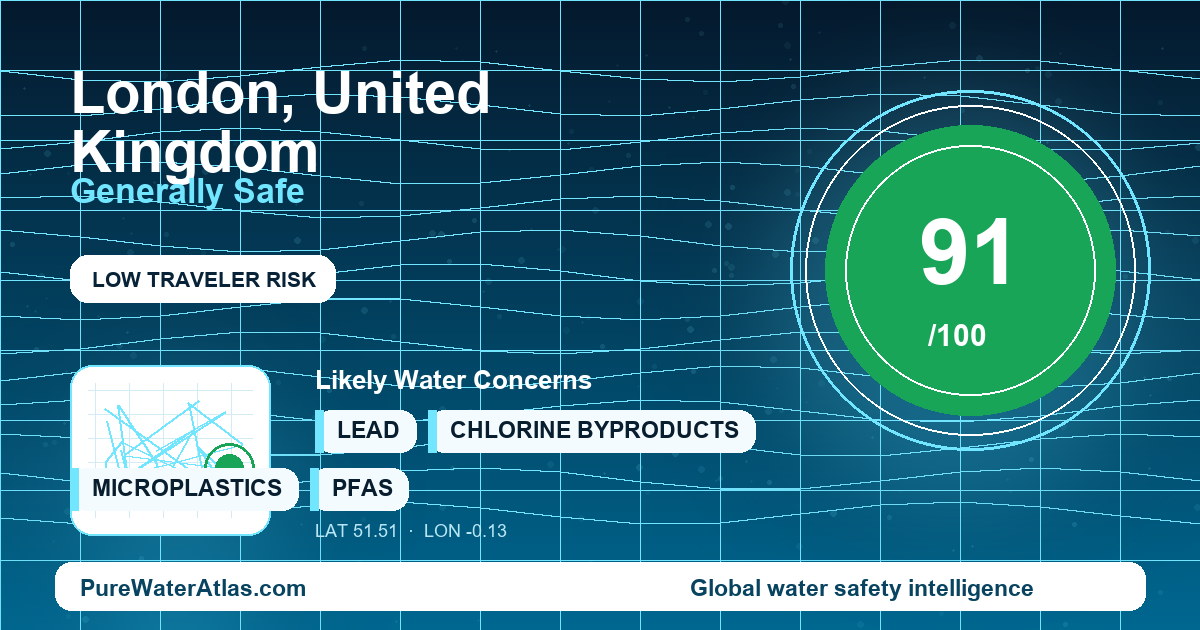
| Overall safety status | Generally Safe — PureWaterAtlas score: 91/100. London mains tap water is normally safe to drink when it comes from the regulated public supply. |
|---|---|
| Traveler advice | Visitors can normally drink cold tap water, brush teeth with it, and accept ice in reputable hotels, restaurants, cafes, and pubs. Bottled water is mainly a taste, convenience, or medical preference. |
| Resident advice | Residents should check property-specific risks, especially in older homes, converted buildings, flats, and buildings with private cold-water storage tanks or possible lead pipework. |
| Main water sources | Primarily treated surface water from the River Thames and River Lee or Lea, stored in large reservoirs before treatment, with groundwater from chalk aquifers also contributing to the wider system. |
| Main authority | Thames Water supplies most London addresses. Some outer Greater London postcodes may be supplied by Affinity Water or another company, so supplier should be verified by postcode. |
| Filter recommendation | A filter is not generally required for safety in mains-supplied London homes. Filters may help taste, chlorine, hardness-related acceptability, or specific lead concerns if certified for the target contaminant and maintained properly. |
Why London Is Different
London’s drinking water profile is shaped by three local realities: a heavily engineered river-and-reservoir supply system, a very old and varied building stock, and naturally hard water. The treated mains supply is subject to United Kingdom drinking-water regulation and Drinking Water Inspectorate oversight, but the quality at an individual tap can still be affected by what happens inside a building.
The main practical risks in London are usually not the treated water leaving the water company’s works. They are more often property-side issues: old lead service pipes, legacy internal plumbing, long pipe runs, stagnant water in low-use flats or large buildings, poorly maintained private cold-water storage tanks, and short-term discoloration after bursts or mains work. London also has a long history of Victorian, Edwardian, interwar, and postwar properties, so plumbing age can vary sharply from one street or building to the next.
London water is typically hard because its source waters are influenced by chalk and limestone catchments and aquifers. Hardness commonly causes kettle scale, appliance scaling, and taste preferences. It is an important local user-experience issue, but hardness itself is not usually a drinking-water safety issue.
Where Does London’s Tap Water Come From?
London is supplied mainly by treated surface water abstracted from the River Thames and the River Lee or Lea. This raw water is stored in large reservoirs before treatment. Groundwater from chalk aquifers also contributes to the wider supply system. The modern system is highly engineered and does not mean Londoners are drinking untreated river water.
Key infrastructure serving London includes River Thames abstraction and the west London reservoir system, River Lee or Lea abstraction and the Lee Valley reservoirs, large storage reservoirs in west and north London, and major treatment works such as Hampton, Ashford Common, Kempton, and Coppermills. The Thames Water Ring Main is a major underground treated-water transfer system that helps move drinking water around London.
London also has the Beckton desalination plant, which is intended as a drought and resilience asset using brackish tidal Thames water. It should not be understood as the normal everyday source for most consumers. London sits in the lower Thames basin and is in a water-stressed part of south-east England, so drought planning, population growth, and climate variability are important long-term water-resource issues. These pressures are mainly about supply resilience unless an official notice says there is a water-quality issue.
Who Manages Drinking Water in London?
Thames Water is the principal water company for most London addresses, but not every Greater London postcode is necessarily supplied by Thames Water. Some outer areas may be supplied by Affinity Water or another supplier, so residents should verify their supplier by postcode rather than relying only on a citywide assumption.
Drinking water quality in England and Wales is regulated under national drinking-water regulations and independently scrutinised by the Drinking Water Inspectorate. Ofwat regulates water companies economically, the Environment Agency regulates abstraction and environmental pressures, and local authorities have roles for private water supplies and certain public-health matters. For consumer advice and complaints escalation, the Consumer Council for Water is also relevant.
For a London household, the most useful first step is the water company’s postcode-level information. Thames Water provides a postcode water-quality checker and wider water quality help and guidance. These tools are useful for supply-zone information, but they cannot prove the condition of every private pipe, loft tank, or individual tap.
Main Local Water Concerns
Lead from old service pipes or internal plumbing: Lead is the most important property-specific drinking-water concern in older London buildings. Lead is not desirable at any level of exposure, especially for infants, children, and pregnant people. A dull grey pipe that scratches shiny may be lead, but identification should be confirmed by a qualified plumber or a water test. Thames Water provides specific lead pipes guidance.
Private cold-water storage tanks: In older houses, flats, commercial buildings, schools, offices, and hotels, some cold taps may be fed from a private tank rather than directly from the mains. Poorly covered, dirty, or stagnant tanks can affect taste, odour, sediment, and microbial quality. Kitchen cold taps are usually preferred for drinking because they are more likely to be mains-fed than bathroom taps in older properties.
Hard water and chlorine taste: London’s hard water can leave scale in kettles and appliances. Chlorine residual can also create a taste or odour that visitors from soft-water regions notice. These are usually acceptability issues rather than signs that the water is unsafe. Chilling water in a covered jug or using a properly maintained certified carbon filter can improve taste.
Discoloration, sediment, or turbidity after works: Brown, orange, cloudy, or particle-laden water can occur temporarily after mains disturbance, bursts, or maintenance. Avoid drinking visibly discoloured water until it clears. If it persists after flushing, check the supplier’s incident information or contact the water company.
Catchment pressures and emerging contaminants: The Thames and Lee catchments are intensively used and can be affected by agriculture, urban runoff, wastewater influence, and pollutants such as pesticides, nitrate, pharmaceuticals, PFAS, and microplastics. Treatment and monitoring are designed to manage these pressures, but official annual reports and postcode water-quality reports are better than assuming uniform contaminant levels across London.
For Travelers
Yes, travelers can normally drink cold mains tap water in London. It is suitable for brushing teeth unless a specific hotel, property, or utility notice says otherwise. Ice made from mains tap water in regulated hotels, restaurants, cafes, and pubs is generally acceptable. Avoid ice only if the premises appears unhygienic or if there is a local boil-water or do-not-drink notice.
In hotels and older converted buildings, use the cold tap clearly intended for drinking. If bathroom tap water tastes stale, run it until cold or use the room kettle after filling it from the main drinking tap if one is provided. Carrying a refillable bottle is practical in London, and bottled water is usually a preference for taste or convenience rather than a safety necessity.
Do not drink water that is brown, orange, visibly cloudy with particles, or has an unusual sewage, fuel, or chemical odour. In that situation, ask the premises, check for local water-company notices, or use bottled water until the issue is clarified.
For Residents
Most London residents on a regulated mains supply do not need a filter for general safety. A filter may be useful for taste, chlorine, or hardness-related acceptability. If lead is suspected, use only a filter certified for lead reduction and replace cartridges on schedule. An ordinary taste filter should not be relied on for lead unless it is specifically certified for that purpose.
Residents in older properties should inspect the incoming service pipe and internal plumbing, especially before or during renovations. Test for lead if the property is older, if lead pipework is visible, if infants, children, or pregnant people drink the water regularly, or if plumbing materials are uncertain. Replacement of confirmed lead pipework is the preferred long-term solution.
Blocks of flats and large buildings deserve extra attention. Ask the building manager whether drinking-water taps are mains-fed and whether cold-water storage tanks are inspected, cleaned, covered, and maintained. After being away for several days, run the cold kitchen tap until the water is fresh and cold before drinking, especially in older homes or low-use flats. For infant formula, use a fresh cold mains-fed tap where available and follow NHS guidance on preparing baby formula.
Relevant Contaminants and Water-Quality Issues
For London, the most relevant PureWaterAtlas contaminant profiles are linked to practical local issues rather than a claim that every London tap has the same contaminant levels. Start with Lead, because older London buildings and service pipes are the clearest property-specific concern. For more detail, see Lead in Drinking Water: Complete Guide, Lead in Drinking Water: Testing and Detection Methods, and Lead in Drinking Water: Best Filters, Systems and Solutions.
For taste and odour, see Chlorine. For cloudy or disturbed water after bursts, repairs, or pipe disturbance, see Turbidity and Sediment. For catchment-related context, see Nitrate, Nitrate Contamination in Drinking Water: Testing and Detection Methods, PFAS, and PFAS in Drinking Water: Testing and Detection Methods. For storage-tank hygiene concerns, E. coli explains why microbial indicators matter.
How to Verify Your Water Quality
London has strong public water-quality information, but city-level summaries have limits. Greater London is not one single hydraulic zone, and some outer postcodes may have a different supplier. Public reports generally describe treated water and distribution-system performance, while lead plumbing, private tanks, stagnant internal pipework, and building maintenance are property-specific. Temporary bursts, planned works, and discoloration can also be local and time-limited.
To verify your own situation, first use the Thames Water postcode water-quality checker or the equivalent tool from your actual supplier. Then inspect your property plumbing or ask a qualified plumber if lead pipes, storage tanks, or unusual pipe layouts are possible. If water has persistent discoloration, particles, metallic taste, unusual odour, or repeated cloudiness, document the tap, time, and photos, then contact the supplier and consider laboratory testing.
PureWaterAtlas resources that can help include the Global Water Quality Checker, the Contaminants Search Engine, Water Testing, Drinking Water Safety, Water Contamination, Water Treatment Systems, and Global Water Quality.
Official and Technical Sources
- Check your water quality by postcode — Thames Water.
- Water quality help and guidance — Thames Water.
- Lead pipes guidance — Thames Water.
- Drinking Water Inspectorate — independent drinking-water quality regulator for England and Wales.
- Drinking water quality annual reports — Drinking Water Inspectorate.
- PFAS and drinking water — Drinking Water Inspectorate.
- Water stressed areas 2021 classification — UK Government and Environment Agency.
- Thames Water drought plan — Thames Water.
- Ofwat — Water Services Regulation Authority.
- Consumer Council for Water — water consumer advice and complaints support.
- Preparing infant formula — NHS.
Bottom Line
London tap water is generally safe to drink from the regulated mains supply, and visitors can normally use it for drinking, brushing teeth, and ice in reputable venues. The city’s biggest practical water-quality questions are local to individual buildings: old lead pipework, stagnant internal plumbing, poorly maintained private cold-water storage tanks, and temporary discoloration after bursts or mains work. London’s water is also typically hard and may taste chlorinated, which affects preference more than safety. Residents should verify their supplier by postcode, check older plumbing, and test for lead when risk factors are present. Citywide data is strong, but it cannot prove conditions at every tap in every London building.
Read the full guide: Global Water Quality Guide
Explore more in this category: Global Water Quality Articles