
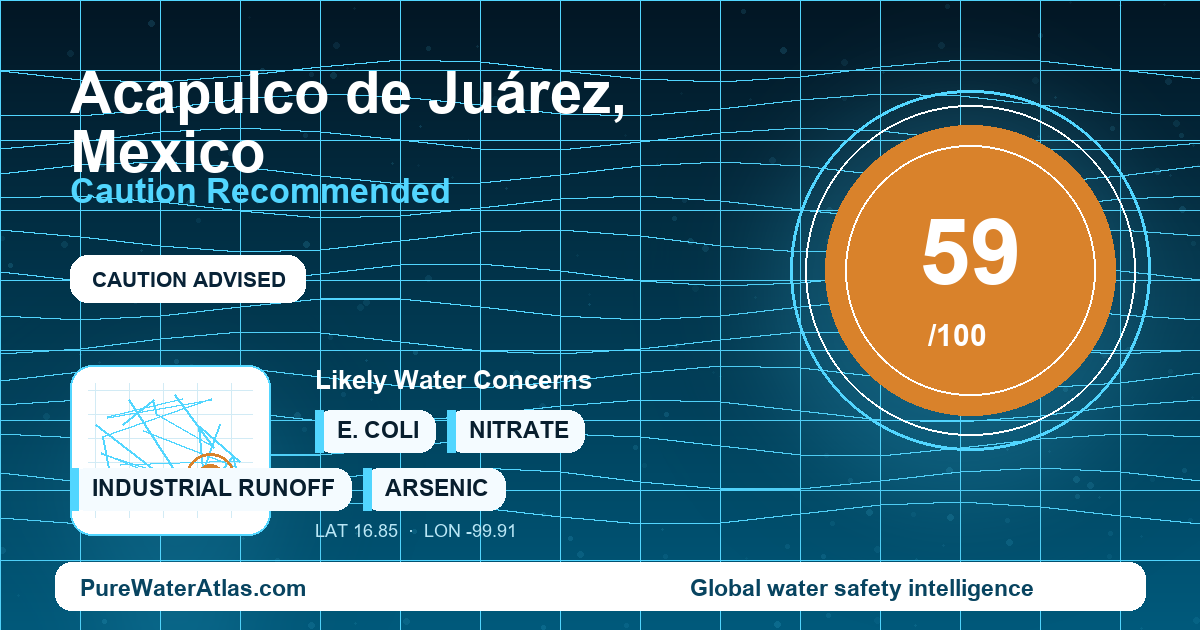
Acapulco de Juárez, Mexico: municipal water from Papagayo-basin systems, elevated practical risk from intermittent service, storm vulnerability, aging distribution infrastructure, and building-level cisterns and rooftop tanks.
Quick Answer
| Water safety score | 59 / 100 |
|---|---|
| Risk level | Caution Recommended |
| Can visitors drink the tap water? | Not recommended for routine drinking. Visitors should use sealed bottled water, professionally purified water, or water that has been boiled or treated with a reliable point-of-use system. |
| Resident guidance | Tap water may be suitable for washing and general household use, but drinking and cooking water should normally be filtered and disinfected or otherwise treated, especially where cisterns or rooftop tinacos are used. |
| Main water identity | Acapulco’s municipal supply is primarily associated with the Papagayo River basin and the Papagayo I, Papagayo II, and Lomas de Chapultepec systems. |
| Local water authority | Comisión de Agua Potable y Alcantarillado del Municipio de Acapulco, commonly known as CAPAMA. |
| Filter recommendation | Sediment prefiltration plus activated carbon is advisable; add UV or another disinfection barrier when water is stored in cisterns or tinacos. Reverse osmosis can help where taste, dissolved minerals, salinity, nitrate, or some metals are concerns, but it does not replace tank hygiene. |
Editorial verdict: Caution is recommended. Acapulco de Juárez has an organized municipal water system, but the practical drinking-water risk is elevated by intermittent service, storm exposure, pressure variation, aging infrastructure, and building-level storage. Short-term visitors should not treat bathroom tap water as reliably potable unless it is additionally treated at the point of use.
Why Acapulco de Juárez Is Different
Acapulco de Juárez is not a simple flat-grid water system. It is a Pacific coastal city built around Acapulco Bay, with dense tourist zones, hillside neighborhoods, low-lying coastal areas, and lagoon-adjacent zones. That geography makes water delivery dependent on pumping, pressure management, storage tanks, and distribution across sharply different elevations. In practical terms, two buildings on the same trip can have very different tap-water risk depending on pressure history, tank condition, internal plumbing, and recent outages.
The city’s resort growth also created a high seasonal water demand layered on top of a large resident population. Local water reliability has been a recurring public issue because Acapulco combines tourism peaks, hillside distribution areas, and aging or storm-exposed infrastructure. Hurricane Otis in 2023 highlighted this vulnerability by causing major disruption to electricity, pumping, water distribution, and sanitation infrastructure.
For drinking-water safety, Acapulco’s distinctive issue is the gap between system-level treatment and the final glass of water. Even where municipal water is chlorinated before distribution, the water a person actually drinks may pass through a building cistern or rooftop tinaco. In apartments, small hotels, older buildings, and vacation rentals, that storage step can be the weak point if tanks are dirty, poorly sealed, stagnant, or affected by low pressure and service interruptions.
Where Does Acapulco de Juárez’s Tap Water Come From?
Acapulco’s municipal supply is primarily associated with the Papagayo River basin and related intake, wellfield, pumping, and aqueduct systems commonly identified locally as Papagayo I, Papagayo II, and Lomas de Chapultepec. These systems convey raw water toward treatment, storage, and distribution zones serving the bay, urban core, hillside neighborhoods, and tourist areas.
Key infrastructure includes the Papagayo I supply system, Papagayo II supply system, the Lomas de Chapultepec supply system and wellfield area, CAPAMA pumping stations, storage tanks, and the municipal distribution network. After Hurricane Otis, municipal and state-supported repair work became especially important because the storm damaged and disrupted electricity, pumping, distribution, and sanitation systems.
Historically, Acapulco’s growth as a coastal resort outpaced smaller local sources, increasing dependence on larger Papagayo-basin supply works and long-distance pumping. Local references also describe earlier reliance on wells, springs, and smaller systems before the present multi-system municipal network became dominant. Today, household and building-level cisterns and rooftop tinacos are also part of the real water system experienced by residents and visitors, particularly in areas with intermittent supply.
Who Manages Drinking Water in Acapulco de Juárez?
The local drinking-water and sewerage utility is CAPAMA, Comisión de Agua Potable y Alcantarillado del Municipio de Acapulco. CAPAMA operates the municipal service, including drinking-water and sewerage responsibilities within the city.
The Gobierno Municipal de Acapulco provides local government context for public services, emergency communication, and water-related notices. At the national level, CONAGUA, Comisión Nacional del Agua, is the federal water authority for water resources and infrastructure support, and its Sistema Nacional de Información del Agua is a national portal for hydrologic and water-resource information.
Drinking-water quality in Mexico is governed through national health regulations, including NOM-127-SSA1-2021 for water for human use and consumption. Public-health and sanitary-risk roles also involve the Secretaría de Salud and COFEPRIS. However, publicly accessible finished-water monitoring data are not consistently available in a form that supports precise, current, neighborhood-by-neighborhood safety claims for Acapulco. This profile therefore gives risk-based guidance tied to documented infrastructure, storm, storage, and service conditions rather than claiming that all city tap water is either compliant or unsafe.
Main Local Water Concerns
The most important concern in Acapulco is not a single named contaminant across the whole city. It is the combination of intermittent supply, pressure variability, heavy-rain events, storm damage, and private storage. Low-pressure periods and long outages can increase contamination risk in distribution pipes, especially if water mains, building plumbing, or nearby sanitation systems are stressed.
Post-storm conditions are a major local risk factor. Tropical storms and hurricanes can disrupt pumping, power, treatment, and distribution. Heavy rains can increase raw-water turbidity and cause flooding or sewage overflows. After intense rainfall, main breaks, repairs, flooding, or major outages, tap water should be treated as higher risk until the building system has been flushed, tanks are cleaned if needed, and water quality is confirmed.
Building-level storage is another major concern. Cisterns and rooftop tinacos can accumulate sediment, lose disinfectant residual, support biofilm growth, or become contaminated by insects, roof runoff, floodwater, poor lids, or stagnant conditions. In older parts of the city, aging municipal infrastructure and older internal plumbing can further affect the water that reaches the tap. Some coastal or groundwater-influenced areas may experience salty or mineral tastes, but available public evidence is not sufficient to make neighborhood-level salinity claims without testing.
For Travelers
Visitors to Acapulco de Juárez should not drink tap water as a routine practice. Use sealed bottled water, professionally treated hotel or restaurant water, or water that has been boiled or treated by a maintained point-of-use system. This advice is especially important after heavy rain, tropical storms, service interruptions, repairs, or if staying in a smaller rental, older building, or property that relies on a rooftop tank or cistern.
For brushing teeth, bottled or treated water is the safer choice for short-term visitors, immunocompromised travelers, pregnant travelers, young children, and anyone staying in accommodations where the building water system is uncertain. Many residents may use tap water for brushing, but traveler tolerance and building-specific risks vary.
Use ice only from reputable hotels, restaurants, or packaged commercial sources. Avoid informal ice if you cannot confirm it was made from purified water. Larger hotels and established restaurants in tourist zones often use purified water for drinking, ice, and food service, but travelers should confirm this directly. Do not assume that bathroom tap water is the same as the water used in kitchens, bars, or bottled service.
Carry sealed water during excursions and avoid drinking from taps after storms or outages. If boiling is necessary, bring water to a rolling boil and let it cool in a clean, covered container. For emergency treatment details, see the PureWaterAtlas guide to boiling water purification.
For Residents
Residents should treat Acapulco tap water as variable-quality water that needs a final household barrier for drinking and cooking. A practical home setup is sediment prefiltration plus activated carbon, with UV or another disinfection barrier if water is stored in a cistern or rooftop tinaco. UV water purification is especially relevant where microbial control is the main concern and the water has been prefiltered enough for UV to work properly.
Reverse osmosis can be useful where taste, dissolved minerals, salinity, nitrate, or some metals are concerns. It must be maintained, and it should not be treated as a substitute for cleaning and disinfecting storage tanks. If the home uses a cistern or tinaco, tank hygiene is a core safety measure, not an optional maintenance detail.
Residents should test for total coliform and E. coli if water is stored in a cistern or rooftop tank, after flooding, after long outages, or if household members experience recurring gastrointestinal illness. Checking free residual chlorine at the tap is also useful after service interruptions or tank refilling. Test turbidity, color, odor, and basic chemistry if water becomes cloudy, rusty, salty, or has a sewer-like smell.
Older hotels, apartment blocks, and homes may have internal plumbing, old tanks, corroded pipes, or stagnant sections that are not reflected in municipal treatment. Test for lead if the building is older, has unknown internal plumbing, brass fixtures, or stagnant water conditions. If using private wells, groundwater-influenced water, or water with salty, metallic, or staining characteristics, consider testing nitrate, total dissolved solids, chloride, hardness, iron, and manganese.
Relevant Contaminants and Water-Quality Issues
The most relevant Acapulco concern for drinking safety is microbial risk from intermittent supply, storage tanks, floods, and loss of pressure. E. coli is a key indicator because its presence suggests fecal contamination and a possible gastrointestinal illness risk. For broader context, see PureWaterAtlas resources on water microbiology.
Turbidity and sediment are also locally important because heavy rain, raw-water disturbance, pipe repairs, tank accumulation, and post-storm conditions can make water cloudy or visibly dirty. Turbid water can interfere with disinfection and may indicate a need to stop drinking untreated tap water until the cause is understood.
Chlorine matters because residual chlorine is a practical field indicator for distributed and stored municipal water. If water has been sitting in a cistern or rooftop tinaco, disinfectant residual can decline. Lead is relevant mainly to older internal plumbing and stagnant building water, not because the dataset identifies Acapulco’s source water as lead-contaminated. Nitrate is relevant for private wells, groundwater-influenced supplies, or sanitation-impacted settings, but citywide nitrate claims should not be made without testing.
How to Verify Your Water Quality
Because Acapulco lacks consistently public, current, neighborhood-level finished-water reporting, the most reliable answer for a household or accommodation is local verification. Start with the building: ask whether water for drinking is bottled, reverse osmosis-treated, UV-treated, or otherwise purified, and whether cisterns and tinacos are cleaned on a routine schedule.
For residents, combine observation with testing. Check for discoloration, sediment, sewer-like odor, salty or metallic taste, low pressure, and recent outage history. After storms, floods, major repairs, or long service interruptions, treat water as higher risk until flushing, tank inspection, and testing support normal use.
PureWaterAtlas resources that can help include the complete guide to water testing, the drinking water safety guide, the water treatment systems guide, and the global water quality guide. You can also use the Global Water Quality Checker and search individual substances in the Contaminants Search Engine. For targeted topics, see lead testing methods and nitrate testing methods.
Official and Technical Sources
- CAPAMA, Comisión de Agua Potable y Alcantarillado del Municipio de Acapulco — local drinking-water and sewerage utility.
- Gobierno Municipal de Acapulco — municipal public-service and emergency context.
- CONAGUA, Comisión Nacional del Agua — national water authority for water resources and infrastructure support.
- Sistema Nacional de Información del Agua, CONAGUA — national hydrologic and water-information system.
- NOM-127-SSA1-2021 — Mexican drinking-water standard for water for human use and consumption.
- Secretaría de Salud, Gobierno de México — federal public-health authority.
- COFEPRIS — federal sanitary-risk authority relevant to potable-water surveillance.
- CDC Travelers’ Health: Mexico — traveler food and water exposure guidance.
- WHO Guidelines for Drinking-water Quality — international reference for microbial risk and safe drinking-water principles.
Bottom Line
Acapulco de Juárez has a real municipal water system operated by CAPAMA and supplied through Papagayo-basin and related systems, but tap water should be approached with caution. The city’s practical risk comes from intermittent service, pressure changes, storm disruption, aging infrastructure, and the widespread use of cisterns and rooftop tinacos. Visitors should drink sealed bottled or confirmed purified water and avoid relying on bathroom taps, especially after rain, outages, or in rentals. Residents should use household treatment for drinking and cooking, maintain storage tanks, monitor chlorine where possible, and test after floods, long outages, discoloration, odor, or illness. Current public data do not support precise neighborhood-by-neighborhood safety claims, so building-level verification is essential.
Read the full guide: Global Water Quality Guide
Explore more in this category: Global Water Quality Articles