Los Mochis, Sinaloa: treated municipal water from the Río Fuerte system, but limited public tap-level data means caution is recommended for drinking.
Quick Answer
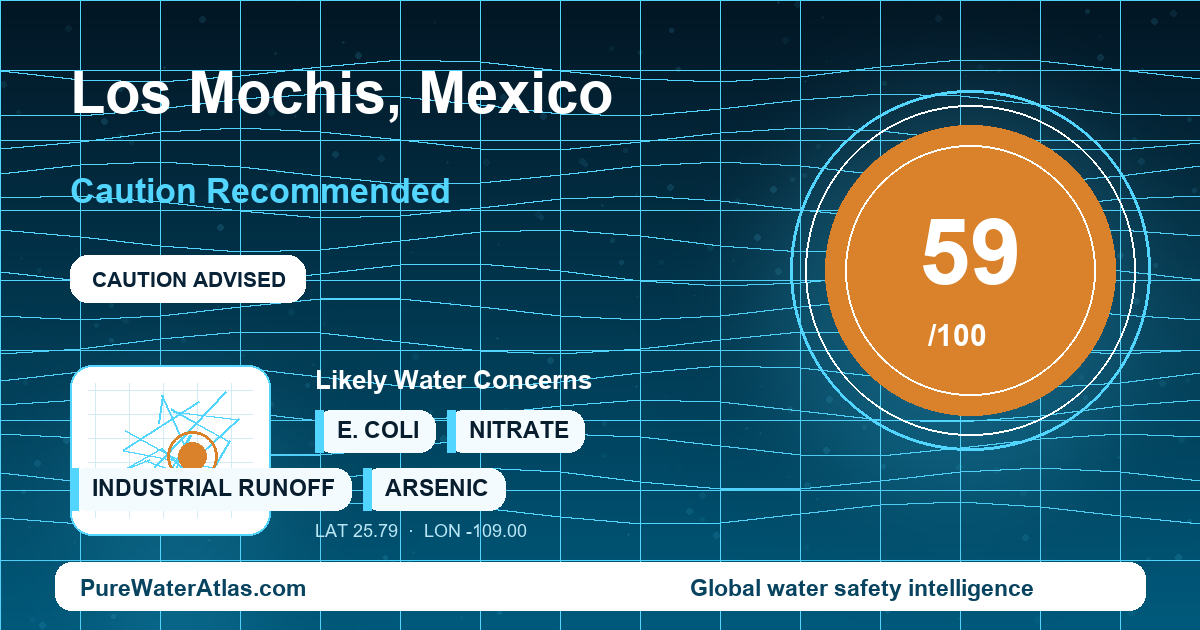
| Water safety score | 59 / 100 |
|---|---|
| Risk level | Caution Recommended |
| Can visitors drink the tap water? | Not recommended for most travelers. Use sealed bottled water, reputable garrafón water, or properly treated water. |
| Resident guidance | Municipal water is generally suitable for bathing, cleaning, and cooking with precautions, but routine drinking is better handled with garrafón water, a maintained purifier, or boiling during incidents. |
| Main water source | Primarily treated surface water associated with the Río Fuerte system, reservoirs, and Valle del Fuerte canal infrastructure. |
| Local water authority | JAPAMA, Junta de Agua Potable y Alcantarillado del Municipio de Ahome. |
| Filter recommendation | A home drinking-water treatment system is advisable. For microbial safety, use boiling during disruptions or a properly maintained UV, ultrafiltration, or reverse-osmosis system where appropriate; carbon alone improves taste but does not disinfect unsafe water. |
Overall verdict: caution recommended. Los Mochis has a formal municipal drinking-water system, but recent neighborhood-level, tap-level laboratory reporting is not consistently available for public review. The practical risk is highest after storms, low pressure, service interruptions, pipe repairs, dirty storage tanks, or building plumbing problems.
Why Los Mochis Is Different
Los Mochis is not a simple groundwater-only city. It sits in the agricultural Valle del Fuerte in northern Sinaloa, inland from the Gulf of California port of Topolobampo, and its drinking-water context is closely tied to the Río Fuerte surface-water system. The same regional setting that supports large-scale irrigation also shapes the city’s water-risk profile: canal water, reservoir operations, agricultural runoff pressure, summer heat, seasonal storms, and drought conditions all matter.
The city has a formal municipal system rather than relying on informal household wells as the default urban supply. That is a major advantage compared with places lacking organized treatment and distribution. However, it does not automatically prove that water at every hotel sink, apartment tap, restaurant ice machine, rooftop tank, or household cistern is safe to drink. In Los Mochis, the weak point can be the final stretch: distribution pressure changes, repairs, service cuts, leaks, storage tanks, and internal building plumbing.
For visitors from countries where tap-water safety is routinely assumed, the important difference is verification. Even if treated water leaves a municipal plant in acceptable condition, the consumer usually cannot easily check current microbiological safety at the tap. That uncertainty is the reason PureWaterAtlas rates Los Mochis as “Caution Recommended” rather than “generally safe to drink untreated.”
Where Does Los Mochis’s Tap Water Come From?
Los Mochis is primarily associated with the Río Fuerte surface-water system. The Río Fuerte basin is regulated by major reservoirs including Luis Donaldo Colosio, Miguel Hidalgo y Costilla, and Josefa Ortiz de Domínguez. Water availability and raw-water conditions in the region are therefore influenced by dam storage, reservoir operations, irrigation demand, canal conveyance, rainfall, drought, and seasonal runoff.
The Valle del Fuerte canal and irrigation network is central to how water moves through the Los Mochis-Ahome area. Historically, Los Mochis developed as an agricultural and sugar-industry city, and irrigation infrastructure shaped both urban growth and the surrounding water context. Groundwater exists in the coastal plain region, but the most important city-scale drinking-water identity for Los Mochis is treated surface water linked to the Río Fuerte and canal-reservoir system.
Before reaching taps, raw water must pass through municipal potabilization infrastructure operated for Los Mochis and other Ahome communities. After treatment, water moves through urban distribution mains, service connections, cisterns, rooftop tanks, and building plumbing. These last components are not minor details: a clean treated supply can become less reliable if it loses disinfectant residual, sits in a dirty tank, is exposed to heat, insects, dust, or animals, or passes through deteriorated plumbing.
Who Manages Drinking Water in Los Mochis?
The local drinking-water and sewerage utility is JAPAMA, Junta de Agua Potable y Alcantarillado del Municipio de Ahome. Los Mochis is within the municipality of Ahome, and the Gobierno Municipal de Ahome provides municipal context for local public services and public works.
Drinking water in Mexico is regulated under national health standards, including NOM-127-SSA1-2021, Agua para uso y consumo humano. Water-resource administration and national water information are connected to CONAGUA and the Sistema Nacional de Información del Agua. State sanitary-risk oversight includes Sinaloa authorities such as COEPRISS Sinaloa.
This regulatory framework matters, but it should not be overread. The existence of a utility and a national standard does not prove that any specific Los Mochis tap is safe on a given day. Publicly accessible, recent, tap-level laboratory results and neighborhood residual-chlorine summaries for Los Mochis are not consistently available in an easy-to-audit format. The score here reflects that combination: formal treatment and regulation, plus meaningful uncertainty at the distribution and building level.
Main Local Water Concerns
The most important short-term health concern in Los Mochis is microbial risk if treatment, chlorine residual, pipe integrity, or storage-tank sanitation fails. Surface-water systems can experience increased turbidity after heavy rain, canal disturbance, runoff, or storm events. Higher turbidity can make filtration and disinfection more operationally important because suspended particles can interfere with effective microbial control.
Agricultural runoff is also a plausible source-water pressure in the Valle del Fuerte. In an irrigated agricultural region, canals and rivers can be exposed to runoff, sediment pulses, nutrients, and pesticides before treatment. However, PureWaterAtlas did not find public evidence supporting a citywide claim that specific contaminants are currently exceeding drinking-water limits at Los Mochis taps. This distinction is important: runoff is a reasonable source-water concern, not proof of a specific tap-water exceedance.
Chlorine taste or odor may be noticeable because chlorination is commonly used for disinfection. A normal chlorine smell is often a palatability issue rather than a health problem. The higher concern is the opposite situation: water that has no disinfectant residual after long storage, warm conditions, or distribution problems.
Seasonality matters in Los Mochis. Summer heat can accelerate disinfectant loss in stored water. The Pacific hurricane and tropical-storm season can bring intense rain, flooding, runoff, turbidity, and repair conditions. Dry-season and drought periods can reduce reservoir storage and increase stress on the regional water system; official drought context can be checked through the Monitor de Sequía en México. After service cuts, low pressure, main breaks, or visibly dirty water, residents should treat tap water as higher risk until it is flushed and confirmed safe.
For Travelers
Most travelers should not drink Los Mochis tap water directly. Use sealed bottled water, reputable garrafón water, packaged commercial ice, or water treated by boiling, UV with proper prefiltration, or a certified purifier suitable for microbial risks. This recommendation is based on uncertainty and point-of-use risk, not on proof that all municipal water in the city is unsafe.
For brushing teeth, short-term visitors, people with sensitive stomachs, immunocompromised travelers, and families with infants should use bottled or treated water. Long-term residents may make different choices if their household system is well maintained and the water is clear and normally chlorinated, but visitors usually lack that background knowledge.
Ice deserves special attention. Avoid ice from unknown street vendors or informal sources. In established hotels and restaurants, ask whether ice is made from purified water. Commercial packaged ice is preferable when available. Better hotels and restaurants commonly use purified water for drinking water and ice, but this should not be assumed automatically. Ask for bottled water or agua purificada if uncertain.
Coffee, tea, and cooked foods are generally lower risk when brought to a full boil and prepared hygienically. Carry bottled water during hot weather, avoid refilling bottles from bathroom taps, and be especially cautious after storms, flooding, nearby pipe work, or water outages. If water is cloudy, contains sediment, or has an unusual smell beyond normal chlorine, do not drink it untreated.
The CDC Travelers’ Health guidance for Mexico supports cautious use of safer drinking-water options where local tap-water safety is uncertain.
For Residents
Residents can usually use municipal water for bathing, cleaning, and many cooking uses with sensible precautions. For routine drinking, many households in Los Mochis are better served by garrafón water, a properly maintained point-of-use purifier, or boiling during service interruptions and advisories. A drinking-water filter is advisable for households that want a higher safety margin than untreated tap water.
Filter choice should match the risk. Activated carbon and sediment prefilters can improve taste, chlorine odor, and visible particles, but carbon alone should not be relied on to disinfect unsafe water. For microbial protection, use boiling during incidents or a maintained treatment system such as UV with prefiltration, ultrafiltration, or reverse osmosis where appropriate. See PureWaterAtlas guides on boiling water purification, UV water purification, and choosing a water treatment system.
Testing is especially important if your home uses a cistern, rooftop tank, private well, or if infants, pregnant people, older adults, or immunocompromised people live in the household. Test for total coliform and E. coli after flooding, sewage backflow, major plumbing work, unexplained illness, or long service interruptions. If using a private well or other non-municipal source in the Ahome area, include nitrate, total dissolved solids, hardness, chloride or salinity indicators, and basic metals as appropriate.
Older buildings and unknown plumbing deserve extra caution. Corroded fixtures, stagnant dead-end lines, and older materials can contribute metals or sediment at the point of use. Where children or pregnant people live, consider first-draw and flushed lead testing. Storage tanks should be covered, screened, cleaned, and disinfected on a routine schedule. A clean municipal supply can become unsafe if held in a dirty or exposed tank, especially during hot weather.
Relevant Contaminants and Water-Quality Issues
For Los Mochis, the key water-quality issues are not based on a verified public list of citywide exceedances. They are based on the city’s surface-water setting, agricultural region, warm climate, storage practices, and limited tap-level transparency. The most relevant issue for immediate illness risk is microbial contamination, especially E. coli and other indicators of fecal contamination.
Turbidity and sediment are important because storms, runoff, canal disturbance, or pipe work can make water visibly dirty and can complicate disinfection. Chlorine is relevant because it is commonly used for disinfection; a chlorine taste may be noticeable, while absent residual after storage can indicate higher microbial risk.
Because Los Mochis is in a major irrigated agricultural area, nitrate is relevant for testing, especially for private wells or non-municipal sources. For older buildings, lead is a point-of-use concern best evaluated by testing rather than assumptions. For broader context, see PureWaterAtlas resources on nitrate testing, lead testing, and agricultural runoff in drinking water.
How to Verify Your Water Quality
The most reliable way to know whether a specific Los Mochis tap is safe is to test that tap, especially after water outages, repairs, flooding, storage-tank problems, or unexplained gastrointestinal illness. Use an accredited laboratory when results will guide health decisions. Home strips can help screen for chlorine, hardness, or basic chemistry, but they should not be treated as final confirmation of microbiological safety.
Start with the PureWaterAtlas guide to water testing and the pillar page on how to know if tap water is safe to drink. For microbial context, see Water Microbiology. You can also compare country and city-level guidance using the Global Water Quality Checker and look up specific substances in the Contaminants Search Engine.
If you are reviewing local conditions, check JAPAMA announcements, municipal notices, and state sanitary information when available. Remember that a city-level statement is not the same as a building-level result. In Los Mochis, cisterns, rooftop tanks, and internal plumbing can change water quality after it leaves the municipal system.
Official and Technical Sources
- JAPAMA, Junta de Agua Potable y Alcantarillado del Municipio de Ahome — local water and sewer utility for Los Mochis and Ahome.
- Gobierno Municipal de Ahome — municipal context for Los Mochis, local services, and public works.
- NOM-127-SSA1-2021 — Mexican national drinking-water quality standard.
- CONAGUA — federal water-resource authority.
- Sistema Nacional de Información del Agua — national water-information system for basin, dam, and water-resource context.
- Monitor de Sequía en México — official drought monitoring relevant to Sinaloa reservoir and supply pressure.
- COEPRISS Sinaloa — state sanitary-risk authority.
- CDC Travelers’ Health: Mexico — traveler health guidance.
- WHO Guidelines for Drinking-water Quality — international reference for microbial risk, source protection, and household treatment principles.
Bottom Line
Los Mochis has a formal municipal drinking-water system operated by JAPAMA and supplied mainly through the treated Río Fuerte surface-water and Valle del Fuerte canal-reservoir context. That is better than an unmanaged supply, but it does not make every tap automatically safe to drink. Publicly available, recent neighborhood-level tap results are limited, and real-world quality can be affected by storms, drought stress, pipe repairs, pressure changes, cisterns, rooftop tanks, and building plumbing. Travelers should use bottled or purified water and avoid unknown ice. Residents should maintain tanks, consider point-of-use treatment for drinking water, boil during disruptions, and test when household conditions or vulnerable occupants make the safety margin important.
Read the full guide: Global Water Quality Guide
Explore more in this category: Global Water Quality Articles