Cilacap, Central Java: treated municipal supply exists, but direct drinking from the tap is not recommended without boiling, verified filtration, or recent point-of-use testing.
Quick Answer
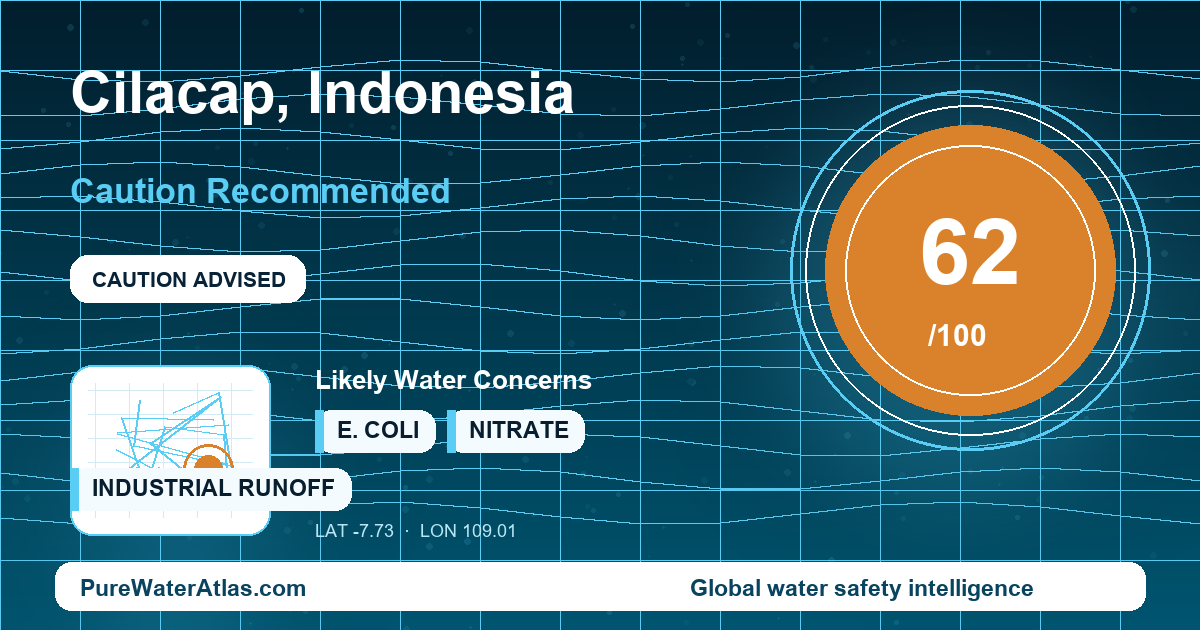
| Water safety score | 62 / 100 |
|---|---|
| Risk level | Caution Recommended |
| Can tourists drink the tap water? | No. Visitors should use sealed bottled water, reputable refill water, or boiled/filtered water for drinking in Cilacap. |
| Resident guidance | Perumda Air Minum Tirta Wijaya piped water is generally the preferred household source, but drinking water should be boiled or treated with a maintained point-of-use system when recent tap-level test results are not available. |
| Main formal supply | Treated piped water operated by Perumda Air Minum Tirta Wijaya Kabupaten Cilacap, with the main urban supply publicly associated with the Serayu River system and other sources used across different district service zones. |
| Local authority | Perumda Air Minum Tirta Wijaya Kabupaten Cilacap, with public-health oversight under Cilacap Regency health authorities and Indonesia’s Ministry of Health drinking-water framework. |
| Filter recommendation | Use a maintained drinking-water system if consuming tap water. Private wells should be tested before selecting treatment because bacteria, nitrate, salinity, iron, manganese, turbidity, and site-specific industrial risks require different solutions. |
Editorial verdict: Caution is recommended. Cilacap has a formal municipal drinking-water utility and treated piped supply, but recent citywide finished-water laboratory results by neighborhood are not consistently published in an easily verifiable public format. The safest interpretation is that treated Perumda Tirta Wijaya water is more reliable than private shallow wells, but it should not be assumed safe to drink directly at every tap.
Why Cilacap Is Different
Cilacap is not an inland city with a simple groundwater story. It is a low-lying south-coast city on the Indian Ocean side of Central Java, near Nusakambangan Island and the Segara Anakan/Donan estuarine system. That coastal and estuarine setting matters for drinking-water safety because salinity, tidal drainage, flooding, shallow groundwater quality, and household storage all become practical risk factors.
The city is also a major port and industrial/refinery center for southern Central Java. This does not prove that treated municipal tap water is contaminated, and this profile does not make that claim. It does mean that private wells, surface drains, and shallow groundwater near industrial corridors, fuel storage, workshops, drainage canals, or the port should be treated cautiously and tested before being used for drinking.
A visitor or resident may encounter several water sources in the same area of Cilacap: Perumda piped water, hotel storage-tank water, private well water, refill-gallon water, or bottled water. These sources can have very different risk profiles even within the same neighborhood. For that reason, the question is not only “Is Cilacap’s water treated?” but also “What water is actually reaching this tap, dispenser, roof tank, or well?”
Where Does Cilacap’s Tap Water Come From?
Cilacap’s formal piped drinking-water service is operated by Perumda Air Minum Tirta Wijaya Kabupaten Cilacap. Publicly available local information points to treated surface-water supply tied to the Serayu River system for the main urban Cilacap service area, while other raw-water sources may be used for district service units outside the central city. Because Cilacap is a regency capital rather than a separate city utility, raw-water arrangements can vary by service zone.
The key drinking-water infrastructure includes Perumda Tirta Wijaya’s abstraction, treatment, distribution mains, reservoirs, customer connections, and localized pressure zones typical of Indonesian municipal systems. The main urban supply corridor is commonly referenced around the Kesugihan/Maos-Cilacap service context linked to the Serayu system.
Water quality at the kitchen tap can still differ from water quality leaving the treatment plant. Distribution pressure changes, pipe condition, repairs, building plumbing, ground tanks, roof tanks, filters, refill-gallon dispensers, and private wells can all determine what residents and travelers actually consume. This is especially important in older buildings, boarding houses, budget accommodation, small shops, and homes that store water before use.
Before and alongside piped-water expansion, many Cilacap households have relied on shallow wells, boreholes, stored water, and purchased refill water. In the coastal plain around Cilacap, shallow groundwater can be affected by salinity, iron, manganese, septic contamination, flooding, and local drainage conditions. Private wells should therefore not be treated as equivalent to treated municipal water.
Who Manages Drinking Water in Cilacap?
The local drinking-water utility is Perumda Air Minum Tirta Wijaya Kabupaten Cilacap. Local administrative and public-service context is provided by Pemerintah Kabupaten Cilacap, while demographic and regional profile information is available from BPS Kabupaten Cilacap.
Indonesia’s drinking-water and environmental-health requirements are set nationally through Ministry of Health regulations, including Permenkes No. 2 Tahun 2023. Local utilities are expected to operate treatment and disinfection, and local health offices have roles in surveillance. Water-resources context for the Serayu system is also connected to the river-basin authority, Balai Besar Wilayah Sungai Serayu Opak, and national drinking-water infrastructure programs are associated with Kementerian Pekerjaan Umum, Cipta Karya.
The important limitation is transparency at the tap level. Public pages reviewed do not provide enough recent Cilacap finished-water sample results—such as routine E. coli, turbidity, residual chlorine, salinity trends, or distribution-zone summaries—to make a confident citywide direct-drink compliance claim. This profile therefore uses a risk-based conclusion rather than stating that all Cilacap tap water is either safe or unsafe.
Main Local Water Concerns
- Microbial contamination at the point of use: Even treated water can become unsafe if pipes lose pressure, tanks are dirty, or water is stored and handled in open containers. This is the main practical concern for both travelers and residents in Cilacap.
- Rainy-season turbidity and runoff: Surface-water systems associated with rivers such as the Serayu can face higher turbidity after heavy rain. Storm runoff, flooding, and drainage problems can also affect wells and household storage.
- Coastal salinity and high dissolved solids: Cilacap’s low-lying coastal and estuarine setting can make shallow groundwater brackish or mineralized, especially in dry periods or where groundwater is stressed. Boiling does not remove salinity.
- Industrial-port and urban drainage pressure: Cilacap’s port, refinery, fuel, and industrial activities are site-specific risk factors for wells and surface drainage. They do not prove a citywide treated-water violation, but they justify caution and laboratory testing for private water sources.
- Iron, manganese, sediment, taste, and odor: These can occur in groundwater or older building plumbing. They may stain fixtures, affect taste, and reduce the performance of UV units or filters if pretreatment is inadequate.
Season also matters. During the rainy season, higher river turbidity, storm runoff, flooding, septic overflow, and contamination of wells or tanks are more plausible. During the dry season, lower river flow, stronger salinity pressure in coastal groundwater, increased stored-water use, and possible supply interruptions can become more relevant. During tidal or storm-surge periods, low-lying areas may face drainage backflow or inundation that can affect wells, ground tanks, and plumbing.
For Travelers
Tourists should not drink Cilacap tap water straight from the tap as a default practice. Use sealed bottled water, reputable refill water, or water that has been properly boiled or passed through a verified purification system. Treated municipal water may be suitable for bathing and washing, but direct drinking is not recommended for short-term visitors.
For brushing teeth, use bottled, boiled, or filtered water if you have a sensitive stomach, are traveling with children, are pregnant, are immunocompromised, or are staying in budget lodging with uncertain plumbing. Many travelers use bottled water for brushing teeth in Indonesian cities as a precaution, and Cilacap’s mixed water-source environment makes that a reasonable approach.
Be cautious with ice. Avoid ice unless the venue is reputable and can confirm it is made from treated commercial ice or purified water. Use extra caution with street drinks and small stalls where the water source, ice source, or handling practices are unclear.
Higher-end hotels and established restaurants may provide sealed bottles, dispenser water, or treated water for guests, but do not assume the bathroom sink is potable. Ask whether drinking water comes from sealed bottles, refill-gallon water, or an in-house treatment system. In hot coastal weather, carry sealed water around the port, bus terminals, beaches, and industrial areas.
If you must use tap water, bring it to a rolling boil and let it cool in a clean, covered container. See the PureWaterAtlas Boiling Water Purification: Complete Guide. Boiling helps control microbes, but it does not remove salt, metals, nitrate, PFAS, petroleum compounds, or other dissolved chemicals.
For Residents
Residents connected to Perumda Air Minum Tirta Wijaya can generally treat piped supply as the preferred household source compared with private shallow wells. However, if the water is used for drinking and recent point-of-use results are not available, boiling or a maintained point-of-use system is advisable, especially when there are taste, odor, sediment, pressure interruptions, pipe repairs, or household storage tanks.
Private wells require testing before treatment decisions. At minimum, test for E. coli or total coliform, nitrate, conductivity or TDS, pH, iron, manganese, hardness, and turbidity. If the home is near the coast, estuary, port, refinery, fuel storage, workshops, or drainage canals, consider adding chloride or salinity indicators, petroleum hydrocarbons or VOC screening where available, and metals relevant to local conditions.
Households with infants, pregnant people, elderly residents, or immunocompromised people should prioritize microbial and nitrate testing. After flooding, pipe repair, long service interruption, tank cleaning, or a sudden change in color, odor, or taste, flush and disinfect the system as appropriate and retest before drinking.
Older buildings and repaired plumbing can contribute metals, sediment, taste, and microbial regrowth even when incoming utility water is treated. There is no public evidence that Cilacap has a documented citywide lead-in-water problem, but older fixtures, solder, brass components, and stagnant water should be treated cautiously. Flush stagnant taps and test if children or pregnant residents will drink the water.
Roof tanks and ground tanks are a major practical weak point. Tanks should be covered, screened against insects and animals, cleaned regularly, and protected from floodwater. UV units and filters work poorly when tank water is turbid or biologically contaminated unless prefiltration and maintenance are adequate. For treatment selection, see Water Treatment Systems and UV Water Purification: Complete Guide.
Relevant Contaminants and Water-Quality Issues
The most important practical issue for Cilacap is microbial safety at the point of use. Learn more about E. coli in drinking water and broader water microbiology risks. Rainy-season source-water stress and sediment complaints are connected to turbidity and sediment, both of which can interfere with disinfection and household treatment.
Disinfection is also relevant. Municipal systems commonly rely on treatment and disinfection, and consumers may notice taste or odor associated with chlorine. For private wells and vulnerable households, nitrate is an important testing priority; PureWaterAtlas also has a guide to nitrate testing and detection methods.
For wells and older plumbing, aesthetic and operational problems such as iron and manganese can affect taste, staining, and treatment performance. If older fixtures are present, residents can also review lead testing and detection methods, while recognizing that this profile does not identify a documented citywide lead problem in Cilacap.
How to Verify Your Water Quality
The only reliable way to know whether water is safe at a specific Cilacap tap, well, boarding house, hotel, shop-house, or tank is to verify the actual source and test at the point of use. Testing at the utility connection may not reflect what happens after a roof tank, ground tank, dispenser, filter, or old plumbing.
Start with the PureWaterAtlas Water Testing guide and the broader Drinking Water Safety resource. For a wider comparison, use the Global Water Quality Checker and the Contaminants Search Engine. National and international context can be compared through Global Water Quality, but citywide or national context should not replace a Cilacap tap-level test.
Official and Technical Sources
- Perumda Air Minum Tirta Wijaya Kabupaten Cilacap — official local drinking-water utility for Cilacap Regency.
- Pemerintah Kabupaten Cilacap — official local government source for administrative context and public services.
- BPS Kabupaten Cilacap — official statistics source for Cilacap geography, population, and regional profile information.
- Balai Besar Wilayah Sungai Serayu Opak — river-basin authority relevant to the Serayu-Opak water-resources system.
- Kementerian Pekerjaan Umum, Cipta Karya — national public-works directorate for drinking-water infrastructure programs.
- Ministry of Health Regulation No. 2 of 2023 — Indonesian national drinking-water and environmental-health framework.
- CDC Travelers’ Health: Indonesia — traveler food and water precaution guidance.
- WHO Drinking-water Fact Sheet — global public-health reference for drinking-water risks.
- WHO/UNICEF Joint Monitoring Programme Data Portal — national WASH context for Indonesia, not a substitute for Cilacap tap-water results.
Bottom Line
Cilacap has a formal municipal water provider, Perumda Air Minum Tirta Wijaya, and treated piped water is generally the preferred household source compared with private shallow wells. However, Cilacap’s coastal setting, estuarine environment, rainy-season runoff, household storage tanks, and mixed use of wells, refill water, and building-level plumbing mean tap safety can vary at the point of use. Tourists should not drink tap water directly; use sealed bottled water, reputable refill water, or boiled/filtered water. Residents should boil or use a maintained treatment system for drinking when recent tap-level results are unavailable. Private wells—especially near the coast, port, refinery, drainage canals, or septic-dense areas—should be tested before drinking or choosing treatment.
Read the full guide: Global Water Quality Guide
Explore more in this category: Global Water Quality Articles