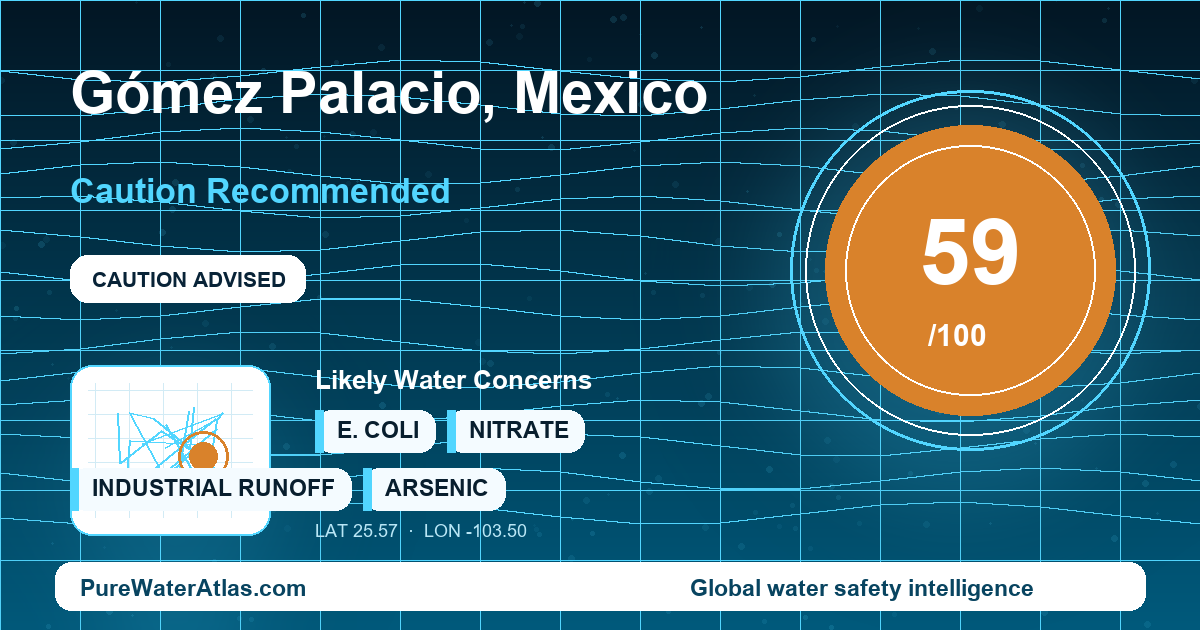
Gómez Palacio sits in Mexico’s Comarca Lagunera, a groundwater-stressed region with documented arsenic concerns and a major transition toward treated Nazas River water through Agua Saludable para La Laguna.
Quick Answer
| Water safety score | 59 / 100 |
|---|---|
| Risk level | Caution Recommended |
| Can visitors drink the tap water? | Not recommended as a default. Use sealed bottled water, hotel-provided purified water, or water from a reputable maintained filter. |
| Resident advice | Do not rely on taste, clarity, or chlorine smell as proof of safety. Verify the water serving your property and consider certified point-of-use treatment for drinking water. |
| Main water source | Historically groundwater wells from the Principal Región Lagunera aquifer system; now in transition as Agua Saludable para La Laguna introduces treated Nazas River surface water to the region. |
| Local authority | SIDEAPA, the Sistema Descentralizado de Agua Potable y Alcantarillado de Gómez Palacio. |
| Best household filter direction | Reverse osmosis is the most practical point-of-use option when arsenic, nitrate, salinity, dissolved solids, and hardness are concerns. Carbon alone is not enough for those issues. |
Overall verdict: caution recommended. Gómez Palacio has a real regional source-water story: long dependence on deep groundwater in the Laguna aquifer system, documented concern about naturally occurring arsenic, and an ongoing federal surface-water supply project intended to reduce reliance on wells. Because neighborhood-level finished-water results are not consistently easy to verify publicly, residents and visitors should take a conservative approach for drinking water.
Why Gómez Palacio Is Different
Gómez Palacio is not a city where tap-water safety can be judged only by whether the water looks clear or smells chlorinated. It is part of the Comarca Lagunera metropolitan area in northeastern Durango, beside Torreón and Lerdo, in an arid basin shaped by the Nazas River and regional irrigation development. The area’s drinking-water history is closely tied to groundwater extraction, long-term aquifer pressure, and naturally occurring contaminants in the regional aquifer system.
The Laguna region is one of Mexico’s best-known examples of groundwater-quality concern related to arsenic. The issue is regional rather than limited to one building or street. It is linked to aquifer geology, long-term pumping, and the way water sources have been managed in an arid basin. That does not mean every tap in Gómez Palacio has the same water quality, and it does not mean every household has the same risk. It does mean the city deserves more caution than a simple “yes, drink it” answer.
Another reason Gómez Palacio is different is that its supply is in transition. The federal Agua Saludable para La Laguna program is designed to bring treated Nazas River surface water to municipalities in the Laguna region, including Gómez Palacio, reducing dependence on deep wells. During this kind of transition, different sectors may not experience the same source blend, pressure pattern, or distribution conditions at the same time.
Where Does Gómez Palacio’s Tap Water Come From?
Gómez Palacio has historically depended mainly on groundwater wells from the Principal Región Lagunera aquifer system in the Nazas-Aguanaval basin. This groundwater identity matters because the Comarca Lagunera has long-standing concerns about overexploitation and water quality, especially arsenic in drinking-water wells. Federal authorities describe Agua Saludable para La Laguna as a response to overexploitation and water-quality problems associated with the aquifer.
The raw-water picture is now changing. Agua Saludable para La Laguna is designed to supply treated surface water from the Nazas River system, including water regulated by the Lázaro Cárdenas and Francisco Zarco dam system, through regional treatment and aqueduct infrastructure. In practical terms, Gómez Palacio residents should assume a mixed or transitional supply unless SIDEAPA confirms the source serving a specific sector.
Key infrastructure affecting local drinking water includes municipal groundwater production wells, the distribution network, pumping stations, storage tanks, and the regional intake, treatment, conveyance, and aqueduct works associated with the Agua Saludable project. At the property level, many urban Mexican water systems also involve household cisterns or roof tanks. In Gómez Palacio, those storage practices can be important: even where water leaves a plant or well chlorinated, a dirty cistern, open tinaco, old internal pipes, or stagnant plumbing can change water quality before it reaches the kitchen tap.
Who Manages Drinking Water in Gómez Palacio?
The local water utility is SIDEAPA Gómez Palacio, the Sistema Descentralizado de Agua Potable y Alcantarillado de Gómez Palacio. SIDEAPA is the practical first point of contact for local service notices, sector information, supply interruptions, and questions about whether a property is being served by groundwater, Agua Saludable-related supply, or a changing blend.
At the federal level, CONAGUA manages national waters and the Agua Saludable para La Laguna project. Health-based drinking-water quality oversight is tied to Mexico’s Secretaría de Salud and COFEPRIS framework, with state and municipal roles in surveillance and operation.
Mexico’s drinking-water health standard is NOM-127-SSA1-2021, which sets criteria for water for human use and consumption, including microbiological, physical, chemical, and disinfection-related requirements. Compliance should be confirmed through official monitoring or certified lab testing. This profile does not claim that every tap in Gómez Palacio currently meets the standard, because recent neighborhood-level finished-water results are not consistently available in a public, easy-to-verify format.
Main Local Water Concerns
Arsenic is the central regional concern. The Comarca Lagunera has a documented history of naturally occurring arsenic in groundwater. Arsenic is not visible, does not reliably change taste, and is not removed by boiling. For health context, the World Health Organization arsenic fact sheet identifies drinking water as an important exposure pathway in affected regions.
Dissolved minerals, hardness, salinity, and taste issues may matter. Arid-zone groundwater systems can have high dissolved solids, hardness, or salty taste. These conditions are not the same as microbial contamination, but they influence filter selection and household acceptance of tap water.
Nitrate is plausible but should be tested, not assumed. Gómez Palacio is in an irrigated agricultural basin, so nitrate deserves attention. However, this profile does not claim a specific tap nitrate level for Gómez Palacio. Residents who drink tap water daily should verify nitrate through a reputable laboratory.
Turbidity, sediment, and discoloration can occur after system disturbances. Pipe repairs, pressure changes, storms, or tank disturbance can produce turbidity, visible sediment, or temporary discoloration. After service interruptions, repairs, or low-pressure events, avoid using discolored water for drinking until it clears and flush taps before collecting drinking water.
Microbial risk is often a storage and pressure issue. Chlorination helps control microbiological risk, but poorly maintained cisterns and roof tanks can undermine safety. E. coli and total coliform testing are especially relevant after cistern flooding, long vacancy, plumbing work, or pressure loss.
Lead is mainly a building-plumbing concern. Lead is more likely to come from older fixtures, solder, valves, or internal plumbing than from the regional source water. Older properties should consider first-draw and flushed samples if children or pregnant residents drink the water.
For Travelers
Short-stay visitors should not use Gómez Palacio tap water as their default drinking water. Use sealed bottled water, hotel-provided purified water, or water from a maintained filtration system. The concern is not only short-term stomach illness; it is also uncertainty about building storage, roof tanks, local plumbing, and the city’s regional groundwater-quality history.
For brushing teeth, many healthy adults are unlikely to have a problem from small incidental exposure. Still, cautious travelers, children, pregnant travelers, and anyone with a sensitive stomach should use bottled or filtered water, especially in budget lodging, older buildings, or places that rely on roof tanks.
For ice, use ice only in established restaurants, hotels, or chains where it is commercially produced or made with purified water. Avoid informal ice if the source is unclear. Better hotels and restaurants commonly use garrafón water, purified water, or commercial ice. Ask whether drinking water is from “garrafón,” “filtro,” or “agua purificada,” and do not assume bathroom tap water is the same as the drinking water served at the table.
During hot weather, carry bottled water rather than refilling from unknown taps. If traveler’s diarrhea occurs, use oral rehydration salts. Boiling can reduce microbial risk, but it will not remove arsenic, nitrate, salinity, or dissolved minerals, so boiling is not a complete solution for Gómez Palacio’s water concerns. For a broader background, see the CDC Mexico traveler water advice and PureWaterAtlas guide to boiling water purification.
For Residents
Residents who drink tap water daily should use a more deliberate approach than relying on taste or appearance. A practical Gómez Palacio household plan includes checking SIDEAPA notices, asking which source or sector supplies the property, maintaining any cistern or tinaco, and testing water when health-sensitive users are present.
For drinking and cooking water, point-of-use reverse osmosis is the most defensible household treatment direction because it can address multiple concerns relevant to Gómez Palacio, including arsenic, nitrate, total dissolved solids, salinity, and hardness when properly designed and maintained. A typical setup should include sediment prefiltration and activated carbon before the RO membrane. Activated carbon alone may improve chlorine taste and odor, but it should not be relied on for arsenic, nitrate, or high dissolved solids. For more detail, see PureWaterAtlas resources on arsenic filters, nitrate treatment, and choosing water treatment systems.
Testing is especially important after installation of an RO system, after membrane replacement, after taste changes, after plumbing work, after pressure loss, or after long vacancy. If the home has old or unknown plumbing materials, consider first-draw and flushed lead samples. If water is stored in a cistern or roof tank, clean and disinfect it routinely, keep it sealed against dust and insects, and inspect it after interruptions. A well-treated municipal supply can become unsafe inside a dirty storage tank.
Relevant Contaminants and Water-Quality Issues
The most relevant PureWaterAtlas contaminant profiles for Gómez Palacio are Arsenic, because of the Comarca Lagunera groundwater history; Nitrate, because the city sits in an irrigated agricultural basin; Turbidity and Sediment, because distribution events and household tanks can create visible short-term problems; Chlorine, because disinfection residual affects microbial control and taste; E. coli, because storage tanks and low-pressure events can create microbiological risk; and Lead, mainly for older internal plumbing.
For deeper reading, see arsenic testing and detection methods, nitrate testing and detection methods, and lead testing methods.
How to Verify Your Water Quality
The strongest way to verify drinking-water safety in Gómez Palacio is to test the water actually coming from the kitchen tap, not just assume the regional source. Ask SIDEAPA about the sector serving the property and whether it has been connected to Agua Saludable para La Laguna, but still verify household water quality if children, pregnant residents, older adults, or immunocompromised people will drink the water.
A useful lab panel for Gómez Palacio drinking water should include arsenic, nitrate, total dissolved solids, hardness, fluoride, iron, manganese, chloride, sulfate, and basic microbiology. If you use reverse osmosis, test both raw tap water and treated water after installation and periodically thereafter. If water has sat in old plumbing overnight, consider first-draw and flushed lead sampling.
PureWaterAtlas resources that can help include the complete guide to water testing, the Contaminants Search Engine, the Global Water Quality Checker, and the broader guide to drinking water safety. For background on risk sources, see water contamination in drinking water.
Official and Technical Sources
- Agua Saludable para La Laguna — Comisión Nacional del Agua, Gobierno de México.
- NOM-127-SSA1-2021, Agua para uso y consumo humano — Diario Oficial de la Federación, Gobierno de México.
- SIDEAPA Gómez Palacio — local potable water and sewer utility.
- CONAGUA groundwater availability information — official groundwater information platform.
- WHO arsenic fact sheet — health context for arsenic exposure in drinking water.
- WHO Guidelines for Drinking-water Quality — international drinking-water risk-management reference.
- CDC Mexico traveler water advice — travel-health guidance for safe food and drink practices.
Bottom Line
Tap water in Gómez Palacio should be treated with caution for drinking. The city is in the Comarca Lagunera, where groundwater dependence, aquifer overexploitation, and arsenic concerns are well documented. Agua Saludable para La Laguna is changing the source-water picture by introducing treated Nazas River water, but that transition also makes tap-by-tap certainty difficult without local confirmation. Visitors should use bottled or purified water for drinking and be cautious with ice and tooth brushing. Residents who drink tap water regularly should maintain tanks, follow SIDEAPA notices, and consider point-of-use reverse osmosis with periodic lab verification. Clear water is not proof of safety.
Read the full guide: Global Water Quality Guide
Explore more in this category: Global Water Quality Articles