
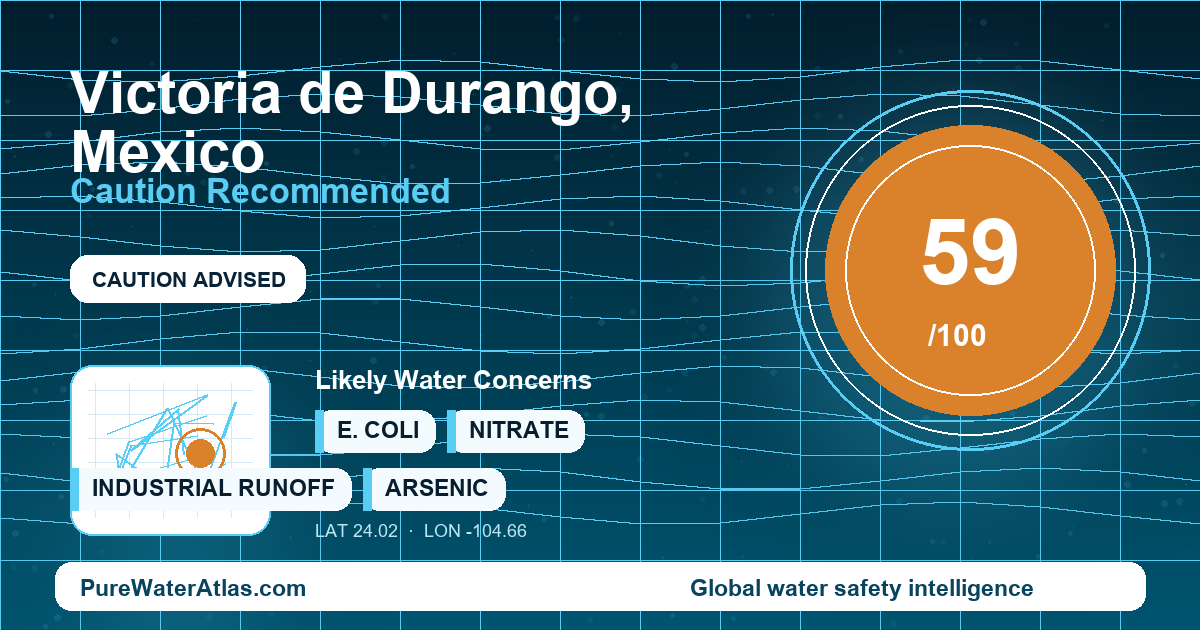
Victoria de Durango’s tap water is mainly groundwater from the Valle del Guadiana system, managed by Aguas del Municipio de Durango. The main safety question is not only the municipal source, but what happens in wells, pipes, pressure changes, cisterns, rooftop tinacos, and building plumbing before water reaches the tap.
Quick Answer
| Water safety score | 59 / 100 |
|---|---|
| Risk level | Caution Recommended |
| Can visitors drink the tap water? | Not recommended for most travelers. Use sealed bottled water or reliably treated water for drinking, especially in rentals, small hotels, older buildings, or places using cisterns and rooftop tanks. |
| Resident guidance | Municipal water may be usable after local verification, but a point-of-use treatment barrier and periodic tap testing are prudent because household storage and plumbing can change water quality. |
| Main water source | Primarily groundwater from municipal production wells associated with the Valle del Guadiana basin/aquifer system. |
| Local water authority | Aguas del Municipio de Durango, commonly abbreviated AMD. |
| Best practical filter approach | For general use: sediment prefilter plus certified activated carbon. Add ultrafiltration or UV where microbial uncertainty is a concern. Consider reverse osmosis only if testing shows high dissolved minerals, fluoride, arsenic, nitrate, salinity, or related groundwater issues. |
Why Victoria de Durango Is Different
Victoria de Durango is different from many cities that visitors picture as being supplied by a river intake and a large surface-water treatment plant. The city sits in the Guadiana Valley, a semi-arid interior region of Durango where groundwater is a strategic urban drinking-water source. Its practical drinking-water identity is therefore shaped by wells, pumping, storage, disinfection, and distribution rather than by a single visible lake or river source.
The current safety verdict is caution recommended. That does not mean every tap in Victoria de Durango is known to be unsafe. It means that publicly accessible, routinely updated, neighborhood-level tap-water lab results are limited, and the quality at the final tap can vary by building. In this city, a glass of water may begin as municipal well water, move through city pipes, enter a hotel or apartment cistern, sit in a rooftop tinaco, and then pass through building plumbing before it reaches a traveler or resident.
That final storage step matters. A municipal supply that is acceptable at the network level can become riskier if tanks are uncovered, dirty, poorly sealed, affected by insects or dust, or connected to old or stagnant plumbing. For this reason, advice for Victoria de Durango must focus not only on the official source, but also on the condition of the building where the water is consumed.
Where Does Victoria de Durango’s Tap Water Come From?
Victoria de Durango is supplied mainly by groundwater from municipal production wells associated with the Valle del Guadiana basin and aquifer system. Official groundwater documentation from CONAGUA’s aquifer availability publications identifies the Valle del Guadiana aquifer as the relevant groundwater unit for the Durango urban area. The broader national water information context is available through the CONAGUA Sistema Nacional de Información del Agua.
This groundwater-dependent setup creates a different risk profile than a surface-water city. Important operational factors include pumping depth, energy demand, variable mineral chemistry between wells, the need for consistent disinfection, distribution-pipe age, pressure fluctuations, and the quality of final-user storage. The city’s modern system depends on municipal wells, pumping stations and well fields, storage tanks, elevated or ground-level reservoirs, chlorination or other disinfection points, and then household-level cisterns and rooftop tinacos.
Historically, Durango developed around local valley water resources, springs, irrigation channels, and groundwater in the Guadiana Valley. Modern urban growth has shifted the day-to-day drinking-water reality toward deep wells, pumping stations, storage reservoirs, chlorinated distribution, and in-building storage. For users, this means that taste, hardness, sediment, chlorine residual, and microbial reliability may differ from one location or building to another.
Who Manages Drinking Water in Victoria de Durango?
The local municipal water and sanitation operating agency for Durango city is Aguas del Municipio de Durango, commonly known as AMD. The Gobierno Municipal de Durango provides the municipal institutional framework for public services, including the local water utility context.
At the national level, drinking-water quality in Mexico is governed by federal sanitary standards, including NOM-127-SSA1-2021, which establishes sanitary quality requirements for water for human use and consumption. Federal and state health authorities have oversight roles, including the Secretaría de Salud. Groundwater extraction and aquifer availability are regulated through the federal water framework led by CONAGUA.
The data limitation is important: city-level institutional and source-water information is available, but recent, easily accessible, neighborhood-level tap-water compliance data for Victoria de Durango are limited in public form. This profile therefore does not claim that all taps comply with standards or that all taps fail. The main uncertainty is the water quality delivered inside individual homes, hotels, and apartments after distribution, cistern storage, rooftop tanks, and building plumbing.
Main Local Water Concerns
The main local concerns in Victoria de Durango are consistent with a groundwater-dependent municipal system in a semi-arid interior region. The first is groundwater dependence and aquifer stress in the Valle del Guadiana system. Public water-management discussions for Durango often emphasize sustainable groundwater extraction rather than reliance on a single surface-water intake.
The second concern is variable groundwater chemistry. Different wells can produce water with different mineral character. Households may notice hardness, dissolved minerals, taste, scaling, salinity variation, iron or manganese staining, or general changes in the feel and appearance of water. These issues are not always acute health hazards, but they can affect treatment choices and indicate the need for testing.
The third concern is microbial risk after distribution or storage problems. Low pressure, pipe repairs, service interruptions, tank disturbance, or poorly maintained cisterns and tinacos can allow contamination risk to increase at the point of use. Rainy-season conditions can also increase turbidity and contamination risk in stormwater pathways, shallow wells, poorly sealed storage systems, and catchments, even when the main municipal supply is groundwater.
The fourth concern is sediment or discoloration after network work, pressure changes, outages, or tank cleaning. Dry-season demand can increase pumping stress, pressure variation, storage time, and dependence on household storage. After outages, repairs, or reported low-pressure events, residents should flush lines and use boiled or treated water until clarity and disinfection confidence return.
Finally, some regional groundwater contaminants such as fluoride, arsenic, nitrate, and other naturally occurring or land-use-related constituents should be verified through testing before making household health decisions. This profile does not assume these contaminants are present at unsafe levels in every tap in Victoria de Durango; it recommends testing because groundwater systems can vary by well, neighborhood, and building.
For Travelers
For short visits to Victoria de Durango, the practical answer is simple: use sealed bottled water or water treated by a reliable purifier for drinking. Tap water may be chlorinated in the municipal system, but visitors should not assume that it is reliably safe at the point of use, especially in vacation rentals, small hotels, older buildings, or places that rely on cisterns and rooftop tinacos.
For brushing teeth, bottled or treated water is the lower-risk choice if you have a sensitive stomach, are immunocompromised, are traveling with infants, or are staying in a building where tanks or plumbing appear poorly maintained. Many travelers may use tap water for brushing without incident, but PureWaterAtlas recommends a conservative approach because building-level storage is a key uncertainty in Victoria de Durango.
For ice, use only ice that is made from purified water, such as bagged commercial ice or ice from reputable hotels and restaurants that can confirm the source. Ask for agua purificada or bottled water. Avoid informal ice when the water source cannot be verified. Larger hotels and established restaurants commonly use purified water for drinking and ice, but that should not be assumed in small guesthouses, older buildings, street-food settings, or informal venues.
Carry bottled water during the first days of a visit, avoid drinking from bathroom taps, and be cautious after heavy rain, water outages, or visible discoloration. If boiling is the only option, bring water to a rolling boil. Boiling can reduce microbial risk, but it does not remove dissolved metals, fluoride, nitrate, salinity, arsenic, or many other chemicals. For broader travel-health context, see the CDC Travelers’ Health guidance for Mexico.
For Residents
Residents in Victoria de Durango should treat the municipal supply as potentially usable after local verification, but a point-of-use barrier is prudent unless the household has recent tap-level results and well-maintained storage. A practical baseline setup is a sediment prefilter plus certified activated carbon to improve taste, chlorine, and particulates. Where microbial uncertainty is a concern because of cisterns, rooftop tanks, low pressure, or intermittent service, add ultrafiltration or UV. Reverse osmosis is more appropriate when testing shows high dissolved minerals, fluoride, arsenic, nitrate, salinity, or related groundwater concerns.
Testing should be done at the kitchen tap, not only at the street connection, because household plumbing and storage can change water quality. At minimum, test for total coliform and E. coli, free chlorine residual, turbidity, pH, total dissolved solids, hardness, nitrate, arsenic, fluoride, iron, and manganese. If the building is older or the plumbing materials are unknown, include lead and copper even though lead service-line information for Durango is not publicly well characterized.
Retest after major plumbing work, flooding, tank cleaning, nearby sewer repairs, persistent discoloration, taste changes, or recurring gastrointestinal illness in the household. Use an accredited laboratory when results will guide health decisions, especially for arsenic, fluoride, nitrate, and metals. Older buildings can introduce risk through corroded pipes, solder, brass fixtures, dead-end plumbing, and stagnant water. Flush taps after long stagnation, use cold water for cooking, and test for metals when building age or materials are uncertain.
Cisterns and rooftop tinacos deserve special attention in Victoria de Durango. Keep tanks covered, sealed against insects and dust, cleaned and disinfected periodically, and protected from cross-connections. A safe source can become unsafe after poor storage, so tank maintenance is not optional for households that rely on stored water.
Relevant Contaminants and Water-Quality Issues
Chlorine is relevant because municipal groundwater systems still need residual disinfection to protect water through the distribution network. Too little residual can increase microbial uncertainty, while noticeable chlorine taste can lead households to seek carbon filtration.
Turbidity and sediment are important in Victoria de Durango after pressure changes, pipe repairs, storage-tank disturbance, outages, or seasonal runoff effects. Cloudiness, particles, or discoloration should not be ignored, especially if they appear after service interruptions.
E. coli is a key indicator for fecal contamination risk at the tap. It is especially important where water passes through building-level cisterns or rooftop tanks. For groundwater chemistry, arsenic and nitrate are relevant testing targets because some groundwater systems in Mexico can be affected by naturally occurring contaminants or land-use-related nitrogen sources. Presence or absence should be determined by local testing, not assumption.
How to Verify Your Water Quality
The best way to verify tap-water safety in Victoria de Durango is to combine local documentation with household testing. Start with the utility and regulatory context from AMD, municipal sources, CONAGUA, and Mexico’s drinking-water standard, but do not stop there. Test the water actually used for drinking at the kitchen tap, after it has passed through the building’s cistern, tinaco, pipes, and fixtures.
Use the PureWaterAtlas guide to water testing to plan a sampling strategy, and review drinking water safety basics before interpreting results. If microbial uncertainty is the main issue, see the guide to water microbiology and the UV water purification guide. During outages or suspected microbial events, the boiling water purification guide explains what boiling can and cannot do.
For chemical concerns, review arsenic testing methods, nitrate testing methods, and lead testing methods for older or unknown plumbing. To compare broader risk guidance, use the Global Water Quality Checker and the Contaminants Search Engine. For treatment decisions, see Water Treatment Systems.
Official and Technical Sources
- Aguas del Municipio de Durango — local municipal water and sanitation operating body for Durango.
- Gobierno Municipal de Durango — municipal institutional context for local public services.
- CONAGUA Sistema Nacional de Información del Agua — federal water data portal for national water resources and aquifer information.
- CONAGUA groundwater availability publications — official aquifer availability documentation relevant to the Valle del Guadiana system.
- NOM-127-SSA1-2021 — Mexico’s federal sanitary standard for water for human use and consumption.
- Secretaría de Salud, Gobierno de México — national public-health authority involved in drinking-water sanitary policy.
- INEGI Cuéntame, Durango — geographic and demographic context for Durango.
- CDC Travelers’ Health, Mexico — conservative traveler food and water precautions.
- WHO Guidelines for Drinking-water Quality — international health-based guidance for drinking-water risk management.
Bottom Line
In Victoria de Durango, tap-water safety deserves caution because the city is primarily groundwater-supplied through the Valle del Guadiana system, and public neighborhood-level tap results are not easy to verify. The main concern is not proof that every municipal tap is unsafe; it is uncertainty after wells, chlorinated distribution, pressure changes, cisterns, rooftop tinacos, and older building plumbing. Travelers should use sealed bottled or reliably purified water for drinking and be careful with ice. Residents should maintain storage tanks, test at the kitchen tap, and use treatment matched to results: sediment and carbon for general use, UV or ultrafiltration for microbial uncertainty, and reverse osmosis only where dissolved contaminants are confirmed or strongly suspected.
Read the full guide: Global Water Quality Guide
Explore more in this category: Global Water Quality Articles