
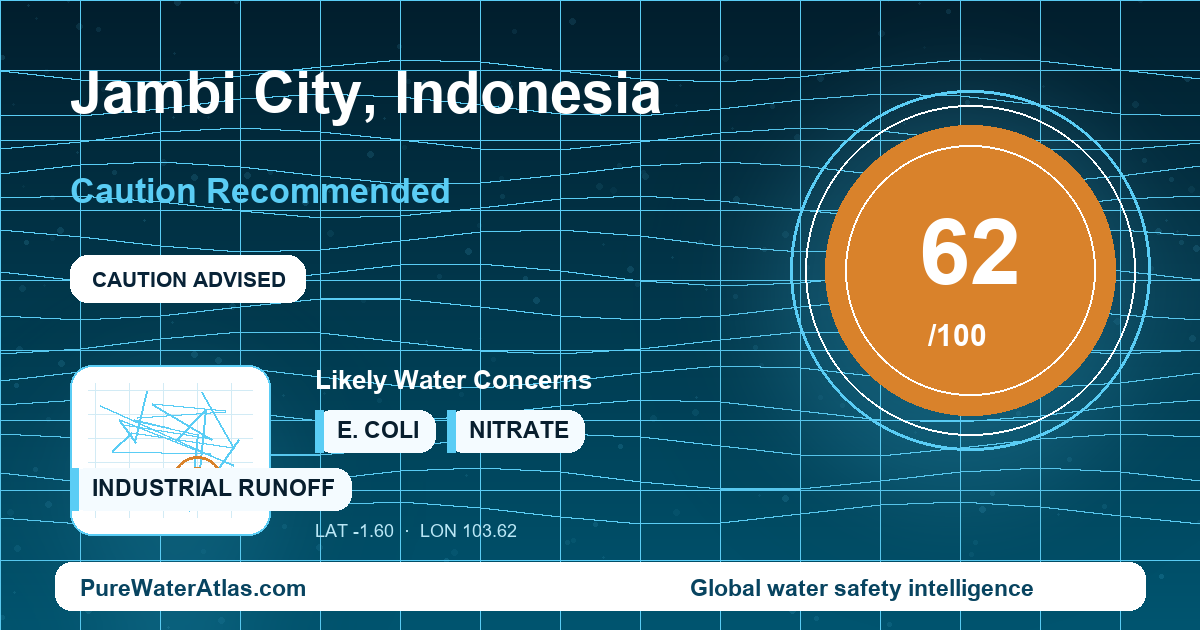
Jambi City, Indonesia: Batang Hari River source-water pressure, municipal treatment, household storage, and practical tap-water precautions for visitors and residents.
Quick Answer
| Overall safety status | Caution recommended. Jambi City’s piped water is an improved municipal supply, but it should not automatically be treated as drinkable at every tap without household safeguards. |
|---|---|
| Water safety score | 62 / 100 — risk level: Caution Recommended. |
| Can visitors drink the tap water? | Not recommended for direct drinking unless it has been boiled, filtered and disinfected, or supplied by a trusted hotel treatment system. |
| Resident guidance | Use a maintained point-of-use filter and add boiling, UV, or another validated disinfection step where water is stored, pressure is intermittent, or water appears turbid, colored, odorous, or sedimented. |
| Main local source context | Treated surface water associated with the Batang Hari River system and municipal treatment installations in Jambi City. |
| Local water authority | Perumda Air Minum Tirta Mayang Kota Jambi, the city-owned drinking-water company. |
| Filter recommendation | For drinking and cooking: sediment prefilter plus activated carbon, followed by boiling or UV disinfection when microbiological risk is possible. Private wells should be tested before choosing treatment. |
Why Jambi City Is Different
Jambi City’s drinking-water risk profile is shaped by its position on the Batang Hari River, one of Sumatra’s major river systems. The city is not a place where the main question is simply whether a water utility exists. The more practical question is how river conditions, seasonal rainfall, treatment performance, distribution pressure, and building-level storage affect the water that finally reaches a household, hotel, restaurant, or apartment tap.
The local piped-water system is associated with treated surface water from the Batang Hari River and water-treatment installations operated by Perumda Air Minum Tirta Mayang Kota Jambi. That makes the river the key raw-water context for the city. Jambi is also a downstream urban user in a basin affected by urban wastewater, agriculture, plantation activity, mining-related sediment concerns, and other land uses across the wider catchment. These pressures do not prove a specific contaminant is present at any individual tap, but they do explain why turbidity, microbial safety, disinfection, and storage conditions matter.
Publicly accessible, recent, citywide tap-water compliance reporting for Jambi City is limited. For that reason, this guide does not claim that every tap is unsafe, nor does it claim that all taps meet Indonesian drinking-water standards. The safest interpretation is more practical: municipal water may be treated, but direct drinking should be approached with caution unless the water is further treated, recently tested, or supplied through a reliable drinking-water system.
Where Does Jambi City’s Tap Water Come From?
Jambi City sits on the Batang Hari River in central-eastern Sumatra. The municipal drinking-water system is tied to this surface-water environment, with raw water treated through local water-treatment infrastructure before entering the distribution network. The important infrastructure elements are the river intake and raw-water environment, treatment plants operated by the city utility, the distribution network serving connected users, and the building-level tanks and plumbing that may alter water quality after it leaves the utility system.
Historically, before modern piped-water expansion, households in Jambi commonly relied on shallow wells, river water, rainwater, and small local sources. Some non-piped sources and private wells may still be used as supplementary water in parts of the city and peri-urban areas, especially where service continuity or pressure is unreliable. These sources should not be assumed safe. A private well near septic systems, flood-affected ground, urban runoff, or agricultural influence needs laboratory testing rather than visual inspection alone.
Because the source is river-linked, seasonal conditions matter. Rainy-season storms can increase turbidity, suspended sediment, organic matter, and microbial loading in the raw water. Flooding can stress intakes, treatment plants, sewers, septic systems, and household wells. Dry-season low flows can concentrate pollutants and change river-water quality. Salinity intrusion is a regional lower-river and coastal concern, but public evidence for routine salinity impact at Jambi City taps is limited, so it should not be assumed without testing.
Who Manages Drinking Water in Jambi City?
The local piped-water utility is Perumda Air Minum Tirta Mayang Kota Jambi. It is the city-owned drinking-water company serving Jambi City and is the most direct local reference for municipal supply information, service updates, and utility operations. Its official website is available at tirtamayang.com.
Drinking-water quality in Indonesia is governed nationally by Ministry of Health environmental health standards, including Permenkes No. 2 Tahun 2023. Municipal water-supply infrastructure is also shaped by Ministry of Public Works and Housing SPAM policy and local government oversight. In practice, the relevant local actors are the water utility, the city government, and local health offices. For background city information, the Pemerintah Kota Jambi website and BPS Kota Jambi provide official local context.
The main data limitation is that recent consumer-facing, neighborhood-level tap-water results are not readily available in a single public source. Public information can identify the utility, the river context, and the national regulatory framework, but it does not allow a precise claim about residual chlorine, E. coli compliance, metals, pesticides, or other contaminant concentrations at every tap in Jambi City.
Main Local Water Concerns
The most important concern for Jambi City is not a single confirmed contaminant at every tap. It is the combination of river-source pressure, seasonal turbidity, treatment and distribution conditions, and what happens after water enters a building.
- High turbidity and sediment: The Batang Hari River can become muddy after heavy rain or flooding. High raw-water turbidity can challenge treatment and may be noticed by residents as brown water, suspended particles, or deposits if distribution or storage problems occur.
- Microbial risk: Microbial contamination is the primary immediate health concern when treated water is recontaminated through pipe leaks, intermittent pressure, illegal connections, unclean storage tanks, or private wells.
- Urban wastewater and runoff: Domestic wastewater and urban runoff can enter drains and waterways connected to the Batang Hari system, adding pressure to the river environment.
- Agricultural and plantation runoff: Wider watershed activity may contribute nutrients, pesticides, organic matter, and treatment challenges. This is a source-water concern, not proof of tap-water pesticide levels.
- Mining-related basin concerns: Mining in the broader Batang Hari basin can raise concerns about sediment loads and possible heavy-metal issues, but city tap-water exposure should only be evaluated with laboratory testing.
- Taste, odor, color, chlorine, iron, manganese, or sediment complaints: These may occur locally, but neighborhood-level conditions require direct testing rather than assumptions.
For Travelers
Short-term visitors to Jambi City should not assume bathroom tap water is safe to drink directly. The lower-risk choice is sealed bottled water, hotel-provided treated water, commercial purified water, or water that has been properly boiled. This advice is especially important for travelers with sensitive stomachs, immunocompromised travelers, young children, pregnant travelers, and anyone using water for medicines, infant formula, or oral rehydration.
For brushing teeth, bottled or treated water is the safer option. Healthy adults may tolerate small amounts of tap water for brushing, but that is not the same as saying the tap water is reliably drinkable. If you are staying in basic accommodation, using a bathroom with visible tank storage, or seeing brown water, sediment, or unusual odor, use bottled or treated water even for brushing.
Ice should be treated cautiously. Avoid ice from street vendors or informal sources unless you know it was made from treated water. Ice in reputable hotels and larger restaurants is generally lower risk, but it is still sensible to ask whether it is made from filtered or commercial purified water. Better hotels and restaurants may use bottled water, dispenser water, or internal filtration, but drinking-water systems and bathroom taps should not be assumed to be the same.
Carry bottled water during day trips, check that bottle caps are sealed, avoid swallowing shower water, and use boiled or treated water for any oral health or medical use. For longer stays, a portable purifier or certified filter plus disinfection provides an added safety margin.
For Residents
Residents connected to Perumda Air Minum Tirta Mayang should treat the supply as improved municipal water, but not automatically drinkable at every household tap without safeguards. A practical home setup is a sediment prefilter to manage particles, activated carbon for taste and some organic compounds, and a validated disinfection step such as boiling or UV where microbial risk is a concern. PureWaterAtlas has detailed guidance on boiling water purification and UV water purification.
Households with roof tanks, ground tanks, older plumbing, private wells, or intermittent supply should be more cautious. Storage tanks are a major practical risk point in Jambi City because treated water can become recontaminated if tanks are open, dirty, cracked, poorly screened, or affected by insects, rodents, dust, or floodwater. Tanks should be covered, periodically cleaned, and disinfected after maintenance or flooding.
Private wells should be tested rather than assumed safe. At minimum, test for E. coli or thermotolerant coliforms, turbidity, pH, nitrate, iron, manganese, and total dissolved solids. After floods, long outages, pipe repairs, or brown-water episodes, test microbial indicators before using the water untreated. If water has metallic taste, black staining, reddish sediment, or persistent color, test for iron, manganese, turbidity, and metals before selecting a treatment system.
Older buildings can also add risk after water leaves the utility system. Lead should not be claimed as a citywide Jambi problem without evidence, but older solder, brass fixtures, galvanized pipes, and stagnant plumbing can contribute metals or sediment. If children, pregnant people, or long-term residents will drink the water, consider first-draw and flushed sampling, and review PureWaterAtlas guidance on lead testing and detection.
Relevant Contaminants and Water-Quality Issues
For Jambi City, the most relevant water-quality issues are linked to river-source conditions, distribution pressure, household storage, and private wells. Turbidity is especially important because Batang Hari raw water can become muddy after rainfall and flooding. Sediment is relevant to brown-water episodes, pipe deposits, and storage tanks.
E. coli is the key indicator to understand when microbiological contamination is possible. It is particularly important after floods, low-pressure events, tank contamination, or when using private wells. Chlorine is also relevant because disinfectant residual helps protect piped water in distribution, but residual levels can vary with distance, storage, and system conditions.
For taste, color, staining, and sediment complaints, iron and manganese are useful reference topics. For wells and peri-urban areas influenced by septic systems or agriculture, see PureWaterAtlas guidance on nitrate testing and agricultural runoff.
How to Verify Your Water Quality
The only way to know whether a specific Jambi City tap is safe for drinking is to verify the water at that tap or at the point where drinking water is collected. Start by identifying whether your water comes from the municipal supply, a private well, a storage tank, a refill dispenser, or a combination of sources. Then test based on the risk: microbial indicators for safety, turbidity for treatment performance and clarity, nitrate for wells, iron and manganese for staining, and metals where older plumbing is present.
For a broader testing strategy, use the PureWaterAtlas complete guide to water testing and analysis. For general safety principles, see Drinking Water Safety, Water Microbiology, Water Purification, and Water Treatment Systems.
You can also explore the Contaminants Search Engine and compare country or city risk context with the Global Water Quality Checker. For official sampling options, residents should contact the local health office, Perumda Air Minum Tirta Mayang, or an accredited Indonesian laboratory where possible.
Official and Technical Sources
- Perumda Air Minum Tirta Mayang Kota Jambi official website — local municipal drinking-water utility reference.
- Pemerintah Kota Jambi official website — official city government context and public-service information.
- BPS Kota Jambi — official statistics for Jambi City geography, population, infrastructure indicators, and development context.
- Kementerian Kesehatan RI, Permenkes No. 2 Tahun 2023 — Indonesian health-based environmental standards relevant to drinking water.
- Kementerian PUPR, Direktorat Jenderal Cipta Karya — national SPAM and drinking-water infrastructure policy context.
- Badan Pemeriksa Keuangan legal and regional regulation database — official Indonesian legal database for national and local regulations.
- KLHK, Kementerian Lingkungan Hidup dan Kehutanan — national environment authority for river-basin and water-pollution context.
- CDC Travelers’ Health: Indonesia — conservative food and water precautions for travelers.
- WHO Guidelines for Drinking-water Quality — international framework for microbial safety, turbidity, disinfection, and household treatment.
Bottom Line
Jambi City’s tap water should be approached with caution for direct drinking. The city has a municipal water utility, Perumda Air Minum Tirta Mayang Kota Jambi, and its supply is associated with treated surface water from the Batang Hari River system. However, recent public, neighborhood-level tap-water compliance data are limited, and practical risks can arise from rainy-season turbidity, flooding, low pressure, pipe intrusion, private wells, and unclean roof or ground tanks. Visitors should use sealed bottled water, boiled water, or trusted treated water. Residents should consider filtration plus disinfection for drinking and cooking, keep storage tanks clean and covered, and test wells or problem taps rather than relying on appearance, taste, or assumptions.
Read the full guide: Global Water Quality Guide
Explore more in this category: Global Water Quality Articles