
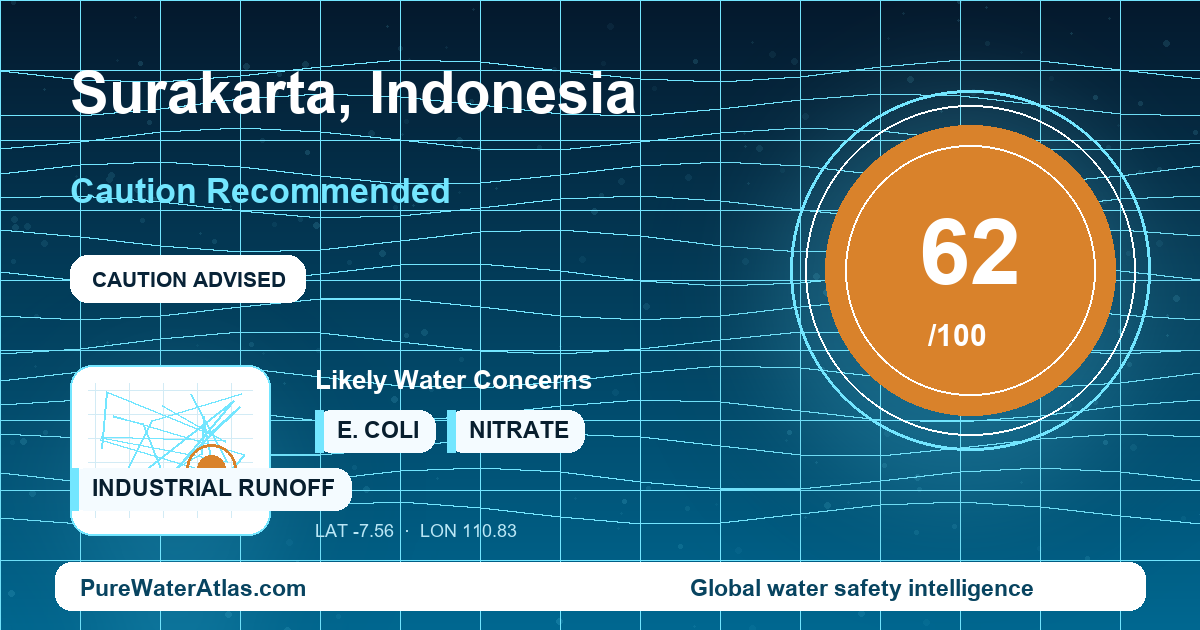
Surakarta, also known as Solo, has a managed municipal water system, but untreated tap water should not be assumed safe to drink at the household tap without boiling, reliable filtration, UV treatment, or verified testing.
Quick Answer
| City | Surakarta, Central Java, Indonesia |
|---|---|
| Water safety score | 62 / 100 |
| Risk level | Caution Recommended |
| Can you drink the tap water? | Not as a default recommendation. Surakarta has treated piped water, but travelers and residents should use boiled, filtered, UV-treated, reputable refill, or sealed bottled water for drinking. |
| Traveler advice | Use sealed bottled water or trusted treated refill water. Do not rely on untreated bathroom or kitchen tap water, especially in budget lodging or buildings with unknown storage-tank hygiene. |
| Resident advice | PDAM water is commonly used for bathing, washing, and cooking, but drinking water should be boiled or treated with a maintained point-of-use system, particularly for infants, pregnant people, elderly residents, and immunocompromised residents. |
| Main water sources | A mixed system using the Cokro Tulung spring supply from Klaten, deep wells, and treated surface water connected to the Bengawan Solo river system and regional Solo Raya infrastructure. |
| Water authority | Perumda Air Minum Toya Wening Kota Surakarta, formerly PDAM Kota Surakarta, with public-health oversight involving Dinas Kesehatan Kota Surakarta and national standards from Indonesia’s Ministry of Health. |
| Filter recommendation | For drinking: at minimum boil. For a stronger home barrier, use sediment prefiltration plus activated carbon and UV, or reverse osmosis where nitrate, dissolved solids, or metals are confirmed by testing. |
Why Surakarta Is Different
Surakarta is an inland, dense urban city in Central Java located in the Bengawan Solo basin. Its drinking-water situation is not the same as a coastal Indonesian city where seawater intrusion is the main concern. For Solo, the more relevant risks are river pollution pressure, urban drainage, shallow groundwater vulnerability, older distribution sections, intermittent pressure, building plumbing, household storage tanks, and hygiene at the point of use.
The city has an organized municipal water utility and treated piped-water supply, which is an important advantage compared with areas relying mainly on unprotected wells. However, the practical question for households and visitors is not only whether water is treated before distribution. It is whether the water remains microbiologically safe after traveling through mains, service lines, pumps, rooftop tanks, dispensers, and premise plumbing. In Surakarta, that final treatment-to-tap pathway is the reason PureWaterAtlas classifies the city as Caution Recommended rather than “drink freely from the tap.”
Another Surakarta-specific issue is the city’s long association with dense settlement, batik activity, domestic wastewater, and small industries in the wider Solo urban environment. These pressures matter because the Bengawan Solo river system is part of the regional water-resource context whenever treated surface water is used. This does not mean every tap has the same risk, but it does mean source-water management and treatment performance are important, especially during rainy-season runoff and high-turbidity periods.
Where Does Surakarta’s Tap Water Come From?
Surakarta is supplied by a mixed municipal system rather than one simple source. Publicly described sources include the long-standing Cokro Tulung spring source in Klaten Regency, utility-operated deep wells, and treated surface water connected to the Bengawan Solo river system through municipal or regional water-treatment infrastructure. This diversified supply gives the city redundancy, but it also creates different water-quality profiles.
The Cokro Tulung spring has historically been important for Solo because spring water can be conveyed toward the city and is generally more stable than polluted urban surface water. As Surakarta and the surrounding Solo Raya area have grown, demand pressure and source constraints have pushed the system toward a broader portfolio that also includes deep groundwater and treated surface water.
Deep wells can provide useful supply reliability, but groundwater-influenced systems may have aesthetic or mineral issues such as iron, manganese, color, odor, or sediment in some locations. These issues should be confirmed by testing rather than assumed for every neighborhood. Surface water connected to the Bengawan Solo context requires robust treatment, particularly when rainy-season runoff increases turbidity, suspended sediment, and pollutant loading.
Key infrastructure relevant to Surakarta includes Perumda Air Minum Toya Wening Kota Surakarta, the Cokro Tulung spring transmission supply from Klaten, deep-well production points, Bengawan Solo-related treatment and intake infrastructure, locally referenced treatment plants such as Jurug and Semanggi in the Surakarta system context, and regional SPAM Wosusokas bulk-water infrastructure serving the wider Wonogiri, Sukoharjo, Surakarta, and Karanganyar area.
After treatment, water quality can still change inside distribution mains, service connections, customer plumbing, pumps, roof tanks, ground tanks, and dispensers. For drinking-water safety in Surakarta, this last section of the journey is especially important.
Who Manages Drinking Water in Surakarta?
The local water utility is Perumda Air Minum Toya Wening Kota Surakarta, formerly known as PDAM Kota Surakarta. Local government oversight is connected to the Pemerintah Kota Surakarta, while public-health oversight involves Dinas Kesehatan Kota Surakarta. National drinking-water quality requirements are set by Indonesia’s Ministry of Health, including current provisions under Permenkes No. 2 Tahun 2023.
Water-resource and river-basin management for the Bengawan Solo system is under the Ministry of Public Works and Housing through BBWS Bengawan Solo. Regional supply development is also relevant; the Ministry of Public Works and Housing has public information on SPAM Regional Wosusokas, which is intended to strengthen water service for Solo Raya, including Surakarta and nearby districts.
Data limitations matter. Official sources identify the utility, the broader source-water context, and regional infrastructure, but recent open-access consumer-level tap-water compliance data by Surakarta neighborhood, building type, season, and point of use are limited. This profile therefore does not claim that every tap in Surakarta either meets or fails a specific standard. The conclusion is risk-based: treated supply exists, but drinking safety at the tap should be verified through boiling, reliable treatment, maintenance, or testing.
Main Local Water Concerns
- Microbial risk at the point of use: The most practical concern is water that has been treated but then passes through old pipes, intermittent-pressure areas, rooftop tanks, unclean dispensers, or household storage containers. Learn more about E. coli and microbial indicators in drinking water.
- Rainy-season turbidity: Rain can increase suspended sediment, runoff, sewer overflow, and flood-related contamination risk, particularly for river water, shallow wells, and household storage. Turbidity matters because cloudy water can interfere with disinfection and signal treatment challenges.
- Bengawan Solo pollution pressure: Domestic wastewater, urban drainage, small industries, textile and batik-related wastewater, and basin-wide pollution pressures are relevant when river water is part of the raw-water portfolio.
- Private shallow wells: In dense neighborhoods, shallow wells can be vulnerable to septic systems, drains, floodwater, and nearby contamination pathways. Testing for microbes and nitrate is especially important for private wells.
- Sediment, color, odor, iron, and manganese: Groundwater-influenced supplies or building plumbing can produce sediment or aesthetic complaints. See PureWaterAtlas on sediment for practical context.
- Residual chlorine: Chlorine helps control microbes in piped systems, but taste or odor can be noticeable. It also does not guarantee safety after water sits in dirty tanks or containers. See chlorine.
- Premise plumbing metals: Lead is not documented in the reviewed sources as a citywide Surakarta tap-water contaminant. However, older plumbing, brass fixtures, solder, and building-level materials can justify first-draw testing in older properties. See lead.
For Travelers
Visitors should not drink untreated tap water in Surakarta as their default water source. Use sealed bottled water, reputable refill water, or water that has been boiled, filtered, or UV-treated. This is especially important for short stays because travelers may not be adapted to local microbial exposures. The CDC Travelers’ Health guidance for Indonesia supports conservative food and water precautions for travelers.
For brushing teeth, use bottled, boiled, or filtered water if you have a sensitive stomach, are staying in budget accommodation, or do not know whether the building’s storage tank and plumbing are maintained. In higher-end hotels with verified treated water, risk may be lower, but bottled water remains the conservative choice.
Avoid ice of uncertain origin from street stalls or informal vendors. Ice in reputable hotels, cafes, and restaurants is usually lower risk if made from treated commercial water, but travelers prone to gastrointestinal illness should ask or skip ice. In restaurants, choose sealed drinks or hot beverages made with boiled water. In hotels and guesthouses, ask whether drinking water is bottled, refill-gallon, filtered, or boiled. Many accommodations provide bottled or dispenser water precisely because tap water is not generally marketed as directly potable.
Carry a refillable bottle, but fill it only from trusted filtered dispensers or sealed water sources. Avoid drinking from bathroom taps, garden taps, roof-tank outlets, or visibly discolored water.
For Residents
For Surakarta residents, a home treatment barrier is advisable for drinking water. At minimum, boil water used for drinking and infant formula unless a properly maintained purifier is used. PureWaterAtlas has a practical guide to boiling water purification, which remains one of the simplest barriers when microbial safety is uncertain.
For households wanting a stronger system, consider sediment prefiltration followed by activated carbon and UV. UV can be useful when the water is clear and the goal is an added microbial barrier; see the UV water purification guide. Reverse osmosis may be appropriate where testing confirms nitrate, dissolved contaminants, or metals of concern, but RO should not be selected blindly as a substitute for testing and maintenance.
If using PDAM water for drinking, test the water at the actual tap after any storage tank or household filter. Useful parameters include E. coli or total coliform, turbidity, residual chlorine, pH, iron, manganese, and total dissolved solids. If using a private shallow well, test for E. coli, total coliform, nitrate, turbidity, iron, manganese, and basic chemistry, especially after flooding or nearby septic problems. For nitrate-specific concerns, see nitrate testing and detection methods.
Older houses, schools, clinics, boarding houses, and buildings with old brass fittings or unknown plumbing should consider first-draw and flushed lead testing rather than assuming the municipal supply is the source. PureWaterAtlas explains this process in lead testing and detection methods. If water has a metallic taste, discoloration, or long stagnation time, flush stagnant water and arrange laboratory testing for metals and microbes.
Storage tanks deserve special attention in Surakarta. Rooftop tanks, ground tanks, and refill dispensers can become a major risk point if uncovered, poorly cleaned, or contaminated after repairs or flooding. Keep tanks covered, screened, cleaned, and disinfected on a schedule. After floods, pipe repairs, pressure interruptions, brown-water events, or long periods of non-use, do not drink stored water until the system is cleaned and the water is boiled or tested.
Relevant Contaminants and Water-Quality Issues
The most relevant Surakarta drinking-water issue is not a single confirmed citywide toxic contaminant; it is the combined risk from source-water variability, distribution, storage, and point-of-use handling. Start with E. coli because it is the key indicator for fecal contamination and traveler illness risk. Add turbidity and sediment because rainy-season runoff, pipe work, and old plumbing can affect clarity and treatment effectiveness.
Chlorine is relevant because residual disinfectant helps protect piped water, but chlorine smell alone does not prove that water remains safe after sitting in a tank or dispenser. For private shallow wells, nitrate is important where septic systems, drains, or runoff may influence groundwater. Lead is not identified here as a citywide Surakarta problem, but older building plumbing can still create building-specific risk.
How to Verify Your Water Quality
The safest way to make a Surakarta-specific decision is to test the water you actually drink, not just the source listed on a bill. Start with the PureWaterAtlas complete guide to water testing and analysis. Residents using PDAM water should sample after building tanks and filters because those components can change water quality after treatment. Private-well users should test more often after floods, drainage problems, septic issues, or changes in taste, odor, or color.
For background decision-making, use the PureWaterAtlas guide to drinking water safety, the water microbiology guide, and the water treatment systems guide. If you want to look up specific substances, use the Contaminants Search Engine. To compare Surakarta with other destinations, use the Global Water Quality Checker. For broader category reading, see Drinking Water Safety, Global Water Quality, Water Microbiology, and Water Testing.
Official and Technical Sources
- Perumda Air Minum Toya Wening Kota Surakarta — local municipal water utility for Surakarta’s piped drinking-water service.
- Pemerintah Kota Surakarta official portal — city government context and municipal-service linkage.
- Dinas Kesehatan Kota Surakarta — local health authority relevant to sanitation, environmental health, and drinking-water oversight.
- Badan Pusat Statistik Kota Surakarta — official city context and dense urban municipality framing.
- BBWS Bengawan Solo — river-basin authority for the Bengawan Solo water-resource system.
- Kementerian PUPR, SPAM Regional Wosusokas — regional bulk-water infrastructure context for Solo Raya.
- Permenkes No. 2 Tahun 2023 — Indonesian national environmental health and water-quality regulatory framework.
- CDC Travelers’ Health: Indonesia — conservative traveler food and water safety context.
- WHO Guidelines for Drinking-water Quality — global guidance on microbial safety, turbidity, disinfection, and risk-based water safety management.
Bottom Line
Surakarta has a real municipal water system managed by Perumda Air Minum Toya Wening and supplied by a mix of Cokro Tulung spring water, deep wells, and treated Bengawan Solo-related surface water. That infrastructure supports daily urban water use, but it does not make untreated tap water a safe default drinking choice at every household tap. The main risks are practical treatment-to-tap risks: rainy-season turbidity, river and drainage pressure, intermittent distribution, older plumbing, rooftop tanks, private shallow wells, and dispenser hygiene. Travelers should use bottled, reputable refill, boiled, filtered, or UV-treated water. Residents should boil or treat drinking water, maintain tanks and filters carefully, and test taps or wells when water is used for routine drinking.
Read the full guide: Global Water Quality Guide
Explore more in this category: Global Water Quality Articles