
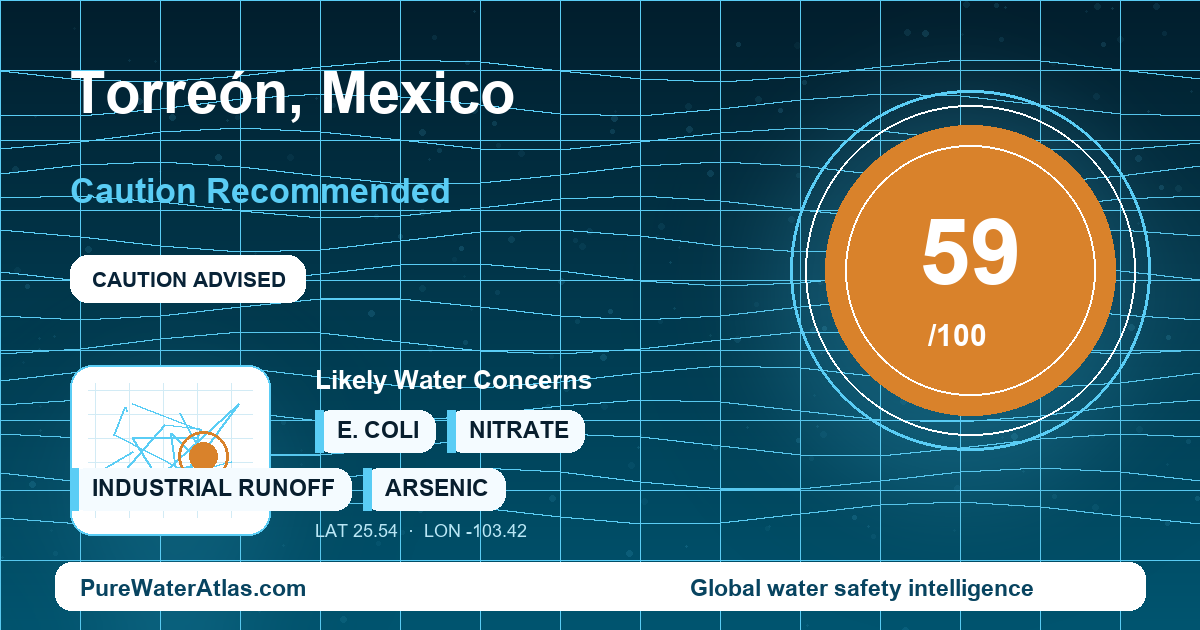
Torreón’s tap water safety depends on more than municipal treatment: the city sits in the Comarca Lagunera, where groundwater overuse, naturally elevated arsenic risk, dissolved minerals, household storage tanks and an ongoing regional source-water transition all matter.
Quick Answer
| Overall safety status | Caution recommended — PureWaterAtlas score: 59/100. Torreón has an official municipal supply, but public tap-level data are not transparent enough to treat every building as equally low risk. |
|---|---|
| Can visitors drink the tap water? | Not recommended as a default. Visitors should use sealed bottled water or verified filtered water, especially in older buildings or places with unknown tank maintenance. |
| Resident advice | Residents using tap water for daily drinking should consider testing and a point-of-use system selected for local risks, especially arsenic, nitrate, dissolved salts and microbial risks from storage tanks. |
| Main water source context | Historically heavy reliance on groundwater from the Principal-Región Lagunera aquifer system, with the Agua Saludable para La Laguna project intended to add treated surface water from the Nazas River reservoir system. |
| Water authority | Sistema Municipal de Aguas y Saneamiento de Torreón, commonly known as SIMAS Torreón, with federal infrastructure and water-resource roles under CONAGUA. |
| Filter recommendation | For regular drinking water, a certified reverse osmosis system is often more appropriate than a basic carbon taste filter because Torreón’s main concerns include arsenic risk, nitrate and dissolved minerals. |
Why Torreón Is Different
Torreón is not a simple “safe” or “unsafe” tap water city. It is a major city in the Comarca Lagunera, an arid metropolitan region spanning Coahuila and Durango, where urban demand, irrigated agriculture and limited renewable water create chronic pressure on groundwater. The local drinking-water question is shaped by the region’s hydrogeology as much as by the municipal distribution system.
The Laguna region is one of Mexico’s best-known examples of groundwater arsenic concern. Regional literature and official project descriptions repeatedly connect historical dependence on deep wells with aquifer depletion and naturally occurring arsenic in parts of the groundwater system. That does not mean every Torreón tap has the same water quality, but it does mean appearance and taste are not enough to judge safety.
A major additional factor is transition. Agua Saludable para La Laguna was promoted to reduce exposure by replacing part of the groundwater supply with treated surface water from the Nazas River system. During and after such transitions, service sectors may differ in source mix, blending, pressure conditions and timing. Public, address-level finished-water results are not sufficiently searchable to say that all taps in Torreón have the same risk profile.
Where Does Torreón’s Tap Water Come From?
Torreón has historically relied heavily on groundwater pumped from the Principal-Región Lagunera aquifer system. The city’s water identity is therefore closely tied to wells, pumping equipment, pressure management, storage tanks and local distribution zones rather than a single large upland reservoir sending water to all users by gravity.
The newer regional strategy, Agua Saludable para La Laguna, is designed to bring treated surface water from the Nazas River reservoir system to municipalities in the Laguna region, including Torreón. Its purpose is to reduce dependence on groundwater affected by arsenic and overexploitation. However, the existence of a regional project does not prove that every building currently receives the same source water, the same blend, or the same water quality at the kitchen tap.
Key infrastructure for Torreón includes municipal production wells and wellfields, the SIMAS Torreón distribution network, pumping equipment, storage tanks and pressure zones, plus the regional intake, conveyance, treatment and bulk-delivery infrastructure developed by CONAGUA. A final and very important layer is building-level infrastructure: cisterns, rooftop tinacos and private storage tanks can materially change tap quality after water leaves the public network.
Who Manages Drinking Water in Torreón?
The municipal water and sanitation operator is SIMAS Torreón. Residents should look to SIMAS for local service notices, infrastructure information, pressure interruptions, repairs and customer advisories. Federal water-resource planning and major regional infrastructure are handled by the Comisión Nacional del Agua, CONAGUA, including the Agua Saludable para La Laguna program and groundwater availability information available through CONAGUA systems.
Drinking water quality in Mexico is governed by national sanitary standards, including NOM-127-SSA1-2021 for water for human use and consumption. Sanitary oversight is tied to Mexican health authorities including COFEPRIS and state or municipal health agencies.
For users, the practical distinction is important: a regulatory framework and an official utility do not equal recent, tap-specific results for a particular apartment, hotel, restaurant, school or home. Torreón’s regional arsenic context, ongoing source-water transition and common use of household storage mean the safest assessment is local and building-specific.
Main Local Water Concerns
The most important documented concern for Torreón is naturally occurring arsenic in parts of the Laguna groundwater system. Arsenic is not detectable by taste, smell or color, and boiling does not remove it. This is why Agua Saludable para La Laguna is so central to the city’s long-term drinking-water story.
Groundwater-derived supply can also carry high hardness, dissolved minerals, salinity or elevated total dissolved solids. These issues may affect taste, scaling and treatment choices. In a heavily agricultural and urbanized region, nitrate is also a relevant screening parameter, especially for private wells or poorly protected sources.
Distribution and building-level factors matter as well. Low-pressure episodes, pipe repairs, pipe age and tank disturbance can affect turbidity, sediment, chlorine residual and microbiological risk at the tap. Cisterns and rooftop tinacos are a major practical variable: if they are poorly sealed, dirty, uncovered or affected by intermittent pressure, microbial contamination can occur after water has entered the property.
Lead is not identified here as Torreón’s main source-water issue. However, older buildings can have internal plumbing, solder, fixtures or service materials that create household-level lead or copper exposure. This is why residents should not assume regional water information captures conditions inside their own building.
For Travelers
Visitors to Torreón should generally drink sealed bottled water or water from a reputable hotel or restaurant filtration system. This is a conservative recommendation based on the city’s groundwater arsenic history, the limited availability of tap-specific public results, and the possibility that hotels or apartments may use building storage tanks. Check that bottle seals are intact, especially during hot weather when dehydration risk is higher.
For brushing teeth, many healthy adults can use tap water if they avoid swallowing it. More cautious travelers should use bottled water, including children, pregnant travelers, immunocompromised travelers, people with sensitive stomachs and anyone staying in a building with questionable cisterns or rooftop tanks.
Use ice only in reputable hotels, restaurants and cafes that can state they use purified water. Do not assume bathroom tap water is the same as drinking water offered in the lobby, restaurant or guest room. Ask whether drinking water and ice come from garrafón, sealed bottled water or a maintained filtration system.
If traveler diarrhea occurs, oral rehydration salts can be useful. Boiling water may reduce microbial risk, but it is not a complete solution for Torreón because boiling does not remove arsenic, nitrate or dissolved salts. For broader travel-health context, see the CDC Travelers’ Health guidance for Mexico.
For Residents
Residents should not rely on clarity, taste or odor to decide whether Torreón tap water is suitable for daily drinking. If your household drinks municipal tap water regularly, a point-of-use system is worth considering, especially where infants, pregnant residents, immunocompromised people or older adults are present.
For Torreón’s risk profile, a certified reverse osmosis system is often more appropriate than a basic taste-and-odor carbon filter. Carbon can improve chlorine taste and may help with some organic compounds, but it should not be assumed to solve arsenic, nitrate or high dissolved minerals. Reverse osmosis systems must be properly selected, installed and maintained, and treated water should be tested to confirm performance.
Testing should be done at the kitchen tap, not only at the street connection, because internal plumbing and storage tanks can change water quality. Priority parameters include arsenic, nitrate, total dissolved solids, hardness, conductivity, pH, turbidity, residual chlorine, total coliform and E. coli. In older homes or buildings with unknown plumbing materials, add lead and copper testing using first-draw and flushed samples.
Private wells require special caution. If a property uses a private well, test at least annually for bacteria and nitrate and periodically for arsenic and dissolved minerals. Cisterns and rooftop tinacos should be covered, screened, cleaned and disinfected periodically. In Torreón, the condition of the building’s own storage can be just as important as the water entering from the street main.
Relevant Contaminants and Water-Quality Issues
The most locally relevant contaminant profile is arsenic in drinking water, because the Laguna groundwater system has a documented arsenic history. Residents who need to verify exposure should also read Arsenic in Drinking Water: Testing and Detection Methods and, if arsenic is detected, Arsenic in Drinking Water: Best Filters, Systems and Solutions.
Nitrate is relevant for agricultural-region groundwater and private-well screening; the companion guide on nitrate testing and detection is useful for households outside fully controlled municipal conditions. Turbidity is relevant after pipe repairs, pressure changes and tank disturbance. E. coli is a key indicator where cisterns, tinacos or low-pressure events raise microbial concerns. Lead is mainly a building-specific issue in Torreón, but older plumbing should still be checked; see Lead in Drinking Water: Testing and Detection Methods.
How to Verify Your Water Quality
The most reliable way to understand a Torreón household’s risk is to test the actual tap used for drinking. Regional source-water information is useful, but it cannot confirm whether your building receives blended groundwater, new regional treated water, stored tank water, or water affected by old internal plumbing.
Start with a certified laboratory or a well-designed sampling plan that includes arsenic, nitrate, total dissolved solids, hardness, conductivity, pH, turbidity, residual chlorine, total coliform and E. coli. Add lead and copper if the property is older or plumbing materials are uncertain. After installing reverse osmosis or another treatment system, test the treated water and maintain cartridges and membranes on schedule.
For a broader framework, use the PureWaterAtlas guides on water testing, water treatment systems, drinking water safety and water microbiology. You can also use the Contaminants Search Engine and the Global Water Quality Checker to compare Torreón with other destinations.
A key limitation remains: recent, independently searchable, neighborhood-level finished-water results for Torreón are limited. This guide therefore does not claim that all Torreón taps are unsafe, nor that all taps are low risk. The correct conclusion is that building-specific verification is prudent.
Official and Technical Sources
- SIMAS Torreón — municipal water and sanitation operator for Torreón.
- CONAGUA: Agua Saludable para La Laguna — federal project to supply treated surface water to the Laguna region.
- CONAGUA groundwater availability and aquifer information — official groundwater data portal.
- Diario Oficial de la Federación: NOM-127-SSA1-2021 — Mexican drinking water quality standard.
- COFEPRIS: Agua para uso y consumo humano — federal sanitary authority context.
- CDC Travelers’ Health: Mexico — traveler health guidance.
- World Health Organization: Arsenic fact sheet — health background on arsenic exposure through drinking water.
- National Library of Medicine: Comarca Lagunera arsenic literature — searchable scientific literature on regional arsenic exposure.
Bottom Line
Torreón’s tap water deserves a cautious, building-specific approach. The city has an official municipal operator, SIMAS Torreón, and the Agua Saludable para La Laguna project is intended to reduce dependence on arsenic-affected groundwater by adding treated surface water from the Nazas River system. But Torreón’s long groundwater history, aquifer pressure, arsenic context, hardness and dissolved minerals, plus cisterns, rooftop tinacos and older plumbing, mean tap quality can vary after water enters a property. Visitors should default to sealed bottled or verified purified water. Residents who drink tap water daily should test at the kitchen tap and consider certified reverse osmosis or another treatment system matched to actual results.
Read the full guide: Global Water Quality Guide
Explore more in this category: Global Water Quality Articles