
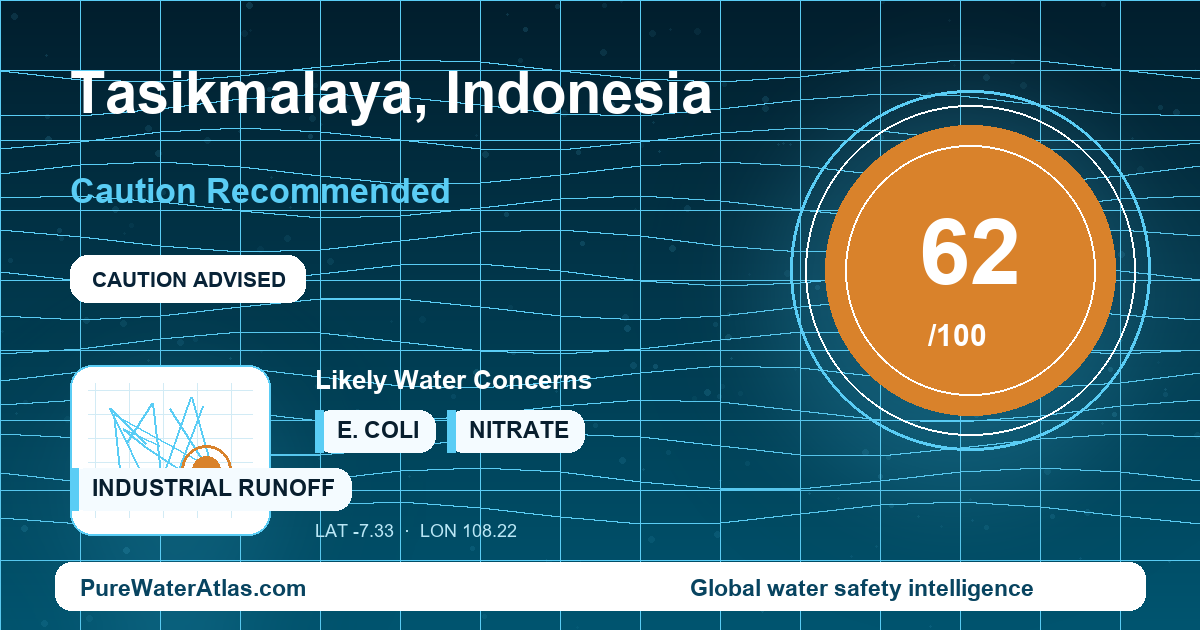
Tasikmalaya, Indonesia: inland West Java water profile for travelers and residents, with caution recommended for untreated tap water.
Quick Answer
| Water safety score | 62 / 100 |
|---|---|
| Risk level | Caution Recommended |
| Is tap water safe to drink? | Not untreated. Tap water in Tasikmalaya should be treated before drinking unless you have recent tap-specific testing showing microbiological safety and acceptable chemical quality. |
| Traveler advice | Use sealed bottled water, properly boiled water, or water from a reliable purifier. Use safer water for brushing teeth if you are a short-term visitor, immunocompromised, traveling with children, or prone to stomach illness. |
| Resident advice | Boil drinking water at minimum, especially after water interruptions, heavy rain, cloudy water, sediment, or storage-tank disturbance. Consider household treatment and periodic testing. |
| Main water setting | Inland volcanic highland and river-basin environment in eastern West Java, associated with the Citanduy and Ciwulan watershed context, using a mix of piped utility water, springs, groundwater, surface-water systems, wells, household tanks, and refill-water depots. |
| Local authority | PDAM or Perumda Air Minum Tirta Sukapura is publicly referenced as the local piped-water operator for the Tasikmalaya area, with health oversight by local health offices and national standards from Indonesia’s Ministry of Health. |
| Filter recommendation | A home treatment barrier is recommended for drinking water. A practical setup may include sediment filtration and activated carbon, followed by boiling, UV, or reverse osmosis depending on test results and household source conditions. |
The practical answer for Tasikmalaya is conservative: the city has an organized piped-water system and is not a coastal salinity hotspot, but complete recent tap-level compliance data are not publicly available in a consumer-facing format. The main concerns are microbial safety at the point of use, turbidity after heavy rain, variable residual chlorine in distribution, and household plumbing or storage-tank conditions.
Why Tasikmalaya Is Different
Tasikmalaya is not a coastal city where seawater intrusion would be the dominant city-wide drinking-water concern. It is an inland city in eastern West Java, located in a volcanic highland and river-basin setting. That geography changes the risk profile: rainfall-driven turbidity, watershed runoff, sanitation intrusion, intermittent distribution pressure, and household storage conditions matter more than salinity as broad practical concerns.
The city’s water identity is tied to the upper West Java watershed landscape and the Mount Galunggung region. Volcanic geology can support springs and aquifers, and historically springs and shallow groundwater have been important for households in this part of West Java. At the same time, urban growth has increased reliance on piped distribution, communal systems, refill-water depots, private wells, and household tanks.
This means Tasikmalaya water safety is best assessed at the tap, not only at the city level. Water reaching a drinking glass may have passed through a utility network or private well, a roof or ground tank, a household pump, a filter, or a refill-water depot. Each point can improve or degrade safety depending on maintenance, pressure, disinfection, storage hygiene, and nearby sanitation conditions.
Where Does Tasikmalaya’s Tap Water Come From?
Tasikmalaya’s water supply is described in public and regional planning context as a mixed system rather than a single publicly documented source serving every neighborhood. The city sits in the Citanduy and Ciwulan watershed setting, and local supply is associated with developed surface-water and spring or groundwater resources. Public documents indicate a supply context involving local rivers, springs, reservoirs or intake works, treatment installations, and distribution reservoirs.
The formal piped system is commonly associated with PDAM or Perumda Air Minum Tirta Sukapura. Its infrastructure context includes raw-water intakes and treatment facilities, distribution reservoirs, pressure zones, and a piped distribution network serving parts of the Tasikmalaya urban area. As in many mid-sized Indonesian cities, not every household necessarily receives continuous, directly drinkable water at the tap.
Household-level infrastructure is especially important in Tasikmalaya. Many urban households in Indonesia use roof tanks, ground tanks, small pumps, or other storage arrangements to manage intermittent or low-pressure supply. These systems can help with reliability but can also become contamination points if lids are damaged, tanks are not cleaned, insects or rodents enter, or stagnant water is stored for long periods.
Private wells and refill-water depots also remain part of the practical water landscape. Well water quality can vary by depth, casing, distance from septic tanks or drains, and maintenance. Refill-water depot safety depends on source water, treatment process, bottle handling, and hygiene controls. For that reason, the safest answer for any Tasikmalaya address depends on the actual source, building plumbing, storage, treatment, and recent test results.
Who Manages Drinking Water in Tasikmalaya?
The local piped-water operator is publicly referenced as Perumda Air Minum Tirta Sukapura, also commonly referred to in the PDAM context for the Tasikmalaya area. The utility provides institutional context for service and water-supply operations, but its public website should not be treated as a complete neighborhood-level water-quality report unless current laboratory results are published for specific service zones.
Local oversight and public-health monitoring involve Tasikmalaya city or district health offices, while national drinking-water health requirements are set by Indonesia’s Ministry of Health. The relevant national health-based environmental standard is Ministry of Health Regulation No. 2 of 2023. This regulation defines drinking-water and sanitation-related parameters, but it does not by itself prove that any specific Tasikmalaya tap meets all parameters on a given day.
Raw-water and river-basin management also sit within Indonesia’s public-works and water-resources framework. The Balai Besar Wilayah Sungai Citanduy is relevant because Tasikmalaya lies within the Citanduy regional water-resources setting, where watershed conditions, flooding, drought, and raw-water availability can influence supply risk.
The main data limitation is important: a complete, recent, public, neighborhood-level consumer confidence style report for Tasikmalaya was not found. This profile does not claim verified city-wide absence of E. coli, exact residual chlorine, exact turbidity, or specific contaminant concentrations at any address.
Main Local Water Concerns
The most important practical concern in Tasikmalaya is microbial safety at the point of use. Risk can increase after pipe breaks, low-pressure periods, flooding, storage-tank contamination, or poor well protection. Water that appears clear can still carry microbial risk, which is why untreated tap, tank, or well water should not be assumed safe for drinking.
Heavy rain is another Tasikmalaya-specific factor because the city is in a river-basin and volcanic-foothill environment. Rainy-season storms can increase turbidity and carry runoff from roads, farms, drains, and settlements into surface-water systems. Higher turbidity can interfere with disinfection and may indicate increased treatment stress.
Distribution-system conditions also matter. Intermittent pressure, long distribution lines, building plumbing, repairs, and service interruptions can produce discoloration, low disinfectant residual, or sediment. After interruptions, first-flush water may contain particles or discolored water and should not be used for drinking without treatment.
Groundwater and wells have their own issues. Some users may encounter iron or manganese, especially where water stains laundry, turns reddish or blackish, or has a metallic taste. Shallow wells near septic tanks, drains, livestock areas, agriculture, or dense settlements should be tested for nitrate and microbial indicators. Older buildings may also introduce plumbing-related metal exposure, including possible lead risk where materials are old or unknown, although city-wide lead-in-water data for Tasikmalaya were not found.
For Travelers
Visitors should not drink untreated tap water in Tasikmalaya. Use sealed bottled water, properly boiled water, or water treated by a reliable purifier. This is a practical risk-management recommendation, not a claim that every tap is contaminated. The available public information does not provide enough tap-level verification for short-term visitors to rely on untreated tap water.
For brushing teeth, use bottled, boiled, or filtered water if you are a short-term visitor, immunocompromised, traveling with children, or prone to stomach illness. Long-term residents may become accustomed to local conditions, but adaptation is not the same as verified safety.
Avoid ice from informal vendors unless you know it was made from treated water. In hotels, cafes, and restaurants, ask whether ice is made from commercially produced or filtered water. Higher-end hotels and reputable restaurants commonly provide bottled, dispenser, or filtered water for guests, but do not assume the bathroom tap is potable.
Carry sealed water during hot weather, use safe water for medicines and infant formula, avoid swallowing shower water, and use hand sanitizer when water access is uncertain. If staying in a rental house, ask whether the property uses a roof tank or ground tank and when it was last cleaned. For general traveler food and water precautions in Indonesia, see the U.S. CDC Travelers’ Health guidance for Indonesia.
For Residents
Residents using piped water in Tasikmalaya should treat water intended for drinking unless recent tap-specific test results show that the water is microbiologically safe and chemically acceptable. Boiling is the minimum practical barrier for microbial risk. The PureWaterAtlas guide to boiling water purification explains when boiling helps and what it does not remove.
For better day-to-day performance, consider a sediment prefilter plus activated carbon for particles, taste, and odor, followed by UV or reverse osmosis depending on test results. UV can be useful for visually clear water where the main concern is microbes; see UV Water Purification: Complete Guide. Reverse osmosis may be appropriate where testing confirms dissolved contaminants such as nitrate, arsenic, or metals, but it should be selected based on data rather than guesswork.
Private-well users should test for E. coli or thermotolerant coliforms, especially after flooding, nearby sanitation problems, or well repairs. Test nitrate if a shallow well is near septic tanks, drains, agriculture, animal keeping, or dense settlement. If water stains fixtures or laundry, test iron and manganese. If your building is older or plumbing materials are unknown, consider lead testing using first-draw and flushed samples. For more detail, see PureWaterAtlas resources on nitrate testing and lead testing.
Storage tanks deserve special attention. Clean and disinfect tanks on a routine schedule, keep lids sealed, prevent insects and rodents from entering, and avoid cross-connections with drains or wells. Do not assume water remains microbiologically safe after long storage, even if it came from a treated supply.
Relevant Contaminants and Water-Quality Issues
For Tasikmalaya, the most relevant issue is not one single confirmed city-wide contaminant, but a practical group of risks associated with watershed runoff, disinfection, distribution, wells, and household storage. The first concern is E. coli, because its presence indicates fecal contamination and potential pathogen risk. It is especially important for wells, tank-stored water, and water after interruptions or flooding.
Turbidity and sediment are relevant during heavy rain, after repairs, and when tanks are disturbed. Chlorine matters because residual disinfectant helps protect piped water in distribution, but taste or odor may vary, and weak residual can be a concern in long or intermittent networks.
For well-water users, nitrate is important near septic systems and agricultural or animal sources. Iron and manganese are possible groundwater-related issues when staining, black deposits, or metallic taste occur. Lead is mainly a building-plumbing concern in older or unknown systems rather than a documented city-wide finding for Tasikmalaya.
How to Verify Your Water Quality
The most reliable way to evaluate drinking water in Tasikmalaya is to test the actual water you use for drinking: at the kitchen tap, dispenser, well outlet, tank outlet, or refill source. City-level context is useful, but it cannot prove the condition of building plumbing, tanks, private wells, or point-of-use filters.
For a practical testing plan, start with microbial indicators such as E. coli or thermotolerant coliforms if using well water, stored water, or water after interruptions. Add turbidity, color, odor, pH, total dissolved solids, and residual chlorine if you use utility water and notice changes after rain or repairs. Add nitrate for shallow wells near septic tanks or agricultural sources. Add iron and manganese when staining occurs. Add lead if the building is older or plumbing materials are unknown.
Use an accredited or government-recognized laboratory where possible. Collect samples carefully, and when investigating plumbing metals, compare first-draw water with flushed water. For broader guidance, see the PureWaterAtlas pillar guides on Drinking Water Safety, Water Testing, Water Microbiology, and Water Purification.
You can also explore the Contaminants Search Engine and compare broader destination-level context with the Global Water Quality Checker. Related topic areas include Global Water Quality, Drinking Water Safety, Water Testing, and Water Microbiology.
Official and Technical Sources
- Perumda Air Minum Tirta Sukapura — local piped-water utility context for the Tasikmalaya area; not a complete tap-level compliance report unless current zone-specific lab results are published.
- BPS Kota Tasikmalaya — official city statistics useful for demographic, infrastructure, and public-service context; not a substitute for tap testing.
- Pemerintah Kota Tasikmalaya — municipal government context for geography, administration, public works, health, and city services.
- Balai Besar Wilayah Sungai Citanduy — river-basin authority relevant to source-water, watershed, flood, and drought context; not proof of finished tap-water safety.
- Indonesia Ministry of Health Regulation No. 2 of 2023 — national drinking-water health standard framework.
- World Health Organization Guidelines for Drinking-water Quality — global public-health framework for microbial safety, turbidity, disinfection, chemical contaminants, and water safety planning.
- U.S. CDC Travelers’ Health: Indonesia — national traveler guidance supporting conservative food and water precautions.
Bottom Line
Tasikmalaya tap water should be treated with caution for direct drinking. The city has an organized piped-water system and sits in an inland volcanic highland and river-basin setting, so the leading practical concerns are not coastal salinity but microbial safety, rainy-season turbidity, distribution-system changes, storage tanks, wells, and household plumbing. Visitors should use sealed bottled, boiled, or reliably filtered water for drinking and brushing teeth. Residents should boil drinking water at minimum, maintain storage tanks, and test well or tap water when conditions change. Because complete recent neighborhood-level tap-water results are not publicly available, the safest assessment in Tasikmalaya is address-specific and test-based.
Read the full guide: Global Water Quality Guide
Explore more in this category: Global Water Quality Articles