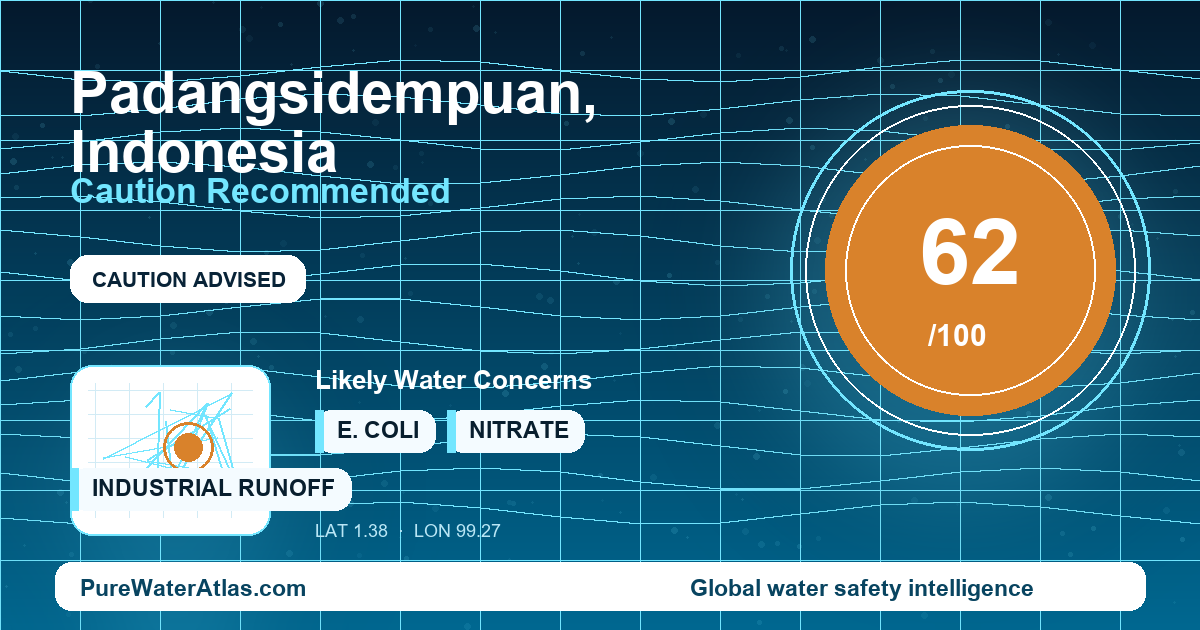
Padangsidempuan, Indonesia: municipal water exists, but tap-level safety is not well documented publicly, and untreated tap water is not recommended for short-stay visitors.
Quick Answer
| Overall safety status | Caution recommended. PureWaterAtlas assigns Padangsidempuan a water safety score of 62/100 because the city has an identifiable municipal water utility, but recent public tap-water compliance data is limited. |
|---|---|
| Can tourists drink the tap water? | No, not untreated. Visitors should use sealed bottled water, boiled water, or reliably filtered and disinfected water. |
| Resident guidance | Residents should treat municipal tap water as a utility supply that may need point-of-use protection for drinking and cooking unless recent testing confirms safety at the household tap. |
| Main water identity | Padangsidempuan is an inland North Sumatra city in a hilly upland catchment. Local supply is best understood as municipal water drawn from nearby upland raw-water sources, including surface-water and spring-fed catchments associated with local rivers such as the Batang Ayumi or Aek Batang Ayumi drainage. |
| Water authority | Municipal piped water is operated by Perumda Air Minum Tirta Ayumi Kota Padangsidimpuan, historically referred to as PDAM Tirta Ayumi. |
| Filter recommendation | For drinking water, use boiling, UV after prefiltration, ultrafiltration, or another validated disinfection barrier. Sediment and activated carbon filtration can help with particles, taste, odor, and chlorine, but carbon alone is not a reliable microbial safety barrier. |
Why Padangsidempuan Is Different
Padangsidempuan’s water-risk profile is shaped by its inland upland setting, not by coastal salinity intrusion. The city is located in North Sumatra within a hilly river-basin environment, away from the coast. That means the practical drinking-water concerns are more likely to involve rainfall-driven turbidity, catchment runoff, treatment and disinfection performance, pipe-network reliability, household storage, and private wells rather than seawater entering a coastal aquifer.
The city also differs from large international travel hubs in Indonesia because public, neighborhood-level water-quality reporting is not readily available in a consolidated source. A visitor staying in Padangsidempuan should not assume that hotel taps have the same risk profile as major hotels in large Indonesian cities. Drinking water may be supplied from sealed gallon dispensers, bottled water, or locally treated sources, but this should be confirmed rather than assumed.
For residents, the most important distinction is between municipal piped water, household-stored water, and private wells or other non-network sources. These are not equivalent from a safety standpoint. A municipal supply may be treated before distribution, but household tanks, low-pressure events, old plumbing, and intermittent supply can change water quality before it reaches the glass.
Where Does Padangsidempuan’s Tap Water Come From?
Padangsidempuan is served by a local municipal piped-water network. The public system is best understood as a city-scale drinking-water system using nearby upland raw-water sources, including surface-water and spring-fed catchments associated with local rivers such as the Batang Ayumi or Aek Batang Ayumi drainage. Exact current allocations by intake, treatment unit, and service zone are not consistently published in accessible national or city datasets, so this page does not assign precise source percentages.
Historically, Padangsidempuan developed in the Bukit Barisan highland environment, where communities relied on rivers, springs, and shallow groundwater before broader piped-water service. Some households may still supplement piped supply with wells, rainwater, delivered water, or stored water during interruptions. These supplemental sources require separate caution because they may not receive the same treatment or monitoring as municipal water.
Key infrastructure includes local raw-water intakes, treatment or disinfection facilities, transmission lines, service reservoirs, distribution mains, and household connections. The city’s practical risk points also include private roof tanks, buckets, small reservoirs, and other storage containers. If tanks are uncovered, cracked, rarely cleaned, or refilled through unhygienic hoses, treated water can become unsafe after it leaves the municipal system.
Who Manages Drinking Water in Padangsidempuan?
Municipal piped water in Padangsidempuan is managed by Perumda Air Minum Tirta Ayumi Kota Padangsidimpuan, commonly referred to historically as PDAM Tirta Ayumi. Public references to the city’s water services commonly use the Tirta Ayumi name, reflecting the importance of the Ayumi watercourse in the local water context.
Water-quality oversight involves local government and health authorities, while national drinking-water and environmental health requirements are set by Indonesia’s Ministry of Health. Indonesia’s current national health-based framework includes Ministry of Health Regulation No. 2 of 2023. Infrastructure context for Indonesian SPAM drinking-water systems is also connected to national public works institutions, including the Directorate General of Human Settlements and the SPAM performance information system, where utility data may be available depending on reporting.
The key limitation is that recent Padangsidempuan-specific tap-water compliance tables, treatment-plant performance reports, residual chlorine data, and tap-level microbiology results are not readily available in a single public source. For that reason, PureWaterAtlas does not claim that every tap in the city is unsafe or safe. The correct conclusion is more specific: caution is recommended, and household-level verification matters.
Main Local Water Concerns
- Microbial contamination: The main health concern is potential contamination at the tap if treatment, residual disinfectant, distribution pressure, or household storage is inadequate. Learn more about E. coli in drinking water.
- Turbidity after rainfall: Upland catchments and surface-water intakes can receive soil wash-off, runoff, and disturbed organic matter during storms. High turbidity can make disinfection less reliable if filtration is overloaded.
- Intermittent pressure and pipe intrusion: Low-pressure periods, leaks, repairs, or outages can allow contaminated water to enter distribution pipes.
- Household storage tanks: Tanks, buckets, and small reservoirs can become contamination points if they are open, poorly maintained, or exposed to insects, animals, sewage contact, or roof runoff.
- Private wells: Wells near septic tanks, drains, livestock areas, or agricultural plots may face microbial or nitrate risk and should be tested separately from municipal water.
- Sediment, color, iron, or manganese aesthetics: Some homes may see sediment, rusty water, color, or particles, especially after repairs or in older pipe sections. There is no public evidence supporting a quantified citywide heavy-metal claim.
Seasonally, rainy periods can increase raw-water turbidity, while flooding or drainage backups can contaminate shallow wells and poorly protected storage. Dry periods can reduce spring or stream yield, making stored water more important and tank hygiene more critical. After pipe repairs or pressure restoration, flush water that appears cloudy, rusty, or strongly chlorinated and treat it before drinking.
For Travelers
Do not drink untreated tap water in Padangsidempuan. Short-stay visitors should use sealed bottled water, boiled water, or water treated by a reliable filter plus disinfection. Even if many local residents tolerate their usual water, a short exposure to unfamiliar microbes can still cause gastrointestinal illness.
Use bottled, boiled, or properly filtered water for brushing teeth if you are a visitor, immunocompromised, pregnant, traveling with children, or staying in budget accommodation where tank hygiene is uncertain. For medicines and infant formula, use sealed bottled water or water that has been boiled and handled hygienically.
Avoid ice unless the hotel or restaurant can confirm that it is made from treated commercial ice or purified water. Clear ice is not proof of microbiological safety. In better hotels and established restaurants, drinking water is often supplied from sealed gallon dispensers or bottled water rather than the tap, but you should ask whether table water and ice are purified.
If bottled water is unavailable, bring water to a rolling boil as a practical microbial safety step. See the PureWaterAtlas boiling water purification guide for method details. Avoid drinking from bathroom taps, stored buckets, or containers with uncertain cleaning history.
For Residents
For Padangsidempuan households, the most practical approach is to treat tap water for drinking and cooking unless recent testing at your own tap confirms microbiological safety. A sediment prefilter can reduce particles, and activated carbon can improve taste, odor, and some chlorine-related issues. However, microbial protection requires a stronger barrier: boiling, UV after prefiltration, ultrafiltration, or another validated disinfection method. For UV systems, read the UV water purification guide, especially the need for clear water before UV treatment.
Households using municipal water should test at least annually for E. coli or thermotolerant coliforms if the water is consumed without boiling. Test again after major outages, flooding, pipe repairs, unusual odor, or visible discoloration. Private wells should be tested for E. coli, nitrate, turbidity, pH, electrical conductivity, iron, and manganese. Add arsenic or other metals only where local geology, plumbing, or a laboratory screening indicates concern.
If infants, pregnant people, elderly residents, or immunocompromised people live in the home, prioritize microbiology, nitrate, and disinfection reliability. For older buildings or renovated homes, do not assume that municipal-water quality alone determines tap quality. Internal plumbing, fittings, dead legs, stagnant lines, and rarely used taps can introduce sediment, rust, microbial growth, or metals. If water has a metallic taste or persistent discoloration, consider first-draw and flushed testing for lead and other plumbing-related metals.
Storage tanks are a major control point. Keep tanks covered, screened from insects and animals, cleaned periodically, protected from roof runoff and sewage contact, and disinfected after flooding or repair work.
Relevant Contaminants and Water-Quality Issues
The most relevant issue for untreated drinking water in Padangsidempuan is microbiology, especially indicators such as E. coli. Where treatment, residual disinfectant, pipe pressure, or storage conditions are uncertain, microbial testing is more important than assuming visual clarity equals safety.
Turbidity and sediment are also relevant because heavy rainfall, upland runoff, pipe repairs, and pressure changes can affect clarity and disinfection performance. Chlorine taste or odor may occur where municipal disinfection is present, but residual disinfectant is also an important safety barrier. For private wells near sanitation or agricultural sources, nitrate deserves attention. For older household plumbing, lead is a building-level concern, not a verified citywide claim.
How to Verify Your Water Quality
Because public Padangsidempuan tap-water data is limited, the most reliable answer for a household is a sample from the actual tap, tank, or well being used. Start with the PureWaterAtlas complete guide to water testing. Residents using private wells should also review nitrate testing and detection methods. If older plumbing is present, use the lead testing guide to understand first-draw and flushed sampling.
For broader comparisons, use the Global Water Quality Checker. To research specific hazards, search the PureWaterAtlas Contaminants Search Engine. For general decision-making, see the guides on drinking water safety, water microbiology, and water purification methods.
Official and Technical Sources
- Government of Padangsidempuan City — official local government context.
- BPS Kota Padangsidimpuan — official statistics and city-level administrative context.
- Ministry of Health Regulation No. 2 of 2023 — national health-based framework for environmental health and drinking-water quality requirements in Indonesia.
- Directorate General of Human Settlements, Ministry of Public Works and Housing — national infrastructure authority for water and sanitation context.
- Sistem Informasi Kinerja Penyelenggara SPAM — national reference point for Indonesian drinking-water utility performance information where available.
- WHO/UNICEF Joint Monitoring Programme: Indonesia — country-level WASH context, not a substitute for Padangsidempuan tap testing.
- CDC Travelers’ Health: Indonesia — traveler food and water safety context.
Bottom Line
Padangsidempuan has a municipal drinking-water utility, Perumda Air Minum Tirta Ayumi, and an inland upland water context tied to local surface-water and spring-fed catchments. However, recent public tap-level compliance data for the city is limited, so PureWaterAtlas rates the situation as caution recommended rather than confirmed safe. Travelers should avoid untreated tap water and use sealed bottled, boiled, or properly treated water, including for brushing teeth when risk tolerance is low. Residents should focus on household-level controls: test taps, wells, and storage tanks; maintain covered and clean tanks; and use boiling, UV with prefiltration, ultrafiltration, or another validated disinfection barrier for drinking water unless recent local testing confirms safety.
Read the full guide: Global Water Quality Guide
Explore more in this category: Global Water Quality Articles