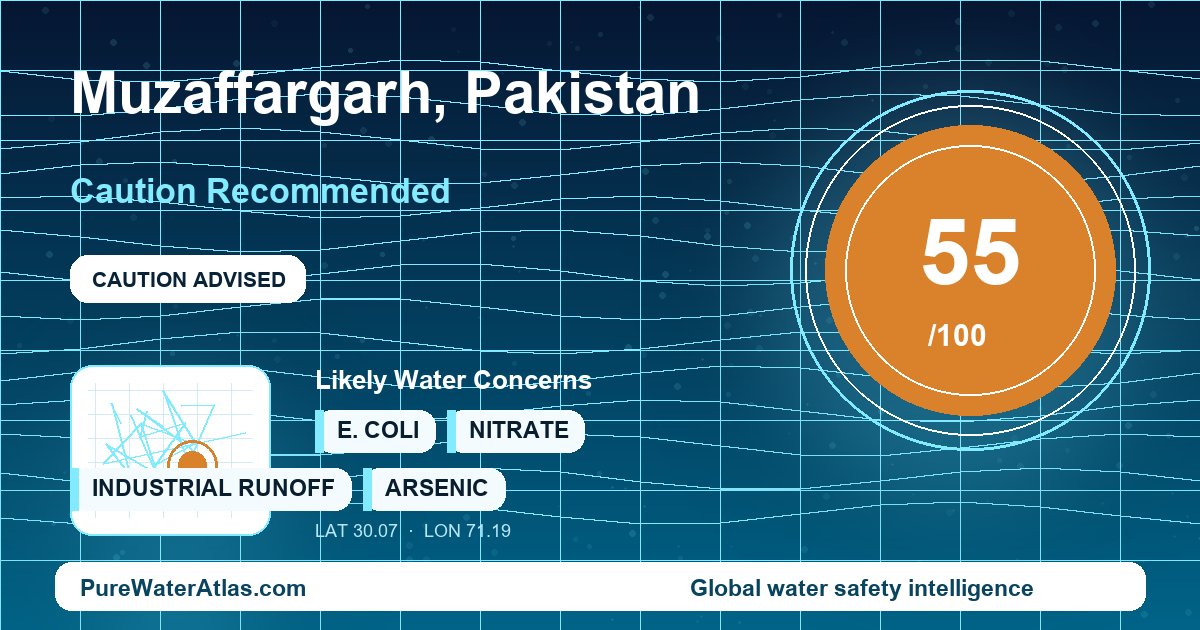
Muzaffargarh, Pakistan: groundwater-based urban supply in the Indus-Chenab floodplain, with caution recommended for untreated tap, bore, and stored household water.
Quick Answer
| Water safety score | 55 / 100 |
|---|---|
| Overall status | Caution recommended. Untreated tap water in Muzaffargarh should not be assumed to be reliably safe. |
| Traveler advice | Do not drink ordinary untreated tap water. Use sealed bottled water, hotel-provided treated water, or water that has been boiled or filtered with a reliable purifier. |
| Resident advice | Use municipal or bore water for drinking only after recent testing of the actual drinking tap and appropriate treatment for the contaminants found. |
| Main practical water source | Groundwater from the Indus Basin alluvial aquifer, pumped by municipal tube wells, private bores, motor pumps, and hand pumps. |
| Local authority context | Municipal Committee or local government structure for Muzaffargarh, with Punjab Public Health Engineering Department and Punjab Aab-e-Pak Authority relevant to schemes and filtration projects. |
| Filter recommendation | Often advisable, but the correct system depends on testing. Microbial risks require disinfection or filtration; high TDS, salinity, nitrate, or arsenic may require RO or other contaminant-specific treatment. |
For a broader safety framework, see the PureWaterAtlas guide to Drinking Water Safety.
Why Muzaffargarh Is Different
Muzaffargarh is not best understood as a city supplied by one large, conventional, fully treated surface-water system. Its practical drinking-water identity is groundwater-based. The city sits in southern Punjab in an alluvial floodplain setting associated with the Indus and Chenab river systems. That geography makes groundwater the dominant practical source, but it also means water quality can change sharply by depth, bore location, construction quality, and season.
The city’s risk profile is therefore different from places where a single centralized treatment plant provides stable, continuously pressurized water. In Muzaffargarh, drinking water may travel through a chain of municipal tube well, piped network, household suction pump, underground storage tank, rooftop tank, and kitchen tap. A safe-looking source does not guarantee a safe glass of water if pipes are leaky, pressure is intermittent, or household tanks are open, cracked, dirty, or rarely cleaned.
Historically, households in southern Punjab towns commonly relied on shallow wells, hand pumps, and local groundwater. Urban growth has shifted more people toward municipal tube wells, piped distribution, private motor pumps, and household storage. This mixed system creates highly local water-quality outcomes. Two homes in the same city may face different risks depending on bore depth, tank hygiene, pipe condition, and whether water is treated after storage.
Where Does Muzaffargarh’s Tap Water Come From?
Muzaffargarh’s practical drinking water supply is primarily drawn from the Indus Basin alluvial aquifer. Municipal tube wells pump groundwater into the urban supply, while many households and peri-urban users may also rely on private boreholes, motor pumps, or hand pumps. The aquifer is influenced by nearby Indus and Chenab river systems, irrigation canals, seepage, rainfall, and irrigation return flows.
The key infrastructure elements are municipal tube wells, a piped distribution network, household underground or rooftop storage tanks, private bores, motor pumps, and hand pumps. Irrigation canals and floodplain recharge influence the aquifer, but they should not be confused with fully treated drinking-water sources. Where community filtration or drinking-water schemes exist, their safety depends on verified maintenance, operating condition, and filter replacement.
The main local risk is not only the water at the tube well. Intermittent supply, low or changing pipe pressure, aging or leaking pipes, nearby drains, and household storage can introduce microbial contamination after pumping. This pathway is especially important in a groundwater and distribution-network city: even if a tube-well sample is acceptable, the water at the kitchen tap may be different after passing through pipes, pumps, and tanks.
Season also matters. Monsoon rainfall can increase turbidity, drain overflow, and contamination of shallow wells or poorly sealed bores. Flooding associated with the Indus or Chenab river systems can contaminate wells, hand pumps, and distribution infrastructure. In hot weather, longer household storage time can encourage microbial growth in rooftop tanks and dispensers. During power outages, pumping pressure may drop, increasing the possibility of back-siphonage or contamination through leaky lines.
Who Manages Drinking Water in Muzaffargarh?
Urban water supply and sanitation functions in Muzaffargarh are locally linked to the Municipal Committee or local government structure under Punjab’s Local Government and Community Development Department. The Local Government and Community Development Department Punjab provides the provincial local-government context for municipal service delivery.
The Public Health Engineering Department Punjab is also relevant because it is involved in drinking-water supply and sewerage schemes in districts and peri-urban or rural areas. The Punjab Saaf Pani Authority has a provincial safe-drinking-water and filtration-project mandate. Municipal service and infrastructure context may also be documented through the Punjab Municipal Development Fund Company.
Drinking-water quality in Pakistan is referenced against national drinking-water quality standards and guidance from Pakistan Standards and Quality Control Authority, Pakistan Council of Research in Water Resources, provincial public health and environmental institutions, and WHO drinking-water guidance. However, recent public, ward-level, tap-by-tap compliance results for Muzaffargarh are limited. This is a central limitation: the safest conclusion is evidence-based caution, not a blanket claim that every tap is safe or every tap is unsafe.
Main Local Water Concerns
- Microbiological contamination: The most immediate health concern is contamination by fecal indicator bacteria such as E. coli, especially where pipes, storage tanks, shallow bores, hand pumps, sewage, drains, or floodwater interact.
- Intermittent pressure and leaky distribution: Low or changing pressure can allow contaminated water to enter pipes through leaks, particularly near drains or sewerage-affected areas.
- Household storage contamination: Underground and rooftop tanks can become major risk points if they are open, cracked, unscreened, dusty, insect-contaminated, or rarely cleaned.
- High TDS, salinity, hardness, and taste: These are known concerns across parts of southern Punjab and alluvial aquifers. Salty or hard water is not just a taste issue; it should prompt testing and treatment selection based on results.
- Arsenic: Arsenic is a regional groundwater concern in parts of Punjab and the Indus plain. It cannot be reliably identified by taste, smell, or appearance, so Muzaffargarh groundwater users should test rather than assume it is absent.
- Nitrate: Nitrate risk is plausible where shallow groundwater is influenced by agriculture, animal waste, septic leakage, sewer seepage, or irrigation return flows.
- Turbidity and sediment: Turbidity, sediment, rusty water, or black particles may appear after pipe repairs, pump cycling, tank disturbance, or low-pressure events.
- Inconsistent disinfection: If chlorine residual is inconsistent or lost, microbial regrowth and intrusion become more likely within the distribution and storage system.
For Travelers
Visitors should avoid drinking untreated tap water in Muzaffargarh. Use sealed bottled water from reliable shops, hotel-provided treated water, or water that has been boiled or filtered with a reliable purifier. If bottled water is used, choose sealed containers and have them opened in front of you when possible.
For brushing teeth, use bottled, boiled, or properly filtered water, especially for short-term visitors, children, pregnant travelers, and anyone with a sensitive stomach. Avoid ice unless it is made from treated water by a reputable hotel or restaurant. Roadside ice and loose ice are higher risk because the water source and handling are usually unknown.
In hotels and restaurants, prefer sealed bottled water, hot tea or coffee made with boiled water, and reputable venues that use filtered water. You can ask whether water is RO-treated or boiled, but treatment claims depend on maintenance and storage. A neglected filter, dirty storage tank, or poorly cleaned dispenser can still create risk.
In hot weather, carry oral rehydration salts and do not rely on roadside diluted juices or drinks made with unverified water. Boiling is useful for microbial safety when bottled water is unavailable, but it does not remove arsenic, nitrate, salts, high TDS, or many chemical contaminants. For emergency boiling guidance, see Boiling Water Purification: Complete Guide.
For Residents
Residents should treat municipal tap water or bore water as source water that needs verification. A household can use it for drinking only if the actual drinking tap has been recently tested for microbiological safety and key chemical risks, and if tanks, pipes, and filters are maintained. Do not choose a filter only because the water tastes salty, hard, or unpleasant. Taste does not identify arsenic, nitrate, or microbial contamination.
For microbial risk, boiling, UV, chlorination, ultrafiltration, or other maintained systems can help. A UV unit must be properly sized and maintained; see UV Water Purification: Complete Guide. For high TDS, salinity, nitrate, or arsenic, a certified reverse osmosis system or other contaminant-specific treatment may be needed. If arsenic or nitrate is detected, review PureWaterAtlas guidance on arsenic treatment systems and nitrate treatment systems.
Test the actual drinking tap, not only the bore or municipal connection. At minimum, testing should include E. coli or thermotolerant coliforms, total coliforms, turbidity, TDS, electrical conductivity, pH, hardness, chloride, and residual chlorine where chlorinated supply is used. For groundwater or private bores, include arsenic, nitrate, fluoride, iron, manganese, and, where relevant, pesticides or other agricultural indicators.
Retest after floods, sewer overflows, new bore installation, pipe repairs, unusual taste or color, or illness clusters in the household. Use an accredited laboratory where possible, such as PCRWR-linked facilities, provincial public health laboratories, universities, or reputable private laboratories with documented methods. If using RO, test both raw and treated water, monitor TDS reduction, and keep the RO storage tank clean.
Older buildings may have corroded galvanized iron pipes, metal fittings, poor cross-connections, or stagnant plumbing. Lead service lines are not as well documented in Muzaffargarh as in some older Western cities, so lead should not be assumed to be the main risk. Still, older plumbing should be flushed and tested if water is stagnant, discolored, or metallic-tasting.
Storage tanks deserve special attention. Keep underground and rooftop tanks covered, screened, sealed against insects and dust, cleaned on a schedule, and protected from sewage leakage. A good filter cannot fully compensate for a dirty post-filter storage tank.
Relevant Contaminants and Water-Quality Issues
The most urgent short-term concern in Muzaffargarh is microbial contamination, especially E. coli, because groundwater distribution systems with intermittent pressure and household storage can be vulnerable to sewage intrusion and tank contamination. Learn the broader risk pathway in Water Microbiology.
Visible cloudiness, particles, rusty water, or disturbed tank deposits should be treated as warning signs and checked using the PureWaterAtlas pages on turbidity and sediment. Chemical concerns require testing because they may not be visible. Groundwater users should understand arsenic, nitrate, and the role of chlorine residual where chlorinated municipal supply is present.
For broader context, see PureWaterAtlas resources on Water Contamination and Water Treatment Systems.
How to Verify Your Water Quality
Because recent public laboratory results for every Muzaffargarh supply zone, tube well, private bore, household tank, and point-of-use tap are not consistently available in an accessible public dashboard, household verification is important. Start with the actual water you drink, after it has passed through your pipes, tank, filter, and dispenser.
Use the PureWaterAtlas Water Testing guide to plan sampling and understand lab reports. If your report lists specific substances, the Contaminants Search Engine can help interpret them. For groundwater-specific chemical concerns, see Arsenic in Drinking Water: Testing and Detection Methods and Nitrate Contamination in Drinking Water: Testing and Detection Methods.
Travelers comparing Muzaffargarh with other destinations can also use the Global Water Quality Checker. Related PureWaterAtlas categories include Drinking Water Safety, Water Testing, Water Microbiology, Water Purification, and Global Water Quality.
Official and Technical Sources
- District Muzaffargarh official portal — Government of Punjab source for district identity, geography, administration, and local context.
- Local Government and Community Development Department Punjab — provincial local-government and municipal service delivery context.
- Public Health Engineering Department Punjab — drinking-water supply and sewerage scheme context for districts and peri-urban areas.
- Punjab Saaf Pani Authority — provincial safe drinking-water and filtration-project mandate.
- Punjab Municipal Development Fund Company — municipal services and infrastructure profile context for Punjab municipalities.
- Pakistan Council of Research in Water Resources water quality reports — national water-quality monitoring and research source.
- WHO Guidelines for Drinking-water Quality — international reference for microbial and chemical drinking-water risk interpretation.
- WHO/UNICEF Joint Monitoring Programme household drinking-water data for Pakistan — national WASH service-level context.
- Provincial Disaster Management Authority Punjab — flood and monsoon risk context relevant to wells, sanitation, and water-supply infrastructure.
Bottom Line
Muzaffargarh’s tap water deserves caution, not automatic trust. The city’s drinking water is mainly groundwater from the Indus Basin alluvial aquifer, delivered through municipal tube wells, private bores, pipes, pumps, and household storage tanks. That chain creates multiple risk points: microbial intrusion, tank contamination, intermittent pressure, flood impacts, high TDS or salinity, and groundwater contaminants such as arsenic and nitrate that require testing. Travelers should use sealed bottled, boiled, or reliably treated water and avoid unverified ice or roadside drinks. Residents should test the actual drinking tap, maintain tanks and filters, and choose treatment based on lab results. Because recent public ward-level tap compliance data are limited, the safest Muzaffargarh-specific verdict is: caution recommended.
Read the full guide: Global Water Quality Guide
Explore more in this category: Global Water Quality Articles