
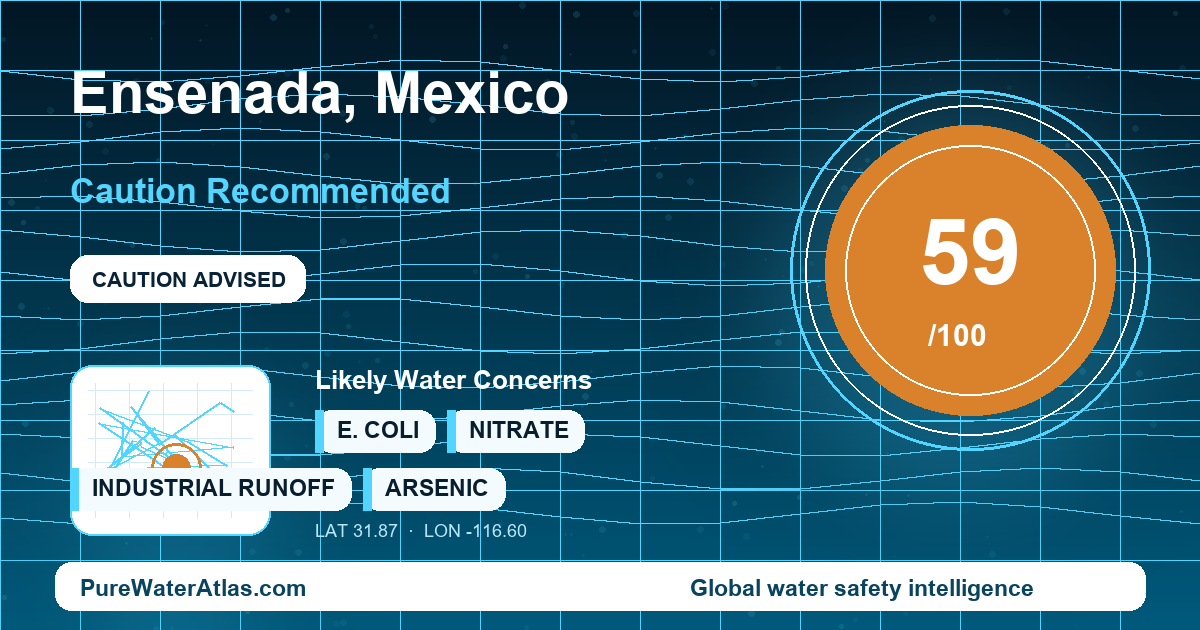
Ensenada, Mexico: municipal water from groundwater, regional transfers, and seawater desalination in a coastal arid city where storage tanks, salinity pressure, and intermittent service can affect what reaches the tap.
Quick Answer
| Overall safety status | Caution Recommended — water safety score: 59/100. |
|---|---|
| Can visitors drink the tap water? | Not recommended for most short-term travelers. Use sealed bottled water, reputable refill-station water, commercial ice, or water treated by a verified point-of-use system. |
| Resident approach | Treat municipal tap water as a utility supply that may be disinfected but should be verified at the household tap, especially after outages or when water is stored in cisterns or rooftop tinacos. |
| Main water identity | Mixed coastal-arid system: local and regional groundwater aquifers, historically including Ensenada, Maneadero, Guadalupe Valley, and La Misión-related supplies, supplemented by the Ensenada seawater reverse-osmosis desalination plant. |
| Water authority | Comisión Estatal de Servicios Públicos de Ensenada, commonly known as CESPE. |
| Practical filter recommendation | Sediment prefilter plus certified activated carbon for taste and chlorine; add reverse osmosis when total dissolved solids, salinity, nitrate concern, or drinking-water taste is a priority. UV can help after storage tanks if water is clear and the unit is maintained. |
Why Ensenada Is Different
Ensenada is not a city with a single abundant mountain reservoir feeding a consistently pressurized urban network. It is a Pacific coastal city in an arid to semi-arid part of Baja California, where low rainfall, limited dependable surface water, aquifer stress, and coastal salinity pressure shape the drinking-water picture. That local context is the reason this profile gives Ensenada a Caution Recommended verdict rather than a simple “safe” or “unsafe” label.
The city’s water story is closely tied to scarcity. Historically, Ensenada depended heavily on nearby groundwater because it does not sit on a large reliable river. Growth, tourism, surrounding agriculture, and prolonged dry conditions increased pressure on aquifers such as Maneadero and Guadalupe. The Ensenada seawater desalination plant was added to improve supply reliability because local groundwater alone was not a sufficiently resilient long-term solution.
At the consumer tap, the most important Ensenada-specific issue is not one single exotic contaminant. The practical concerns are the combination of mineralized groundwater, possible salinity influence, desalinated-water blending, pressure variation, pipe work, and household storage. Taste complaints are often more plausibly connected to dissolved minerals, hardness, chloride or salinity influence, chlorine, sediment, or storage conditions than to one universal citywide contaminant.
Where Does Ensenada’s Tap Water Come From?
Ensenada’s municipal supply is a mixed coastal-arid system. The core sources are local and regional groundwater aquifers serving the Ensenada area, historically including Ensenada, Maneadero, Guadalupe Valley, and La Misión-related supplies. These are supplemented by the Ensenada seawater reverse-osmosis desalination plant, a key infrastructure project documented by the North American Development Bank.
This source mix matters because each component creates a different water-quality and reliability profile. Groundwater can contain naturally elevated dissolved minerals and can be affected by agricultural or septic influence depending on the area. Coastal aquifers under pumping stress can be vulnerable to salinity intrusion. Desalination adds a supply source that is less dependent on rainfall, but the final water reaching homes still depends on blending, pumping, distribution conditions, service continuity, and building-level storage.
Key infrastructure includes CESPE’s municipal distribution network, groundwater wells in local and regional aquifers, Maneadero and Guadalupe Valley source areas, La Misión-Ensenada supply infrastructure and regional transfer connections referenced in Baja California water planning, the seawater desalination plant, and household cisterns or rooftop tinacos commonly used to manage pressure variation or service interruptions.
Because Ensenada’s system is operationally complex, water quality can vary by supply blend, neighborhood service history, and the condition of the plumbing and tanks inside a specific property. This is especially important in rentals, older buildings, and homes that store water for long periods.
Who Manages Drinking Water in Ensenada?
The local water and wastewater utility serving Ensenada is Comisión Estatal de Servicios Públicos de Ensenada, CESPE. CESPE is the first official source for local service notices, utility operations, billing, and municipal water information.
At the state level, Baja California water-sector planning and infrastructure are connected to the Secretaría para el Manejo, Saneamiento y Protección del Agua de Baja California, SEPROA. Nationally, water resources, aquifer availability, concessions, and hydrologic data are under CONAGUA. Drinking-water quality in Mexico is governed by national health standards, including NOM-127-SSA1-2021, with public-health oversight involving federal and state health authorities such as COFEPRIS.
A key limitation for consumers is that recent, detailed, citywide finished-water laboratory results by distribution zone are not consistently easy to access in a consumer-friendly format. For that reason, this guide does not claim exact contaminant concentrations or uniform safety across every Ensenada tap. Household testing remains important, especially where storage tanks, older plumbing, outages, or taste changes are present.
Main Local Water Concerns
Salinity, chloride, sodium, hardness, and total dissolved solids: Coastal aquifers under pumping stress can be vulnerable to seawater intrusion, and regional groundwater can be mineralized. These issues often affect taste, scaling, and suitability for people on sodium-restricted diets. They also signal source-water stress, even when they are not the same as an acute microbial hazard.
Intermittent pressure and storage-tank microbiology: When service is intermittent or pressure drops, residual chlorine and clean storage become more important. In Ensenada-style water use, cisterns and rooftop tinacos can determine the final water quality a person drinks. If tanks are uncovered, dirty, poorly screened, or left with depleted chlorine residual, bacteria can grow after water leaves the utility network.
Turbidity and sediment after repairs or service changes: Pressure changes, pipe repairs, older pipes, and distribution work can release sediment. Visible discoloration or particulate matter should be treated as a reason to flush lines, protect filters, and avoid drinking untreated water until conditions normalize.
Nitrate risk in agricultural and septic-influenced groundwater zones: Maneadero and Guadalupe Valley are important agricultural areas, making nitrate a plausible groundwater concern in some contexts. This should be verified by source-specific or tap-specific testing rather than assumed for every home.
Lead from building plumbing: Lead risk is usually property-specific. It can come from old internal pipes, solder, brass fixtures, valves, or other building plumbing. Knowing that the municipal source is regulated does not rule out lead at a specific first-draw tap.
Chlorine taste and residual management: Chlorine is important for microbiological protection in a warm-climate distribution system, but it can create taste and odor complaints. It can also dissipate in household tanks, reducing protection before the water is consumed.
For Travelers
Most short-term visitors should not drink Ensenada tap water directly. Use sealed bottled water, professionally filtered water, reputable refill-station water, or water treated by a verified system. This is a precaution based on local infrastructure and traveler vulnerability, not a claim that every tap in Ensenada is unsafe.
For brushing teeth, bottled or verified filtered water is the safer choice for tourists, especially for people with sensitive stomachs, immunocompromised travelers, pregnant travelers, young children, or anyone prone to gastrointestinal illness. Many local residents may use tap water for brushing, but a short-term visitor has less time to adapt and less knowledge of a building’s storage tanks or filter maintenance.
Use ice only in established restaurants, hotels, or bars that state they use purified water or commercial ice. Avoid homemade ice from unknown taps, especially at informal rentals or street stands. Better hotels and restaurants commonly use garrafón water, commercial ice, or filtration for drinking water, but it is still reasonable to ask whether drinking water and ice are purified.
In vacation rentals, check whether the dispenser bottle is sealed and whether any installed filter has a recent maintenance date. Avoid drinking from bathroom taps. Be more cautious after a city water outage, pressure restoration, plumbing repair, or visible discoloration. Boiling can reduce microbial risk, but it does not remove salinity, nitrate, metals, or dissolved minerals. For more detail, see PureWaterAtlas’ Boiling Water Purification: Complete Guide.
General traveler-health precautions for Mexico are also supported by the CDC Travelers’ Health Mexico guidance.
For Residents
Residents connected to CESPE should treat tap water as a municipal utility supply that may be disinfected but still deserves household verification. For daily drinking, a practical Ensenada setup is a sediment filter to protect equipment, certified activated carbon for chlorine taste and odor, and reverse osmosis if high dissolved solids, salinity, nitrate concern, or improved drinking-water taste is a priority. UV can be useful after storage tanks, but only when the water is clear and the system is maintained; see the PureWaterAtlas UV Water Purification: Complete Guide.
Testing is especially important where taste, scaling, agriculture, storage tanks, or old plumbing are part of the household picture. At minimum, residents noticing mineral taste or scaling should test for total dissolved solids, electrical conductivity, chloride, sodium, hardness, pH, and alkalinity. Test for total coliform and E. coli after cistern cleaning, long outages, flooding, plumbing work, or recurring gastrointestinal illness in the home.
Test for nitrate if the property is near agricultural areas, uses a private well, relies on trucked water, or includes infants, pregnant residents, or immunocompromised residents. For guidance, see Nitrate Contamination in Drinking Water: Testing and Detection Methods and Nitrate Contamination in Drinking Water: Best Filters, Systems and Solutions.
Older buildings should be treated as site-specific unknowns. Let stagnant water run before use, avoid using hot tap water for cooking or infant formula, and consider first-draw and flushed testing for lead if plumbing age is uncertain. PureWaterAtlas has a dedicated guide to Lead in Drinking Water: Testing and Detection Methods.
Cisterns and rooftop tinacos are a major point-of-use risk. Tanks should be covered, screened, cleaned, and disinfected on a routine schedule. If water sits for long periods or chlorine residual disappears, microbiological testing or final disinfection is recommended before drinking.
Relevant Contaminants and Water-Quality Issues
The most relevant PureWaterAtlas topics for Ensenada are tied to disinfection, sediment, stored water, agricultural groundwater indicators, and building plumbing. Chlorine in Drinking Water is central because residual disinfectant protects water in distribution and storage, but can also cause taste and odor complaints.
Turbidity in Drinking Water and Sediment in Drinking Water are relevant after pressure changes, pipe repairs, service restoration, or visible discoloration. E. coli in Drinking Water is important for understanding microbial risk in cisterns, tinacos, low-pressure events, or any water suspected of fecal contamination.
Nitrate in Drinking Water matters because some surrounding groundwater source areas are agricultural or septic-influenced. Lead in Drinking Water matters because lead is usually a building-plumbing issue rather than a source-water issue, and it cannot be ruled out without property-specific testing.
How to Verify Your Water Quality
For Ensenada, the best verification strategy is local and point-of-use specific. Start with the property: confirm whether the building uses a cistern, rooftop tinaco, dispenser, under-sink filter, reverse-osmosis unit, or private/trucked water supply. Then test according to the actual risk pathway: minerals and salinity indicators for taste and scaling, microbiology after storage or outages, nitrate for agricultural or private-well contexts, and lead for older or unknown plumbing.
PureWaterAtlas resources that fit Ensenada include Water Testing: Complete Guide to Water Testing and Analysis, Drinking Water Safety: How to Know If Your Tap Water Is Safe to Drink, Water Microbiology, and Water Treatment Systems.
You can also use the Contaminants Search Engine to look up specific contaminants and indicators, or compare Ensenada with other destinations using the Global Water Quality Checker. Related PureWaterAtlas categories include Drinking Water Safety, Water Testing, Water Purification, and Global Water Quality.
Official and Technical Sources
- Comisión Estatal de Servicios Públicos de Ensenada, CESPE — local utility responsible for Ensenada water and wastewater service.
- SEPROA Baja California — state water authority relevant to regional supply planning and infrastructure.
- CONAGUA Groundwater Availability System — national water resources authority for aquifer and hydrologic context.
- North American Development Bank: Ensenada Desalination Plant — documentation for the seawater desalination project.
- Diario Oficial de la Federación: NOM-127-SSA1-2021 — Mexican drinking-water quality standard.
- COFEPRIS — federal public-health and sanitary oversight authority.
- CDC Travelers’ Health: Mexico — traveler food and water precaution guidance.
Bottom Line
Ensenada tap water deserves a cautious, location-specific approach. The city has an organized municipal utility, CESPE, and drinking water is governed by Mexican standards, but Ensenada’s actual water picture is shaped by coastal groundwater stress, salinity pressure, drought-driven shortages, desalinated-water blending, pressure variation, and household storage tanks. Most visitors should use bottled, commercial, or verified filtered water for drinking and tooth brushing, while residents should consider sediment filtration, activated carbon, and reverse osmosis when taste, dissolved minerals, salinity, or nitrate are concerns. Cisterns and rooftop tinacos require routine cleaning and microbiological verification after outages or long storage. Because detailed consumer-facing distribution-zone lab results are limited, testing at the tap remains the most reliable way to confirm household safety.
Read the full guide: Global Water Quality Guide
Explore more in this category: Global Water Quality Articles