
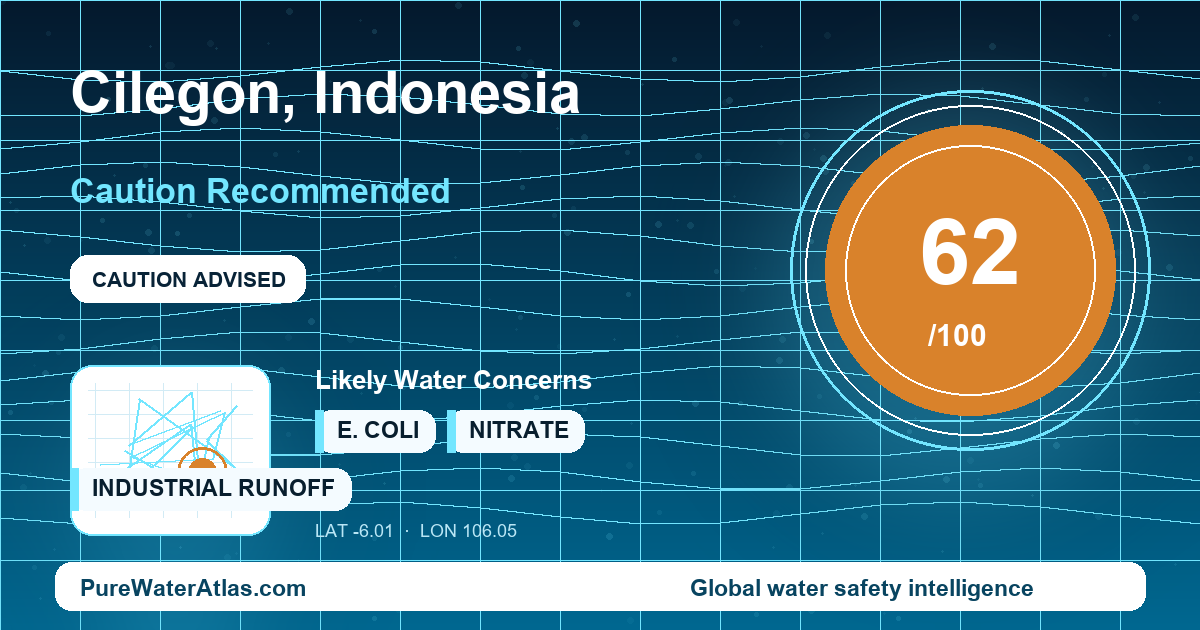
Cilegon, Indonesia: coastal industrial-city tap water profile for municipal supply, Cidanau-linked source water, household storage tanks, travelers, and residents.
Quick Answer
| Overall safety status | Caution recommended. Cilegon has an identifiable municipal piped-water system and a major treated-water supplier, but untreated tap water is not the safest default for drinking because public, neighborhood-level finished-water test results are not easy to verify. |
|---|---|
| Water safety score | 62 / 100 — risk level: Caution Recommended. |
| Traveler advice | Do not rely on untreated tap water for drinking. Use sealed bottled water, boiled water, hotel-provided drinking water, or water treated by a reliable purifier. |
| Resident advice | Treat tap water intended for drinking, especially if it passes through a roof tank or ground tank. Test private wells before drinking, particularly near coastal or industrial areas. |
| Main water identity | Cilegon’s piped-water environment is strongly tied to the Cidanau River and Rawa Danau catchment, treated-water infrastructure, municipal distribution, and building-level storage. |
| Local authorities | Perumda Air Minum Cilegon Mandiri / PDAM Cilegon for municipal piped-water service; PT Krakatau Tirta Industri as a major treated-water and industrial water supplier. |
| Filter recommendation | For drinking water, use sediment filtration plus activated carbon, followed by boiling, UV, ultrafiltration, or reverse osmosis depending on microbial risk, TDS, salinity, nitrate, and lab results. |
Why Cilegon Is Different
Cilegon is not a generic Indonesian city water case. It is a coastal industrial city in Banten Province on the western end of Java, facing the Sunda Strait. Its water-risk profile is shaped by three local realities: a surface-water and treated bulk-water system linked to the Cidanau River and Rawa Danau catchment, a municipal distribution network serving residents and businesses, and a heavy industrial setting that includes steel-related operations, ports, power facilities, petrochemical activity, and large industrial water demand.
The most practical question in Cilegon is often not whether a treatment plant exists. It does. The more important household-level question is what happens after treated water leaves the controlled treatment and distribution environment. Water may pass through pipes, pressure-changing sections, pumps, hotel plumbing, restaurant plumbing, refill systems, roof tanks, or ground tanks before it reaches a glass. Those final steps can affect E. coli risk, clarity, taste, odor, and sediment.
Because routinely updated, tap-level compliance data for Cilegon neighborhoods are not publicly available in a consolidated official dashboard, this guide does not claim that all taps are continuously safe or unsafe. The best verified conclusion is more cautious: municipal and treated-water infrastructure is identifiable, but direct-from-tap drinking without point-of-use treatment is not the safest default.
Where Does Cilegon’s Tap Water Come From?
Cilegon’s piped-water identity is strongly associated with the Cidanau River and upstream Rawa Danau catchment system in Banten. PT Krakatau Tirta Industri publicly describes the Cidanau River as a raw-water source for treated clean-water production serving the Cilegon industrial estate and surrounding users. This makes Cilegon different from a city whose supply is mainly small-scale local groundwater. The local water environment is a combination of surface-water sourcing, treatment, bulk clean-water supply, municipal distribution, and building-level storage.
Key water infrastructure relevant to Cilegon includes the Cidanau River and Rawa Danau catchment, PT Krakatau Tirta Industri’s water-treatment and bulk clean-water system, and Perumda Air Minum Cilegon Mandiri, commonly known as PDAM Cilegon, as the municipal piped-water utility. In homes, hotels, shops, rented accommodation, and commercial buildings, final water quality can also depend heavily on roof tanks, ground tanks, pumps, internal plumbing, and whether tanks are covered, cleaned, and protected from insects or debris.
Cilegon also has a historical water-supply context tied to the growth of the Krakatau Steel industrial complex and related heavy industry. Water infrastructure in the area developed not only for households but also to support large industrial demand. In less-connected or historically underserved settings, households may also use wells, delivered water, refill depots, bottled water, or on-site storage. Those alternatives can vary widely in quality and should not be assumed safe without testing or treatment.
Who Manages Drinking Water in Cilegon?
The local municipal utility is Perumda Air Minum Cilegon Mandiri, commonly referred to as PDAM Cilegon. It is the key local institution for municipal piped-water distribution and customer service. PT Krakatau Tirta Industri is also highly relevant because it is a major regional treated-water and industrial water supplier connected to the Cilegon industrial water system and Cidanau raw-water use.
Source-water and watershed context are also relevant. The Balai Besar Wilayah Sungai Cidanau-Ciujung-Cidurian, under Indonesia’s public works water-resources framework, is the official river-basin institution for the Cidanau-Ciujung-Cidurian water region. Cilegon’s geography, administrative context, and city-level statistics are documented through the BPS Kota Cilegon official statistics portal.
Drinking-water health standards in Indonesia are set nationally by the Ministry of Health, currently under the health-based environmental quality framework in Permenkes No. 2 Tahun 2023. Local governments and health offices are responsible for surveillance and public-health implementation, while water utilities manage treatment and distribution. The important limitation for consumers is that public access to routine Cilegon tap-level microbial results, residual chlorine data, and neighborhood distribution-zone testing is limited.
Main Local Water Concerns
The most realistic water-quality concerns in Cilegon are practical and location-specific rather than based on a single public claim that the whole city’s water is contaminated. Surface-water sources can experience higher turbidity during heavy rain, runoff, or pipe disturbance. Turbid water is not only unpleasant; it can interfere with disinfection and can signal sediment movement in the system or building plumbing.
Microbial risk is a central concern after treatment if water enters unclean tanks, depot containers, roof tanks, or low-pressure distribution sections. This is why E. coli and total coliform testing are important at the actual kitchen tap, not only at the treatment plant. Treated municipal water may contain chlorine residual for disinfection, and some users may notice a chlorine taste or smell. However, the absence of chlorine odor does not prove water is unsafe, and the loss of disinfectant residual in stored water can increase microbial risk.
Because Cilegon is coastal, private wells may have elevated salinity, chloride, total dissolved solids, or a brackish taste, especially in low-lying or near-shore areas. The industrial surroundings also make site-specific testing more important for private wells. This does not prove that regulated municipal tap water contains industrial contaminants, but it does mean well users should avoid assuming safety based on appearance alone.
Other possible household-level issues include iron and manganese staining, reddish-brown or black particles, metallic taste, and sediment from older internal plumbing. Lead is best treated as a building-plumbing question rather than a documented Cilegon-wide source-water finding. Older fittings, brass fixtures, solder, or imported plumbing components can still justify testing in older buildings.
Season matters. Rainy season can increase raw-water turbidity, runoff, drain overflow, and sediment disturbance after storms. Dry season can increase pressure on the Cidanau source system and may worsen salinity or high-TDS problems in private coastal wells. After flooding, pipe repairs, tank cleaning, long outages, or brown-water events, drinking water should be boiled or otherwise disinfected until clarity and safety are restored.
For Travelers
Short-stay travelers should not drink untreated tap water in Cilegon as a default. Use sealed bottled water, boiled water, hotel-provided drinking water, or water treated by a reliable purifier. This is especially important because visitors are not adapted to local microbes and usually cannot verify whether a hotel or rented room has clean storage tanks and well-maintained plumbing.
For brushing teeth, cautious travelers, children, pregnant travelers, and anyone with a sensitive stomach should use bottled or boiled water. In higher-end hotels, tap water may be acceptable for rinsing, but bottled water is the lower-risk choice. Avoid drinking from bathroom taps unless the property clearly provides treated potable water at that outlet.
Ice should be treated with the same caution as water. Ice from reputable hotels, chain restaurants, and established venues is lower risk when made from commercial purified water and handled hygienically. Avoid ice from street stalls or small vendors if you cannot tell whether it was made from treated water.
In hotels and restaurants, ask whether drinking water comes from sealed bottles, a maintained dispenser, or an in-house filtration system. Do not assume the bathroom tap and the drinking-water dispenser are the same quality. Hot tea and coffee are safer when water has been brought to a rolling boil. Travelers should also carry bottled water during local travel and consider oral rehydration salts if diarrhea develops. The CDC Travelers Health guidance for Indonesia supports cautious food and water practices for visitors.
For Residents
Residents connected to municipal piped water should use a treatment barrier for drinking and cooking, particularly if water is stored in a roof tank or ground tank. A practical Cilegon setup is sediment filtration for visible particles, activated carbon for taste and odor control, and a final safety step such as boiling, UV, ultrafiltration, or reverse osmosis depending on test results. See the PureWaterAtlas guide to water treatment systems for help matching treatment to the problem.
Reverse osmosis is more appropriate when testing shows high TDS, salinity, nitrate, or certain dissolved contaminants. UV can be useful for clear but microbiologically uncertain water, but it requires clear water and maintenance; the UV water purification guide explains these limits. Boiling remains a practical microbial barrier after outages, flooding, tank cleaning, or brown-water events; see Boiling Water Purification: Complete Guide.
If using municipal water, test at the kitchen tap after the building’s tank for E. coli or total coliform, turbidity, pH, residual chlorine, TDS, iron, manganese, and nitrate when moving in or after repeated complaints. If using a private well, add chloride, electrical conductivity, hardness, ammonia, nitrite, sulfate, arsenic, lead, cadmium, chromium, mercury, and VOC screening where industrial influence is plausible. Private wells near the coast or industrial areas should be lab-tested before drinking.
Older buildings, workshops converted to housing, and rental properties can have unknown internal plumbing. Lead is not documented as a Cilegon-wide tap-water contaminant, but older fittings, brass fixtures, solder, and stagnant water can create household-specific risk. Flush stagnant water and test if infants or pregnant people live in the building. For more detail, see Lead in Drinking Water: Testing and Detection Methods.
Storage tanks deserve special attention in Cilegon. Keep roof tanks and ground tanks covered, screen vents and overflows, clean and disinfect tanks periodically, and do not connect drinking taps to tanks that are visibly dirty, open to insects, or receiving untreated well water. After tank cleaning, flush lines before drinking.
Relevant Contaminants and Water-Quality Issues
The most relevant Cilegon water-quality topics are turbidity, sediment, E. coli, chlorine, iron, manganese, nitrate, and plumbing-related lead. These issues match the local profile: surface-water treatment, rainy-season turbidity, storage tanks, coastal wells, older plumbing, and private-well uncertainty.
For private wells near industrial influence, advanced screening may be appropriate where site history justifies it. PureWaterAtlas has additional testing guides on nitrate contamination testing and PFAS testing. No city-wide PFAS claim is made for Cilegon; this is only a screening consideration for specific sites where industrial history or lab advice supports it.
How to Verify Your Water Quality
The best way to verify Cilegon tap water is to test the water you actually drink, after it has passed through your building’s tank, plumbing, dispenser, or filter. Start with microbial testing, turbidity, pH, residual chlorine, TDS, iron, manganese, and nitrate. For wells, expand the panel to include salinity indicators and relevant metals. Use an accredited Indonesian laboratory or a local health-office testing pathway where available. Home strips can screen for some basic parameters, but they cannot confirm microbial safety or trace-metal compliance.
For a broader testing framework, use the PureWaterAtlas Water Testing Guide. For health-risk context, see Drinking Water Safety and Water Microbiology. To compare Cilegon with other locations, use the Global Water Quality Checker. If a lab report lists an unfamiliar parameter, search it in the PureWaterAtlas Contaminants Search Engine.
Official and Technical Sources
- Perumda Air Minum Cilegon Mandiri official website — local municipal piped-water utility for Cilegon.
- PT Krakatau Tirta Industri official website — major Cilegon-area treated-water and industrial water supplier associated with Cidanau raw-water use.
- Balai Besar Wilayah Sungai Cidanau-Ciujung-Cidurian — official river-basin institution relevant to Cidanau watershed context.
- BPS Kota Cilegon official statistics portal — authoritative city geography, administrative, and development context.
- Ministry of Health Regulation, Permenkes No. 2 Tahun 2023 — Indonesian health-based environmental quality standards framework.
- CDC Travelers Health: Indonesia — travel-health guidance supporting cautious food and water practices.
- World Health Organization drinking-water fact sheet — global public-health context for microbial contamination and safe drinking water.
Bottom Line
Cilegon’s tap water should be approached with caution rather than assumed unsafe everywhere or safe everywhere. The city has recognizable water institutions, including PDAM Cilegon and the Krakatau Tirta Industri treated-water system, and its water identity is closely tied to the Cidanau River and Rawa Danau catchment. However, Cilegon’s coastal industrial setting, reliance on storage tanks in buildings, possible turbidity after rain, intermittent-pressure risks, and limited public tap-level test data make untreated tap water a poor default for drinking. Travelers should use bottled, boiled, or reliably purified water. Residents should test water at the actual kitchen tap, maintain tanks, and use appropriate point-of-use treatment for drinking and cooking.
Read the full guide: Global Water Quality Guide
Explore more in this category: Global Water Quality Articles