
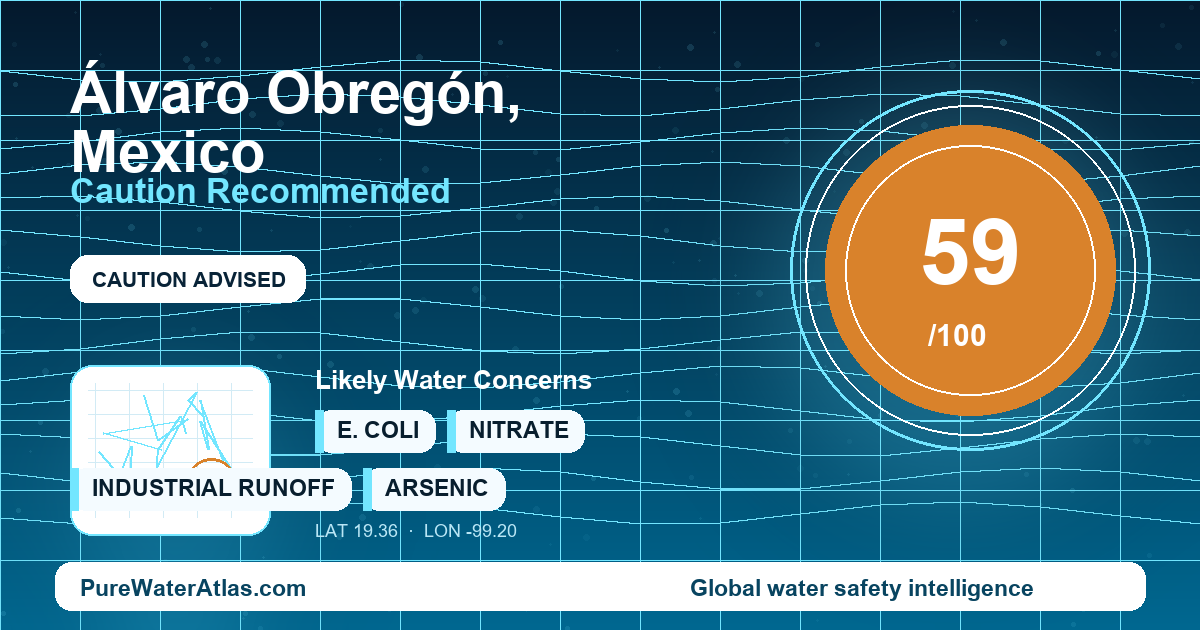
Álvaro Obregón, Mexico City: treated municipal water, but point-of-use safety depends heavily on pressure continuity, cisterns, rooftop tinacos, pumps, and building plumbing.
Quick Answer
| Overall safety status | Caution recommended. Álvaro Obregón’s water is part of the regulated Mexico City system, but it is not a low-risk tap-water destination without filtration or site-specific verification. |
|---|---|
| Water safety score | 59 / 100 — Caution Recommended |
| Traveler advice | Most short-term visitors should avoid drinking unfiltered tap water. Use sealed bottled water, reputable garrafón water, hotel-provided purified water, or water treated with a reliable purifier. |
| Resident advice | Treat safety as building-specific. Tap water may be usable after point-of-use filtration where cisterns, tinacos, chlorine residual, and plumbing are well maintained and testing is current. |
| Main supply identity | Mexico City’s mixed system: Valley of Mexico groundwater, imported Cutzamala surface water, and Lerma System water, distributed by SACMEX. |
| Main authority | Sistema de Aguas de la Ciudad de México, SACMEX, with federal water-resource roles for CONAGUA. |
| Filter recommendation | For routine drinking, use a maintained point-of-use filter. A practical setup is sediment prefiltration where turbidity occurs, followed by an activated carbon block filter certified to NSF/ANSI 42 and 53 for chlorine taste, particulates, cysts, and lead reduction. Reverse osmosis may be appropriate where testing shows dissolved solids, metals, nitrate, or arsenic concerns. |
Why Álvaro Obregón Is Different
Álvaro Obregón is not just another flat urban service area in Mexico City. It is a western and southwestern borough with pronounced elevation changes, dense neighborhoods, ravines known as barrancas, and higher-elevation zones toward the southwest. That terrain makes water pressure management more complex than in flatter parts of the city. In practice, water quality at a kitchen tap in Álvaro Obregón can be shaped not only by treatment at the municipal level, but also by pumps, pressure zones, storage tanks, and the condition of the building itself.
The key safety issue is therefore point-of-use variability. SACMEX operates a treated and regulated citywide drinking-water network, but many homes and apartment buildings rely on cisterns and rooftop tinacos. These storage systems can act like a second water system after municipal treatment. If tanks are uncovered, dirty, poorly disinfected, exposed during outages, or connected through aging building plumbing, water quality can deteriorate before it reaches the faucet.
This profile is interpreted specifically as Álvaro Obregón, the Mexico City borough. Public sources document Mexico City’s supply systems and water authorities, but readily accessible, current tap-level datasets for individual Álvaro Obregón neighborhoods, pressure zones, buildings, and outlets are limited. For that reason, this page does not claim that every tap is safe or unsafe. It gives a cautious borough-specific interpretation based on the known supply system, infrastructure conditions, and practical risks.
Where Does Álvaro Obregón’s Tap Water Come From?
Álvaro Obregón is served by the broader Mexico City metropolitan water system operated through SACMEX. The system is not a single local river, spring, or reservoir source. It is a mixed portfolio combining groundwater from the Valley of Mexico aquifer and wells, imported surface water from the Cutzamala System, and imported water from the Lerma System.
This mixed identity matters for Álvaro Obregón because the borough’s service can be influenced by both local distribution conditions and citywide bulk-water availability. Western and southwestern areas of Mexico City, including parts of Álvaro Obregón, can be affected when Cutzamala deliveries are reduced because of drought, maintenance, or reservoir shortages. Mexico City has historically expanded from local springs, lakes, and groundwater to imported Lerma and Cutzamala water as the urban population grew and local aquifers became overdrawn.
Important infrastructure serving the broader system includes SACMEX’s citywide drinking-water distribution network, Mexico City groundwater wells and pumping systems, Lerma infrastructure, Cutzamala infrastructure, local pressure zones, pumping stations, storage tanks, and distribution mains. In Álvaro Obregón specifically, steep topography and elevation changes make local pressure management especially important. At the property level, cisterns and rooftop tinacos are often part of the real drinking-water pathway.
Who Manages Drinking Water in Álvaro Obregón?
The principal drinking-water service authority for Álvaro Obregón is Sistema de Aguas de la Ciudad de México, SACMEX. SACMEX is responsible for operating the Mexico City drinking-water distribution system, managing service information, and addressing issues such as leaks, supply interruptions, and water-quality responsibilities within the city.
Comisión Nacional del Agua, CONAGUA is the federal water authority and is central for national water resources and major bulk-water systems such as Cutzamala. Health and sanitary oversight is tied to national standards, especially NOM-127-SSA1-2021, Mexico’s standard for water for human use and consumption. COFEPRIS is also relevant as the federal health authority for sanitary surveillance and drinking-water health protection.
The Alcaldía Álvaro Obregón is an official local-government source for borough identity, geography, public services, and local notices, but it is not the primary drinking-water utility. Residents may still interact with borough or city service channels for leaks, local interruptions, or water-truck support during shortages.
Main Local Water Concerns
- Intermittent or reduced supply: Pressure drops can disturb sediment and may increase intrusion risk where pipes are compromised. This is especially relevant in a borough with complex elevation and pressure zones.
- Brown, cloudy, or particle-laden water: Turbidity may occur after repairs, outages, tank cleaning, or changes in flow direction. Do not drink visibly discolored or turbid water until it clears and is appropriately filtered or disinfected.
- Building-level microbial risk: The most likely microbial problem is often not the treated water leaving the municipal system, but contamination in cisterns, rooftop tanks, hoses, pumps, or stored water.
- Storage time during outages: During extended interruptions, water stored in cisterns and tinacos ages, and residual chlorine can decay.
- Chlorine taste or odor: Chlorine residual is an important microbial barrier, but taste alone does not prove water is safe or unsafe.
- Older plumbing: Legacy pipes, galvanized components, brass fixtures, solder, or stagnant first-draw water may contribute metals such as lead in some buildings. Available public data are not sufficient to claim a borough-wide lead problem.
- Pipas during shortages: Water trucks may be used when supply is reduced. Water intended for drinking should come from an official or trusted source, and receiving tanks should be clean and disinfected.
Seasonal and event-related factors also matter. Dry-season and drought periods can reduce Cutzamala storage and contribute to lower pressure or service cuts in parts of Mexico City. The rainy season, generally May to October, can increase runoff, localized flooding, turbidity events, and sewer-cross-connection concern where pipes or tanks are compromised. After earthquakes, major road works, or pipe repairs, sediment and microbial risk may temporarily rise in affected buildings or blocks.
For Travelers
For visitors staying in Álvaro Obregón, the default recommendation is simple: do not drink unfiltered tap water unless the property’s water treatment and storage are verified. Use sealed bottled water, reputable garrafón water, hotel-provided purified water, or water treated by a reliable purifier. If tap water must be used in an emergency, bring it to a rolling boil or use a purifier appropriate for microbial risks, and avoid any water that is cloudy, brown, or visibly contaminated.
Brushing teeth with tap water is tolerated by many travelers, but conservative guidance is to use bottled or purified water. This is especially important for children, pregnant travelers, immunocompromised travelers, and anyone with a sensitive stomach.
Use caution with ice. Established hotels, restaurants, and cafés in Mexico City commonly use purified water for guests, but do not assume that all ice in informal venues is made from purified water. Ask whether ice and drinking water are purified, and avoid ice when the source is unclear.
In hotels and short-term rentals, the most important Álvaro Obregón-specific question is whether the building has clean cisterns and tinacos, not just whether municipal water is treated. Ask whether drinking water is purified, whether the kitchen tap has a maintained filter, and when storage tanks were last cleaned. For broader travel decision-making, see the PureWaterAtlas Global Water Quality Checker.
For Residents
Residents should treat drinking-water safety as household- and building-specific. If your building has well-maintained cisterns and tinacos, adequate residual chlorine, and recent testing, tap water may be usable after appropriate point-of-use filtration. If your building is older, experiences irregular supply, receives pipa deliveries, or has unknown tank maintenance, use a certified filter for daily drinking and cooking water.
A practical residential setup in Álvaro Obregón is a sediment prefilter where cloudy or particle-laden water is common, followed by an activated carbon block filter certified to NSF/ANSI 42 and 53 for chlorine taste, particulates, cysts, and lead reduction. Reverse osmosis is reasonable where testing shows high dissolved solids, metals, nitrate, or arsenic concerns, but it requires maintenance and produces reject water.
Testing should be done at the kitchen tap, not only at the building inlet, because cisterns, tinacos, pumps, and indoor plumbing can change water quality. For microbial safety, test for total coliforms and E. coli, especially after tank cleaning, flooding, long outages, or if water has odor or cloudiness. Measure free residual chlorine, turbidity, pH, and total dissolved solids as basic operational indicators.
If your building is old or plumbing materials are unknown, test first-draw and flushed samples for lead and other metals. First-draw samples help identify contributions from fixtures and internal plumbing. Use cold water for cooking, flush stagnant water before use, and prioritize testing where children or pregnant people live in the home. Cisterns and tinacos should be sealed, screened, cleaned, and disinfected on a regular schedule.
Relevant Contaminants and Water-Quality Issues
Several PureWaterAtlas contaminant profiles are especially relevant to Álvaro Obregón’s point-of-use risk profile. Chlorine in drinking water is important because residual disinfectant helps protect against microbial contamination in distribution and storage, while taste and odor complaints are common. Turbidity and sediment matter after pressure changes, repairs, outages, tank cleaning, or flow-direction changes.
E. coli is a critical indicator when tank contamination, pressure loss, or suspected sewage intrusion is possible. Lead is relevant as a building-level concern in older plumbing, even though available public information is not enough to claim a borough-wide lead issue. Residents comparing treatment options can also read Lead in Drinking Water: Best Filters, Systems and Solutions.
For outages or suspected microbial contamination, Boiling Water Purification: Complete Guide explains what boiling can and cannot do. Boiling helps with microbes, but it does not remove lead, arsenic, salts, or many chemicals. UV Water Purification: Complete Guide is useful for understanding why turbidity and prefiltration matter when using UV systems.
How to Verify Your Water Quality
The most reliable way to know whether a specific Álvaro Obregón tap is safe is to test that tap under real household conditions. Start with microbial indicators, free residual chlorine, turbidity, pH, and total dissolved solids. If the building is old, add first-draw and flushed metals testing, especially for lead. If water comes from a private well, nonstandard source, or repeated pipa deliveries, use a certified laboratory and include nitrate, arsenic, hardness, iron, manganese, and microbial indicators.
Repeat testing after major plumbing work, tank replacement, unusual taste or color, prolonged interruption, flooding, or a change in water source. Use the PureWaterAtlas Water Testing guide for sample-planning basics, and the Lead in Drinking Water: Testing and Detection Methods guide if old plumbing is a concern. For interpreting individual contaminants found in a report, use the Contaminants Search Engine. For a broader safety framework, see Drinking Water Safety, Water Microbiology, and Water Treatment Systems.
Official and Technical Sources
- Sistema de Aguas de la Ciudad de México, SACMEX — official Mexico City water authority for distribution, service information, leaks, interruptions, and water-quality responsibilities.
- Comisión Nacional del Agua, CONAGUA — federal water authority for national water resources and major bulk-water infrastructure.
- CONAGUA: Sistema Cutzamala — official information on one of the major imported water systems affecting Mexico City supply reliability.
- Diario Oficial de la Federación: NOM-127-SSA1-2021 — national sanitary standard for water for human use and consumption in Mexico.
- COFEPRIS — federal health regulator relevant to sanitary surveillance and drinking-water health protection.
- Alcaldía Álvaro Obregón — official borough source for local-government context and notices.
- Centers for Disease Control and Prevention: Mexico Traveler Health Information — high-authority traveler health source supporting conservative food and water precautions.
- INEGI — national geography and statistics authority for Mexico City and borough context.
Bottom Line
Álvaro Obregón’s tap water should be treated with caution, not panic. The borough is supplied through Mexico City’s treated and regulated SACMEX system, drawing from a mix of groundwater, Cutzamala, and Lerma sources. The main risk is what happens after water enters local pressure zones and buildings: intermittent supply, steep terrain, cisterns, rooftop tinacos, pumps, old plumbing, and stagnant stored water can all affect the tap. Visitors should generally drink bottled or purified water. Residents should use maintained point-of-use filtration unless recent testing and storage-tank maintenance confirm good conditions. Because public tap-level data for Álvaro Obregón are limited, the safest conclusion is building-specific verification through testing and proper tank maintenance.
Read the full guide: Global Water Quality Guide
Explore more in this category: Global Water Quality Articles