Is Tap Water Safe in Pachuca de Soto? Water Quality & Safety Guide
Pachuca de Soto has a formal treated municipal water supply, but groundwater dependence, pumping, intermittent pressure, storage tanks, and building-level plumbing mean visitors and residents should use caution before drinking directly from the tap.
Quick Answer
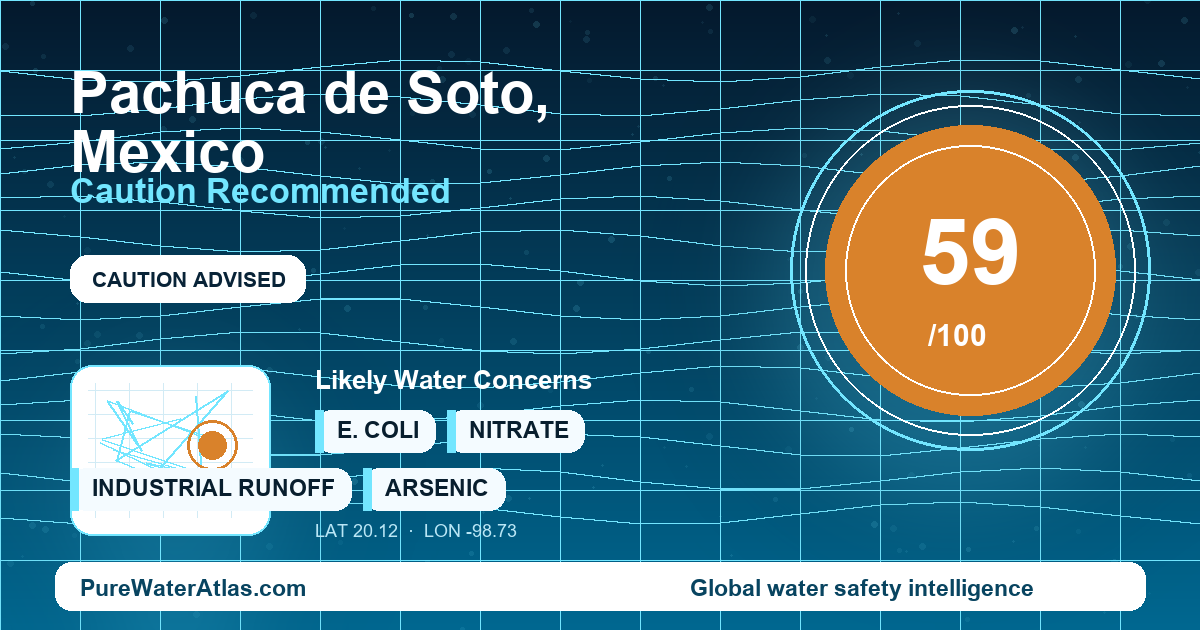
| Water safety score | 59 / 100 |
|---|---|
| Risk level | Caution Recommended |
| Can visitors drink the tap water? | Not recommended as the default. Short-term visitors should use sealed bottled water, a trusted refill source, or water from a verified hotel or restaurant purification system. |
| Resident advice | Treat safety as building-specific. A maintained point-of-use filter, clean cisterns or tinacos, and periodic lab testing are prudent. |
| Main water source | Primarily deep groundwater wells in the Pachuca metropolitan supply system, with water moved through pumping, transmission, storage, and distribution infrastructure. |
| Water authority | Comisión de Agua y Alcantarillado de Sistemas Intermunicipales, commonly known as CAASIM. |
| Filter recommendation | For routine drinking, use a maintained point-of-use system unless recent laboratory results show the tap is satisfactory. Sediment filtration plus activated carbon is a practical baseline; reverse osmosis or UV should be selected based on testing. |
Editorial verdict: Caution recommended. Pachuca de Soto has a treated public supply and an identifiable municipal operator, but the water should not be treated as reliably drinkable for visitors without additional filtration or bottled water. The main uncertainty is not a single confirmed citywide contaminant; it is the full delivery chain from wells to pumps, tanks, pipes, cisterns, rooftop tinacos, and older internal plumbing.
Why Pachuca de Soto Is Different
Pachuca de Soto is a high-altitude, semi-arid city in central Hidalgo. That setting matters for drinking water because local water security depends heavily on groundwater, pumping energy, pressure management, and storage rather than abundant local surface-water supplies. Publicly available information does not support describing surface reservoirs as the city’s main drinking-water source. The practical reality is a groundwater-based urban system that must move water across elevated and uneven terrain.
Pachuca is also part of the historic Comarca Minera mining region. This is important context for source-water awareness because mining districts and local geology can justify attention to metals and dissolved minerals in groundwater assessments. However, mining history by itself is not proof that municipal tap water currently exceeds health standards. Any claim about arsenic, fluoride, lead, manganese, nitrate, or other contaminants at a specific address should come from current laboratory testing, not regional assumptions.
The most city-specific concern is what happens after water leaves the municipal system. In Pachuca, as in many Mexican cities, water arriving at the kitchen tap may have spent time in a building cistern or rooftop tinaco. Even when municipal water is chlorinated, a dirty, uncovered, or poorly maintained tank can reintroduce bacteria, sediment, insects, or biofilm. This means two homes on the same street may not have identical tap-water safety.
Where Does Pachuca de Soto’s Tap Water Come From?
Pachuca de Soto is supplied primarily by groundwater extracted from deep wells in the Pachuca metropolitan supply system, associated with the Cuautitlán-Pachuca and local basin aquifer context. Water is then moved through intermunicipal transmission lines, aqueduct-style conveyance, booster pumping stations, storage tanks, and distribution networks operated by CAASIM.
The infrastructure chain is central to understanding risk. Key elements include deep groundwater production wells, intermunicipal transmission mains, booster pumping stations required by the city’s elevation and topography, municipal storage tanks, sectorized distribution networks, and household or building-level cisterns and rooftop tinacos. Disinfection infrastructure, mainly chlorination, is used to maintain microbiological protection in the network.
Because the system relies on pumping and pressure control, service interruptions, pump failures, electrical issues, pipe repairs, or pressure changes can affect the water that reaches a building. After a prolonged outage, water may be discolored or contain sediment, and residents should flush taps, check clarity, and consider boiling or using bottled water until service and clarity return to normal.
Who Manages Drinking Water in Pachuca de Soto?
The principal water and sewerage utility serving Pachuca de Soto and parts of the surrounding metropolitan area is the Comisión de Agua y Alcantarillado de Sistemas Intermunicipales, commonly known as CAASIM. CAASIM is the key local authority for the intermunicipal supply system, service notices, and operational context.
Mexico’s drinking-water quality framework is governed by national health standards, including NOM-127-SSA1-2021, which sets requirements for water for human use and consumption. Source-water concessions and aquifer management fall under CONAGUA, with national water information available through the Sistema Nacional de Información del Agua and groundwater availability publications from CONAGUA.
These authorities and standards matter, but they do not provide a simple, address-level answer for every kitchen tap in Pachuca. Current, parameter-by-parameter tap-water results by supply zone and date are not consistently available in an easy-to-audit public format. For residents, that makes building-level testing more important.
Main Local Water Concerns
- Groundwater dependence: Pachuca’s supply is shaped by groundwater management in the broader central Mexico basin context, including aquifer stress and pumping requirements.
- Hardness, mineral taste, and dissolved solids: Groundwater systems commonly produce mineral taste, hardness, or elevated total dissolved solids, though actual levels should be confirmed by testing.
- Intermittent service and low pressure: In some areas, interruptions or pressure changes can increase reliance on storage tanks and may raise sediment or microbial risk.
- Sediment and discoloration: Pipe repairs, pump failures, pressure changes, old pipes, or tank sediment can cause visible particles or cloudy water.
- Storage tank contamination: Cisterns and tinacos can become important contamination points if they are not cleaned, covered, and protected from insects, dust, and biofilm.
- Older plumbing: Legacy pipes, solder, brass fixtures, galvanized plumbing, or corroded internal lines can contribute metals such as lead or copper at the building level.
- Groundwater screening parameters: Arsenic, fluoride, nitrate, iron, manganese, salinity, and related geogenic or legacy-source concerns should be evaluated with actual test results rather than assumed.
Season also matters. Dry-season demand can place additional pressure on wells and pumping systems. Rainy-season storms may cause localized runoff, street flooding, sewer overflows, or turbidity issues if infrastructure is compromised, even though the main supply is groundwater.
For Travelers
Most short-term visitors to Pachuca de Soto should not make untreated tap water their default drinking water. Use sealed bottled water, a trusted purified refill station, or water from a hotel or restaurant system that staff can confirm is treated. The reason is not a single confirmed citywide contamination event; it is limited public tap-result transparency combined with distribution, storage, and building-level risks.
For brushing teeth, many healthy adults can usually use tap water if they avoid swallowing it. More cautious travelers, children, and people with sensitive stomachs should use bottled or filtered water. For ice, avoid cubes from unknown street vendors or small establishments unless they are clearly made from purified water. In better hotels and established restaurants, ask directly whether the ice and drinks are made with purified water.
Many hotels and restaurants in Mexican cities use garrafón water, filtered water, or commercial ice. Good signs include a visible purified-water dispenser, sealed bottled water, or staff who can clearly explain that water and ice are purified. Travelers can also review general Mexico food and water precautions from CDC Travelers’ Health.
For Residents
Residents should treat household tap safety in Pachuca as address-specific. A home filter is advisable for regular drinking water unless the household has recent, satisfactory laboratory results and well-maintained storage. A practical baseline is sediment prefiltration plus activated carbon to improve particles, taste, chlorine-related issues, and some organics. Reverse osmosis should be considered where testing shows high dissolved solids, arsenic, fluoride, nitrate, or other dissolved contaminants. UV can help with microbial control, but it should be installed after sediment filtration and does not remove metals or salts.
Testing should be done at the kitchen tap, not only at the building inlet, because internal plumbing, cisterns, and rooftop tinacos can change water quality after the municipal meter. At minimum, test total coliform and E. coli if the home uses a cistern or tinaco, has had recent outages, or relies on a private well. A fuller long-term panel should include turbidity, free chlorine residual, pH, conductivity or total dissolved solids, hardness, nitrate, arsenic, fluoride, iron, and manganese.
Older buildings deserve special attention. Lead risk is building-specific and cannot be ruled out by general source-water information. Residents in older homes should test first-draw and flushed samples for lead and copper to distinguish plumbing contribution from source-water quality. Cisterns and tinacos should be covered, sealed against insects and dust, and cleaned and disinfected regularly. If a tank has visible sediment, biofilm, insects, odor, or a poor lid, water from that building should be treated as higher risk until cleaning and testing are completed.
Relevant Contaminants and Water-Quality Issues
Pachuca’s treated municipal supply relies on disinfection, so chlorine in drinking water is relevant both for microbial protection and for understanding why residual chlorine can decline in long lines or storage tanks. When water appears cloudy, dirty, or discolored after repairs, pressure changes, or tank disturbance, review turbidity in drinking water and sediment in drinking water.
For microbial safety, especially after outages or in buildings with cisterns and rooftop tanks, E. coli in drinking water is one of the most important indicators to test. For older buildings, lead in drinking water is a plumbing-specific concern that requires first-draw and flushed sampling. Because Pachuca depends on groundwater and sits in a region where geology and legacy mining context matter, residents may also want to understand arsenic in drinking water and nitrate in drinking water, while remembering that neither should be assumed without laboratory evidence.
How to Verify Your Water Quality
The best way to verify tap-water safety in Pachuca de Soto is to test the water actually used for drinking. Start with the PureWaterAtlas guide to water testing, then match treatment decisions to results using the guide to water treatment systems. For a broader decision framework, see Drinking Water Safety and Water Microbiology.
For specific sampling issues, residents can use the PureWaterAtlas guides on lead testing, arsenic testing, and nitrate testing. After an outage or suspected microbial event, the boiling water purification guide can help with temporary precautions, while the UV purification guide explains where UV fits and where it does not.
Travelers comparing destinations can use the Global Water Quality Checker. If a lab report lists a contaminant, look it up in the Contaminants Search Engine. Related PureWaterAtlas categories include Drinking Water Safety, Global Water Quality, Water Testing, and Water Purification.
Official and Technical Sources
- CAASIM, Comisión de Agua y Alcantarillado de Sistemas Intermunicipales — local utility identity and operational context for Pachuca and the metropolitan intermunicipal system.
- CONAGUA, Sistema Nacional de Información del Agua — national water information, basin, aquifer, and management context.
- CONAGUA, Disponibilidad por acuíferos — groundwater availability publications relevant to aquifer stress and groundwater dependence.
- CONAGUA, Calidad del agua — national water-quality monitoring and surveillance context.
- Diario Oficial de la Federación, NOM-127-SSA1-2021 — Mexico’s official drinking-water standard for water for human use and consumption.
- INEGI, Pachuca de Soto geographic and statistical area — official city and municipality geographic framing.
- UNESCO Global Geoparks, Comarca Minera Hidalgo — geological and mining-region context for Pachuca; not evidence of current tap contamination.
- CDC Travelers’ Health, Mexico — practical traveler food and water precautions.
- World Health Organization, Drinking-water fact sheet — general public-health principles for safe drinking water and protected distribution.
Bottom Line
Pachuca de Soto’s tap water deserves a cautious rating, not because of one verified citywide contamination event, but because the system depends on deep groundwater, pumping, storage tanks, pressure management, and building-level cisterns or tinacos. CAASIM operates the public water system, and Mexico has national drinking-water standards, but current tap-specific results by zone and date are not consistently easy to audit. Visitors should drink sealed bottled or verified purified water and be careful with ice. Residents should focus on their own building: clean and cover storage tanks, test the kitchen tap, watch for sediment after outages, and use filtration selected from actual lab results.
Read the full guide: Global Water Quality Guide
Explore more in this category: Global Water Quality Articles